The posts are actually in the porch Sarah is building, with proper assistance, which she missunderestimated how long would take. Therefore, no posts for you for now, unless you install them yourself in the comments. See you later! (I expect all y’all have at least a dozen post memes.)
Category: Uncategorized
The Engineer And His Apprentice
I’m not going to tell me there will not be a post. I know your ways and am wise to your rebukes. You will tell me this is a post.
Instead I’m going to tell you why the post is this late.
Yes, there was another death in close friends, which I learned of in a phone call from mom. I have talked about it in a post on Sarah’s Diner on facebook, so some people would know I’d be unusually weird for a little while, but I’m not ready to discuss it in public.
Instead I’m going to talk about the part of my troubles that amuses you fiends. There’s no use denying it. I know it does. Though I’ll maintain the reason it amuses you is that you don’t have to live with it, yourselves.
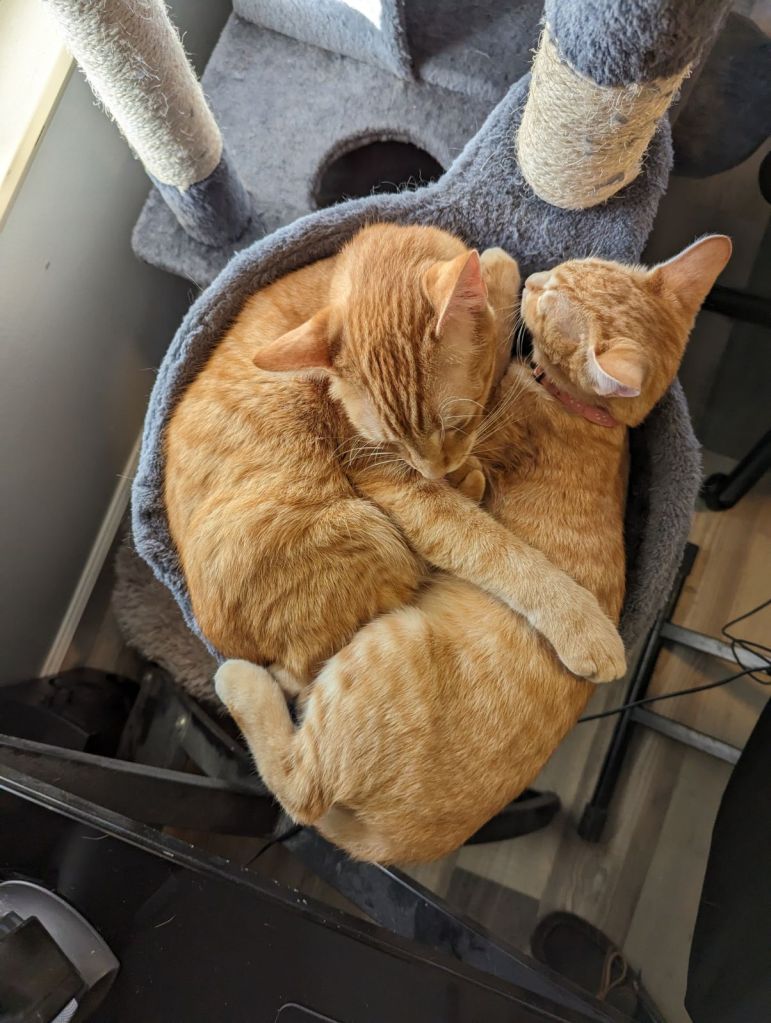
This. This right here is the shape of our problem. Though their buff Siam-Musey sister might contribute. If she does it’s as a mastermind.
She’s silent and a hooman “influencer.”
All three of them seem to have the intelligence of a bright, pre-verbal toddler. Indy is a little more…. experienced with things is all. But I’ve observed them all three in “let’s pretend” play, where they hide a toy, they pretend to look for it before “finding” it with “Surprise” something that I’ve never seen in other cats. The girls also…. throw toys for each other. Don’t ask.
This morning we woke up to the house upside down. There were curtains down in the dining room, which I didn’t notice till I’d had my coffee in my nightgown, in front of the neighborhood and passerby. Now my nightgown is huge and covers me from shoulders to ankles, so I’m more likely to be thought of as a ghost. I’ll grant you that, but it’s the principle of the thing.
Someone, probably Valeria had thrown up all over the house, but that’s not so much being bad as poor girl is sick and getting thinner and thinner. Well, that’s life, I guess? We treated the UTI and the peeing everywhere has stopped, but she’s not gaining weight. There are more tests in her future.
Meanwhile, as Dan got up, we not only found that the water fountain downstairs had been taken apart again, but we caught CIRCE taking the one upstairs apart under the supervision of her older brother. And arranging the pieces by size and type, of course. The fountain was unplugged, the cord carefully wrapped around it, as Indy does to keep his sisters safe.
So, it’s official. The Engineer Cat now has an apprentice.
Fortunately I was ready. I’ve bought ceramic fountains, the components just too heavy for them to move. Unless Indy discovers levers. Something I’m not putting past him.
I’ve now installed the ceramic one downstairs and will probably do the upstairs one tonight or tomorrow morning.
They were much disgusted with my wrecking their fun downstairs. They are now on the sofa being despondent.
I told them “It didn’t have to be this way. But every morning Indy gets up and chooses engineering. And now he’s made your apprentice. I had no choice.”
Both of them are upset with me.
*This post had a lot more pictures, but wordpress is being a pain. If I can I’ll post more pictures of the feline delinquents later.
Book Promo And Vignettes By Luke, Mary Catelli and ‘Nother Mike
Book promo
If you wish to send us books for next week’s promo, please email to bookpimping at outlook dot com. If you feel a need to re-promo the same book do so no more than once every six months (unless you’re me or my relative. Deal.) One book per author per week. Amazon links only. Oh, yeah, by clicking through and buying (anything, actually) through one of the links below, you will at no cost to you be giving a portion of your purchase to support ATH through our associates number. A COMMISSION IS EARNED FROM EACH PURCHASE.*Note that I haven’t read most of these books (my reading is eclectic and “craving led”,) and apply the usual cautions to buying. I reserve the right not to run any submission, if cover, blurb or anything else made me decide not to, at my sole discretion.– SAH
FROM JAMES TOTTEN: MICLICs and Big Bears (Breaching Ain’t Easy! Book 1)

When the nukes dropped, the draft happened and America recovers on a total war economy. Opportunities dry up and the factories retool for war. Out of opportunities and money, Lisa Brown looses a full ride at Cornell and enlist as a Sapper in the Army. Now a Company Commander, CPT Brown’s 14 Grizzly assault breachers are leading the way back to Kiev. The Russians covering the obstacle belts have some issues with this. “Sappers Lead the Way”.
https://amzn.to/4bKSzppFROM SEAN FENIAN: Bearing Gifts (The Stardock Series Book 1)

When the over-driven hyperdrive on their mobile shipyard burned out, the Chhrt’ktk’t abandoned it in an inhabited system along their path, hoping it would work as a decoy to buy them more time to escape the Khreetan fleet pursuing them. They didn’t anticipate how far the pre-spacefaring species they turned over their broken-down maintenance facility to would subvert their plan.
Alex Holder, a retired engineer, just happened to be in the right place, at the right time, with the right mindset, to find himself chosen by the Chhrt’ktk’t to hand over control of their shipyard to, simply because he was the first person they found able to interface with it. The Chhrt’ktk’t could not possibly anticipate what he would do with it. And neither would anyone else.
https://amzn.to/3UJxFBaFROM CELIA HAYES: Adelsverein – The Sowing
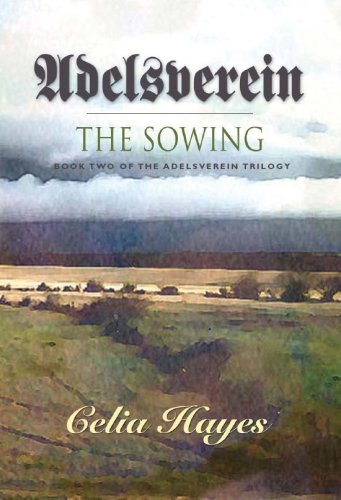
Adelsverein: The Sowing is Volume 2 of the Adelsverein Trilogy, following the fortunes of German settlers who came to Texas seeking land and political freedom in the 19th century through the auspices of the Mainzer Adelsverein – a consortium of German nobles who formed a corporation and took up a land grant in the Republic of Texas.
In the fifteen years which have passed since “Vati” Steinmetz and his children came from Germany to Texas, they have prospered. His older daughter Magda has married former Texas Ranger Carl Becker, born him children and helped him build a happy life as a cattle rancher in the beautiful valley of the Guadalupe River. Vati’s son-in-law Hansi Richter prospers as a farmer, and his son Johann has returned from years of study in Germany to become a doctor. But his beautiful adopted daughter Rosalie is in love … with a man who intends to serve in the Confederate Army! Texas has voted for secession and to join with the Confederacy. The German settlers in the Texas Hill Country are opposed to slavery, and to secession; what will happen to them now that they will be seen as enemies in their new homeland?
Ideals, friendship and cruel circumstance clash with the coming of civil war to the Hill Country, bringing Carl Becker and Hansi Richter into mortal danger from the ‘hanging band’ – a pro-Confederate lynch mob, while Johann and his twin brother Friedrich are drawn into fighting on opposite sides; Johann with the Union Army, Friedrich with the Frontier Regiment.
Adelsverein: The Sowing continues the epic story of how one family became American, through the brutal tragedy of the Civil War!
FROM SEAN FENIAN: For Love Of Caitlîn: A short tale of mortals and Fae.

When Domnall mac Caiomhin accepted an ill-advised wager to spend a night atop the barrow at Dun Gol, and his fiery bride Caitlîn failed to talk him out of it, he shouldn’t have been surprised that she insisted upon going along with him. But the Sidhe took her spirit underhill, and now her body is wasting away.
It falls to the wits and courage of her father Ceallach mac Seaghda to win her back — if he can. The stakes are high … but Ceallach mac Seaghda is a man who will give everything for his beloved daughter.
For Love of Caitlîn is a short standalone novella set in a medieval Ireland a little different than our own.
FROM MICHAEL A. HOOTEN: Cricket’s Song

Cricket just wanted to learn how to play the harp. Instead he became the only true Bard of Glencairck.
In the green land of Glencairck, Bards are the musical, magical, and responsible for rendering judgment in any dispute. But the bards have grown soft and corrupt, ignoring the basic tenants of the Bardic Code, and abusing their power and authority.
Cricket is born on a small farm in the hinterlands, and knows nothing of the wide world. But he learns music and harping from an old man known simply as Harper, who also teaches him the basics of the Bardic Code. When Harper disappears, Cricket enters the world he knows only through stories and finds that not everyone knows the old rules, or follows them, and he has to decide for himself what is right—and how far he is willing to go to defend his beliefs.
This edition contains the ebooks The Cricket Learns to Sing, A Cricket at Court, and The Cricket That Roared.
https://amzn.to/3wokjjGFROM PAM UPHOFF: Twist of Fate (Chronicles of the Fall Book 4

Yuri Egorov is a Intel agent on a distant World. His main problem? He inherited the family home–a serious wreck–from the uncle who disliked him. The solution? In the Troystvennyy Soyuz–the Three Part Alliance–a brutal form of slavery, enforced through mandatory brain chips. So, however unsavory to Yuri, buying a worker should be no problem.
But this worker is . . . not standard.
Then a cross dimensional invasion puts his own problems in perspective . . .
FROM DALE COZORT: New Galveston Book 1: Operation Croatoan

In February 1939, with World War II looming, the US Navy held a massive naval exercise in the Caribbean, involving almost fifty thousand sailors and marines. President Franklin Roosevelt personally attended.
In this alternate history novel, the US of 1939 disappears at the peak of the exercise, along with the rest of the New World. In its place is a New World still inhabited only by Indians.
While the US remnants try to make a new home for themselves, Nazis, Fascists and Japanese Imperialists scheme with Aztecs and other Indian powers to take over the resource-rich and now nearly defenseless New World.
Nazi Germany pours resources into it’s navy and into an advanced new generation of cargo planes. By summer 1941, the Nazis are ready to move. A mysterious “Operation Croatoan” is at the core of their schemes. Milo Gentry and a handful of other Americans race to figure out what the Axis powers are up to and stop them.
FROM HOLLY CHISM: The Schrödinger Paradox: Heisenberg’s Point of Observation

To save the future, sometimes you have to reach to the past.
Thomas Sutton was not your average fourteen year old, not even in an Ark City. Born in one of the three refuges of the last remnants of life on earth, deep underground, he knows his history. A century after an asteroid shattered and struck the earth, they have been trapped below by volcanic eruptions, toxic gasses, and radioactive dust. But what if he could…change things? What if he could reach the past, to prevent the asteroid’s impact?
FROM LEIGH KIMMEL: The Shadow of a Dead God
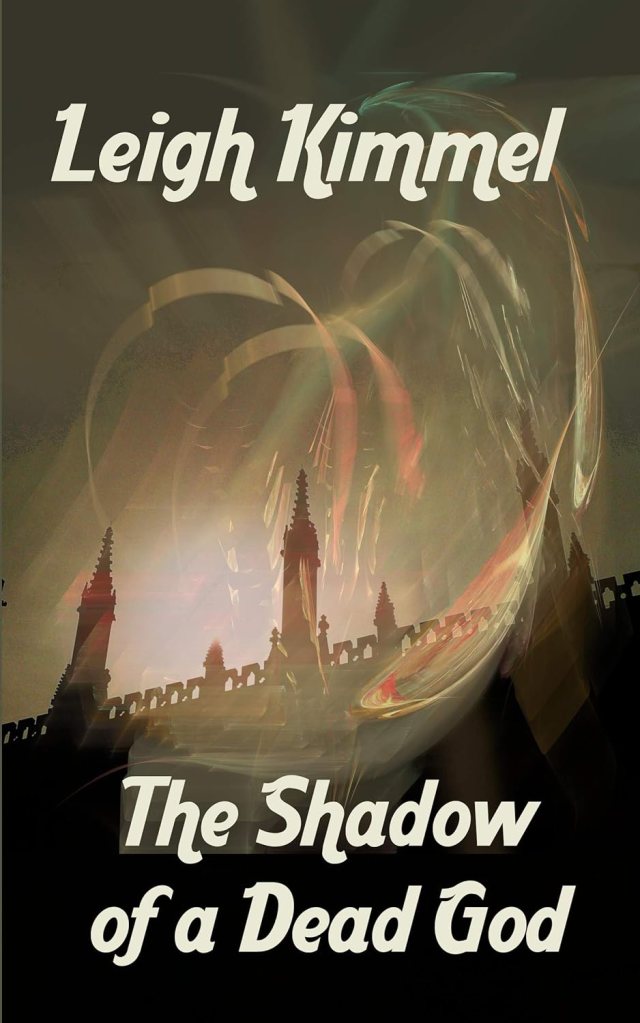
What secrets lie beneath an alien world?
A routine archeological dig on a world once ruled by the mysterious Star Tyrants. For Moon-born Liu Shang, working on a planetary surface might be unsettling, but she could manage — until the dreams started.
Unwilling to drag others into a harebrained search, she headed out alone, contrary to mission rules. Just as she was about to give up, she found an unlikely artifact.
Handling it connects her to the mind of a long-ago rebel against the Star Tyrants’ rule. Nothing will ever be the same.
A short story.
Vignettes by Luke, Mary Catelli and ‘Nother Mike.
So what’s a vignette? You might know them as flash fiction, or even just sketches. We will provide a prompt each Sunday that you can use directly (including it in your work) or just as an inspiration. You, in turn, will write about 50 words (yes, we are going for short shorts! Not even a Drabble 100 words, just half that!). Then post it! For an additional challenge, you can aim to make it exactly 50 words, if you like.
We recommend that if you have an original vignette, you post that as a new reply. If you are commenting on someone’s vignette, then post that as a reply to the vignette. Comments — this is writing practice, so comments should be aimed at helping someone be a better writer, not at crushing them. And since these are likely to be drafts, don’t jump up and down too hard on typos and grammar.
If you have questions, feel free to ask.
Your writing prompt this week is: CHALLENGE
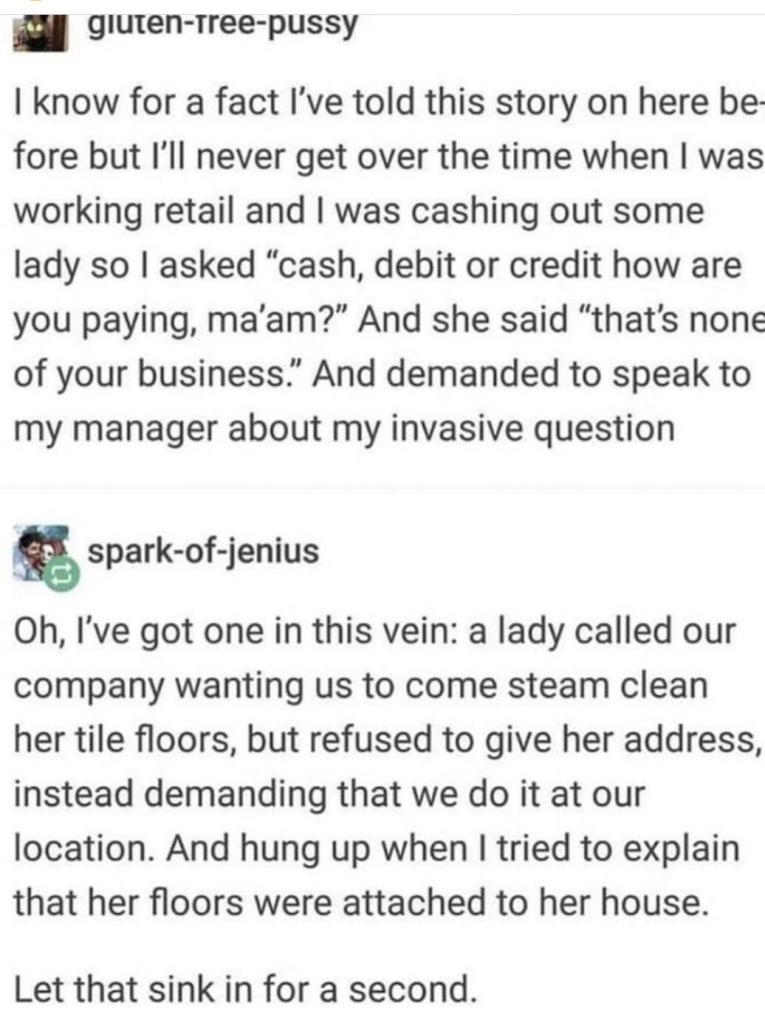
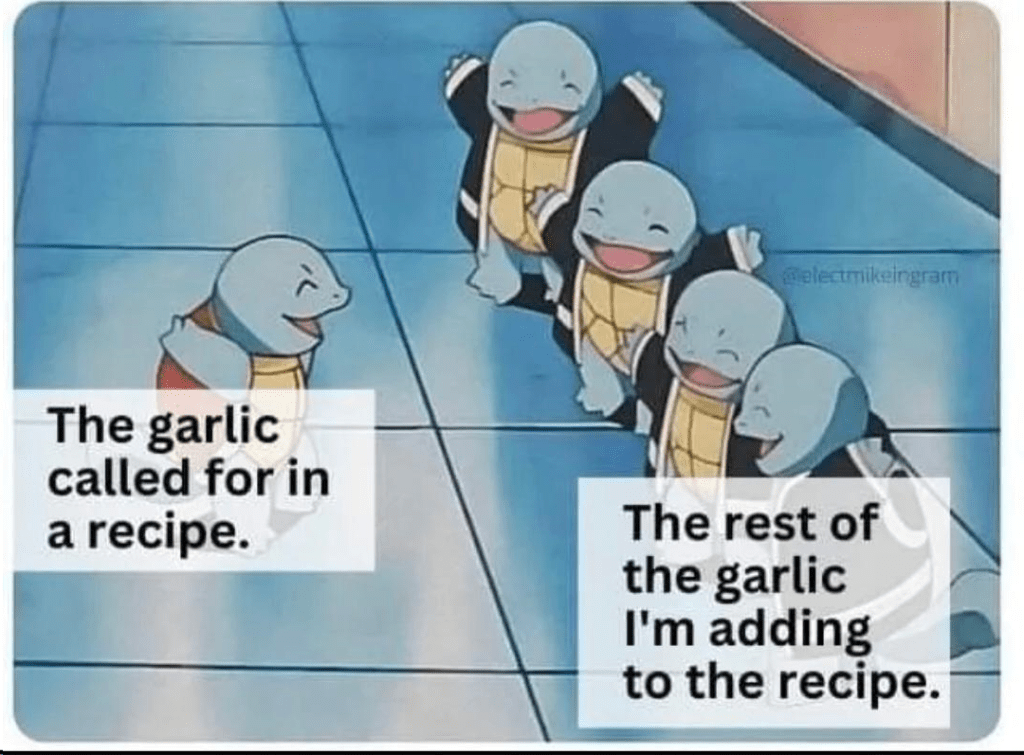
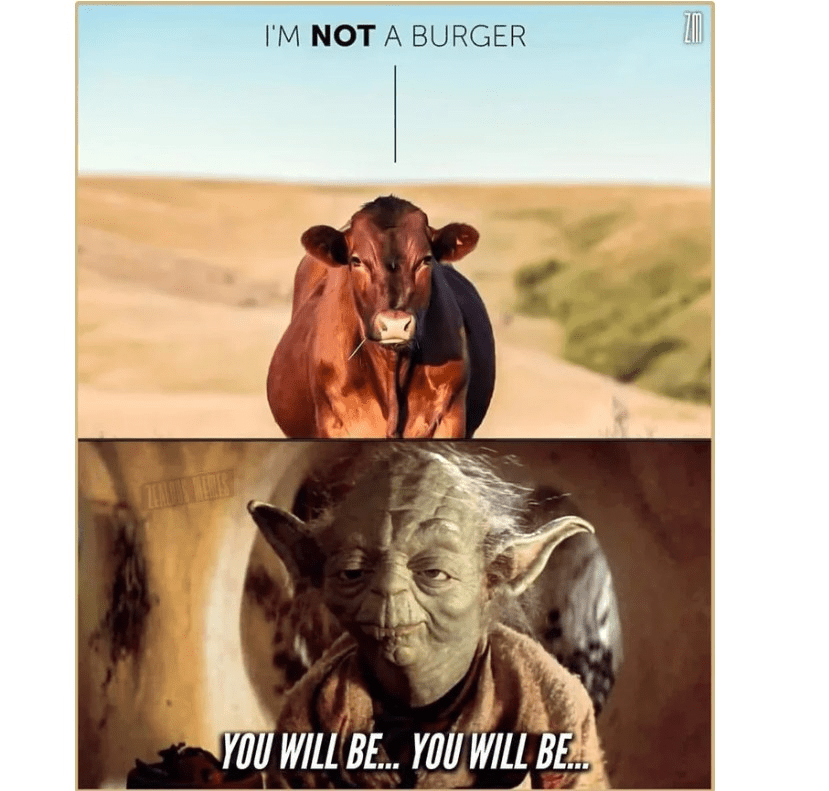
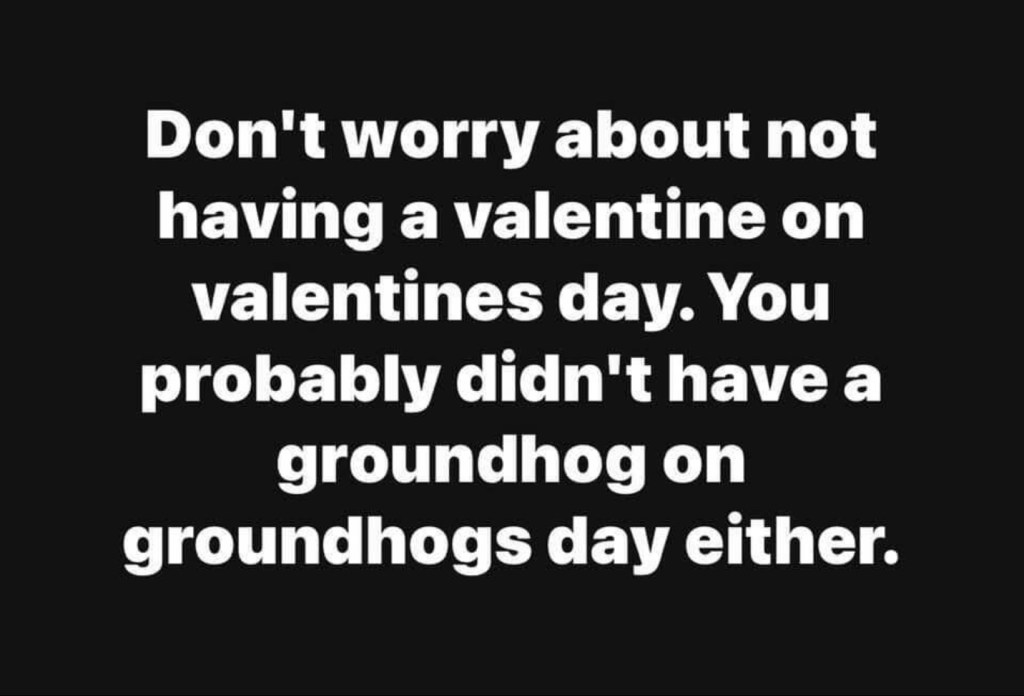
FOLLOW THE LAUGHING MEME ROAD


























































There’s been entirely too much death this year already
We have two Emergencies going and one “I’ll do in all our names, okay?”
I really could use this another month, considering that right now we’re up to 10k for the main water pipe and 2k for Valeria, treating her so maybe the pissing on everything stops. Maybe. BUT some months are like this and these are real emergencies. Also, we’re okay. (In case you worry. We won’t hurt ourselves. Don’t hurt yourselves either.)
So, Julie Pascal, our very own Synova (Who makes those delightful drawings I sometimes feature, at least when they’re not by Caitlin Walsh) moved to tiny town TX a few months ago. The idea was they’d have a paid off house, and she’d get a job, and her husband could finally write his science fiction series. Makes sense. They’re younger than us.
Well, about two weeks ago her husband got sick and was hospitalized. Turns out that due to a genetic issue his viral illness killed his liver and he was too weak for a transplant. (This is what I understood. Julie has not been very clear for obvious reasons.) They’re on COBRA, the same service that cost us 28k for delivering son 33 years ago. And she is staying in a hotel until he passes which is estimated a week, give or take. Her kids are away from jobs they might lose before they can go back. If you can’t help (AND LORD I GET THAT RIGHT NOW) please pray for the whole family. Anyway, our Holly has started a Give Send Go for them: If you can give, go here.
Second, and almost as urgent: Sean Gartlan, some of you know him as Wolfie from the old Baen Bar. Kate Paulk played havoc with him when she tuckerized him in the con series.
For some years now, he’s been caretaker first to his dad, then his sister. Meanwhile his mom was the sole bread earner in the house. She passed this week. His family is renting. They need to pay cremation costs. And he needs to find a job. I think he’s in his forties, his resume is a shambles, and you all know what it’s like out there right now. Also, if he doesn’t find a work from home job, he’ll have to find someone to caretake his sister. I honestly have no clue what he can do, but if you can help on the job front, get in touch with him. He has a Go Fund Me. (Yes, I know but it’s still the go-to for a lot of people.)
Earlier this year, Peter DaDalt died suddenly of a heart attack (no, not OF suddenly, he had a heart condition.) I never met him in person, but he was a fan who became a friend anyway, and his death hit me very hard. Here is his obituary. The obituary asks for donations for golfforekids, which was important to him. They fund research in childhood cancer. (He lost his oldest son to childhood cancer.) Obviously it’s not a right now emergency to donate to them, but maybe add it to your donations when you have money.
I have made a donation, in the name of Sarah’s Diner our non-political facebook group, where he was a frequent poster. Not as much as I’d like to. See this horrible month. But I’ll try to write and donate more a month that’s not quite so crazy.
The Tuna Equation

Jacques hands were trembling, as he reached for the can of tuna. His French accent was back full strength though he’d lost most of it over the eight months of living in the Schrodinger experimental interstellar colony in Alpha Centauri with all Americans and British colonists.
“Eh bien,” he said. “This is our last can of tuna. If this doesn’t work…”
Mike, aka Michaela Smith, who was American, redheaded and a full head taller than him but had kind feelings for the lone Frenchman put her hand on his shoulder. “It will work Jacques. Let it rip.”
Still his hands shook and he took hold of the ring on the can, then let it go, “But what if… We remember…”
“Okay, yes,” Mike said. “We all know what Ausra did. It was a stupid idea. And we all remember how it worked.”
The people standing around in a ring shuddered, remembering Ausra’s idea for opening ten cans at once, and the mechanism she’d rigged. It had caused a reality entanglement event which had killed ten cats. And incidentally Ausra.
“Courage,” John said. “Or do you want me to open the can?” He reached for it.
“Non, no, I’ll do it.” Jacques pulled the ring back, then the lid of the can, with a barely audible sound as the metal parted along the scored portion.
For a long moment nothing happened. Long enough to wonder if all the cats in the Schrodinger program had died. Or perhaps the researchers. In which case it would be a long, slow starvation for the colony….
Then from very far off came a meow. Mike pressed the button of the remote viewer focused on the dock. The supply ship had materialized.
There was another muffled meow, this one indignant. And then the cat door between the supply ship and the station opened, and an orange tabby came running out and towards them along a long tunnel.
When the cat erupted into their room, Jacques had put the can of cat food down for him.
John had made it through the human airlock into the supply ship and now commed “We have supplies for 6 months ladies and gentlemen. And enough tuna for year. Also, starter kit for hydroponics.”
Fifty colonists dissolved into hugs and tears. The little cat ate his tuna on the floor, undisturbed by their effusions.
Who knew, through mankind’s long struggle for the stars, the key would be cat’s ability to teleport at the sound of a tuna can and human ability to create a cage from which the cat could not escape or teleport until the entire ship teleported and attached to a station in the new world?
Sure, the first tuna can and structure — a tiny dome, just large enough for the cat — had to be sent by drone. But after that? After that humans could conquer the stars.
Thanks to cats.
And tuna.
*Yes, I know it’s silly. Yes, I could make it longer and better and just as silly. Yes, I might do it later. But right now you just get this, you gonzo geeks. JUST TO GET IT OUT OF MY HEAD. And into yours. – SAH*
With Open Eyes

Remember when it was given that no conservatives worked in the arts? Remember when it was a given that conservatives were uneducated and conformist? Remember when it was a given conservatives were just dumb? Remember when it was a given that conservatives were CONSERVATIVE instead of utter and complete rebels defying the status quo.
You probably still know a lot of people that think that way. Pat them on the head. They’re either old or so conformist that they’ve never examined their assumptions.
When a commercial a few years ago told the boss who talked of “sticking it to the man” that he was THE MAN I knew that the long con of the left was done with. And it must be now a good five years since I had a knock out drag out fight with someone proclaiming the received wisdom that the reason conservatives are scarce in the arts is because we’re less creative, less inventive. Since we’re, you know, part of the establishment.
Which would make perfect sense of course, if “conservative” meant, as it was supposed to be, those who defend the establishment.
But during the 20th century, the word … evolved. There is this perception that the left distorts words on purpose, but that’s not actually — I think — the truth. The distortion of words only started as their concept of the world and reality deviated to a point that they couldn’t use the words in the intended sense and not confront the reality. In fact, some future historians — if there are any — will probably identify the rate of distorting word meanings with an ideology in power and still holding on to power, but in deep distress because its vision of the future has been disproven, and it’s now just holding on for power’s sake. But is unable to confront it.
In fact, this goes with nonsensical things proclaimed by any regime in power. Take the divine right of kings, a thing invented only when the very idea of monarchy was in distress. By the time monarchies started falling like ripe fruit, kings themselves claimed to be revolutionaries and for the radical equality of man, which they, somehow, could preserve. (And only they.) In the earlier times, when the ideology was healthy, the divine right of kings was implied and never questioned. By the time it had to be proclaimed, it was dead as the dodo, so it had to be shouted from the rooftops.
Over the twentieth century “Conservative” came to mean “To the right of Lenin.” Because after all, communism was the way of the future and therefore anyone holding on to the old “capitalist” mode of society was someone trying to conserve the past.
This vision got hit with wave after wave of discomfirmation even as it adherents climbed to positions of power and held it through dirty pool.
In this, their ideology being dead gave them a leg up. At some level, they knew they couldn’t justify what they were doing, so they abandoned all principles, played for power, and attracted power-hungry horrors. And hired people who served their vision of power at all costs.
They project this, btw, by characterizing anyone who escaped from a leftist regime as someone who was in power there. Or perhaps they believe it. Since their life is now all about power, they view everyone who wants to do something for altruistic and moral reasons as a liar and vaguely stupid. Because proclaiming THEIR ideology is the way to power.
It really is, you know? The right, like idiots, tend to sacrifice less-than-clean members to principle — see Santos — while the left will hold on to the Hamass “Squad” and the ridiculously corrupt members (Pelosi) for dear life, because the principles they proclaim are all from the lips out.
There is a lot of power in a dead ideology. For the divine right of kings, see Monsieur L’Etat C’est Moi Louis XIV.
For the left it made the “long march” a thing. Because they hired only those who agreed with them while the right hired whoever was “competent” they were able to grab all the positions of power.
Game it out. You get one leftist in and allow him or her power over hiring, all the next hiring will of leftists. And no one who isn’t at least willing to pretend to be left will be denied work, or run off if they manage to get in.
This is how news reporting fell, and the arts, and academia, and and and, culminating with corporate leadership.
There is a price, though. If you hire for any reason other than competence, you’re going to lose competence. Maybe not all at once, but slowly, over time.
Admittedly if you’re doing that, you’re safer hiring for nepotism, if only because certain type of abilities and talents run in families. Having grown up where all my ancestors had for a long while, I can tell you that. Everyone expected me to be academically gifted, physically awkward and blunt as wooden sword. Which, by and large, I was. My family, too, unless it’s going through one of its “poor as Job” phases is good for administrative jobs. If in a poor phase, we tend to climb through being gifted and industrious craftsmen (My path really.)
But if you’re hiring people who mostly know their “principles” are bullshit to be proclaimed from the mouth-out while playing for power, your entire structure is going to devolve — instead of the structure designed to do “the thing” whatever that thing is — into a structure devoted to fuck-fuck games.
Also, as the final waves of discomfirmation hit, with the fall of the USSR and the at least somewhat open propagation of what a horror life was there and how many people communism killed, the people willing to pay lip service to leftism were both dumber and more venal than usual. Those with a brain were even more focused on power and usually psychopaths of the first order.
Which leads us to the state of the arts, the media, most of the corporate leadership and academia.
The revelation of the plagiarism infesting academia surprised you? Oooooh boy, do I have bad news for you. It’s been like that for 50 years at least. They can’t create and they can’t think. Part of it is the few of them who can are afraid to, because the ideology has gone crazy-irrational and turns around and beats you down for thoughts that were acceptable last week. See for instance, how many movies from the eighties and nineties couldn’t be made today. (I have one series of books published 15 years ago that couldn’t be published today. (Yes, I’ll be bringing it back out, because you know what? I’m done giving a f*ck.)) So the ones who can think have decided not to. Or are too scared to. And might not even be aware of it. All they have is a bottomless pit of fear and hunger for power and that is really bad at creating “new contributions to the knowledge base of humanity.”
And this why traditional publishing is dying an ugly and flailing death. It’s why the arts aren’t. It’s why if you hooked up electrical cables to Walt Disney’s tomb you could power America, he’s spinning so hard.
It’s not so much that they want to shove the ideology down our throats: it’s that it’s ALL they have. It’s what put them in the position they are in.
Create? They can’t create. They are the ultimate establishment men and women, raised to repeat back what they heard, flawlessly, and never to deviate. They always knew that was the path of to success. And it was. They look around, and everything at the top is like them. So they imagine everyone else are subhumans.
And because questioning, denying, creating are completely beyond their reach, they assume it’s beyond everyone’s reach. They’re just clever enough to hide it, see? And mouth the right words. And that’s why they’re supposed to lead.
This sad state of affairs, with worsening performance for every infested field, persisted as long as it did, under the illusion that the people creating increasingly soggier pieces of cardboard passing itself as novels, or paintings or whatever, because the critics and academia were also infested. So what was praised to the sky was soggy, moldy cardboard. What people trained on was soggy, moldy cardboard. Even the occasional still-creative soul was thus destroyed and made into a copy of those hollowed out by the poisonous ideology and craving for power.
But it’s been many years since I had to argue that yes, there are as creative people on our side of the isle as the other, and that what was happening was pre-and-quiet-cancellation of anyone who wouldn’t sing in the choir.
Pre, if you were identified as “to the right of Lenin” before you broke in. and quiet, after. In writing as in the arts, as in industry, they invented some crime, some reason you were cancelled. it was never “because his/her thoughts threatened us.” You had insulted someone. You were secretly a horrible person who tortured animals. Whatever. In writing it didn’t need to be anything specific. The entire industry worked by hearsay because there were so many people trying to break in and so few slots for them.
All you needed was a whisper campaign: “Well, she” intent look “you know.” And if the other person had no clue at all, they pretended they did, because not to know, and to associate with someone who’d been cancelled meant you were also cancelled, also “you know?”
In the heights of industry, where people were likely to fight more, they usually found some reason or created it. I wonder how many people were drugged and photographed with live girls, dead boys, horses and parrots? Probably a lot. Probably a lot more were implicated in embezzling and financial crimes. Even if the crime had to be invented.
I laugh — but not with any joy — when people complain of cancel culture.
Cancel culture? What, you noticed when? Ten years ago?
Ah, but that’s when their power started falling apart. And then cancellation had com out in the open. Which means it’s done. It’s already done.
Why? Can’t I see all the cancelled people?
Yes, I can. I can also see the mechanism failing and sputtering, and the cancelled coming back.
Look, it used to work because the establishment was unified. No one could come to the attention of the people who had been cancelled. This means the establishment could make up whatever it very well wanted about the cancelled person, and more importantly, people were FORGOTTEN.
What killed that regime was the ability for the cancelled to say in the public eye. Indie publishing, and mass-broadcasting. This blog, sure, but also podcasts, indie music, etc. etc. etc.
The cancelled don’t go away and disappear, allowing the lies about them to proliferate. Or their fans to imagine they are dead.
Eventually this means that cancelling is just a sign you displeased the left who, as our own boycotts are starting to show, are a minuscule part of the buying public.
I fully expect the time to come when people put “cancelled by the left” on the cover of their normal, no politics, books. (They already put it in the cover of political books.)
For now? For now it means very little, outside a very limited circle. Which means of course that the left has gotten more vicious, trying to make it stick with stuff like debanking, and trying to equate challenging them with being evil.
But it’s not sticking. People are using this brave new world to get around, get over, get under.
Not saying it doesn’t hurt — both emotionally and financially. — In fact I made the point when explaining why even Glenn Reynolds fundraises. No matter how well some of us manage to do, you can take it to the bank that if you’re may age or older, started out under the ancien regime and are to the right of Lenin, you’ve taken major financial body blows. Most of them, of course, before tech opened things up. But not all of them. Not nearly. We’re still throttled to a great extent. (Explain to me how MHI doesn’t have movies yet? one of the most visual and successful series. Even more so, explain why Honor Harrington doesn’t? When mediocre series on the other side were filmed and pushed at people?)
But it’s changing. And cancellation? Utter cancellation? It no longer works. Which is why the old argument is only trotted out by the old and the terminally out of touch.
Cancelling doesn’t work while it’s in the open. It’s a thing of darkness and quiet social maneuvering.
Once it’s visible, once people stare at it with open eyes, it starts to lose power. Like “the divine right of kings” if you have to say it and defend it to the masses in general, you’re going to lose.
So don’t look away. Don’t let them maneuver in the dark. Keep your eyes wide open and ask questions.
Yes, what you see might be horrible, but watch it. don’t flinch.
You kill it by not looking away.
Who Do You Love?

I have a complaint. Who in heck set Valentine’s Day on Ash Wednesday? It’s a fishy affair if you ask me!
However, it prompts me to say remember you are dust and to dust you shall retur– Er…. Okay, but what I mean is: let’s talk about love.
In present day when we mention love, it’s always one sort of love: eros. Or at best, romantic love, the sort of love between married people.
But love has many forms. And to the credit of valentine’s day in schools and childhood, people do have “love” in the sense of friendship. Although in schools you have to love everyone, which of course means you love no one.
STILL to our point…
I’ve been — rather surprisingly, considering it was not something I expected, and I’m neither good with feelings nor with people — blessed with a grand love affair. I married the love of my life, and 38 years on, we’re still very much in love.
However, despite that, and taking nothing from it, my life is beset with other loves as well. I love my kids. I love my extended family. I love my friends. I love my country. I even love my commenters, and worry about you guys when you’re missing. (Or take a powder and wander off, usually over something silly.) Oh, and I love my cats. Though apparently not as much as Muse loves me, because today she won’t leave me alone. At all.
Anyway, the juxtaposition of Ash Wednesday and St. Valentine’s and the fact that recently a lot of friends and acquaintances, some younger than I, are dropping off — stop that. Seriously. I mean it — make me think that this love stuff, not just eros, but agape, and the friendly, companionable love we have for pets, and and and… are important. Else, what is life for?
I’ve reached the weird part of my life where I get more fun doing something nice for someone that they aren’t expecting, or perhaps secretly helping someone than you know going out and getting a big dinner. Which is good, since there will be no big dinner today.
It’s sometimes hard to explain this to people. “Oh, no. But you should take that money and do something good for yourself.” (Seriously, people.) When in fact I am doing something good for myself. This is not the bad kind of altruism, where I hurt myself to make others happy, but the happy kind of altruism where I do things because I can and they make people happy. (Yes, I know. I should put up free short stories more often!)
On this very fishy Valentine’s Day, yell back at death and desolation by loving someone. And I don’t mean that kind of love. I mean… Do something nice for someone you love. Even if the someone is a cat who has no idea it’s a special day. Get out of your own head, and give the cat a treat. Call an old friend who might be feeling lonely. Go for a walk with your spouse. Water your house plant. Something. Do something for someone else.
And do it with love. It will make you feel better, I promise.
The View From this Side

When it comes to being “Latin” Portuguese are the Schrodinger nationality. One of my favorite comments from the left of the field about me was that I couldn’t be Latin, since Portugal was “solidly European.”
Sure, and potatoes are solidly vegetables but they sure ain’t greens. I will grant them that the EU has pasteurized Portugal and turned it into England’s idea of an exotic vacation spot. That’s not even vaguely the Portugal I grew up in, though. Even ten years ago, Europeans were not exactly quiet about saying that Portuguese were more Africa than Europe.
Missed in all of this is the left’s obsession with race, and with “Latin” being a race. Some insist to be Latin you have to have some amount of Indian blood. I actually do. Both kinds. Great grand grand must have brought home souvenirs, but that’s nonsense. It’s a tiny fraction — less than Norse — and Latin is not a race. It’s a cultural group. In the forms we feel, Latin is identified as a cultural group. Race is separate.
As far as culture goes — closes eyes and hopes her parents don’t read this — Portugal has more in common with Spain and vast swaths of Latin America than with anywhere else. Take Pope Francis (please? When Benedict died, a call went up from Catholics, “Oh, Lord, wrong pope!” (It’s a joke, son)) I understand his particular brand of idiocy perfectly, because I grew up around my brother and his friends, who were all Latin leftists. Which is to say “Oh, Lord, really?” intensely strange. A very weird brew of Latin machismo and chauvinism and accusing everyone else for the issues caused by the screwed up culture. (And it is screwed up. All cultures are, of course, in some ways, but really.)
Portuguese like to distinguish themselves from Spaniards, like Austrians like to distinguish themselves from Germans. Portuguese say they’re less cruel, less loud, less–
Is it true? Yeah, it actually is. Northern Portuguese in particular tend to be much quieter. Blame it on the British cultural influence because the North of Portugal was where Britain sent remittance men before they had an empire.
However, having spent most of my life in the US and acquired a certain feel from the outside, let me tell you it’s practically a distinction without a difference. Sure, from the inside it looks like a big difference. Heck, the North and South of Portugal look like a great difference. But on the ground, while visiting the North of Portugal from the US the entire country seemed unbearably loud and everyone gestured overly much. (Okay, that might have been just my sons.) It reminds me of Dan’s first visit to Portugal, to propose formally — something my parents insisted on before recognizing our engagement — and how he almost hid under the table, from what he was sure was a to-the-knife argument among my family. In point of fact, we were discussing…. where to buy shoes. It wasn’t even a mild disagreement, let alone a fight.
As for a commonality of culture: I find myself translating from Latin for American friends with Mexican or Argentinian spouses. Or laughing my head off at websites about growing up Cuban because I recognize about half of those, like the idea that the best thing to do when you come home late at night is have a warm mug of…. coffee with milk?
Are there differences? Sure. Myriad. As there are between every single Latin American country. It’s not even an argument. There are also differences in culture you only see from the inside. (Mexicans have a lot of opinions about the rest of Latin America, some of which will have Americans biting their tongues not to hold up a mirror.)
But if you’re going to make “Latin” an officially recognized cultural group, yep, Portugal and Spain should be thrown in. Spain, arguably a little less, since it’s become more Europeanized, having been more prosperous and more integrated into Europe, long before Portugal, for various reasons some of which make no sense.
Heck, there is an argument for throwing in parts of Italy. (But not France. France is its own thing, really.)
Otherwise, what you fall into is the ridiculousness of saying someone if a protected cultural minority, because they spell their name with a z not an s (Chavez, Marquez, Mendez — the list goes on.)
Of course, I’m me, so you guys know what I think of protected cultural minorities. What I think of immigrants and immigration, too. Being an immigrant, I think the whole purpose of immigrating is to become of the country you immigrate into. You’re supposed to learn the language to the best of your ability, (Unfortunately my going back to Portugal at 18 for four years probably set the accent in stone, but I do try to use English with native fluency, with some success. The typos and malapropisms to be fair were worse in Portuguese. Now Portuguese is… difficult.). You’re supposed to adopt the customs and habits of your fellow Americans, to the best of your ability (to be fair, habits and customs vary a lot in this great land, but there’s more commonality than you think.) You’re supposed to respect the history, the civic virtues and the cultural icons of your new country (I take a pass at movie actors. Simply because I can’t tell one from the other.) You’re supposed to do your best to be a good citizen, not a burden to your new homeland. And you’re supposed to love it above all others, and renounce every other allegiance. Or if you prefer, you’re supposed to “Fit In or Fuck Off.”
Therefore where you came from, much less where your ancestors came from should matter not at all.
However, if we’re going to play that game — and the left clearly is — we should play the game logically. Which — in addition to my finding out most people identify as Latin on sight, and also that it annoys the left, started calling myself Latin. But particularly because it annoys the left.
On the other hand I am Latin enough to be highly amused at the black comedy of the left trying to open the borders and toss in amnesty to please “Latins.”
First, most of what is coming over the border at this point is not Latin in any way shape or form.
Second, nothing will piss Latins more than opening the borders and letting the old culture reach and touch them again.
Because here’s the thing: there are good things about Latin culture: a reverence for family, for protecting children and women and the weak. There are double edged things: the concentration on family is good and bad. Good because it gives people more support than they have in looser cultures. Bad because it gives the tribe a veto on everyone’s path in life. Which has repercussions for the culture including making things more difficult for anyone starting or innovating anything.
There is also a certain built-in corruption, because the law is something notional. Things are done over and around it, through influences, connections and bribes. Connections and well bribes count for more than law or system of government. But mostly connections. There is a saying in Portugal “He who is without a godfather dies in jail” and I understand there are similar ones throughout Latin countries. In the same way there are words for Mordida. In Portugal it’s “gloves”.
Now you’re going to say “How will that be different than importing Italian culture?” Oh not much, except for numbers. the greater the numbers of a culture who come in, the harder it is to keep the culture from being everywhere. Also the fact that “Latin” is a protected minority makes enforcing FAFO harder. It still happens, but slower. Much slower.
I felt that frustration when our “classy” vacations in Denver were taken over by a previous wave of Latin migration. If you remember, being classy, and also of course “well off” — snort giggle — when we had little kids we went to Denver for the weekend and stayed at Embassy Suites, because they had a bonus room (of sorts) with a door between our sleeping quarters and the kids’s area. And because they had breakfast. Huge breakfast. Which meant if we pushed the breakfast time as late as possible (I think it was ten thirty on weekends) we could let the kids eat as much as they wanted and skip lunch so we only paid for dinner.
So imagine our shock when we came down with kids and found out that at ten they were already mostly clean of any food. They’d started cleaning up at 9:30, so they were completely clean by 10:30.
I know that culture. Retail and service positions are sinecures, run for the person working there, not the client. And I didn’t want that here.
That is one of the points of annoyance and a reason Latin immigrants don’t want to import every Latin country into the US and destroying the culture we escaped to, and chose to raise our kids in.
But I know the other side of this: legal immigration is difficult, and a considerable number of Latins, and other immigrants have come legally, either as refugees (real ones) or just through much effort at finding a job, being here for enough time, applying for citizenship, staying clean and making sure you’re not a liability of any kind.
I came here on the easy setting. I did have a job to take up, and I could have taken that route. But I happened to fall in love with Dan and we got married. But being a permanent resident with the right to work wasn’t instant or easy. It’s not like in the movies, where you marry someone for citizenship and it all works seamlessly and in weeks. It was six months before I had a green card and permission to work took longer. (A problem for a young couple living on almost nothing.)
My process was easy, relatively. It’s been almost forty years. BUT there was a lot of expense in applying for citizenship because of the papers to file, and the drive to the nearest INS center, and time off work. There was also crawling all over our life, to determine if we were “really” married and not somehow faking it. (The infertility probably didn’t help.)
It was still onerous and work, and nerve wracking. And neither of us — me, or Dan — ever considered allowing me to be a burden on American tax payers. I came here to contribute, not to be a dead weight.
So imagine how I feel about people coming over the border and treating what is handed to them as a sort of deserved reparations. On people coming in to be used as illegal voters and an enforcement army for the Junta (the second won’t work, but it is the intent.)
Imagine how I feel. Imagine how every legal immigrant, who worked and saved and integrated feels.
People whose ancestors immigrated much earlier might think they’re outraged.
Trust me, it doesn’t compare to what us later day Americans feel.
No, this isn’t a matter of pulling the plank after us. I’m not anti-immigration. I am anti open borders. I’m anti-invasion.
I do believe the US should bring aboard the best, most innovative people in the world, those wishing to become American and make a contribution. (We could use more Elon Musks, and a few Javier Mileis or heck, Nigel Farages wouldn’t hurt.) They should be identified and processed to the best of our ability. And then once here, they should be convinced to FIFO. Always.
But people just being allowed in and given every possible bene and care without having intention of fitting in, or respecting the local culture or becoming American? In fact, allowing people in who are actively hostile to America?
That makes my blood boil. I bet it makes the blood of every recent immigrant boil.
We came here to serve and be part of America, and to preserve this wondrous thing for our children.
To have it destroyed and undermined is the worst thing ever.
You see we know how rare America is, and how worthy of preserving. And we know there might never be another one. Not in our life time. So anyone risking destroying it, in any way makes us very angry.
Because America is stronger than blood ties, than cultural ties.
Trying to appease us with stupid pseudo-racist crap, by favoring a presumed race or culture is stupid.
The culture we’re interested in preserving is America.
Shiny! Let’s be Bad! – a blast from the past from January 2018

Shiny! Let’s be Bad! – a blast from the past from January 2018
Most humans want to fit in, and will go a long way to fit in. In fact, most if not all dictatorships in the 20th century depended on this impulse. “You don’t want the neighbors to think you’re a bad person” or mutatis mutandi, Jew/Jew sympathizer/wrecker/hoarder/saboteur/running dog of imperialism/etc etc.
No army in the world can hold even a small mutinous fraction of a large population in subjection, if they are not held back by internal controls and stops, and the ancient social-ape impulse to be liked and accepted by the band.
What strikes me when reading books about the holocaust or the various communist massacres is not that these were horrible people and monsters. It’s that 99.9% of the people involved were just “human beings” put in a position where the unthinkable had become normal, and there was no one to say “oh, wait, this is objectively not only evil, but one of the craziest things ever.”
The same instinct that made us civilized, that creates rules of behavior like “I will not kill and eat the neighbors” can be turned around completely on its head, where killing and eating the neighbors, or at least their children, is acceptable, as something you do to survive. (See holodomor.) In that case, of course, it was needed to survive, because you and yours were being deliberately starved. However, the fact humans can do things like that then move on, get past it, go back to normal life, tells you how plastic humanity is, when faced with times/a community gone crazy.
Manners, good behavior, lack of social aggressiveness, all of that which we take for granted is in fact, completely part of the “we all do this, and that’s how we fit in society.”
And in the west at least, for a long time, it has been part of the public facade that we’re a meritocratic society, that people will succeed or fail, sure, with some element of luck, but mostly based on what you can do, what you know, and how hard you’re willing to work.
Now all of us have been in jobs and situations where … we knew it wasn’t precisely so. Sometimes it was simply that, you know, the editor’s ex-roommate or the boss’s son in law were going to get promotion and advantages no one else could have. This happens, and is, unfortunately human. You lumped it, and you moved on, looking for another situation where your talents were better appreciated.
In the last few decades, in certain industries and certain fields of endeavor, it would slowly (or fast, in my case, since I’d seen the movie before) dawn on you that you weren’t going to get anywhere if your political opinions weren’t left. It became clear, hearing say editors talk, that the furthest to the left, the better — which is why some bright lads and lassies formed the “young communists club” for science fiction writers, AFTER the wall fell, and by the time it was formed not one of them under 30 — but if you believed in the free market, individual freedom, and despised the idea of benes for protected classes (even if — particularly if — you fit at least two of them) you’d better keep your opinions to yourself and pretend you were too stupid to understand politics. Because the moment you revealed your politics your career was done.
This was particularly insidious because the pretense wasn’t that it was your politics. Even the people shutting you out might not realize that’s why they were doing it. The fact is that the left has erected a facile self-image as both concerned underdogs (they’re not, they’ve had most of the power most places since world war II) and the “smart” ones. In fact, of course, they are not that. All of us, even the blind ones, could see the writing on the wall. It took a thoroughly disconnected geek not to perceive leftism as a social positional good. Most of us aren’t that.
The people who embraced the “easiest setting” of life as a leftist intellectual were two categories: The first is the genuine good boys and girls. In this case “good” doesn’t imply moral. It implies people in whom the fitting-in impulse is stronger than thought. They are the kids teachers’ loved and parents praised. They instinctively figured out leftism was how to be “good” and therefore followed it. The other category, of course, are the amoral SOBs, which usually went the furthest. They knew how the wind blew. They were smart enough to know it was wrong, and that communism was the charnel house of history. The brightest might even know why and that the corpses inhere from the principles. But they didn’t care. The way to the top of most professions (except some stem) was to play that game as hard as they could. What if they were screwing future generations. They’d got theirs. I have no proof, but I have long suspected this second group were the ones that were catapulted to leadership.
However, the self image of both groups is that they were the smart ones, the caring ones, and — this is very important — the SANE ones.
This meant the minute you outed yourself as not belonging to either group, as in fact, having too many principles for your own good, you were considered stupid, uncaring (racist/sexist/homophobic) AND insane. So it was easy enough to exclude you “per cause.” “Yeah, so and so is a good writer/worker, but he/she is insane.” “Difficult to work with.” “Couldn’t be part of the team.” “Isn’t googly.” (Follow that link if you have a strong stomach.)
I’ll never forget — pre twitter — the day I voiced a mildly non-conformist opinion in an email list for female writers. I don’t know which was crazier: the public pile on, inferring things about me that my worst enemy couldn’t say, or the private panicked emails, saying “I agree with you, but…”
There is a term for this. It’s preference falsification. And in totalitarian societies it can be so total that each individual can’t figure out that his opinions are in fact the majority and only a small minority at the top actually believes the opinions they enforce. It’s what explains Ceausescu and his equally brutal wife being beloved figures in the morning, and cooling piles of bullet-riddled meat by the afternoon. It’s also what gave us Trump’s victory.
Since then… things have changed.
Look, I kept my peace for many years, and because I couldn’t pretend to be a liberal (because, reasons. I know too much about the nature of the beast. I like to sleep at night. More importantly, I like to look at myself in the mirror in the morning. Putting on makeup by touch is possible, but can yield inconsistent results) I pretended to be apolitical, and would let political references, jokes and barbs roll off my back. Now, that required me to work mostly in historical fiction, of course, but that was fine.
It was only two things that allowed me come out of the political closet — besides something that was either my subconscious or perhaps the divine applying iron-clad boot to my behind — a) the existence of indie. b) the fact that the left had gone so far they were demanding vocal endorsement. And that I couldn’t give.
Freedom is just another word for nothing left to lose.
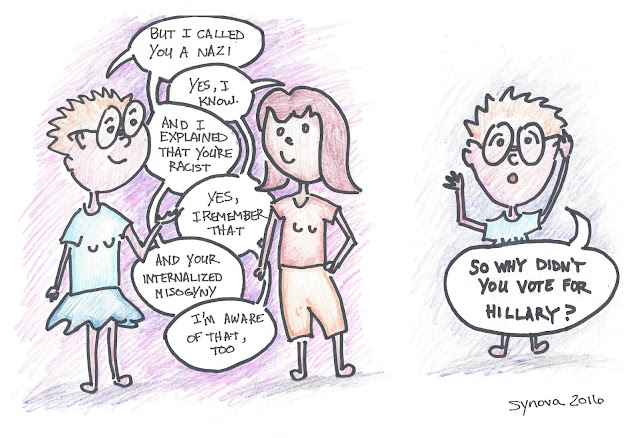
Even after Trump’s victory most people held their social facade. If you were in a certain set of professions you’d never (still) admit you voted for Trump. Wild horses couldn’t make you. For one, you’re probably addicted to food on the table and a roof over your head. For another, the left is so busy demonizing everyone who voted against Hillary, that it would be the same as stepping forward and saying “Yes, I’m racist, sexist and homophobic.” EVEN if objectively not only are you not any of those, but there is no evidence Trump is any of those. (I was told there would be prison camps. Honestly, worst Hitler, EVER. Not even Hillary’s promised “adult fun camps.” Sheesh.)
But the left has now gone as zany everywhere and publicly as it’s been for years in my field and covertly. (As for my field it has gone…. I think it’s achieved terminal velocity on the way to insanity.) You must loudly proclaim your hatred for Trump, you must exhibit something like Tourette’s about everything the man says and does, no matter how unimportant. And you must at all times proclaim yourself of the body and stamp out heresy with all your being.
Of course this sends all the wrong signals. A confident ideology doesn’t engage in heretic hunts, and tolerates the philosophical fringes.
But more importantly, what the left is doing is sending out the same signal I got loud and clear five or six years ago “you can’t pretend well enough for us to leave you alone. You must join, or we’ll destroy you. We’ll make sure you never work in this town/business/field/world again. We’ll leave you nothing, not even your reputation.”
What they’re forgetting, again, is that freedom is just another word for nothing left to lose. Or put another way, if you take away everything because someone failed to conform PERFECTLY, then you leave people free to act the way they always wanted to.
And us, on the right? Us, the damned? We were never “good boys and girls.” We were just conforming enough to fake it. A lot of us were the people who cut classes, spit in the teacher’s eye, and still had straight As. We are the people who have spent a lot of time infiltrating YOUR organizations, just so we could survive. And, oh, yeah, we do have a moral code. And it’s not yours. And you’ll never get us to kiss ass again, because you’ve proven yourselves unstable, narcissistic buffoons.
We’re evil you say? We’re crazy? We don’t play well with others?
Aw, shucks, honey. That was us being good. But you wouldn’t leave us alone. And now many of us are coming to the conclusion the masquerade isn’t worth the reward.
We’re looking at all the work we put in not to disturb you, and the things you call us, nonetheless, and we’re going “Oh, yeah? You think we’re bad? You ain’t seen nothing yet. Shiny. Let’s be bad guys.”
The only question is how fast what I think is a majority gets there. But the worm is already turning, and you can’t stop it. Screaming and name calling will only increase the speed of the turn.
You’d better learn to swim, or you’ll sink like a stone. For the times, they are achanging.
 According To Hoyt