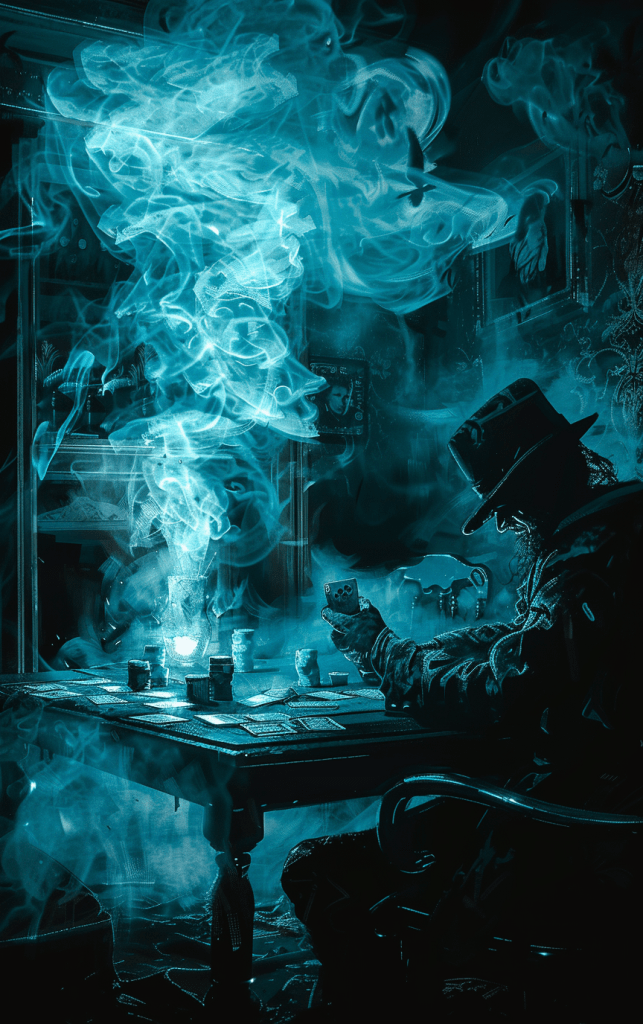
Those Who Fear

At times we’re all afraid of the future. Sometimes this is actually rational.

For instance, it’s 2024, and an election year. And we know what the fun, zany “experts” who have infested every institution and bureaucracy cooked up in 2020. The near future looks clown world, with a high possibility of crazy cakes, and the possibility of a squall of kinectic passing through where any of us lives, at any time.

If you’re not scared, you’re not paying attention. Or you’re lulled to a false sense of normalcy by the droning of the MSM and haven’t realized they lie with every tooth in their mouths.

This is what’s known as a rational fear.

But there are fears that are not rational. Whether or not you believe the government’s recent “admissions” (Splorch, giggle) that there are aliens and the government has touched the sky seen them, living with a dread fear of being kidnapped by an alien and anal-probed is not rational.

Even if it were possible, even if it had happened here and there, the incidence is so small the chance of it happening to you as you go about your lawful occasions is somewhat less than zero.

And then there is a pervasive, all penetrating fear of things changing.

I’ve noticed, sometime ago, that the left routinely accuses us of fearing change. Of course, the change they identify is not a change anyone is really afraid of, because…. well, it’s not a change. Take the late kerffufle in science fiction, for instance. We were accused of being afraid of “Women and people of color writing science fiction.”

This is outright in your face clown world, when you consider how many of us pissed off at log-rolling within a small clique were either women or minorities. But it’s even more clown world, because the minorities and women have always written science fiction. Or in fact whatever the heck they wanted to.

Look, bub, when I was sending out manuscripts, in the days before the internet, all they knew was my name on the manuscript. Yes, my name — all of them, as it happens — was female. But yes, of course, I experimented with initials. it made no appreciable difference. And anyone reading the story didn’t know if I was blond, or dark-sand-colored (guilty) or in fact purple with tentacles. Also, no one particularly cared. I might have had a leg up if I had a cool truly exotic name Smokes With Clouds Littlebottom or Purple Tentacles Blopfog but not so much because cool name sounded ethnic, but because cool name would be remembered. So if I were sending things in, say, every week, it would be noticed I was trying really hard, and it might have got a slightly more charitable reading. (Unless it were truly stupendously horrific, in which case it would get circular-filed with malice.)

Yes, I know, when one was starting out it felt like the universe was against us. And since it took me about 4 times the average 3 years to break into pro — many reasons, some of them being the fact that I tend to go at things backwards and sideways, which provides a unique perspective, but is not the most efficient method — I KNOW that feeling intimately. From the inside. It didn’t help that sometimes you got your story back (back in the day when printing was expensive, and you had to take it somewhere to daisy-wheel print, because they didn’t accept dot-matrix print outs. Yes, I know they were hard to read, but it was also a socio-economic filter) looking like it had been stepped on multiple times with malice.

I suspect it was easy for someone who — and this was already true in the 80s — had been indoctrinated into victimhood and into thinking that everyone was against him/her due to color or sex or sexual orientation, to assume only he/she/it was this badly treated.

But actually we all were. It was a market with a million would be suppliers and room for maybe ten people per month. To make it worse, as I found out when I was briefly an editor of a bottom wrung magazine, the million submissions had a solid 750 thousand, at least, that were absolutely abysmally bad. Because I was young and stupid, I read the whole thing, instead of quitting at the first couple of horrific paragraphs. And it never got better. Most of them read like a kid retelling a Saturday morning cartoon, or an indistinct dream. Some were pamphlets for some kind of ideology, but you often couldn’t tell what the ideology was even.

However the hardest was the quarter million that were good. Sometimes very good. Here you had six slots, and you were paying nothing. How do you choose? And if you choose you’re using this brilliant story’s first shot at publication. And it’s not like the author will get a credit that is worth much. Might have negative value.

Anyway, so, not only didn’t the editors have a chance of knowing what you were — unless you informed them. A not inconsiderable minority of cover letters told me the author’s race, sex and sexual orientation. Which seems to me would be particularly stupid if they thought themselves discriminated against — but also it didn’t matter, because most stories (including my early ones. Granted not cartoon retellings, but extremely peculiar.) were rejected with extreme prejudice because they sucked. Badly.

The only thing that gave you an advantage was knowing someone on the inside, which is why the field was incestuous. (Still is, as far as trad pub.)

But beyond that, women and minorities had always been in science fiction. If they were less represented, it was for cultural reasons, not because of discrimination. (As a geekling girl, I’d have given my right arm for female friends who were as much into science fiction as I was, but even my friendly geekling girls didn’t read that “weird stuff.” It was all either romances or, for the branier ones, history and philosophy and such. Or “Literary” stuff. Because Science Fiction had no prestige. We were the pimply guy in the corner, while women preferred to run off with the son of the mayor — Literary — or fool around with the bad boy — romance — so there was no chance. I just got used to being part of groups of guys, some much older than I.)

Anyway, there was actually no change happening. To the extent there had been change, with a great courting of female readers and writer, that was in the seventies with wholesale traipsing into fantasy. By the eighties the process was almost complete. By the time I broke in, in the late nineties, the publishing field: writers, editors, publishers, even readers, was primarily female. That it was females screaming that they were being discriminated against for being females was something that none of them found funny, so I never pointed it out. It reminds me of this. It was all very cool and edgy to be a woman in science fiction. If you were 20 or 30 years earlier, that is.

Which is sort of the left’s schtick. It’s much easier to fight battles that are already won, of course. And much more satisfying to speak power to truth than the other way around.

But I started noticing this was being shouted in the face of anyone at all who complained or tried to change anything at all in our crazy, ossified institutions. “You’re just a white male scared because you’re being replaced by superior and more able women and minorities.”

The fact that black female friends got this shouted in their faces is something else, but– leaving that aside: since this is deployed everywhere and at all times, as “you’re afraid of the future,” and since the left projects like an IMAX, I started looking around and going “uh.”

Look, being afraid of the future is natural, particularly when you live in a time of catastrophic change. Catastrophic change is so called because it is so rapid that things change suddenly and unpredictably and is experienced like a flood or a hurricane, destroying the landscape you know. EVEN WHEN THE CHANGE IS FOR THE BETTER.

Humans aren’t geared for a high rate of change, for the simple reason that for most of our evolution when things changed rapidly it was a catastrophe and limited in time duration — war, flood, hurricane, fire — and then things went back to changing very slowly. In fact, cultures and tradition are designed to keep things from changing vertiginously. It’s a minor miracle we’re not all still in the fertile crescent, scratching at the ground with a stick.

But the type of change we’re really not geared to is the type of change that affects your every day life, in every aspect. That’s the kind of thing great mythological sagas were written about. ”And then the world was covered in ice, and–“ because even catastrophes were usually on the macro scale, but not the micro. You still ate about the same thing, cooked over the same fire. You still wrapped your babies the same way, sang them the same songs, rubbed the same salve on their gums for teething issues, etc, even if you were doing it while running away from fire or flood.

Then the 20th century. Boy, howdy!  Innovation came fast and furious. People born in a time when the horse-pulled carriage was the height of transportation might (and most did) have grown up to fly in airplanes in late middle age. The “it’s always been so” suddenly wasn’t. Those very important markers of status and class, that all apes rely on, were suddenly upended, then upended again, and then yet again.

And the 21st century came in roaring like a geek boy who just can’t leave his toys alone without improving them every other week.

While the change in my life has not been as shocking as that in my father’s, it has been, really as total, just in a more close-in, personal scale. Look, when I was young, I had pen pals in America (technically to improve my English. Actually because I could send my mind here, part time.) Getting them was a pain involving several dedicated organizations (probably run by one little old lady in a basement), and continuing the correspondence involved a slow exchange over unreliable mail (on my end at least) and a wait of weeks for a question to be answered. These days, I can and do talk to friends across the world by sitting at my social-media computer and firing up one of many programs that allows me to talk to them more or less instantly, either voice or text, and it costs nothing. (When I was first married, and my parents were anxious, the phone bills on either side of the Atlantic were epic.)

Then there is the nineties, only — checks — 30 years ago. My kids, born in the nineties are now in his thirties, and almost in his 30s. I don’t know how much they remember of our early “family vacations.” In Denver, which to us back then was an hour and a half away. We usually went up for a weekend, stayed two nights at the Embassy Suites in the tech center (Cheap on the weekends, since they catered for business travelers. And listen, the advantages of a single room that allowed you to put the kids in another room with a door that closed should not be underestimated) which our younger kid at one point referred to as “our Denver home.” This happened twice a year or so, three times if we were flush. We’d do the museums, the zoo and, in the early days, hit as many used bookstores as we could, because the used bookstores in the Springs were no great shakes, or were thoroughly mined by us on a regular basis. (Four corners and Poor Richards, downtown.)

Getting to the bookstores, or for that matter any restaurant we’d never been to before, or any attraction we didn’t have a pamphlet for, involved getting out the phone book and the map, and plotting a course. And we took the — hotel’s — phonebook with us in the car, so that if we got lost we could stop at a phone booth and call the place and ask how to get there.

All of this sounds like alien maneuvers to my kids, now. You get in the car, look up the thing in your GPS (only not ours. We have to use the phone. For reasons known only to itself, our GPS is convinced we only want to look up things in Montana. It knows where we are. When you put an address in, it directs you correctly. But obviously if we want to go to Hobby Lobby it’s one in some city in Montana. No, the car has never been in Montana, at least not according to its history. I guess it’s pining for the Fjords altitude.) set the course and go.

There have been myriad such changes, including the fact that applications for jobs are all via applications, some of which seem to be mal-functioning in odd ways. And all of which require “keywords” which, as with publishing, are arcane magic, understood by no one but a minority of marketing brains. (And now increasingly AI, which is why wordpress suggests keywords for my posts that range somewhere between laugh-outloud and WHAT?)

And a lot of occupations have changed and turned upside down since people started, but more so in the last 10 years or so.

I’m not going to argue that the so called “elites” haven’t done dirt to the rest of us. They sold us and delivered us bound to our foe, sent jobs abroad, for cheaper labor and fewer regulations. They inflicted regulations on this great land that make it near impossible to start a business or make an honest buck. They are now trying to take away anything that works, from appliances, to food production. And in the name of making it so that the future is female (what the heck crazy slogan is that?) they are destroying our young men and older male teens, not realizing that also destroys females, because humans don’t live in a vacuum. Frankly the fact we still shamble on, even if greatly hampered, is a minor miracle.

But I am going to argue, as justifiable as it is to be scared of whatever the heck they’ll think up to do to us next, we are less fearful than they are, and have less reason to be. The reason is the same one as usual: We, Odds and Nonconformists who hang out on this blog, including the one on this side of the screen, are more flexible and adaptable, and ready to make the best of what we can, while seeing the problems and trying to fix them. I think growing up not fitting anywhere, while uncomfortable, makes it easier to adapt to catastrophic change.

And I’m going to argue part of the reason for the horrible things that are inflicted on us is the left-elite’s panic-fear of the future, of change, of things being different.

First and foremost, they’re terrified of losing their lefty privilege. I’m convinced somewhere, deep inside, beneath the synapses stuck on talking about what brave fighters and allies (most of them aren’t actual minorities — not the vocal ones –) they are, they are very aware of having been given breaks and pushed ahead due to espousing positional-good-leftist-views. They know that most of them are no more qualified for whatever position of power and/or respect they have than my cat. And certainly not more qualified than all the “unpopular” or less sightly people passed over.

And they’re scared the system will be upended. Dry mouth/clenched fists scared. They are all in for “minorities” and “women” taking over, because, of course, that change is predicted in all their “expert” theories and everything they learned from earliest schooling. So, it’s almost reassuring, you know. It’s “according to the prophecies.”

But their job suddenly changing, or going overseas or whatever that is unexpected, and terrifying. So, it’s easier to send other people’s jobs overseas, to be done in the same old way but cheaper, than say to install automation and to have things change completely, and have to learn new skills to manage.

More importantly, they’re terrified of this hypothetical future where all jobs go way, and you just have to deal with all this population, that simply aren’t smart enough to do anything else. This of course, requires that you consider yourself the pinnacle of human evolution and also be dumb enough about history not to figure out that if jobs were ever going to go completely away it would already have happened.

You have to not be aware that once upon a time all humans scratched at the soil from sun to sun to get a bare subsistence and that now only 2% work in agriculture, while the entire multitude of us is fed perhaps too abundantly. (Eyes midriff.)

You have to not be aware that buggy whip makers didn’t starve when horse transportation went away. And that people who did computations by hand didn’t starve when computers came in. But oh, for the plight of the typewriter repairman! Seriously.

Yes, in all the great changes, some people simply can’t adapt, and are unemployed forever, or become depressed and bitter, but they’re by far the minority. Usually people — absent the generous subsidies of a government run by the left who again is sure “surplus humans with no function” are a direct result of innovation — adapt and innovate some more to find a niche. Most of our close personal circle have had three or four completely different skilled jobs in the last 40 years. And many of those have nothing to do with their degrees. Also, some came from a hobby they had while working their first job years ago.

The left can’t conceptualize this. Even when they, themselves, do it, they’re convinced other people (yes, yes, particularly other races, because they’re arrant racists) can’t do it, and therefore must be kept in the dim servitude of the government dole, just enough to keep them quiet, and not enough to give them any freedom, and always having to reapply and go through bureaucracy. Or of course be given “government jobs” many of which are a sort of sinecure like FDRs job corps, which do and undo the same thing over and over.

The truth is that if you don’t do stupid laws and regulations — say, Oregon’s forbidding the pumping of one’s own gas (Will no one think of all the now very old gas station attendants on the corner, with a sign saying “please give” in all other states?) — and don’t swathe the economy in welfare and more welfare, and don’t create make-work jobs, as innovation displaces people, people find other ways and new things to do, or even new ways to do the same job.

I say this as someone who has been assured that AI will write my novels better in the near future (Splorch, giggle. No, do go ahead. Bah) and that this thing I have to do for some reason I don’t even understand can be done better and I’ll be unemployed forevah! Only I can see ways — if I didn’t enjoy the process — how it could make my life easier, or at least stop the long, depressive silences, if nothing else by driving me batty. (Yes, that works. No don’t get any ideas. If clownworld hasn’t done it yet!)

And I say this precisely at the dawn of AI, when the left is convinced their veddy veddy important jobs, all with nose in the air and mysterious and caballistic procedures, like, oh, news reporter, are going away.

They’re losing their minds. If they balk at all sorts of innovation, things that threaten their function — even more than their jobs — directly are even more terrifying.

The people who have made an entire scaremongering movement out of wanting the weather to be exactly as they remember for childhood forever, are not going to allow innovation of any kind. Much less innovation that might free other people to be inventive and foster most innovation. Nooooo.

The only kind of innovation they’re ready for is the one that’s already happened, and that they’re sure people who are not them — those “uneducated white males” they are sure are lurking in the dark and plotting against them, –fear. That “innovation” is fine because it isn’t, and it’s under their control anyway as powerful “allies.”

But real innovation? Things happening that they haven’t foreseen or authorized? Noooo. Don’t you dare move their cheese.

They will go to any lengths, seize as much power as they need to, silence as many voices as they need to, kill as many people as they need to, destroy as many things and nations as they need to so that they remain in control and no changes happen that they dislike.

They have only 3 problems:

1-The current situation is highly unstable, and changes will happen, anyway, and probably rather fast and in the near future.

2- Their attempts to follow their learned script (China, Russia, Cuba) don’t and can’t account for the new and vast territory, or for the fact their end-system never worked and was subsidized by free nations to even subsist.

3- They are so terrified of change that they can never plot second and third order consequences from anything they do or impose from above. And lately –oh, forever, but particularly lately, because they’re exceptionally unqualified, being 4th generation; and because the situation is highly unstable — everything they do tends to turn around and bite them in the fleshy part of the ass, by creating a lot more “unforeseen change” and making things more unstable. (See, lockdowns. Or vaccines. Or installing Brandon. Or–)

Hold on to the side of the boat. Things are going to go very topsy turvy and of necessity, probably dangerous.

Be aware this situation is global, and weirder abroad, because we can’t fully understand the implications of their culture without deep study no one is making.

Stay flexible. Even for those of us who are older, that’s not exactly difficult. Because if you never fit anywhere, you can sort of fit everywhere.

And most of all, be not afraid. Let them be afraid. We have a future to get to.

Book Promo And Vignettes By Luke, Mary Catelli and ‘Nother Mike

Book promo

If you wish to send us books for next week’s promo, please email to bookpimping at outlook dot com. If you feel a need to re-promo the same book do so no more than once every six months (unless you’re me or my relative. Deal.) One book per author per week. Amazon links only. Oh, yeah, by clicking through and buying (anything, actually) through one of the links below, you will at no cost to you be giving a portion of your purchase to support ATH through our associates number. A COMMISSION IS EARNED FROM EACH PURCHASE.*Note that I haven’t read most of these books (my reading is eclectic and “craving led”,) and apply the usual cautions to buying. I reserve the right not to run any submission, if cover, blurb or anything else made me decide not to, at my sole discretion.SAH

FROM MAX COSSAK: Domesticated Terrorists

When his client is railroaded in a DC court, Sam Lapidos decides to give up the practice of law and renew his long dormant interest in exploring nature. His maiden journey into the woods miscarries when an assassin tries to kill him. His friends rally to his defense and gather in his home. His attackers develop their own conflicts, as incompetence, confusion and dissension rile their ranks. What happens next is known only to the author and his readers.

FROM DOUG IRVIN: A Spaceship For Joe

Joe has a problem. It’s summer vacation, and all his friends are unavailable. One moved away, another is
sick and the others are all gone for some reason or another.
In desperation Joe looks for his uncle, who makes a suggestion that he build himself a fort, and even
volunteers the space and materials for it.
But Joe has other ideas. He doesn’t want a simple fort; he wants a spaceship!
There’s just one problem with that. He built it too convincingly ….

FROM LILANIA BEGLEY: Dust Storm: A short SciFi Romance

The deadly planet of Sumire continues to hold secrets. Lyndi of the Space Patrol must make an arrest, before the threatening dust storm arrives. Her partner is a man she can’t trust, whose name she doesn’t even know. Racing against time, and the threat of the Djinn, they might not make it…

FROM HOLLY CHISM: The Schrödinger Paradox: Cataclysm

The end is coming.Unlucky
jerk Tom Beadle was on watch at NASA when the collision alert sounded: a
new asteroid, bigger than the dino-killer, headed for Earth. Big
problem, but that’s why we have NASA, right? Except, after decades of
budget cuts, NASA has no way to shove it off course. That job has to be
contracted out. Will the private sector company his best friend from
college works at succeed where the government option failed? Might be
best to have a backup plan, just in case…

FROM LEIGH KIMMEL: A Hymn for Those Who Fall Forever

Endings always hurt, but Vitali Grigorenko never expected a nightmare in orbit.

Assigned to command the last flight of the orbiter Baikal, Vitali had started the mission in a nostalgic mood. That went out the airlock when he saw the body tumbling through space just beyond the flight deck windows. A body in NASA blue, not Russian tan.

Now he’s trying to get to the bottom of a murder in space, and his own country’s space program as much a hindrance as a help. It’s becoming clear that politics is involved, on both sides of what used to be the Iron Curtain, and he’s going to need to go clear to the top.

A short story of the Grissom timeline.

FROM ALMA T. C. BOYKIN: Castles, Creatures, and Nights: Familiar Generations Book Three

Strange things stalk the nights. Especially nights when the land remembers …

  • Christmas brings surprises both welcome and otherwise for Jude and Shoim. Can they survive the peak of baking season, or will Shoim finally end up in a pie?
  • Mike and Rich find themselves over their heads, assigned to observe delicate diplomatic negotiations in a haunted—perhaps—castle. Abyssal beasts might be easier to survive.
  • Deborah, Hiram, and Art try to prove that they are grown-up magic users. Their parents disagree.
  • How does a Hunter say what he cannot speak, mourn when tears are forbidden?
  • And more!

Jojn the next generation of mages, sorcerers, Healers, and Hunters on a wild trip through nights silent and otherwise.

Vignettes by Luke, Mary Catelli and ‘Nother Mike.

So what’s a vignette? You might know them as flash fiction, or even just sketches. We will provide a prompt each Sunday that you can use directly (including it in your work) or just as an inspiration. You, in turn, will write about 50 words (yes, we are going for short shorts! Not even a Drabble 100 words, just half that!). Then post it! For an additional challenge, you can aim to make it exactly 50 words, if you like.

We recommend that if you have an original vignette, you post that as a new reply. If you are commenting on someone’s vignette, then post that as a reply to the vignette. Comments — this is writing practice, so comments should be aimed at helping someone be a better writer, not at crushing them. And since these are likely to be drafts, don’t jump up and down too hard on typos and grammar.

If you have questions, feel free to ask.

Your writing prompt this week is: Plan

What comes After Fear

This is a very bad time for a lot of people. In fact, perhaps it’s a bad time for everyone. We’ve been kicked around so stupidly by people who were supposed to be acting in our best interests that even those like me who never really trusted experts feel betrayed.

The nature of the betrayal, too, means that lives were ruined, young people were destroyed, education and job prospects blighted. All of us — I think every last one of us — lost friends or relatives, because things like cancer checkups were suddenly “elective” for two years.

Even those of us who suffered almost nothing, who still have jobs and whose marriage didn’t implode, and who are losing the stress weight they gained in lockdown didn’t emerge unscathed. Last week I was talking to a friend how difficult it is to nerve oneself to any social gathering. This is not just for large gatherings — every time a con looms, I start looking for ways to cancel, even if I really, really, really want to go. (And we might need to cancel either SOS or Liberty con this year, for legitimate reasons, not because of this. At the VERY LEAST we’re going to have trouble getting the cats looked after if we attend one or both. Because of family things it means we’d be away a full three weeks, and on the road. And after Helena, boarding isn’t an option.) But to be fair, I’ve never been fond of cons, because they’re WORK. And because I have to be in my public persona around a lot of people, some of which will inevitably be, at best, disagreeable and at worst hostile. But now it’s difficult to nerve myself to see friends, even when I don’t have to travel, which I have always hated. My regular Tuesday “have coffee with a local writer” thing is often on the chopping block, because I freak out before he gets here. Keep in mind that the entire thing is, he comes over and has coffee. Sometimes we talk. Often we just each type at the same table. But I have a quiet freakout and have to stop myself cancelling before he arrives. Or, note I quietly freaked out before Thanksgiving and Christmas, even though the guests were my sons and their spouse/fiance. But they were “more than two people who don’t live with me.” Freakout.

I’m still fine with going out into groups of people I don’t know, with Dan, and sitting quietly and just observing. Okay, fine, to translate, “I’m still okay going into diners and having a meal.” And mildly okay going to church, if it’s not too packed. Everything else, I FREAK OUT. I usually freak out quietly and internally, mind, but it’s still very annoying, because this was never a thing before. it’s just a scar.

As far as I can tell that’s the only (biggish) scar I carry. There might also be a tendency to go from zero into full paranoid mode, or zero into anger more quickly, but that’s…. I’m not sure it’s so much an effect of the lockdowns as an effect of everything else we’ve gone through (and I’ve gone through) in the last three years. Yeah, I’m sure it’s been noticed, but truly, I’m trying to keep it down.

However, I’m aware I’m not the most affected, nor do I have reason to be one of the most affected by the entire mess of the last three years.

There’s a great anger stalking the land. It’s mostly visible on blue on blue (or in our case, I guess red on red, to update the old meme) conflagrations that come out of nowhere. (Not that the usual shit weasels don’t stand by to instigate/claim it’s out of nowhere after countless provocations. That’s condition normal for this kind of situation.) But also sometimes in person, in odd silences, in puzzled expressions.

I think mostly all that’s keeping the anger from erupting in horrible — and likely misdirected, because anger isn’t rational — violence is two things: One, Americans really are fundamentally, decent people. Our civic culture and mutual help and assistance between equals lingers enough that we tend to default to helping each other rather than taking advantage of disruptions. (People in general, not the paid astroturf of the left.) And Two, what was done to us was so large, so horrible, that we can’t fully conceptualize it. The injury was so massive that we’re still stunned and scrambling.

Put it this way: stealing elections is old hat for the left. But doing it by inventing a horrible plague out of a disease that was not big thing (and be aware, because the right is setting up to fall for the same bs again. Note the paper from China was not peer reviewed, so it’s just them bragging, because why not. I doubt what they’re bragging of could be achieved in a way that would affect the world, and not kill ten people and be gone, by US with our higher precision, care, etc. Fro them, it’s beyond reach. Second, the “disease x” thing from the Dravoniacs it’s just psyops. They’re trying to see if it sticks. Be neither afraid nor stupid) and shutting down not just us, but the rest of the world for verisimilitude? That took a special kind of crazy disregard for humanity in general that is hard for normal –or even only slightly abnormal– human beings to conceptualize let alone act on. It’s a level of psychopathy that leaves you going “if they were lizardoids from space, what would be different, really?”

Mind you — and I laughed yesterday when reading a Darvoniac lamenting that somehow, inexplicably, the last three years meant that the people in general no longer trust the institutions or the news, so that their Green New Deals and Great Resets and other grand plans of a Bond-villain kind suddenly seemed to be out of reach — part of the reason for the idiocy spreading all over the world came from the Darvoisie thinking they could use it to achieve their entire agenda faster. Which goes to show you what I keep telling you “Yes, they plan all these things, but we get a vote too. And these people have not thought of all the second, third, or even first order effects of their oh, so cunning plans.” Or if you prefer, not only aren’t they the sharpest tool in the shed, there’s reason to believe they might be a chocolate hammer.

But the point remains: the world suffered a massive injury, in ways the idiots planning the whole thing weren’t even aware would happen. And America specifically suffered a kick in the pants that removed the rest of the illusions we had about the left in this country. Even if most people are still trying to get back into their soft, warm illusions and close their eyes. It’s not possible, and they also know that at some level, which only makes them angrier.

The problem with this free floating, undirected because the legitimate targets are all too far from us, anger is that people can sense it. And some are even aware they’re tamping their own anger down.

And people can sense all this anger, this feeling of “say the wrong thing and everything blows up” and it turns to fear.

Heck, even those of us who think about the whole thing — overthink, as they’ve been telling me since I was 3 or so — are afraid, at a more rational level. Because the whole analogy of the lever (on the left) and the button (on the right) is not wrong. The left thinks of violence as a tool they use to get what they want. Sane people think of violence as a last resort thing. Which means if you use it…. it’s your last resort. This is why Americans are usually slow to wars and then finish them (when not held in check by the left, who again, think it’s a tool.)

The problem is that there is all this anger. If the button gets pushed, the anger is going to feed into the whole thing. Which means chances of its being restricted, or even hitting the legitimate targets then turning off are zero. Or less than that. This won’t be “We get rid of those holding us down, then we are done.” This will be “We get rid of those holding us down, then the traffic cop who gave me an unjust ticket, then the football player who hit my guy too hard, then the guy in the coffee shop who was rude to me, then the guy who looked at me funny, then this guy who did nothing, but my hand hurts from killing so many people.” Which is why some of us are trying to hold it back, unless it becomes absolutely necessary (and alas it might) because we’re talking of Madame Guillotine and her insatiable hunger. And you know, sure, that was a proto-communist revolution, but it was also the payback of centuries of oppression, disparagement and mistreatment by a tiny minority. The anger was there. If you want to know how out of control it burned, you should read about it. People went to the guillotine because a neighbor thought they were too stingy with the potatoes served at the potluck and no, not joking.

Yes, maybe Americans will be different. We are in so many things. I still have to wonder what’s in the heads of the people streaming in. I know what’s in the heads of those bringing them in, and that’s that they’re creating their own private army. But that’s not how any of this works. If the restive population turns (so much rides on the elections. And no, the idiots have no clue) at the very minimum everyone who sticks out will be in danger. (As someone with a noticeable accent, ask how happy this makes me.) This is likely to be worldwide, which is why I tell you it’s a really bad idea to move somewhere you’ll stick out. But in the US we’re not used to it, and in addition to the sheer mess it will be, there will be recovering after, and dealing with what happened and the scars it leaves.

This is just to give an idea of the legitimate fear most people who think and can see past the next week are living with. Then there’s the free floating fear because we sense the anger, ours and others, and don’t know when it will blow up. And then there’s the fear and anger occasioned by knowing that our institutions and most of our press are in the hands of psychopaths, who’d as soon look at us as fillet us for breakfast.

Yesterday in a group fear was brought up, and Cedar — who some of you know has a … complex and not easy history, i.e. she’s a survivor of things most of us would have been destroyed by — said “you know what comes after fear? I come after fear.”

And I realized suddenly and clearly that this applies to me too. I am what’s here, after fear. After doing things that literally felt as though they’d kill me. Things that probably killed a lot of me.

Let me explain: I always laugh when I get called a happy warrior, for the same reason I always laugh when I get called an optimist. I can see how people get that idea, but what they’re looking at is not what I am naturally, nor what I started out with. It’s what came after. After the fear, after the trials, after doing things that I thought were impossible. After thinking I would die in all meaningful ways if– And then the if happened, and we survived. Something died, but something survived. Which one was really me is a good question. But a philosophical one. I’m still here. I came after the fear.

I don’t have the kind of background Cedar had. I had my own trials, some of them severe, but it’s not my story to tell, and a lot of it has to do with when and were I lived at the time.

However, by the time I was an adult, I was so conflict avoidant and agreeable that most people had absolutely no idea what I really thought. All the groups in college claimed me, including the communists, who were convinced I was really, secretly, a sympathizer. (I kept my hooliganism away from the college, because I could endure physical confrontation. Had learned not to flinch from it years before, but I could not endure even mild conflict with people I’d have to see every day.) Mostly I smiled and slid out from under any mildly threatening argument/issue. And, like now, I hated traveling. I hated being among strangers. I hated having to make new connections.

Marrying Dan was the first time I lost my mind. And it wasn’t my fault. When he proposed, I saw very clearly that it would mean losing all my connections; going to a place where my laboriously acquired and very impressive credentials meant nothing; a place where I’d always sound funny. Now, I loved the US, and at the time I had an offer for an assistantship at an ivy league and had been accepted for a doctoral program. But I’ll be absolutely honest, if I hadn’t fallen in love with Dan, the other factors would probably have meant I’d never actually leap. I’d probably still be putting off from year to year coming over, even as way after way offered itself.

However I did love Dan (still do that) and it was stark and clear to me that if I didn’t marry him I’d regret it the rest of my life. The connections and credentials thing was just the price. And sometimes the price must be paid.

So, I came over with a little suitcase and burned all my savings-to-date on the plane ticket. And survived. Then survived acculturating, which sometimes quite literally felt like I was falling to pieces/going crazy, as all the fundamental assumptions of who and what I was and my place in the world were questioned and broken and rebuilt.

And after years of not finding work, or finding work I hated with my whole heart, we had a kid, and I didn’t want anyone else to raise him, so the whole “get serious about writing” thing came up, and Dan said it was time. I’d been writing the whole time, just you know, never expecting to break in, or expecting it to make much money. I had job(s) for that. The writing was just something I had to do and it happened on weekends and evenings if we had time. I won’t say that trying, really trying, wasn’t scary. I mean, it was. But mostly I never expected to succeed.

Oh, and along the line there were other things that genuinely terrified me. We moved twice, once across this vast country, away from all the friends, family and familiar things and places we had. Those weren’t as scary as moving across the ocean, but they weren’t easy, particularly since we had no one to advise us or organize us or even help, so it felt like we were inventing the entire process on our own, as we went along. Oh, the same for looking after the kid and all the financial and other upheavals. None of it was as scary as moving and acculturating. None felt like I would die from doing it.

The only thing that came close was publishing. Particularly once I figured out (pretty much instantly. I have ears and used to hear very well, including conversations across the room) that anyone to the right of Lenin was persona non grata and considered practically a Nazi. (Which let me tel you was a weird experience for a libertarian.) Because I saw them drop people for saying the wrong thing, or not saying the expected thing, and since I didn’t know that indie would be a thing, I knew if I were dropped and cancelled and blacklisted, it would end up being all publishers (depending on the reason, to be sure) and then I knew I’d die.

Spoiler: I didn’t die. It was unpleasant, but I didn’t die. No matter how many years I’d been terrified of it.

And then there’s this blog, and coming out politically. Which of course, this blog wasn’t supposed to do. It was supposed to be a publicity vehicle. I was supposed to write cute little things about my daily life, and what I was writing, and–

Yeah. At some point I … okay, I can’t explain it, but I had to come out politically. I just had to. For one, I couldn’t continue down the path of staying quiet and letting them assume I agreed, much less affirm the crazy and evil things I knew were crazy and evil. I could literally see the point at which I’d lose my soul. And as much as I love writing, and as much as being published is needed for that, because writing is communication, so of course you want to be read, I couldn’t go on without becoming unable to look at myself in the mirror.

That felt like dying. 

My few, in retrospect rather timid posts in this blog horrified me and terrified me. I usually had to show it to three or four friends/friendly acquaintances before I had the nerve to press publish.

As things got fraught, and I started to take attacks from the left (and sometimes the crazier right) a lot of them bizarre and out of nowhere and claiming things I couldn’t understand (irrationality scares me more than just about anything else) how they’d come to think, it felt a lot like dying. The impulse of the still very conflict averse and agreeable person within was to shut up and go away. Only I couldn’t. So I didn’t. Even when keeping going felt like coming apart and dying.

Does it still feel that way? Not most of the time. Not unless I personally care or at least like the person I’m arguing/fighting with. And that’s not very common.

It’s still not pleasant, but scar tissue — though less flexible than unscarred skin — is less sensitive. It doesn’t hurt as badly, and it’s not scary. Even knowing the enemy lists I’m on is not scary, though to be fair that never was. There’s prices to pay and you pay the price and there’s no reason to be afraid of it, no matter how bad. It was the emotional confrontation that terrified me. (And no, I can’t explain that. Maybe I’m naturally snow-flakish?)

The life I wanted, what I thought I was setting out to, was being a reclusive fiction writer, who wrote my little stories, and sold them, and made enough to justify not having another job. And no one ever knew my politics or how I felt about things.

That dream — that person — died somewhere along the line. The fear died too. THAT fear at least.

And I’m still here.

There is life after the fear. Like Cedar, and perhaps with less justification, and in completely different circumstances, I am what comes after the fear.

I just thought you should know. The fear, itself, and the thing that causes the fear, even when the fear is justifiable, and thing horrible — like being cancelled from one’s life-long avocation — are survivable. It’s possible to stand after the fear.

And maybe the anger if it explodes will burn itself quickly — we are American anyway, and therefore unpredictable — and maybe — well I was vouchsafed a certainty it would be so — the Republic is ideal or closer to ideal on the other side.

But we have to face whatever comes, and we have to know that we can get through it. We can get through the fear and the anger. And we have to have hope. Doomerism never solved anything. And doomerism has never been right either. Yes, in certain times and places thing have gotten and will get very bad indeed. But the ultimate defeat of the forces of good hasn’t ever happened. And communism, the particular hobgoblin we’re facing, has never triumphed anywhere. And no — hattip to Don Surber — I don’t think it will be seventy years. Seventy years is what it lasts with external support. We supported the USSR in many ways, financial and not. Even if we were to go full stupid, there is no one with enough resources to support us. There isn’t a USA to support the USA should the USA suddenly go non productive and idiotic. The limit on that seems to be closer to 14 years. Maybe less.The Nazis lasted that long because there were countries they could invade and whose resources could support them. Again, there isn’t a country vast enough and rich enough to support us. We could invade half the world, and it would just cost us more resources.

All totalitarian regimes are warmongering. They have to be. It’s how they survive. But we can’t get anything by wars, except expense. The math doesn’t work. 14 years. Maybe less.

And yes — like Don Surber — at my age that’s likely my remaining life. Or more. But history doesn’t move at human pace. it moves at the pace of large groups of people. Which means, slow and stupid. On our side — and against us, both — is the fact the left by and large is older than us (their young are both stupid and by and large ineffective) which is part of the reason they’re so desperate to “win.” And why each misfire drives them nuttier. Which means they’re likely to get even crazier than locking down the whole world to steal an election. Which means this might be over earlier, just extremely ugly. There is probably no way to avoid the extremely ugly.

But there is a reason to stoically accept the fear, trust we’ll be here when it’s gone. And to not let the fear fuel the anger, and not let the anger burn out of control. Yes, it’s possible they’ll do something so monumentally stupid it all collapses without the anger getting its say. (That is something else to contemplate, because what happens to all that anger then? I don’t know.) And we can hope and pray for that. But if the anger must be let out, let’s try to keep it small and targeted, and effective. (And no, this isn’t a call for violence, Fed the Fred. It’s a call for hoping it doesn’t come to pass. And if it DOES, to keep it as targeted and small as it can possibly be.)

Don’t be ruled by anger and fear. If I hadn’t been so conflict avoidant from the beginning, my career would have been completely different and possibly much better. And perhaps the anger wouldn’t have built up, and I wouldn’t have ended up out of the political closet. I think I am where I’m supposed to be.

But in general, and in group movements letting your fear and your anger decide what you do is bad. And leads to bad things.

So, have hope. Doom is not coming. Something like it might come, but it won’t be doom. Not THAT doom at least. And even if it did, we’d survive. Or our children/grandchildren/young people in our nation would/will.

Waste no time on fear. What will happen will happen. And we’ll come after the fear.

In a way, we won’t be us — trust me on this — what we are will die in the conflagration anyway. But we’ll become what we have to be. And what we have to be — as individuals, as a nation, as a civilization — has a good chance of being better. And it will go on.

Be not afraid.

Let My People Speak

Of all the idiocy going around in the seats of power these days, few things get me more… linguistically creative than The WEF Darvoisie wanting to curb “Misinformation” and “Disinformation” and Sally Karen Suburban in the US joining in because all those people are saying bad think out loud and aren’t even ashamed, and shouldn’t we stop them.

Both “Misinformation” and “Disinformation” as things that should be curbed by institutions and governments are ideas of the ditactorships of the twentieth century. And the reason for that is obvious, of course.

You see, big centralized governments — and there are none more centralized than communist regimes, which usually end up devolving into “strong man rule”– have an information problem.

They are tasked with making decisions for everyone in however big the country is. But they can’t know the conditions on the ground.

Even assuming a large city for a domain, and perfectly honest — bah — reports, the central planner might know that he has x tons of fish, which will allow everyone in the city to survive x days before the fleets have to go out again, and order the fleets to repair and the roads from outside closed to fix. It is impossible for him to know, above a couple thousand people how many of the people in the city have seafood allergies and how many will therefore die in those days.

Now make it into countries. Make the dictator have the ability to order factories started and stopped, to order goals of production, etc. etc. etc.

First, everyone up the line is going to lie. In that kind of regime, where your advancement, or even your life depends on the big guy thinking well of you, you’re not going to admit you had a problem, that a machine broke, that one of your subordinates failed, etc. etc.

This information problem gets worse the further up and more concentrated the information gets, because it’s virtually impossible for say the minister for rural production to know which cows are off their feed at the time.

On top of this, there is the problem of what people want. This is something our own Darvoisie refuses to understand. They keep saying “Buy why can’t you rent everything you need? See how much more efficient it is!”

But I don’t work that way. I’ve found for instance that houses younger than about 80 years feel odd to me. And if you replaced all my stuff with Apple, because “it’s the best for writers” you’d end up with a lot of equipment being given frisbie-tosses. Mostly because I’m not visual, and Apple has no way to get around “this is all visual and you’ll memorize the symbols.”

Normally, except for some very targeted gadgets, I use tech that’s 3 cycles out of date. I no longer buy it in thrift stores simply because thrift stores here don’t have it. They did in Colorado.

I get tech, clothes and furniture used, and then I make it last. And it’s not a matter of price — though it’s also a matter of price — and it’s not a matter of conservation — I’m not a rabid environmentalist, though I come from frugal and non-wasteful people — it’s a matter of what I feel comfortable with. When Dan bought me a car that was only second hand, I was terrified of driving it, lest I crashed. New and shiny computers inspire similar terror. And furniture? Don’t get me started. I like being comfortable most of all. I like not worrying that the crack I just heard was the very expensive table. You know what I mean.

So when they say “You could rent” I say “No. give me the stuff the cutting-edge renters discarded.” I like knowing what’s mine, and controlling it. And I don’t mind if it’s old. I’ll take good care of it, but if it breaks it’s not the end of the world, either.

They can’t understand that. They can’t understand a lot of other Americans who have their own reasons not to give up their autonomy and independence. I mean, some of us would rather wash our clothes by hand in the river than rent a washer, am I right?

The central planners don’t see that. To quote Heinlein, they never used an unsterilized spoon. Their whole lives are lives of chasing the newest and most cutting edge, and of course “renting” is a way to signal and great they are, and how non-materialistic.

Anyway, so, like that. They have an information problem. But as they realize that everything they do turns to sh*t because people are lying to them all along the line they turn around and try to control information from the top. Because if they can’t be infallible, they can stop people from seeing they aren’t infallible, right?

Our idiots have been snake bit for one and a half administrations now: Obama, and then Brandon. ”But I’m doing all the things that should result in wonderful stuff. Why do people hate the economy? What’s wrong with them?”

Because none of these people know, nor can they conceptualize, that a working class family might prefer cheap gas to “clean wind power” or value their kids being healthy and fed over opening the border to migrants. Because even if the functionaries closer to working class people know that, they have no compassion for working class people, or if they do they don’t want to show it, because that would diminish them, socially. It’s a social positional good to show how much you care for the environment, not for the garage mechanic or your waitress.

And so, the “elites” of the Junta come up with the answer for why people think Bidenomics doesn’t work: it’s that bad disinformation and misinformation. Which is when they run around, trying to shut it down. Because if people don’t hear about their failures, they won’t notice they’re paying a king’s ransom at the grocery store and getting less, I guess.

In fact, Brandon’s people have been trying to control people’s speech for a long time, from threatening social media companies, to outright destroying the lives of anyone who said anything about how the Covidioy was idiocy and the virus killed fewer people than the panic.

But the less their grand ideas work, the more they want to shut down disinformation and misinformation. By which they mean, things that disagree with their narrative, or expose them for the frauds and failures they are. Not to mention the things that expose them as totally corrupt freaks of nature.

“Disinformation” and “Misinformation” are very serious sounding words, and as some cookie-eating-(male)-bitch explained to me on Twittex “Misinformation are things people say that they don’t know are wrong.” And “Disinformation are things people say they know are wrong but they want to propagate.”

At which point I corrected him. (I bet he loved that too.) There is no Disinformation and Misinformation. There are truths and there are lies. And while people might believe lies, yes — like believing that Brandon is a good person — usually the cure for that is not to stop them talking. It’s to talk more.

No one, no matter how “expert” or “brilliant” knows everything. No one — on this Earth at least — has special discernment to tell truth from lies. Sure, you’re more likely to be able to tell the closer you are to the event/person. But considering I know three couples who seemed to be/were perfectly happy till it came out one of them had been keeping a whole other family for over 20 years, proximity and familiarity are not always a guarantee that anyone knows the truth.

There is only one way to make sure most of the people know the truth most of the time. And that’s free speech. Let the little boy who sees the king is naked speak. Let the person with no special credentials who can add up numbers realize that if the Diamond Princess numbers are real, then Covid is not the world-killing plague it’s been advertised. Let the flunkie in the low levels point out that his boss just told a lie or is misinformed.

Let them all speak. It will become clear who is right. And you’re less likely to all go careening over the cliff.

Part of the reason we are where we are — and the “elites” are now in a panic — is that for almost a century they did control information, sweep their failures under the rug, and paint themselves as experts and geniuses. (FDR — spit.) Because the communication technology was top down, easy to centralize, and had long since bent to the will of those in power.

Now that’s no longer the case. And they can’t stand it. In Europe and places like Canada they keep making laws on what people aren’t allowed to say, talk about or disagree with the government on.

And even then, their attempts are failing, because people find ways around them, and inform themselves, and trust them less and less.

Which is why at the WEF they’re all talking about how important it is to gag us, and control our speech, so we don’t lose our faith in experts.

That’s right a group that locked down the world, destroyed lives, caused deaths, destroyed young people’s health and happiness, and flushed half a century of wealth down the hole, wants us to trust them. And they think the problem is not that they are clowns trying to create a clown world, but that we don’t trust them.

To them I say, “Misinformation and disinformation are words tyrants use when they don’t want the people to expose their lies with truth.”

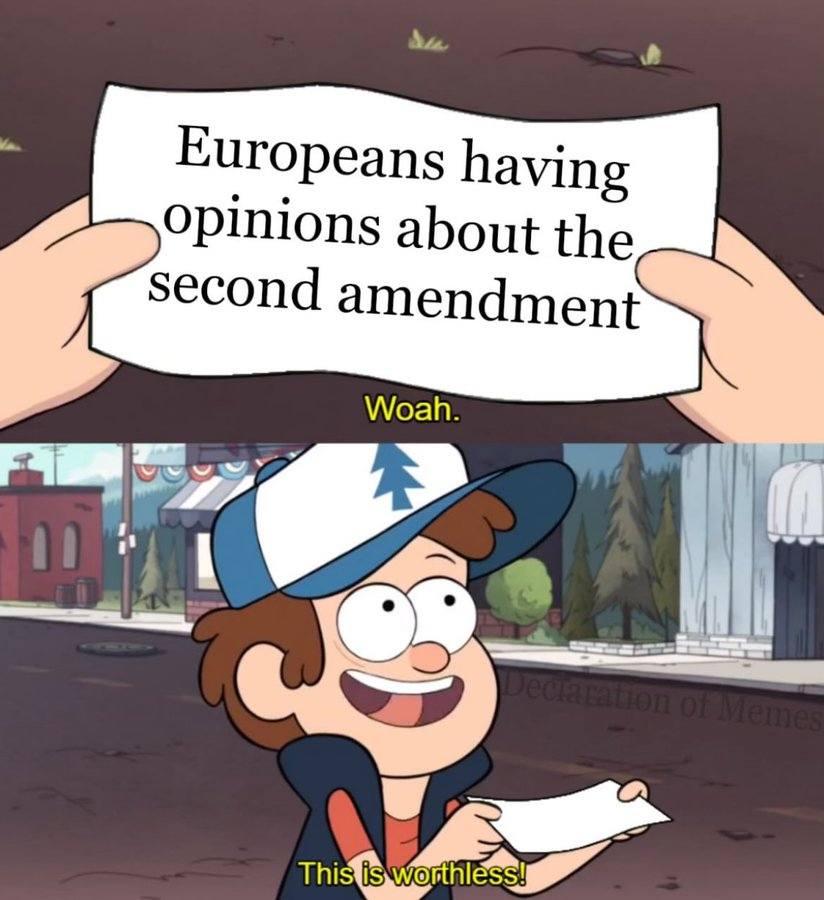
To you I say: hold on to the first amendment. Hold on to it and defend it by every means possible.

The only remedy for corrupted information is more information. The cure for lies is the truth and plenty of it.

Let my people speak. And the truth will become obvious.

Two announcements

Or…. new and interesting ways to get in trouble…. for everyone!

Are you looking for an opportunity to hone your writing skills, get feedback, even make some money?  According to Hoyt has some for you!

First off, money!

Sarah Hoyt’s Inkstain Press is soliciting submissions for our Galactic Enquirer Anthology.  Please submit your humorous science fiction story of 6k-10k words to hollyfrost.inkstainpress@gmail.com by March 1, 2024 (note new date if you have seen this announcement elsewhere).  Payment will be by shares of royalties through Pubshare.

The 41st century is upon us, and historians work to piece together the 21st century from the bits, the bobs, the fragments and flotsam remaining. Humanity roams the stars, but a few overworked, underpaid, dedicated souls work to piece together what went before. What was earth like at the dawn of the first space age? They dig through rubble, occasionally they find a stash of paper, a trove here or there. Imagine, if you will, the 21st century as reconstructed from tabloids, from comic books, from bits written down. Language changes, oh, yes, it changes through the years, centuries and millennia.

But some few precious resources have helped these clever souls to decipher the past. To put together a true picture of life as it was. Glossy magazines, though crumbling, give gems of knowledge! Who knew politicians were lizards? Those creeps and sneaks from Zlorch must have visited earth earlier than officially claimed!

Was all of politics merely theater to entertain the masses? After all, the beloved JFK was reliably seen alive decades after his reported death! What about yeti? Is that the same as the Yschlo in Sector Gamma 3? And UFOs? Clearly, humanity was not the first in their branch to obtain the stars as has been commonly thought, but who or what visited Earth remains mysterious. No other records of these beings are extant, and the purpose of these visits, despite the evidence, remains unclear.

An archaeologist plumbing the remains of plumbing nearly dies, but makes the find of his career! A diplomat averts an alien takeover of his planet. After recognizing the tactics they used two thousand years ago on earth, he uncovers a plot to replace the king and his cabinet. A historian, scorned and shuffled to the side finds success with a new popular history of the 21st century that hinges on the relationship between Hillary and the “Alien”, personages that survive only in the pages of the enquirer. And what about the time traveling bard, Elvis? There are entire symposia designed to discuss and trace his appearances for hundreds of years after death. As for JFK and his many possible deaths, there are entire libraries devoted to them, and librarians who love every single volume and would die to defend them.

The possibilities are endless. Make a silly, over the top story of life as reported by 21st century tabloids, or fragments of our cities.

Join now! You too can see your name on the cover! Or at least be a member of Team And More.

Now, for something completely different:

Enter the short story contest, win recognition, get feedback from a panel of professional writers. See your name in ligh– Okay, fine. You can get a nifty plaque or certificate, and that all important feedback.

See more information and enter at: https://sonofsilvercon.wordpress.com/writers-award/

And for the younger set (share it with your kids, your friends’ kids, your home school group)

Son of Silvercon is delighted to announce our inaugural Young Writers Award Competition. For fiction writers nineteen (19) years of age and under, this competition awards the Fission-Chan Award for Young Writers.

See more information and enter at: https://sonofsilvercon.wordpress.com/young-writers-award-entry/

Obstinate Ignorance by David Bock

This is a characteristic we see all too often where someone refuses, in the face of documented and confirmed facts, to allow themselves to be reasoned out of a position they weren’t reasoned into in the first place.

I’m sure all our readers are aware of the recent attack in southern Israel and the atrocities committed there. Many are also likely aware of the call for a worldwide day of violence on Friday, October 13th by leaders of that horror. Thankfully, it seems very few zealots decided to answer that call.

According to the FBI as well as other sources, Jews are the number one targets of hate crime in the United States, with the second place winner not even being close most years.

For example, in 2019 (the latest year for which data is available) there were a total of 1,521 hate crime incidents reported in the United States, resulting in 1,715 victims. Of these, 953 incidents were targeted against Jews resulting in 1,032 victims.

Muslims were the next highest targeted category with 176 incidents and 227 victims.

As a result of this history as well as current events, I was asked by a member of my congregation to sit outside during services that Saturday. I, of course, said yes. So that morning, myself and another member showed up before services, got a couple of chairs, and placed ourselves outside the main doors of the Synagogue.

We were, again of course, both armed, though his wife asked us not to bring rifles. We complied, but next time we may have a couple of ARs staged at the door, just in case.

We may only be speedbumps to any attackers, but we want to be the most effective speedbumps we can.

Thankfully, nothing untoward happened during services, but I did have some interesting interactions with other members both during the time we were sitting outside and at a social gathering later that evening.

During services, a member came outside to check on us and see if we needed anything. Right before he went back inside, he asked if we had whistles or some other type of noisemaker to alert those attending services if there was trouble outside.

My fellow sentry and I exchanged a knowing glance and assured him that A) we did, in fact, have noisemakers, and B) they would certainly be loud enough to be heard inside if we needed to use them.

We found out later he was completely unaware of the types of noisemakers we were carrying. After he left, we shared some good natured banter about “noisemakers.”

Later that day, many of us gathered for a birthday party for one of the older members who is also the mother of a close friend. While we were there, two members approached me separately to request my assistance.

One, wanted to learn how to handle a firearm. Her husband had one in the house, and she’d always meant to learn how to use it, but she’d never made the time. After what had happened mere days before in Israel, she didn’t want to put it off any longer than necessary.

We are currently working out scheduling for her first lesson.

The other member, who’d been in the Army during the Viet Nam era, but hadn’t done much with firearms since, though he did own some, asked me to go over cleaning and maintenance with him, as they’d been sitting in safe storage for years and he wanted to make sure they were ready to go if needed.

We are also working on coordinating a get together.

Then there was the other side of the coin. I was not present for this interaction, which was probably for the best, but My Wife was, and she relayed some of the main points of the conversation to me on the drive home. Probably also a good decision on her part.

One particular member wasn’t happy there were armed guards outside temple during services. She felt it was somehow sacrilegious to have firearms present at a place of worship and peace.

One of the things mentioned during this conversation was the temple has a contract with a security company for armed security during major holiday services, but not regular weekly services. This is a small congregation and even affording the expense of security for the major holidays is a strain on the budget. There’s no way we can afford to have them there all the time.

In addition, she claimed she’d done the research and guns caused more harm than good, so we didn’t need them there. If there were any problems, we could just call the police.

I don’t know if anyone pointed out that the police would bring guns with them. What was mentioned by several people was her information was wrong, emergency services would take *at a minimum* ten to fifteen minutes to respond, and by the time they got there, any harm would have already been done.

As one person put it, if there was an attack at the synagogue, the police would just bring body bags. She was confused by this statement.

Once it was explained, she refused to accept this and instead started talking about installing steel doors, reinforced windows, and other emergency barriers instead of having armed security present.

Remember the budget issues I mentioned earlier? Yeah, I doubt she had any idea how much these types of things would cost. But that was irrelevant, as she felt it was certainly better than having guns at temple.

I’m also guessing she’s unaware of the story of 25 year old Inbar Lieberman, who distributed firearms to a dozen members of kibbutz Nir Am and coordinated a defense plan as the attacks were occurring. The defenders then used these firearms to kill at least 25 terrorists who had come to murder them. Ms Lieberman killed five of them herself.

As a result of this decision and her personal bravery, unlike every other kibbutz in the area, kibbutz Nir Am suffered no casualties in the attacks that cost so many lives elsewhere.

As I’ve said before, without the means and willingness to apply effective defensive force, “Never Again” is just a catchy slogan. Ms Lieberman had both of those in spades.

Again, I doubt this member of my congregation knew of this story, but if it had been brought up, I’m sure she would have come up with some reason why that was different, or such things couldn’t happen here, or some other dismissive comment.

Due to the efforts of Ms Lieberman and her team, kibbutz Nir Am had a much better outcome than kibbutz Nahal Oz, where Shlomo Ron, being unarmed, sacrificed his life to protect his family. He did the best he could with what his government allowed him to have.

May his memory be a blessing.

Eventually, the topic was changed to a less divisive one. But for some of us, the damage was done. This is not a person I feel should be trusted to be involved with the security of the congregation.

These are not isolated incidents, I’ve had many similar exchanges with people on this as well as other topics over the years. I’ve talked about some of them in earlier segments.

Generally, I tend to be more analytical and fact based in my mindset, due in part to my nature, but also in part from my father being an engineer. This doesn’t mean I don’t have emotionally based positions, of course I do. Some people would likely posit my religious beliefs are of that type, and they could be right.

I figure we’ll all find out the truth of it after we die, so there’s no point in arguing about it now and causing additional strife.

I also hope I won’t find out for a good long while.

Keep aware and stay safe.

Links:

FBI Hate Crime Data

Inbar Lieberman

Shlomo Ron

Israel Music Festival Attack

Jewish People and Trust

Munich Clip

Brena Bock Author Page

David Bock Author Page

Team And More

Violence Inherent In the System

As some of you — all of you? know — we’ve recently acquired two female kittens — now four months old — which means we get to see young mammals up close and personal.

Okay, forget seeing — that would be easy — what we actually get to do is experience young mammals up close and personal at around six to seven am. You see, for reasons known only to the psychiatrist that kittens can’t have, as soon as there’s the slightest hint of light out, the two girls decide it’s time to have a series of fights on my feet.

These aren’t exactly to the death fights — both have “play face” on while they put each other on choke holds, or pretend to rip the other’s belly out. But they growl and squeak at each other. The squeaks get more urgent when Indy joins the fun, because the somewhere North of 16 lbs muscular new-adult (a year old in a couple of weeks) cat thinks he’s his sisters’ size and wants to play with them the same way.

I’ve now trained myself to reach down and put my hand between him and whichever girl he’s squishing without meaning to, without waking up. I wake up with both of them licking my hand, which is a very weird sensation.

But the point here is that limited and play violence seems to be part of being a young mammal. They chase each other and try physical intimidation/attack/defense methods on each other which, if they were you know, wild felis domesticus of the Serengeti (Far side, Poodles of the Serengeti) would be needed for their lives as adults, defending cubs from predators, and/or males bent on cubicide, or females bent on cubicide so the other’s cubs didn’t take resources from their own cubs.

Now, my elementary ( 1st through 4th grade in Portugal) school teacher, admittedly rather old, said mine was the weirdest class of girls she’d ever taught, in terms of the games we played at recess. This might have been my fault because a lot of the games were inspired by what I was reading (and told them about) at the time. So, there were a lot of play sword duels, and chasing each other around with bamboo cane “swords” from the field next door, and pushing each other down the ramp from the Earth berm by the wall to said field, as we played Musketeers or Robin Hood’s men or whatever.

I would often come home with bruises and cuts from recess activities.

Even so, my school (or side of the school. It was a 2-room school house) being all girls, I remember peering over the wall to the boys side, once, somewhere between first and fourth grade, and for the first time in my life till then, being heartily glad I wasn’t a boy.

The entire playground in my memory is complete chaos, a scene where — as opposed to OUR “violence” — violence could erupt at any moment. Two guys would be tossing a ball at each other, then suddenly one would jump the other and start trying to drive him into the dirt of the playground, punching and kicking. Or some kid would be quietly sitting in a corner, and either two boys jumped him, or he’d suddenly, for no reason I could figure out, run across the playground, grabbing a stick on the way, to beat the living daylights out of some kid who was, before, engaged in climbing a tree. Only all of this was happening at the same time, and there were five or six other boys just running around getting into fights.

Look, I’m sure there was an internal “logic” to the interactions that I missed as a little girl, or that it was like watching the last episode of a thriller series, without seeing the previous installments, but to my rather shocked eyes, it seemed like the world of boys my age at that time, in that place, was as chaotic as Circe’s and Muse’s interaction, where the one of them who just ran screaming to hide behind my knee, will suddenly jump on her sister and start biting her ears for no apparent reason.

At the time I looked at that playground I remember thinking “I wouldn’t survive as a boy.” But later, when my kids were in school, the violence was more like the violence on the girls’ side, when I was a kid. It was stylized, and shouting in each other’s face, and maybe pushing if no one was looking, except for the inevitable young psychopath, who would beat on the other kids behind play structures and where no one could see him, and whom we had to give older son permission to beat. (Younger son, about the size of this kid’s arm, had already beat him once, by clambering up his side holding on to his neck and punching him on the head screaming “no one beats on my brother but me.” Note at the time this brought no punishment because no one could believe the tiny pre-schooler who weighed maybe 25 lbs soaking wet was hitting the 3rd grader-but-my-height giant.) After months of his getting older son in places where the playground guards weren’t looking and beating him till he was bruised, and/or breaking his glasses, older son turned around and punched him a couple of times. And suddenly we’re in the office, and being told that we should not have told him that because “violence never solved anything.” To which the 4th grader answer “Tell it to the city fathers of Carthage.” (Proud momma moment, even though I don’t think any of the teachers knew what Carthage, IL had to do with it. Because that was about the level of thought in that room.)

I’ve been re-reading a lot of books I read for the first time when I was a teen. A lot of them are mysteries written at the beginning of the 20th century.

Someone probably 20 years ago in a con, talking about how writers’ research said how mysteries are the best way to research the “texture of real life” in a certain place and time. For instance, Miss Marple captures the texture of life in a small British village at the turn of the 20th century. Like, the post office is in the grocery store, type of thing.

If that’s true — and I think it is — being a man in the early 20th century was a lot more like my vision of being a boy in that playground than what we know of public interaction of males nowadays. 

Leave aside the fact that men are often private investigators you still get a feel for what is acceptable or even possible in society and what is not. And it was possible for some rando on the street to take violent exception to what he thinks you just told your girl. Or to your comment about someone else’s behavior. Or. And it was possible — or it fails as fiction, and also, this appears so often in fiction by so many different people, it’s unlikely to be impossible — for two men to punch each other over this sort of interaction without — unless it was in a private venue where this just wasn’t acceptable — anyone calling the police, or anyone suing anyone else. I mean, it might get you tossed out of the bar (in an attempt not to let it spread, is my guess) but it wouldn’t get you arrested.

There is a physicality to life that just isn’t present nowadays.

Because human evolution simply doesn’t happen in these few generations, the only thing causing this is different “controls.” I.e. these days you’re likely to get arrested for punching someone no matter how much they needed it. And you might get sued for defending some woman who is being abused in public. And–

So what is happening is the same thing that happened in the kids’ schools. Violence is still there but under ground, and hidden, and those who either can afford to be sued/arrested because they’re very rich, or very poor. And the violence is likely to be more intense and far more serious because you have to get it in while you can, before the authorities notice.

And here’s the thing. I don’t have answers, but I have questions:

  • Is it good or bad for society to lose the “first level” of policing on acceptable public behavior and outsource it to courts, police and social arbitration?
  • Is it good or bad for young male development that they are no longer allowed to have playground tussles? How does it work in terms of them being adult males capable of doing or responding to controlled violence?
  • How much does the “violence never solved anything” which we all know is a lie contribute to empowering the bullies at both the child and adult level?

I don’t know. As far as I can tell no one knows. Utopians just decided that men should no longer be at home with controlled violence, and therefore applied the “violence never solves anything’ rule from childhood on.

I mane, no one WISHES for violence, or at least no woman, but sometimes might it be the least evil alternative? 

To what extent does “no violence” work? What side effects does it have in society at large? And what effect on society?

And shouldn’t we know that, before implementing society-wide experiments?

Book Promo And Vignettes By Luke, Mary Catelli and ‘Nother Mike

Book promo

If you wish to send us books for next week’s promo, please email to bookpimping at outlook dot com. If you feel a need to re-promo the same book do so no more than once every six months (unless you’re me or my relative. Deal.) One book per author per week. Amazon links only. Oh, yeah, by clicking through and buying (anything, actually) through one of the links below, you will at no cost to you be giving a portion of your purchase to support ATH through our associates number. A COMMISSION IS EARNED FROM EACH PURCHASE.*Note that I haven’t read most of these books (my reading is eclectic and “craving led”,) and apply the usual cautions to buying. I reserve the right not to run any submission, if cover, blurb or anything else made me decide not to, at my sole discretion.SAH

FROM JERRY BOYD: A Reptile Dysfunction (Bob and Nikki Book 42)

Bob and the crew found out about some castaways, who seemed to be related to their new friends. What to do but take their friends to rescue their people? Of course, things are never as easy as they seem. Come along and find out what their shepherd has in store.

FROM LILANIA BEGLEY: Djinn: A short scifi romance.https://amzn.to/48KpyYY

The planet Sumire’s dry surface holds many surprises. Seona’s academic background hasn’t prepared her for what happens when her flitter crashes, and she nearly lands on top of Henry. Henry has his own secrets, but first, they have to survive…

FROM SABRINA CHASE: Red Wolf: Scout Part 1 (Red Wolf Serials Book 4)

An unexpected hazard of going from a world of modern technology to a primitive, alternate Asia: explaining the concept of “swimsuit” to people who can’t swim. Nic must train a truly effective special forces team, and protect the only safe haven she’s found. The people of Shanmen fortress have accepted her— even if some still think she is a wolf demon in her spare time—but Feng Guo, the general in command, has a powerful enemy determined to wipe them out.

Nic must save the fortress and the people within from sabotage, single spies, and entire squads of soldiers in a world wracked by rebellion. She only has her wits and what she had on her when she was shunted to this timeline. What can she do with a cell phone, a tourist guide, and a very slightly used geology degree? Wreak havok, and let slip the Red Wolf of war!

FROM DAVID COLLINS: Return of the Old Gods

The modern gods are gone; they have been removed from power by the old gods. The old gods are back: Greek, Egyptian, Norse, Roman, Hindu, Aztec, Celtic, Japanese, Chinese, Babylonian, and many others.

The first thing they do is kill off over 1 billion people who have been judged as Evil. They also eliminate the weapons of all of the militaries, all nuclear power fuel, and waste.

Gordon Anderson was a clerk at a 7-11, and he was (as usual) late for work. That is suddenly the least of his problems.

The world is changing; everything is in turmoil. However, the most disturbing fact may be that his phone now has some new contacts listed in his address book.

The gods of old, the ones that have just judged and executed a billion people and are literally shifting continents like chess pieces. They now have him on speed dial…

FROM SEAN FENIAN: Fireborn

An end can be a new beginning … sometimes.

Life is not kind to everyone. Some would say it is cruel to more than it is kind to. But sometimes, someone’s life can become so empty, so miserable, so filled with pain, that they simply don’t want to live it any more. Life has become an unbearable burden. Some people in such a position choose suicide … or perhaps find death rushing at them and simply make no effort to avoid it.

Often, that person doesn’t really want to die. They just can’t bear to continue living that life any longer. What they want is an escape, any escape, from a life that has become intolerable.

But even if you are somehow granted that escape, you must still somehow heal the trauma of the life you escaped — and learn who you are NOW. And you may find that even your second chance comes at a cost.

Fireborn is an alternate-world fantasy novel including dragons, a “magic” system based on Finnish mythology, detailed swordsmithing, and a lot of back-story about poly relationships and healing from past abuse. Ever heard of a smith who can mix advanced metal alloys by ear? In this book, you will.

FROM NATHAN C. BRINDLE: A Huntress on the Rocks (Timelines Universe Book 4)

A young military intelligence agent. Hunting a murderous drug dealer across a floating city on a water world light-years from Earth – with only his name, and a vague description of what he might look like. Will she finally find her quarry and bring him to justice, or will cases of mistaken identity mean she’ll simply end up

A Huntress on the Rocks

(A Delaney Wolff Fox story)

FROM LIANE ZANE: The Harlequin Protocol (The Unsanctioned Guardians Book 2)

Prequel to the Elioud Legacy series

She was trained to follow orders. She chose her conscience instead.

Berlin, 2011—The War on Terror is ten years’ old and shows no signs of abating. While on a high-stakes operation to unearth a terrorist cell on the verge of a devastating attack, newly minted CIA officer Olivia Markham spots a young woman being harassed by a group of immigrants. Unable to stop herself, she intervenes. For better or worse, her actions affect the mission objective. The instincts that made Olivia a stellar CIA recruit threaten her ability to work in the field.

But Olivia’s instincts won’t be denied.

Even as she faces opposition within the CIA, Olivia meets two other operatives from other agencies whose instincts match her own: Captain Alžběta Czerná of Czech military intelligence and Anastasia Fiore of Italian foreign intelligence. Yet each action outside the wire risks her future at the CIA. As what’s right becomes lost in the fog, Olivia must balance her official and unsanctioned covert activities. Until the dangerous mission that forces her to write her own operational protocol.

Set two and half years before THE ELIOUD LEGACY series, THE HARLEQUIN PROTOCOL tells the story of Olivia Markham’s transition from trained field operative to unsanctioned guardian.

“If I loved Olivia before, I am insanely mad about her after this. She is a superb character.” — Ted Fichtl, Col. USA (retired)

FROM HOLLY CHISM: The Godshead (Modern Gods Book 1)

Food and drink for sale; snark for free…

It’s hard to be a god nobody believes in, sometimes. Especially when one spends their days trying to quietly go about his or her life in a world that barely remembers the myths surrounding the old Greek gods, but where some religions still follow the old Norse gods.

And some of the Norse gods are getting more dangerous: Loki, the trickster, has lost the last of what passed for his sanity, and needs to be helped, or stopped. One of the two. And no one seems to be up to it.

At least, not alone. Working together, they can avoid the worst of Loki’s tricks, and maybe even solve their problems.

A tale told from several points of view.

FROM DALE COZORT: Snapshot: Book 1 of the Snapshot Universe

Alternate realities you can fly to.

For eighty million years, the Tourists have taken Snapshots of Earth, creating living replicas of continents. Life in the Snapshots quickly diverges from the real world, creating a universe where humans and animals from Earth’s history fly between Snapshots, exploring, fighting, and sometimes meeting themselves.

In 2014, the Tourists’ newest Snapshot catches Middle East Analyst Greg Dunne rushing toward Hawaii to join his wife, who just went into labor. The new Snapshot doesn’t include Hawaii, cutting Greg off from everyone he loves.

Greg is thrust into the aftermath of a hidden, decades-old massacre, where Germans from a pre-World War II European Snapshot battle ranchers from a Korean War-era U.S. Snapshot,a fun house mirror version of the US cut off from the world since 1953.No Beatles. No Internet. No Personal Computers. No cell phones. No Vietnam War.But an endless new frontier.

FROM LEIGH KIMMEL: Rockin’ the USA

It’s not easy being married to the leader of the band, even in the best of times. When everything becomes political, you’ve got a nightmare on your hands.

Laurel had her doubts when her husband signed on to headline Governor Thorne’s Independence Day concert in Candlestick Park. Now that the band’s committed to the appearance, the Flannigan Administration has decided to shut the show down, with prejudice.

Laurel knows she has to fight this attempt to stop the signal. But doing so may put her in more danger than she could ever have anticipated, and risk those she loves.

A story of the Grissom timeline, originally published in Liberty Island Magazine.

This edition also includes a bonus essay on the era of dictatorship in Grissom-timeline America.

FROM MARY CATELLI: Winter’s Curse

Who but a fool would linger after Zavrien laid his curse? Ill luck can kill — and all the more in Zavrien’s enchanted, endless winter, haunted with ice giants and frost fairies.

When the soldier Gareth is cursed, the young wizard Perriel learns how dangerous lingering can be.

But she can hold out a sliver of hope for breaking the curse — if it doesn’t break them first.

Vignettes by Luke, Mary Catelli and ‘Nother Mike.

So what’s a vignette? You might know them as flash fiction, or even just sketches. We will provide a prompt each Sunday that you can use directly (including it in your work) or just as an inspiration. You, in turn, will write about 50 words (yes, we are going for short shorts! Not even a Drabble 100 words, just half that!). Then post it! For an additional challenge, you can aim to make it exactly 50 words, if you like.

We recommend that if you have an original vignette, you post that as a new reply. If you are commenting on someone’s vignette, then post that as a reply to the vignette. Comments — this is writing practice, so comments should be aimed at helping someone be a better writer, not at crushing them. And since these are likely to be drafts, don’t jump up and down too hard on typos and grammar.

If you have questions, feel free to ask.

Your writing prompt this week is: obedient