I am a novelist with work published in science fiction, fantasy, mystery and historical "novelized biography". I've won the Prometheus award and the Dragon award. I also write under the names Elise Hyatt and Sarah D'Almeida. http://sarahahoyt.com/
Guns are fairly intricate mechanisms. While they can go long periods with minimal maintenance and no issues, it’s a good idea to know how to maintain them beyond a simple cleaning.
Since the AR family of rifles is probably the most popular semi-automatic rifle in the country right now, I’d like to discuss some of the malfunction causes and solutions that the average owner can take care of at home.
The heart of the AR is its gas system, commonly referred to as gas impingement. In this system, gas is diverted from the barrel and fed back into the gas key on the bolt carrier group. This channels the gas into a chamber behind the bolt, pushing the bolt forward and the carrier back. Since the bolt can’t move forward, being locked into the barrel extension, the carrier has to move back. This movement causes another component, called the cam pin, to rotate and unlock the bolt. The bolt and carrier then move back together during the action cycle.
All of this is very dependent on a few components being in good repair and properly set. Specifically the gas key bolts need to be properly tightened and staked and the gas rings need to be within spec and replaced when they wear enough to cause function issues.
Happily, most carriers come with the gas key bolted down and properly staked. Unfortunately, not all of them are. Knowing the signs of gas key leakage or worn gas rings and how to remedy the situation can prevent your rifle from being transformed into a really awkward straight pull bolt action.
Gas Key
If the gas key bolts are not properly tightened and staked, they can loosen during the firing cycle. This allows gas to leak out around the base of the gas key and rob the system of pressure, leading to short stroking of the action, feeding issues, and failure to lock open on an empty magazine.
A replacement gas key won’t be staked and will look similar to this one.
If the gas key is loose, don’t just tighten the screws and call it a day. The key needs to be removed and the mating surfaces thoroughly cleaned before reassembly. Once that’s done, the bolts need to be tightened and properly staked.
There’s no need to really crank down on them. Firmly hand tightened with a proper bit driver is all that’s needed. Once this is done, it’s time to stake the bolts. No special tools are needed for this job other than a center punch. I prefer an automatic center punch like this model from JelBo, though a manual center punch and ball peen hammer can work just as well.
Make sure the carrier is properly secured. I use a bench vice with padded soft jaws, but a couple of pieces of wood clamped to a table can suffice.
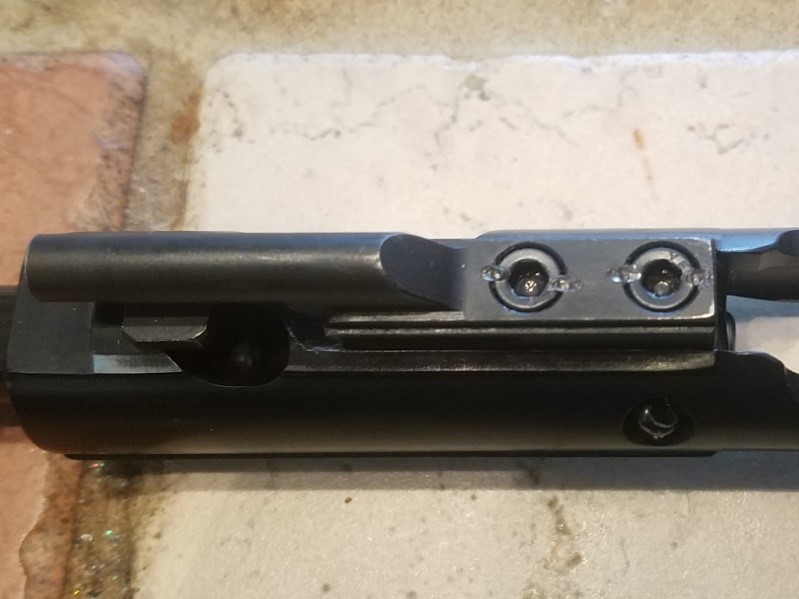
All that needs to be done is to displace a small amount of metal from the gas key into the head of the bolt to prevent it from turning under vibration. Don’t go crazy.
This is one in my collection. The first attempt at staking turned out to be insufficient, so it had to be done again. That’s why the staking looks more messy and aggressive.
In case anyone was wondering, I’m not a fan of thread locker on firearms. There may be some instances where it’s warranted, but much less than it’s used. If you must use some kind of thread locker on a firearm, blue shalt be the color thou shalt use, and the color of the thread locker shall be blue. Green shalt thou not use, nor either use thou red. Black is right out.
Gas Rings
The gas rings on an AR bolt, like the rings on a car engine cylinder, add a gas seal as well as some friction to the system. Every time the bolt cycles, they rub against the inside of the carrier and wear. Gas rings, like springs, are consumable parts and will need to be replaced eventually. The signs are similar to a loose gas key, but there’s a simple test to check the gas ring friction.
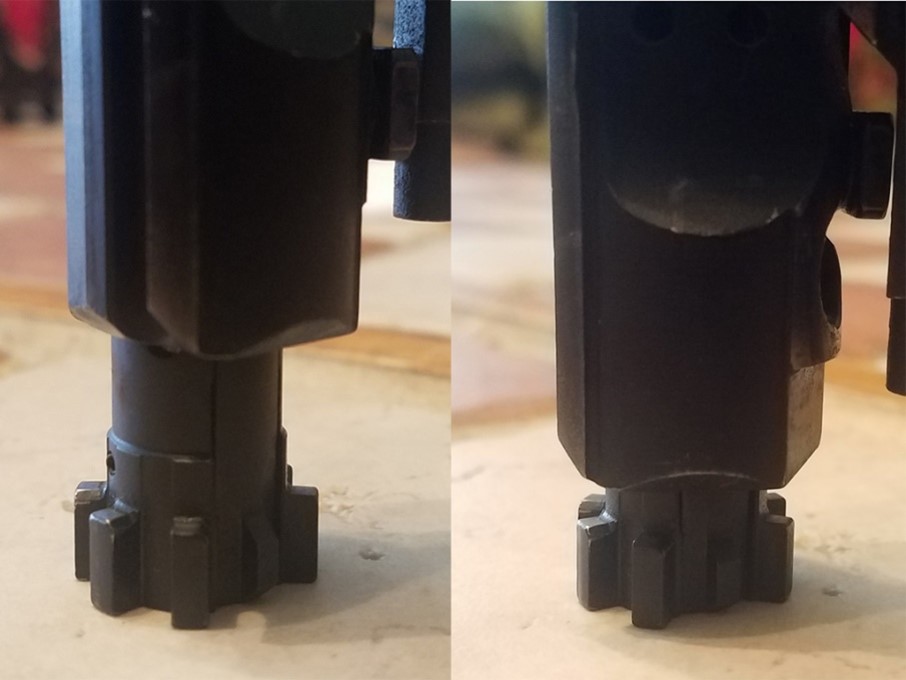
After removing the bolt/carrier group from the rifle, make sure the bolt is in the forward position and gently stand it up on the bolt face. If the carrier stays up, the rings are fine. If it slides down the bolt, it means the rings are sufficiently worn to require replacement.
The bolt requires three rings and they are usually sold in convenient three packs, like these from Brownells.
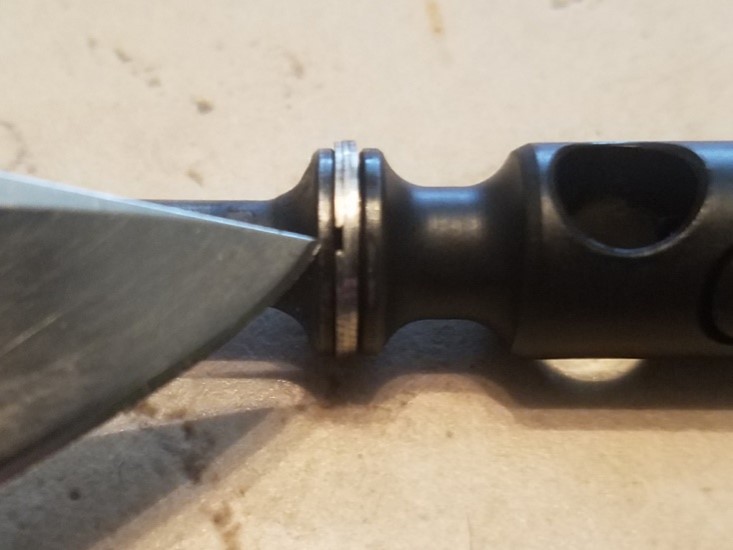
Remove the bolt from the carrier and wipe off any grease, oil, or loose carbon. Using a knife point or sharp pin (do not use the firing pin) find the gap in the rearmost ring and pull it towards the tail of the bolt, stripping the ring out of the retaining groove on the bolt. Repeat for the other two.
Clean the retaining groove and replace the rings. Don’t worry about the gaps in each ring lining up, the first time the bolt cycles they’ll shift around. Lubricate the bolt and reassemble. There should be a noticeable increase in friction.
Remember, take care of your tools and they’ll take care of you.
A journey of a thousand miles, yadda, yadda, yadda….
It’s trite, and you heard it a thousand time. But you know what? It’s true.
All of us — particularly those of us with ADD and of a depressive bend — become paralyzed by a task that’s too big and complex for our brains. You’re not alone.
But when you’re facing a vast quantity of yarn, all snarled together, if you keep trying to find the tip. So you cut it at a convenient place, start unraveling, and assume you’re going to mend it later.
When I was young, I often got tasked to clean the kitchen after my mom had cooked for a party of people. This might seem like nothing, except mom cooks by the fantastic mess method, as in when she’s in the middle of cooking she can’t be bothered to make sure the trash lands in the trash can, and used trays or oven pans just get balanced on the first convenient surface. There’s no rhyme or reason for it, and some of it seriously upsets me, like throwing organic refuse in a sink that lacks a disposal. I hate dealing with that, because particularly if it involves cooked anything — like bones from a cooked piece of meat — it’s sticky and slippery and gross.
After many times of doing that, not the sink, but cleaning the whole kitchen, I started to enjoy it, to the point I’d go directly to the kitchen instead of the party, and start cleaning. Okay, part of this was to avoid people, of course. I might be the very slightest bit introverted (she says, tongue in cheek at obvious understatement.) But that isn’t all. There was a method to it. First clear the sink, because I’ll need the sink to clear everything else. Start throwing obvious trash in the trash. Then take the cleared space by the sink and clean it, so you have a place to put clean dishes.
Then start taking one class of dishes. I usually started with glasses because that way the scrubby wouldn’t get greasy and scruffy from pans, and glasses would come out clean. Clean glasses first. Dry them. Put them away. Then wash and dry any breakables. Plates first, then bowls, then serving dishes. At this point you should be able to tackle the pots pans and oven trays, so put them in order, usually cleaner to dirtier and deal with it. People are going to be bringing stuff in while you’re doing this, so clean a portion of table or counter and tell them to stack stuff there. It will be easier, because you won’t be stepping over things by the time you get there.
You do it one category at a time, so you don’t get lost and discouraged. And often, while it seems like nothing is getting done, if you keep doing one little thing at a time, by the time the party is done, you have nothing but a handful of dishes to do, and the floor has been mopped and the entire place looks nice. (A warning for young women looking for marital prospects: this is not the way to get them. If you do this, the guys never meet you. Go to the party. Because otherwise their mothers and grandmothers will love you — such a nice girl, so organized — but the guys will never know you exist.)
That is what I revisit in my mind when I need to figure out what to do about anything. Even the biggest mess can be dealt with one step at a time.
And this applies to just about anything. For years I’ve been daunted from getting to this book I’m now finishing (somewhat hampered by a massive sinus infection recently) because it’s a whole world and it has so much stuff, and decades of accruing details, so how could I deal with it all? Well, one scene at a time. Sometimes a few lines at a time. And it’s getting done, though it’s taken me much too long.
Our national situation? Heaven knows I’d like to fix it all in one sell fweap so to put it. But it’s impossible to do that way without rivers of blood.
It might still come to that mind, but the thing is, it’s going our way, one step at a time.
Yeah, sure, we’re here washing the glasses, and people are dropping more glasses atop the trays, and it could all slide and break any second.
But–
But it’s getting done, one step at a time, restoring things to the way they should be, one step at a time.
I know it’s disheartening and it seems like they’re winning, but they’re not. We’ve already started turning this around.
It’s just going to take time. One step at a time.
I too wish it were faster. It’s going to consume a lot of treasure and time and, well, people’s lives, but it might be the only way to do that. We didn’t get in this situation in a single step. We won’t get out of it except: step by step by step.
If you wish to send us books for next week’s promo,please email to bookpimping at outlook dot com. If you feel a need to re-promo the same book do so no more than once every six months(unless you’re me or my relative. Deal.) One book per author per week. Amazon links only. Oh, yeah, by clicking through and buying (anything, actually) through one of the links below, you will at no cost to you be giving a portion of your purchase to support ATH through our associates number. A COMMISSION IS EARNED FROM EACH PURCHASE.*Note that I haven’t read most of these books (my reading is eclectic and “craving led”,) and apply the usual cautions to buying. I reserve the right not to run any submission, if cover, blurb or anything else made me decide not to, at my sole discretion.– SAH
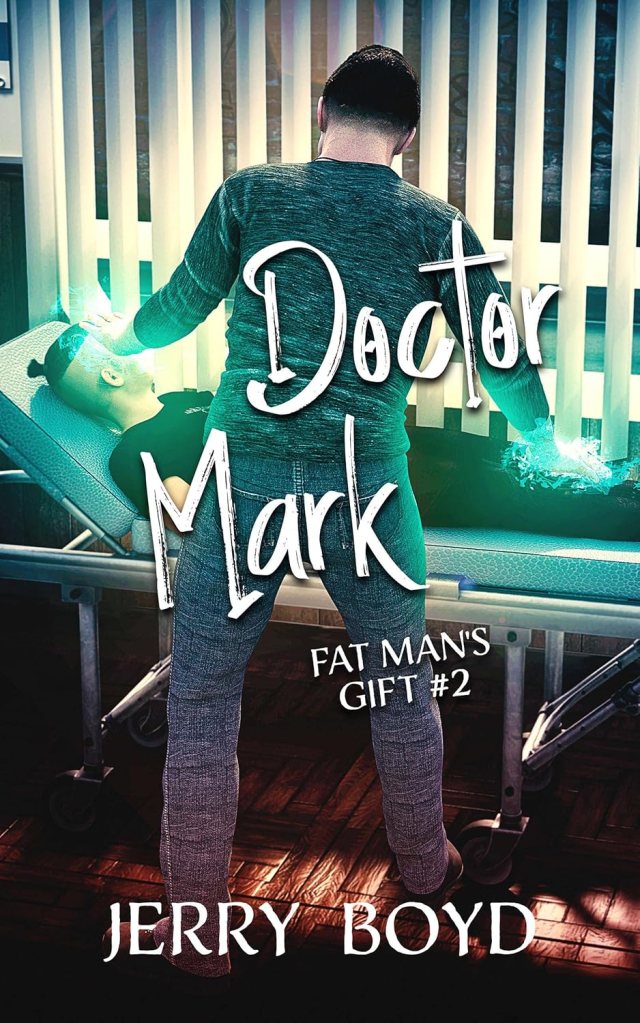
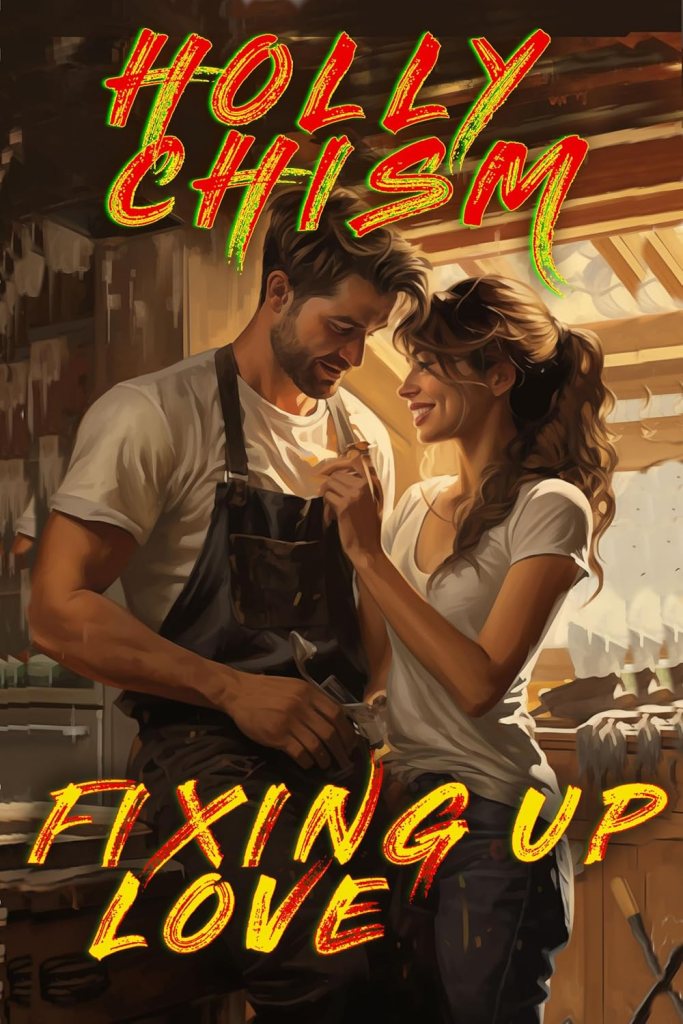
It turns out that the same skills that let Mark fix machines work on people, too. The mismanagement at the local Association has left quite a backlog of folks who need a little help. Mark’s dad thinks Mark is the man for the job. If that wasn’t enough to keep Mark on his toes, there’s always his love life to worry about.
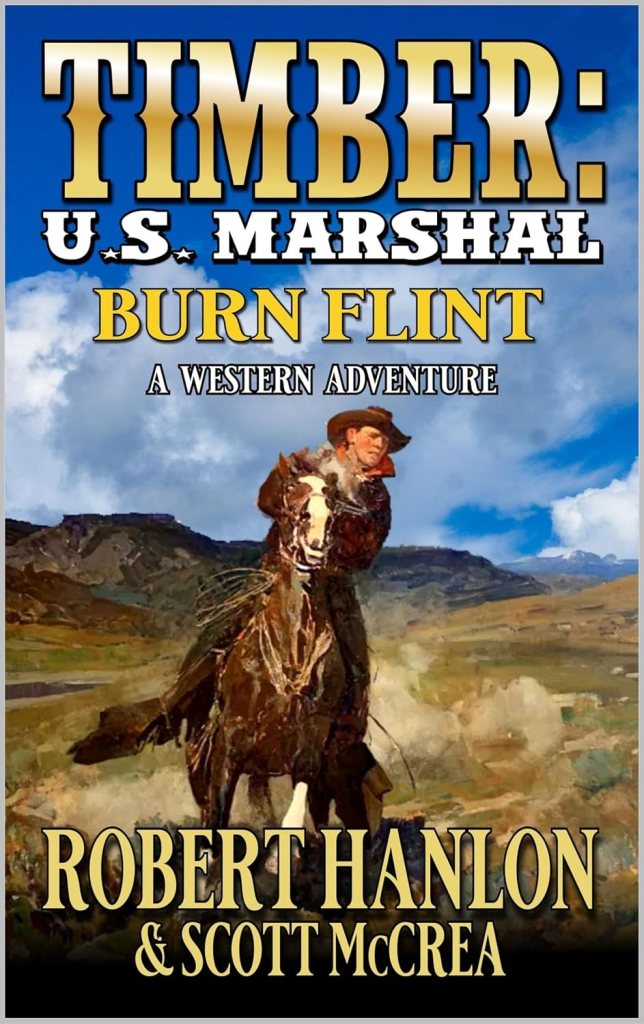
Timber: U.S. Marshal and U.S. Marshal Ezra Flint are working together again in this exciting new adventure sequel from Robert Hanlon and Scott McCrea!
Mad-dog killer Harlon Roache is in custody and on his way to Huntsville Penitentiary when the stagecoach is hijacked by his gang and brought to the small town of Poison Creek.
Roache and his men terrorize the town, killing any who dare fight back, but everything stops when a monumental sandstorm hits the Poison Creek, cutting it off from the rest of the world.
What the badmen do not know is that Marshal Ezra Flint was working undercover on that stage, or that the legendary manhunter Jake Timber is now on their trail…
Every hero starts somewhere. She’s going to take the fast track from student to trained covert operative.
Six months ago, Olivia Markham testified in the grueling murder trial of her cousin Emily’s killer. When her boyfriend Jamie surprises Olivia with a trip to Ibiza, party island of the world, her family and friends urge her to go. After all, Emily had been her best friend, the one she’d planned to room with at Brown University her freshman year.
Olivia gets her chance to let loose—only not in the way anyone could foresee.
What was supposed to be a vacation dancing and drinking on the beach trying to move on from her cousin’s death turns into a nightmare terrorist attack instead. As men with automatic weapons and knives move through screaming, swimsuit-clad, and drunken tourists, Olivia can’t flee. She has to do something. Even if it kills her. So she stops and confronts a knife-wielding man who’d just slaughtered a young couple.
It was a foolhardy act.
But Olivia’s presence of mind and surprising fighting skills don’t go unnoticed—or in vain. A team from the Special Activities Division, the CIA’s ultra-clandestine paramilitary unit, miraculously intervenes. What happens next changes the course of Olivia’s life forever.
Set six years before THE HARLEQUIN & THE DRANGÙE, THE COVERT GUARDIAN narrates Olivia Markham’s genesis from idealistic college student to trained intelligence operative.
People love easily. Look at most of your relatives or coworkers. How lovable are they? Really? Yet most have mates and children. The vast majority are still invited to family gatherings and their relatives will speak to them.
Many have pets to which they are devoted. Some even call them their fur-babies. Is your dog or cat or parakeet property or family? Not in law but in your heart? Can a pet really love you back? Or is it a different affection? Are you not kind to those who feed and shelter you? But what if your dog could talk back? Would your cat speak to you kindly?
How much more complicated might it be if we meet really intelligent species not human? How would we treat these ‘people’ in feathers or fur? Perhaps a more difficult question is: How would they treat us? Are we that lovable?
When society and the law decide these sort of questions must be answered it is usually because someone disapproves of your choices. Today it may be a cat named in a will or a contest for custody of a dog. People are usually happy living the way they want until conflict is forced upon them.
What if the furry fellow in question has his own law? And is quite articulate in explaining his choices. Can a Human adopt such an alien? Can such an intelligent alien adopt a human? Should they?
Of course if the furry alien in question is smart enough to fly spaceships, and happens to be similar in size and disposition to a mature Grizzly bear, wisdom calls for a certain delicacy in telling him no…
The “April” series of books works from an earlier time toward merging with the “Family Law” series.
Your parents thought they were emigrating to a terraformed planet. That didn’t happen.
Now you’re second generation on a lost colony world.
You’re one of Martha’s Sons.
Will Peter Dawe’s perilous mission with a brother he despises end in death?
A lost starship’s settlers, isolated on an uncharted alien world, manage to terraform a mountain-ringed valley into a rich replica of Earth. Despite their success reproducing the environment they need to survive and thrive, only tenuous forces hold together the human colony on the world of Not What We Were Looking For. The governor’s appropriation of the western settlers’ weapons for the city strains those bonds to breaking point—and then beyond when Peter Dawe’s father sends him to get the weapons back.Twenty-year-old Peter Dawe’s restless nature easily endures the lost colony world’s rigors. His genetic modifications make it even easier. So when Peter retrieves the family weapon, he also brings back a motorbike, a piece of technology no longer available to everyone.
It would be a fine prize to keep to himself. He won it. He earned it. He quickly learns that his brother Simon lies in wait to take what isn’t his. Simon wants more than just the motorbike. He wants Peter’s glory.
But when Peter’s father forces him to take his hated older brother on Peter’s next mission, the pair must not only navigate the city’s perils and politics but learn to work together—when neither thinks the other should be in charge. Their success—and their very lives—depend on it. Or will Peter be proven right that he should have faced this task alone?
This box set contains the first three titles in the immersive Martha’s Sons science fiction adventure series: Simple Service, Long in the Land, and Relief Afar. If you like gripping action, insurmountable odds, and alien worlds, you’ll love Laura Montgomery’s tale of a man determined not to let family ties sabotage mission success.
Eight lives depend on Kyle’s desperate trek across the Moon to get help. But someone — or something — intends for him to fail. Can he defeat it in time?
Vignettes by Luke, Mary Catelli and ‘Nother Mike.
So what’s a vignette? You might know them as flash fiction, or even just sketches. We will provide a prompt each Sunday that you can use directly (including it in your work) or just as an inspiration. You, in turn, will write about 50 words (yes, we are going for short shorts! Not even a Drabble 100 words, just half that!). Then post it! For an additional challenge, you can aim to make it exactly 50 words, if you like.
We recommend that if you have an original vignette, you post that as a new reply. If you are commenting on someone’s vignette, then post that as a reply to the vignette. Comments — this is writing practice, so comments should be aimed at helping someone be a better writer, not at crushing them. And since these are likely to be drafts, don’t jump up and down too hard on typos and grammar.
One of the drivers of how scary everything feels is that we’re in an era of catastrophic innovation.
And I know as I type this that half of you are going to go “but from covered wagon to airplanes! Wasn’t that faster?”
Yes, in a way, but we’re talking about different areas of change. (As well as the fact that change builds on change.)
First let’s establish the rate of change humans are good for. It’s very slow, and measured in the pace of a human life. The new generation might expand the hunting grounds, or whatever, but by our middle years (which some scientists claim is around 25) we are set in our ways and pretty much just want our routine. We can shake it up in minor ways, but the major patterns are set.
Humans like their patterns “safe to eat” and “good grazing land” and “friendlies vs. enemies.” We want tomorrow to be more or less like today but a little better. And we want to raise fat babies who have fat babies. For that to happen, we have to know that tomorrow will be more or less like today but a little better.
This is our minds. Our bodies are even slower to adapt. See the rate at which lactose tolerance is disseminating in the population. Evolution is a slooooooow process. You see, it’s a hit or miss thing, and it’s based mostly on “Does it allow you to reproduce more, and produce more viable descendants.” Sure, being petite with violet eyes might make a gal super attractive, but unless it also allows her to have triplets for every birth and have 26 kids who each have 26 kids in her life time, the fact that gentlemen like anime girls is not going to give us all anime girls in two generations or fifty. Keep that in mind, because it’s important.
Second, sure, the late nineteenth to mid twentieth century saw an amazing rate of technological change. There was probably a non-insignificant percentage of people who made it out to the American West in covered wagons who were alive to see the moon landing. Looking back, this seems dizzying to us.
Was it?
Well, yes and no. Like a lot of the changes through the industrial revolution, it was astounding and mind-breaking and…. things that happen to other people either far away or in a much further up social strata.
Look, I was born in the early sixties in a small European country. When I was six we moved from one house to another using an… ox cart. I took my first flight at 17 when I came to the US as an exchange student. I was only the second person in my family to fly anywhere. This included immigrants to other continents who had taken the “vapor.” By which they meant boats. Not sure if they were steamboats, as the name implies.
The rhythm of life was still very much what it had been in the 19th century. Sure cloth manufacturing and clothes manufacturing was easier, cheaper and faster. But that meant some more mill jobs for local youth, and people dressed better.
Again, even when television became common in the seventies, the rhythm of life didn’t change much. The housewives now watched soap operas, as opposed to merely listening to them on the radio.
The difference in our current rate of change is that — mostly because government blocked the big changes that Heinlein expected — at the very personal, every-day life level.
When I moved to the states now almost forty years ago, contact with my family was cumbersome and expensive. It was a major line item on our budget to have calls to mom. Now it’s not only free, but I routinely get pics of grandnephew in my texts when I wake up. I can communicate to friends around the world. In fact, most of my friends, while in the US might as well live in Narnia. I never see them, we just talk every day.
But the … changes hit at every single level that involves information/learning/media. Which means they hit at every level for anyone who works or plays in those realms. Which in the US is almost every single person.
For me, at the professional level the change is particularly dizzying. I mentioned before that we’re just now about to run out of a set of stamps we bought in the early two thousands, expecting them to last a month. But submissions went online that month, and well, after that so went bill paying and most correspondence. We probably won’t use the six month supply of envelopes large and small for the rest of our natural lives. If you get a letter from me, it will have tape on the closures, because the glue is SO old.
Also, I went from trying to always have more than one publisher to publishing myself, and if you think that denotes a demotion, or that it must mean I’m making less, or– Well, oh, you sweet summer child.
And the whole thing is accelerating crazily. For people like me, the ability to produce entertainment that reaches the masses and/or to learn whatever I very well please, at this point is bounded only by my time and energy. (And the demands of this blog, which is– well. Its own time sink.)
Sure, but that’s entertainment. Even supposing that — bet you that — in two to five years I can produce animated movies of stories that rival what Hollywood can do, with minimal learning investment (I can do it now, if I am willing to spend three years to cludge together semi-functional tools, integrate them and LEARN them well enough to use off-label. My problem being I’m not willing to lose three years of not writing at all, and not blogging either.) what is that going to change?
Well, not much, but that’s the nature of my profession. I have friends in other professions, though, and … well…. it gets complicated.
If I’d stayed in my original path as a multilingual scientific translator, my lunch would be currently being eaten by automated translation tools, which, sure, still need human editors, but far less. (If I’d stayed on that path, I suspect right now the mathematician and I would be starting a retirement project of creating better automated translators.)
And I have friends doing work on better 3-d printing. And better machining, the kind you can do at home and used to require a factory. And I have friends working really hard to break all sorts of barriers in distance medicine, and diagnostic, and engineering, and–
As I said, it’s accelerating. Part of the reason it seems like governments have gone to war with their own people is that the “blue model” of centralized governance views the 1930s as its ideal time to be. Because mass everything was obvious and controllable, from communication to manufacturing.
Currently they’re running around screaming misinformation and trying to grow more fingers to plug the leaks in their information dam. And not succeeding. And that doesn’t count the myriad new manufacturing/robotics opportunities over the horizon just waiting for the boot to lift a little, not even be removed, to come into being.
To an extent, the “progressives” — never was a movement more strangely named — are suffering from shock and panic over fast change because of how wedded they are to “systems” that “explain everything.” People with that kind of mindset are not prepared to quickly change how they think, or to take new factors into account.
So even though all of us feel like everything is slip sliding away because of fast change to our everyday life, the left feels even more so.
To an extent their “invented” change, to the numbers of genders, or whatever, are ways to cope with their own cognitive dissonance, in the same way cutting yourself is a way to cope with change you can’t control. Also a way to accuse us of what they’re doing. “You only say that because you’re afraid of change!” etc. because they project like an Imax.
Also, tying in to that evolution thing, their attempts at keeping the new generations ignorant and incompetent, yeah, are going to hurt, but not in the long run. In the long run, humans are as creative and adaptive as they’ve always been, and the kids are finding ways to learn and innovate. The learned neuroticism only paralyzes them for a few years. That means they’re slower to get started, but not permanently crippled.
No matter what the left does, it only seems to feed the acceleration of change that escapes their control.
Which drives them crazier and leads them to do crazier things in an effort to control us.
Which in turn leads to us escaping them faster and in more creative ways.
Have I mentioned: Hold on to the sides of the boat. The seas will get choppier.
And also, remember RAH and keep your clothes and weapons where you can find them in the dark.
*Sorry about the lateness. There were wedding dress fittings, and I was only person available to go with. Threw entire day off. Also Havelock cat is ill which ate the rest. – SAH*
The blue model is collapsing all over the world.
We’re calling it the blue model after the American colors. And no, you don’t need to tell me that the left manipulated those because post fall of the USSR they thought calling themselves reds was too on the nose.
Or perhaps because they tend to think in patterns, they thought the communists were defeated because they were red, and they could rub some of that on us. Who knows? The many many ways they avoid thinking are tiresome and hard to fathom.
But I’m using Blue model instead of Marxian because the blue model at its root is honestly more monarchist than anything else. It’s the idea that the government should take care of you. That you are dependent on it, and lesser-than.
Marxism simply highjacked the structures left over from monarchy. Which is why the blue model was much deeper all over Europe which still had leftover structures and mental categories from monarchy. The idea that someone in the power structure to a degree owns you and you owe them allegiance while they owe you protection/whatever else goes back as far as feudalism. The idea that individual rights trump that is alien in most of the world.
It isn’t alien in the US, and it is in fact, despite everything, the default. Which is why the blue model took a lot longer to penetrate fully here, and it’s still not really fully installed. Yes, I know what you hear on the TV and what recent college graduates spout, but really: In 16 we voted for the guy promising to bring back jobs, over the chick saying jobs were a thing of the past and she’d give everyone welfare. Americans still would rather take care of themselves, given half a choice, despite everything FDR and his ideological successors did to try to break that.
BTW and this is important later, the monarchical model in Europe had its roots in feudalism, which was a system that made sense for its time and place. Division of labor of a sort, under constant attack from outside (moors in Southern Europe, Huns in the East, Vikings in the North.) It is a system that works fabulously when one is under constant attack and short on resources.
It ran into problems as the pressure let up. Contrary to what you’ve been fed over and over in school, revolutions don’t happen when things are intolerable, but when things get better. Actually, revision on that: they can happen when things are intolerable, but then they are far far worse and can often flip totalitarian.
So, what is the blue model: A centralized, “strong” government, run by “experts” who possess some quality the “peasants” lack (this applies back to monarchy, where they were believed to have been installed by G-d. In our era it’s the “they’re so smart.” Kind of the same, said another way.) This allows them to allocate resources and make decisions for everyone. What decisions? Well, those you are too stupid to make, peasant!
No, on the serious side, the problem is that when the current form of the blue model was installed, it was believed that experts really had more knowledge and could see clearer than the average person, including into that person’s daily life.
No? Dudes: WHY THE HECK do we have a recommended daily nutrition? Particularly as we’re finding out how different people/metabolisms are, why do we have someone telling us what we should eat, every day? (And am I the only one who has found that a lot of our dietary diseases only showed up since we’ve had that?) Why is there someone telling you how much you, yes, you, should weigh, for that matter, when humans are completely different, and in the US we come from ethnic groups with widely varying body types? Why do we have regulations on what insulation your house must use, what type of stove you can use to cook your food, what your kids must learn, how your work must be performed, etc. etc. etc. etc. for everything you do every day, from the moment you get up to the moment you go to bed.
Well, “experts say” and “they know better” of course.
If we cut the federal government back to what the funding fathers thought were the functions of the federal government, we’d get rid of 99% of it. Guard the borders. Negotiate with foreign powers. Prevent war between states. I believe that’s it, unless I’m forgetting something.
Everything else is the blue model. Everything else is “Experts say you should wipe your butt three times, using paper of this thickness, folded twice.” EVERYTHING.
And it’s double that abroad. And they give a lot more credence to experts than even our dunderheads do. I remember watching in awe as my parents allowed their electrical panel to be changed with one that would crash at a lower usage to “save the environment” because…. experts said, so there were the government goons going door to door, doing this. And everyone thought this was okay. (Head>desk.)
So, why is the blue model crashing? Well, first because they are now openly against their own countries. Took a while for that to actually sink in, but slowly it’s penetrated. And people will actually defend themselves when they keep getting attacked.
Second, because it never worked and it can never work, beyond a very small population under high pressure.
After all, its idea of the obligation to and from government is based on Feudalism, which was exactly that. Feudalism broke under the twin impacts of the Black Death which — not because it was smaller population, which is what the left took from it the ijits — because it was a massive population CRASH created a surplus in a society that never had it before; and a population explosion following, which caused people to fan out and colonize beyond the immediate reach of the Lords/government.
This type of model, where the government imposes all sorts of dictates on things it has no business touching, only works as long as the government, whether your local lord or your local kommissar can dictate what you believe/talk about and what you do/how you react.
This means it doesn’t work very well in a distributed, spread out society. It does even worse with a from-a-distance, ignorant-of-local-conditions society. It does even worse when the people running it are infected with Marxism and think both that people are widgets and that people will respond to laws as though they were laws of nature. And it does even worse if the people running it are utterly in thrall of “experts” and “Studies” in an era when most of those are falsified. (Because financed by the government.)
But most of all it doesn’t work because it’s centralized, top down ordering of everything. It is particularly clunky in our continent-sized country, but frankly it doesn’t work very well even in the kit-kat sized countries like Portugal, where you need a passport to swing anything above a newborn kitten. The central planners not only can’t see into the needs and desires of people who live distantly/differently from them, but also the bureaucracy itself is optimized for ass covering, so all failures are excused and all data fudged.
The end result is failures no one will acknowledge, which snowball into really big failures.
The central administrative state never works very well, but it gets worse each year, because failures roll bigger and bigger every time, like the dung pushed ahead by a dung beetle.
To make things worse, of course, the stupid fools are INTERNATIONALISTS and aiming for the largest possible of all states. I honestly don’t know if this is because they’re Marxist or because they’ve tweaked accountability and good information are harder the bigger the nation is, which gives them cover, or if they truly believe that the long war of the 20th century was due to nationalism. (If anything it was due to aggregating all the tiny principalities and satrapies of Europe into large nation states who then collided over their macro policies.) However they all want these big aggregates and ultimately a world state. Which is stupidly insane. But anyway, their internationalism and conviction that people are widgets is causing them to a) import vast masses of third worlders into the west b)try to enforce some form of racial social justice that means the natives of the West have no rights.
And to compound their problems, they no longer control the communications, so their failures are becoming impossible to hide. The internet, even faltering and hampered as it is outside the US makes their bias and hooliganism obvious.
So, the blue model is falling in plain sight. The world is on fire, with the people of every western country at all but open war (from what I gather from reading the increasingly panicky “Stop doing that” communiques) with their governments.
How long? I don’t know. I know even here we’re tap dancing on a powder keg, and our idiot Junta keeps playing the music faster and faster.
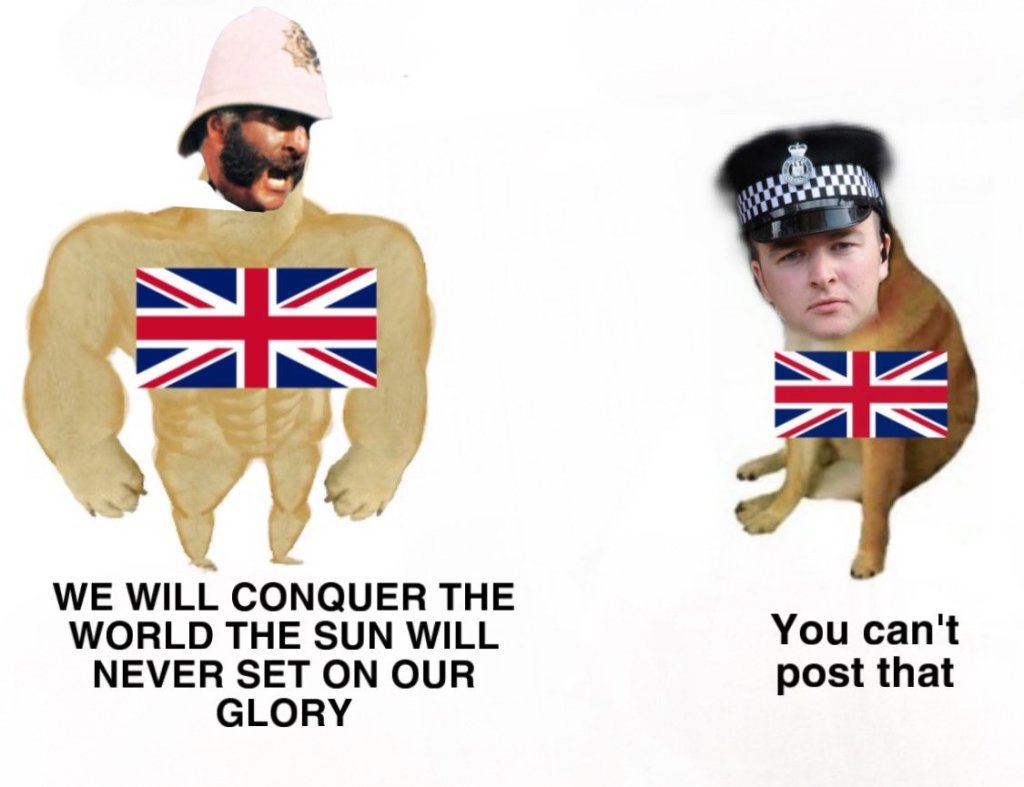
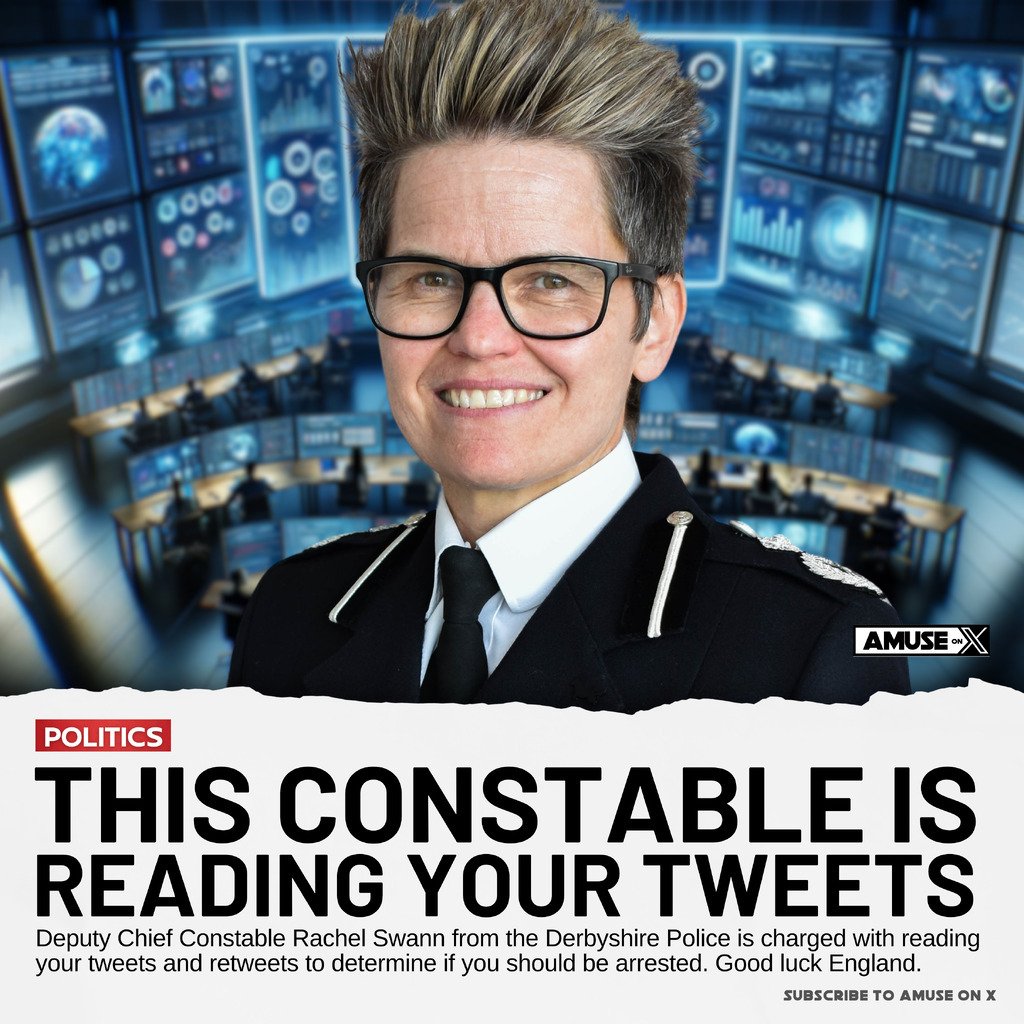
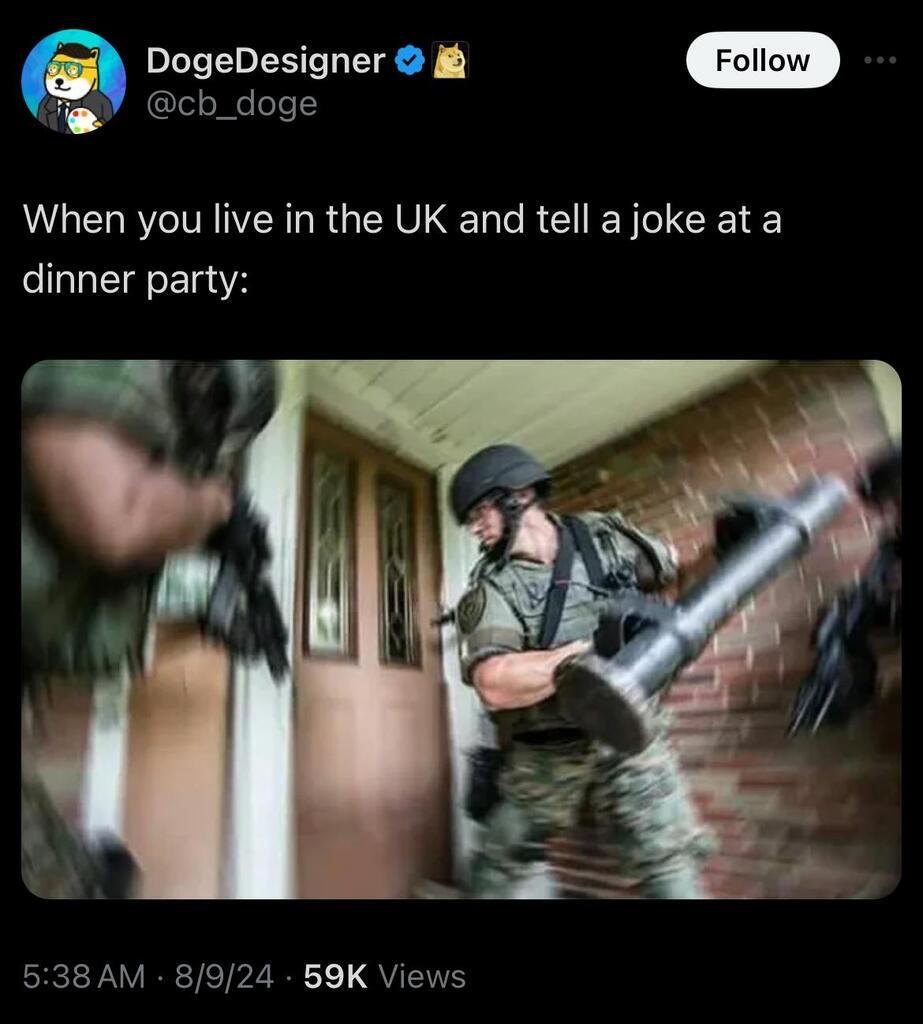
I know anything could set it off. Britain had had horrific events before without fighting breaking out. And the poor bastages aren’t even armed.
At the rate things are breaking down it’s going to get sporty all over, and accelerate.
Make your final selections before flight, and strap in.
*I will continue the post on the bind we’re in, but tomorrow is a really busy day, and someone asked for this. So, here is my post from 2015 on acculturation. – SAH*
Prepare to be Assimilated a Blast From the past From November 22 2015
Yesterday I was surprised when Dave Freer sent me a post that echoed almost exactly what I’ve been thinking. In a late night (for me. He has temporal privilege, living in Australia) conversation last night, I found that we agree in more than one thing, including how nasty things are going to get if we don’t get at least a partial course correction soon. That is a post for another time — how the fact that the left’s escathology and the belief history comes with an arrow and that they are the inevitable “end of history” (a belief that’s religious in nature because no rational principles lead to it) has caused them to be blind to the fact that silencing opposition is NOT winning — but for now it remains scary that both of us are worried about the same things. Why scary? Because I’ve known Dave for… twelve? thirteen? years and the man has a gut feel for the future. Even when you really wish he weren’t right, he tends to be.
But today I want to talk about assimilation, or, in sociological terms, acculturation. I, and Kate Paulk, and Dave Freer, and a ton of the rest of us are immigrants who went to another country with the intention of living there the rest of our lives and who had incentives to fit in and be part of that country. (In the case of two of us, husbands. And in my case a philosophical belief in the principles the nation was founded on.)
But even then, with the best will to fit in, it’s a HARD thing. Really hard.
It’s not just in your head either, though it is there too.
Humans are tribal, and living in a multi-ethnic society doesn’t make you less tribal. This is why people keep looking for racists under their bed, because you know, it’s baked in, and they know they’ve “discriminated” at some point. Only this isn’t the racism of the progressives. Minorities can be (often are) as racist or more racist than the majority.
But more importantly, in a multi-ethnic society that tries as hard as it can to eliminate racism, you get a different kind of “racism” that has nothing to do with race. You get tribalism that fastens onto odd things. It’s best expressed in “Ya’ll are not for around here.”
What you might not realize if you have never immigrated and acculturated is that the way you move, the way you speak (absent accent), the way you eat and the way you walk (not to even mention handwriting) are ALL culturally linked. Most of it is not identifiable at a conscious level, either. Most of it is so deep that all it does is trigger the “ya’ll are not from around here.”
I know I’m fitting in better because it’s been years since people stared at me while I went about my daily business and before I opened my mouth came up to me and asked “Where are you from?”
(And btw, the reason I stopped resisting identifying as Latin is because other people are making that identification for me, usually people who have a grudge (and who, bizarrely, manage to think I’m Mexican.) My kids came to the same decision for the same reason. It’s one of those “you say that I am” and it actuates even when my hair is colored light brown — it has no color of its own anymore — and I’m pale from a combination of lack of sun and illness. SOMETHING is triggering this response in people. I don’t know what it is.)
Now, when you don’t fit in, for whatever reason, you’re going to find that some people — often not the sanest people in the world — are going to have issues with you and often be hostile.
Remember this as we go through the stages of assimilation.
It starts when you find yourself in a completely different land and you realize there’s no going back. I came over after Dan and I discussed our options and decided where we were going to live.
The choices were here or there or between and wherever, a sort of multinational, above nationality existence.
We chose the US for several reasons. To begin with there was that philosophical belief set I had which conformed best to the founding documents of the US. Then there was the fact that Dan could never be REALLY Portuguese, even if he moved there, learned the language and acculturated completely. He’d still be a foreigner living there. Being Portuguese means sharing ancestry. Our kids would be considered mestizos. Our grandkids would probably bear “the Americans” as a nickname. Our great grandkids might too, and by the sixth or seventh generation, THEN they would be Portuguese (and might not remember why they had that nickname, and might think it was just some ancestor who liked American movies.) Then there was HOW we wanted our kids to grow and the options we wanted them to have. We decided the US was our best bet. There were no doubts our kids would be Odd and the more free the society the more outliers thrive in it.
So I came over and set out to acculturate. Part of this involved watching a lot of old TV because it gives you the catch-phrases, the “feel” of things. I also read a lot and pretty much everything, which helps, though what helped most was reading auto-biographies and NOT by famous people, who are presenting an image, but the sort of “my grandma wrote an autobiography and we printed a hundred copies and donated one to the library” candid shots of normal people you can get in those.
Even with the best will of the world, even wanting more than anything to fit in, it’s very hard. Not just in America. America might be one of the easiest places in the world, because it is multi-ethnic and a country of immigrants.
But even so, people catch the subconcious signals of “something wrong about you.” They stare. They don’t trust you. Sometimes they think you’re stupid, because “smart” in a society is not an IQ test but a series of signals a lot of them subconscious.
I muddled through, but sometimes there there were days I felt so homesick that I’d give anything to never have set out on this course. And people treated me oddly, and it’s very easy to use that as an excuse for failure. I learned not to do it because, through friends who did it constantly, I identified it as a trap. I chose to ignore it. But I still knew it was happening, and it made me long to go back to my tribe, to the place I belonged.
Some number of immigrants do this. It gets to be too much for them. They run back “home” where “things make sense.” I might have done it but for that philosophical conviction. That’s how hard it is.
At this stage many people make plans to retire in the “homeland” or at least to go back after death. I guess it’s a comfort.
And I still had that option, six years in, because the hoped-for kids had failed to materialize, so if something happened to Dan, or simply if it got to be too much for me, we could always “go to Portugal.”
Only then I had Robert. And the most important reason to live here and stay here came into being. And if I was to raise this child American, I certainly wasn’t going back, even if a tragedy happened and something happened to Dan.
This is the point at which you’re most offensive to natives, btw. You know just enough of your new society to see all the warts, but not enough to see the good side or necessary side of the warts. And you’ve been far enough from your native society for a while so it creates this glow of nostalgia. You know you’re “trapped” in the new place, which creates resentment.
This is when the words “In my country” — meaning in the old country — come out of the mouths of immigrants. I was lucky to watch a Turkish immigrant in a group we belonged to alienate everyone with this behavior, so I didn’t do it. I thought it, sometimes, but I didn’t DO it.
So then came the serious-fitting-in part, helped, btw, by dad. We took Robert back to meet the family after he was born and dad who, btw, longs to see me every year, told me not to be running back for every important event in the kid’s life. “Don’t be like those immigrants from France who raise the kid to be Portuguese, while in France. You made your choice, now make sure your kid knows his place. Raise him American. We’d love to know him, of course, but he’s American and that’s where he has to fit, and live and thrive.” This was much like Dave Freer’s FIFO advice yesterday.
So… I made my choice. And I really started trying to fit in. This did not involve changing our diet so much, or my clothing choices (I’m odd, okay) but a closer observation of people. I’d have got rid of my accent, if I could. Though being a mother helps with this too, because unconsciously you start picking up speech patterns and gestures from your kids. I might still strike people as somewhat odd, but it wasn’t as in your face anymore.
I also stopped reading in Portuguese, because when I do that a lot, it affects my word choices and rhythm of language in English, and I was trying to get published.
And at some point, I stopped being stared at when I was at the grocery store, and I stopped feeling I stuck out as a sore thumb. I still couldn’t write people who grew up in America. (I still can’t write people who grew up NORMAL in America, but that’s something else.)
I don’t know when that happened because I was busy just living. Somewhere along the line I stopped thinking of Portugal as “home” and Portuguese as “we” and instead changed that to America.
Then came the shock of going to Portugal after a five year hiatus and being in a foreign land, rubbed wrong by the way these people moved, the way they talked, the way they prepared food, a myriad little things.
Now, be aware I’m not an “ugly American”. I’ve been to other countries (neither America nor Portugal) and reveled in the differences particularly in food and dress but also architecture and just ‘different’. That’s the point of traveling, I think. But it’s also easy to enjoy the difference when you know in two weeks or whatever you’ll be back home and have things your way.
It’s harder when the back of your brain remembers doing things that way and — this is hard to phrase, but it’s something like — is afraid of relapsing and of getting “trapped” in the old place. It’s a feeling of being in a foreign land that is nonetheless eerily familiar, and yet not familiar enough that you could survive in it on your own. Because of how familiar it is, you see the warts. Because you’re now acculturated elsewhere, it’s easy to see the solutions too and you find yourself saying “Back home we do it this way” then stop, aghast, realizing what happened. And it’s a relief to come back to your adopted homeland. And you feel guilty it’s a relief, because you love the people you left behind, and they would be hurt if they knew how much your prefer your new place.
This is where I’ve been for at least 15 years. It’s where I’ll be the rest of my life. There will always be little things that aren’t “right” about America, things I learned so far back that they’re not conscious. Nothing big or philosophical, but the little ways of doing things. Sometimes I can’t explain to my husband why I hate an area he loves, or vice versa (this is important while house hunting) all I can do is wave my hands and say “No, just no.” And I know I give the “indicators” of class and intelligence all wrong. (Not REAL class or intelligence but how those markers are perceived in the US.) I KNOW that was part of my trouble in the field. I also know that my “I’m getting really, really angry” is mistaken for shyness or fear here, which has led to some in retrospect funny situations.
I will never fully belong either place again. That’s okay. It’s a choice I made. And of the two, I belong here the most. Say I 90% belong here, opposed to 10% in Portugal.
But the process to get where I am was neither easy nor unintentional. And it involved consciously NOT romanticizing where I came from, which I find is a big temptation for immigrants of all types and colors.
So… So this brings us to taking in refugees from a culture so different from ours as to be mind-boggling, (and you wouldn’t get HOW different unless you’d lived in one half way there), from a religion that considers itself at war (physical, not just spiritual) with us and modernity, from a place where tribe is primary above all…
Do I understand why they want to come here? Sure. Even if half the reason is probably wrong of the “streets paved with gold” variety. They want a better life (or a life) for themselves and their children.
Will it be an easy road to acculturation? No. For one, our culture ACTIVELY DISCOURAGES acculturating. It’s considered a “betrayal” of your “native” culture. I was accidentally in the room yesterday (I am ill, okay) while someone watched an episode of Dr. Ken, in which his wife accuses him (a second generation Korean) of being a lapsed Korean and brags about how she has passed on “her culture” (she’s second generation Japanese) to her kids.
The entire episode could serve as a cultural dissection of “the crazy years.” These two people AND THEIR KIDS are AMERICAN. That’s the only thing they are. Yeah, okay, they come from elsewhere, as do most Americans.
BUT the message heard, loud and clear, is that you’re supposed to hold on to all this culture from an imaginary homeland, even when you marry someone from elsewhere, and pass this entire undigested baggage to your kids. The message is that not only is there no escaping your roots, but it’s somehow bad to want to.
This is the message these new refuggee-immigrants will get, though TV, through movies, through social workers. How important it is they hold on to their all vital tribalism. Not just in food and clothing, but in thought. How it’s somehow “racism” to demand they fit in into their new homeland.
Remember I’m saying this as someone who’s been there. Acculturation HURTS. Even when you want it, it’s a very painful process. Think of the worst days of your teenage years, and multiply them by five or ten years of consciously dragging yourself through this process.
It’s hard enough to do when you chose this, when you love it, and when your tradition doesn’t demand you hold yourself as an enemy of your new land’s ways. (And btw, I think that’s why it’s considered “racist”: acculturation and pushing for people to assimilate hurts people. Bleeding hearts don’t understand that sometimes hurt is part of the growth process.)
I can’t even imagine trying to do it when immigration was forced on me, when going back was never an option, when my habits, culture and religion both encouraged me to be suspicious of my new countrymen and caused them to suspect me.
Hard? Rather say impossible, or close to. And then add to that telling you that you’re not SUPPOSED to assimilate. And you’re supposed to raise your kids in the old culture.
People who have never acculturated, people who are frankly quite ignorant of what “foreign” or “abroad” means, beyond their easy, lazy, fluffy headed vacations talking to other people like them abroad, call those scared of such an influx of people in that bind “ignorant.” I guess because they lack a mirror.
Is it scary? It is very scary. Can it end well? Of course it can.
But the way it ends well is where our society cheerfully smiles and says “fit in, or f*ck off.” We’ll embrace little Achmed and little Fatima as our countrymen, but NOT if they go around demanding Sharia, telling us to stop eating pork, and that we can’t write/make stupid parodies of Allah, as we do of every other religion/belief in our culture. Sure, they can roll their eyes at the stupid parodies, or write outraged blog posts about our disrespect. But they don’t have the right to try to curtail us by law, or to bring their f*cked up culture, which caused their problems to begin with, here.
I don’t see it happening, at least not while our current multi-culti elites are in power. Which means what we’re doing is importing trouble for later.
Further more, what we’re doing is being horrible to these people and ensuring they’ll never fit in, either place. And not like me, not 90%/10%. No, we’re talking they will fit about 30% either place. And because not self-selected immigrants, they’re probably not odd, not used to NOT belonging.
Of such discontent is strife and war born.
UNDERSTAND this is not what i want, not an expression of my desires. It is what it is, and how the human animal works.
It is impossible to have this deranged belief that culture is genetic and that people can’t and shouldn’t change (a belief belied by history) and a multi-ethnic society. At the end of that road is a war none of us wants to imagine and a far more restrictive society than any of us would like.
The only ways out of it are to either take no immigrants, certainly no immigrants in a large group (which makes it harder to leave the old country and its hates and loves behind) OR to hand to every refugee a little handbook.
The cover would say “Fit in or f*ck off.” And the inside would explain “At home we did it–” is banned, that it’s gauche to try to pass the culture you left behind to your kids. Oh, food and attire are fine, no one complains of that, but do not try to pass on “we hate x because in the 11th century, they”. And the only way to stop passing that on is to be American as HARD as you can.
Which hurts. It hurts like hell. The generation that immigrated will never fully heal from it, and their kids will still bear scars.
But it’s the only way to make good on your choice of America. It’s that or go back. There is no other choice. Making your new country fit the old is the WRONG choice. Else, why did you leave.
Fit in or f*ck off. No, this doesn’t mean becoming the Borg. America is the society on Earth with the greatest tolerance for oddities and outliers. BUT you do need to fit in minimally to succeed. And you need to start thinking of America as “we” and not holding yourself up above the rest of your countrymen.
This goes double and with bells on if you were born and raised here. Stop imagining there is a perfect society elsewhere and that you somehow belong to it.
Life is in great part the art of adapting to the flaws in reality that don’t match your desired state.
Of all the weird problems for our age to have oikophobia is probably the most bizarre.
Throughout history humans called their tribe “human” and everything else “the others” and bizarre ceremonies/sacrifices/rites developed out of keeping that distinction clear.
Our people hurray-good. Your people not even human. This is the beginning of human associations, and the basis of tribalism, which to an extent is the curse of mankind.
For all that I’m the first to say things like “Government, what is it good for? Killing its own people and enslaving them!” and loathe the over-extended nation-empires of the 20th century, the truth is that things are complicated when it comes to nations and empires.
Nations as a thing, governed by a distant centralized government suck rotten fish bits. But then again, it’s better than tribalism.
The dumpster fire that was the Roman Empire on many levels, with all its brutal colonial policies was much better than the tribalism before, and for that reason alone the Romans should be blessed, if nothing else. Because they invented nationality that transcended tribalism.
But how did we get from nation states where the leaders might perhaps be a little too proud of and chauvinistic about their own nation and their own people to governments — most of those in the West — that loathe their own people and want to destroy them?
Well, the short one word answer is “Marxists” which is actually hilarious because Marx loved Britain and was actually a nationalist.
Except that Marxism, being a totally effed up theory keeps going through a series of retcons to make it sort of work. And one of them was the Soviet retcon. As in “We’re international socialists, but international really means Russian.”
As the Soviet Union was the beau ideal of their fantasy, they thought of course it would lead the world to communism, and they idolized and wrote paens to this barbaric country at the edge of Asia. For… reasons. Their own countries must be run down and unfavorably compared to the splendors of the Soviet Union.
The wedge between reality and their love affair with Russia (the Soviet Union was a convenient mask Russia wore) just kept widening, but they kept clinging to it like a teenage girl with her first crush.
And when it all fell apart, they retained fury at Reagan who caused their beloved to fall. (As in the reason Obama wanted to be the Anti-Reagan, and said so. He managed it too, the traitorous little bastard.) AND they retained the certainty their own countries were evil for causing Russia to collapse. (“The good guys lost” being the catch phrase through the mid 2ks.)
They fanned out into the colleges carrying their open hatred and disdain for their countries, and taught it to a new generation, which was pushed into positions of power and–
Now, the oikophobia was there before. I know because I grew up with it all around me, directed at Portugal, and I saw it in the early eighties in the US, where everyone who was a leftist was anti-America, because America was the enemy of the USSR and therefore evil, and also so inferior to their ideal country.
I come across references, sometimes, in books of the era. And it’s startling. Like on a book talking about stargate, (the American psychic-research conducted by the military, not the TV series), apropos nothing, in the middle of it, the author tells us about this pill of some kind of natural compound that the USSR issues to all its citizens, which has been proven to extend life. Heaven alone knows if that was even true — I mean, if they issued a pill to all their citizens, let alone I’m sure the supply wouldn’t support that –and what it contained, but it was an article of faith to the bien pensant of the west at the time that the USSR not only could but would do this kind of thing, out of the goodness of its heart, for the good of all, while the US wouldn’t, because it was “capitalist” and “backward.”
You catch it too, in a lot of science fiction books of the period, that weird certainty that the USSR was more advanced and prosperous.
It is to our very great shame that we never publicized how bad things were behind the curtain when it fell. We thought of course the truth would out. Forgetting that the pictures of the concentration camps were essential in exposing Nazi horrors, and that without them the denial of what happened would be even more rampant.
Also we were hampered by the fact that by the time the USSR fell, the institutions of the west had been taken over by USSR sympathizers.
I could, here, adduce many reasons for this. There is the fact, for instance, that Marxism, as a simple, just-so story appeals to the type of sheltered, intellectual elites who don’t fit in very well in the real world but know they should be in charge because they’re “so smart.” Marxism with their “the intellectuals will lead the revolution” feeds their sense of unearned superiority. In that sense “who goes commie” is very similar to “who goes Nazi.”
But most of all, and overarching everything is the fact that commies hire only commies. They will forget everything else, and hire the ideological comrade (eh) over competence, over minority status, over connections, over in fact everything. That kind of selection bias, played hard, will replace all positions of any importance with the factor selected for more rapidly than you can imagine.
So, by the time the USSR fell all the centers of communication in the west were controlled by USSR-devotees and if not communists, communist sympathizers. This led to the misery behind the curtain never being exposed, but also to the utter fury of that class against their own countries for destroying their precious, which is how they experienced it.
As a result, what we have is elites who now not only favor a foreign country (or as they view it “internationalism”) but also hate their own countries and want to punish them.
This has led to their encouraging the outright invasion of their countries (the Gramscian retcon of Marxism said that third worlders are righteous and natural communists) by what they perceive as the dispossessed of the world. But which are in face the result of dysfunctional cultures. And also to their trying to curtail energy supply to the industrial societies of the west, because, of course, if they are rich other countries will be poor. (Amid the many sins of Marx his bloody stupidity about economics is paramount. That shithead never understood that it was not a finite pie.)
So, they need and want to achieve control of their countries, and then seek to destroy them in revenge.
This in turn is growing a strong nationalist trend, which is good and bad.
No, I don’t want us to get to the point we take no immigrants. In the US, at least, we will attract any number of people who WANT to become Americans. We should always choose the best of those, not by color or even perhaps formal qualification, but by a perceived willingness to work to be Americans. The “how to decide” can be solved by demanding they have some period of waiting and not requiring help before they become citizens. (We had all of those. They are fudged in various ways.) And by requiring assimilation. No Oprima dos para Espanol. Just… Fit In or Fuck Off. And weird as it might seem to you guys, there are people who consider themselves “naturally” some other nationality. French, or Italian, or English. And before the “refugee” bs, those countries had hard enough entry requirements to work on that.
I definitely don’t want humans to get to where if you’re another tribe you’re not human. Tribalism is a scourge.
But I also think internationalists are enemies of humanity. Some of them idealistic, unwitting, enemies of humanity. They don’t understand and never processed “culture” as anything more than colorful clothes and different food, and maybe skin color, which they think is somehow connected to all of that and language (which they don’t understand, most of them being linguistically slow and weird.) So they think it is possible to treat all cultures as “equally valid”, the ones that stone gay people and the ones that permit gay marriage, the ones that allow women to study physics, and the ones that insist women wear sofa covers all day everywhere, the ones that encourage people to experiment and learn how the natural world works, and the ones for whom knowledge consists of memorizing the accepted passages of a curated holy book, the ones that consider all humans as humans, and the ones that treat humans as “only those who are related to me” and everyone else should be exterminated.
Throwing all humans together in those conditions is a recipe for the most barbaric to come out on top and for the rebarbarization and retribalization of humanity. And it is precisely what it is doing, in reality.
Also, the internationalists never understood seemingly that one government, far away, who cares nothing for local conditions, is a recipe for disaster. Heck, the US is too large and too diverse for that, and we need to get back to a primacy of local authority tout de suit if we want to survive and remain civilized. The world as a “nation”? Bah. It’s a fantasy for stupid, illiterate children.
So that is the onslaught the West is under. Each nation is under the control of an “elite” who, for all intents and purposes, might as well be a hostile foreign group.
The good sign is that people, on the ground, are starting to wake up and fight back. And though it’s not widely reported, they have the “elites” treed and cornered in many places, and even here, we’ve been able to stop some of their worst excesses.
Can we win this?
As grim as it looks, yes, I think so. In fact I think it’s inevitable. The only question is how much of a mess we’ll allow them to make before patience is exhausted to the point fighting back is palatable, let alone inevitable.
Look, technically, the USSR should never have fallen. It was being propped up by the elites in our country, and they never lost faith.
And yet it fell.
Because their own system was so completely messed up that it would fall, sooner than later. With just a little less propping. It is the same now, nationally, regionally, locally.
And the push back has begun.
The only question is whether we allow nationalism to devolve to tribalism and factionalism. And how far into it.
It is my (and your) unenviable task to keep treading that fine line, and try to keep the ricochet from hitting too hard because a hard ricochet will only set us up for the next turn.
Steady as she goes. Love your country, but be aware other people are also human.
We are in such a complete and accelerating chaos that most of us are suffering from confusion and just wanting to know what comes next, or have SOME sense of normalcy.
I have bad news. It’s not going to happen.
This is because the chaos has at least three different sources. I expect this will be a series of posts, and this one I lay out the types of chaos we’re facing.
1- We are under a governance that loathes the nation it governs. Partly I think, because they are well aware we didn’t vote them in.
As such, it’s seeking to maximize wounding of the nation, which means maximizing chaos — by design or not.
This is primarily accomplished through open borders and giving in to fanatics who want to destroy fossil fuels.
Open borders because in the current state of the economy, we can’t absorb vast hordes of untrained migrants. War on fossil fuels because … well…. the society runs on energy. Control the energy and you might not control society or economy, but you’ll make it very odd.
But that’s not the only two factors of chaos they introduce, of course. For years now I’ve had the feeling they’re running around actively trying to start WWIII (I have ideas on why) and let’s not forget the entire covidiocy ride and their attempt to restart it since.
Then add all their strange ideas of how things work, and the fact they’re not half so smart as they think they are, and most of what they try to do has weirder and weirder effects that reverberate and ricochet around.
2- We are coming to the end of what we’ll call “the blue model” of governance. Or what was called in the cold war the “Mixed system” (One of my teachers was so proud of Portugal having a mixed system. Some sewage in that wine! Chef’s kiss.) This was the “Communism is more efficient and generally better at economy, but look at the human cost. So we’ll do soft communism/socialism with a human face”. People still get to have property, etc, but the state like a benevolent parent stands over them and redistributes property, makes sure everyone is playing nice, etc. etc. etc.
Like hard communism, it never really worked, because it’s broken in the fundamentals.
But for a while, it could pretend to work and even be successful.
Part of what contributed to its success was that though America has been bitten by the virus since FDR, we took in less of the poison. Much less than Europe. This meant we were still relatively free to innovate and create. The Free Market is so amazing that a small percentage allows you to do wonders.
However, socialism always kills, fast or slow. The soft socialist societies failed to reproduce, and the people on top are trying to create a pan-world society and–
It’s coming apart. It’s coming apart everywhere at once, and when it starts (Narrator voice: It had already started) in the actual, fizz bang way, it’s going to propagate all over, because people have had about enough.
BTW this is not just immigration (though that might be the fuse) but is mostly economics. The born again internationalist societies like the EC, not giving a d*mn about any particular country have become playthings of the tiny and blinkered “international elite”.
It will need a full post to go into. But picture Europe and people not being able to live in the places all their ancestors have lived because they can’t afford it. Heck, it’s true here in NYC, in California, in a lot of places.
It’s just here love of specific place — as opposed to love of country — is less common. But in Europe, not being able to live where your ancestors are buried for 10 or more generations?
The burning would already have started if they had more young people. And yet, even so, it might very well be beginning.
3- Technological innovation.
We’re living in a time of catastrophic technological innovation, which both makes the above chaos worse, and feeds into it. Note “Catastrophic.” I’m not saying the tech innovation is BAD but that we are getting it hitting closer and closer with no time to adapt, even when the results are good.
I was talking to friends this morning and I mentioned we don’t realize how fast innovation is. Not even looking back. I just realized we’ve been living for twenty some years off the mailing supplies I had just bought and which usually lasted me a month, when suddenly all magazines went “submit by mail.” It was so fast that the supplies I had on hand to circulate 60 short stories have lasted me this long. I think last year we went through the last roll of stamps.
Think about it: How did that affect envelope makers? The USPS? Etc? We don’t know, because it’s like we’re pretending it didn’t happen.
And this is a very minor corner of a very widespread effect.
Why does it make everything else worse: well, this ain’t the time to be importing people who don’t have very specific, very needed skills, for instance. Our own people are going to have a heck of a time adapting their skills to the new environment. Imagine trying to ride the bucking horse of catastrophic technological change WHILE also adapting to a brand new culture/language/etc. Shudder.
And as for governance: All intrusive governance distorts the market. But the market right now is unreadable, so the distortion has that much more chance of twisting/destroying the beneficial.
On top of that there is an eager chorus of dunces, casting confusion and doubt on real innovation. Whether that’s by thinking AI can do all sorts of things it actually can’t, or by day dreaming that we’re now post fossil fuels, they cast enormous confusion on what is actually happen, and have the potential to make things immeasurably worse.
So, reading the tea leaves?
Keeping an eye open and seeing what is happening might help. Yes, history teaches lessons, but you have to shed the bias of the recorders, and also account for what is different this time around. Few people are able to do it. None can do it perfectly.
I don’t know what’s coming, but it will make very interesting chapters in future history books.
We’re in for a heck of a ride. Prepare, hold on tight and hope for the best.
If you wish to send us books for next week’s promo,please email to bookpimping at outlook dot com. If you feel a need to re-promo the same book do so no more than once every six months(unless you’re me or my relative. Deal.) One book per author per week. Amazon links only. Oh, yeah, by clicking through and buying (anything, actually) through one of the links below, you will at no cost to you be giving a portion of your purchase to support ATH through our associates number. A COMMISSION IS EARNED FROM EACH PURCHASE.*Note that I haven’t read most of these books (my reading is eclectic and “craving led”,) and apply the usual cautions to buying. I reserve the right not to run any submission, if cover, blurb or anything else made me decide not to, at my sole discretion.– SAH
Without bread, hunger stalks the people of Jerwood. The old grist mill burned and a new one must be built. Count Ealdred of Jerwood hires Harald Tolson, called Halfpaw, to construct a larger, modern mill. A mill that the count will own.
Harald and his journeyman walk into trouble when they enter Jerwood’s gates. Why did the mill burn? Who doesn’t want a better, larger mill built? And what lengths will those people go to in order to get what they desire?
Harald finds himself battling the elements, suspicion, and danger in order to complete his contract. But his opponents underestimate how stubborn and determined a millwright can be. The Wheel always turns, something Harald knows full well.
FROM ANNA FERREIRA: The Root of All Evil (I was beta reader on this one, and like it – SAH)
When murder comes to Stockton, it brings long-buried secrets in its wake…
Kate Bereton leads a busy but unexciting life as the clergyman’s only daughter in a small Dorsetshire village. She’s grateful for the break in routine heralded by the arrival of her stepmother’s latest guests, but when Kate discovers a dead body in the parsonage one morning, she finds herself in much more danger than she could have ever anticipated. Terrified and desperate, she turns to the local magistrate for help. Mr. Reddington is eager to aid his dear friend Miss Bereton, but can they discover the murderer before it’s too late, and the secrets of the past are forgotten forever?
With a dash of romance and a generous helping of mystery, The Root of All Evil is a charming whodunit that will delight fans of Jane Austen and Agatha Christie alike.
Morgan Locke, university student, has been hiding his debilitating illness with fair enough success when two unlikely emissaries arrive bearing the news that he is prince to a nation of creatures out of folklore. Ridiculous! And yet, if magic exists…could it heal him? The ensuing journey will resurrect the forgotten griefs of history, and before it’s over, all the world will be remade by thorns and steel….
Book 1 of the Blood Ladders trilogy, an epic fantasy with sociopathic elves, vampiric genets, and the philosophy students mixed up in the lot.
Imagine waking up from a stimulating massage and finding yourself in a stranger’s bedroom in 1824. What do you do? What can you do?
All your skills, your expert-level understanding of work-arounds and pop-culture references? All useless. Your vast knowledge of the cyber-world is mocked by steam-age reality, and you can’t ‘predict’ the future because your recollection of historical happenings since 1824 is … unreliable.
You do have one asset, though – you’re a beautiful woman with a ”modern’take on sex. In any era that will get a woman far.
Kate Thomason, twenty-first century healer, is snatched from an eight-handed clone massage in twenty-ninety-seven by H. G. Wells’ time machine. She awakes in Wells’ bedroom in eighteen-ninety-seven, wearing only a sheer peignoir. Whatever could Wells want her for? He tells her he can’t send her back; what can she do in a world wholly foreign to her? She has ideas.
A romantic steampunk adventure, first in a series. An earlier version was released as The Reluctant Chrononaut.
Whom the gods would destroy, they first drive mad.
It’s 1934, and the assassination of Sergei Kirov, Leningrad’s Communist Party chief, has rocked the Soviet Union. When an up and coming young Party official is assigned to investigate, it looks like an open and shut case.
The further Nikolai Yezhov looks into the case, the stranger things become. Mysterious entities lie beneath the swamps upon which Leningrad was founded. Because he has stumbled upon these secrets older than humanity itself, Yezhov must be eliminated. But first he must be led to commit acts that will ensure that history will forever remember him as a vicious criminal.
Amaryllis left school with a worthless degree and a fiance who wasn’t that into her. She refused to go back home to wallow in her family’s judgment of her choices, so she took refuge with her best friend instead. Her very handy best friend, who was fixing up a foreclosed house he’d bought. It was a really big job, and he could definitely use her help. His handiness kind of made her want to get handsy, but would fixing up the house together fix up their relationship as well?
“So, you’re the ones…” A mysterious package appears just as Maya and Nate start helping in their grandparents’ store. Inside is just one book: a faded copy of Free to Choose. In a race against time, they must decipher a series of cryptic messages to discover the secret under the staircase. But can a bunch of kids really solve the centuries-old riddle? Can they save their beloved town before it’s too late?Under the Staircase™ Books A mystery and adventure series that teaches treasured values: personal responsibility, individual liberty, and economic freedom.Psst! Parents & Teachers: The first book in the series introduces a variety of Milton Friedman’s concepts—the Power of the Market, the Tyranny of Controls, What’s Wrong with Our Schools?, and other topics—using examples from kids’ day-to-day lives in school, with friends, and in familiar situations.
Two novellas of magic and adventure. . . Caught between pirates who would force him to use wizardry in their aid, and a king who would force him to spy, Alik will need every scrap of wits and wizardry to forge his own path. A curse of ill luck leaves Perriel and Gareth trapped in an endless winter, with only the faintest hope of breaking free.
Vignettes by Luke, Mary Catelli and ‘Nother Mike.
So what’s a vignette? You might know them as flash fiction, or even just sketches. We will provide a prompt each Sunday that you can use directly (including it in your work) or just as an inspiration. You, in turn, will write about 50 words (yes, we are going for short shorts! Not even a Drabble 100 words, just half that!). Then post it! For an additional challenge, you can aim to make it exactly 50 words, if you like.
We recommend that if you have an original vignette, you post that as a new reply. If you are commenting on someone’s vignette, then post that as a reply to the vignette. Comments — this is writing practice, so comments should be aimed at helping someone be a better writer, not at crushing them. And since these are likely to be drafts, don’t jump up and down too hard on typos and grammar.
























































































 According To Hoyt