Good Morning kids! The world is on fire, and I do have things to say, but I also have family stuff all day (and probably tomorrow.) I might post some scattered thoughts tonight, if I’m still functional by bed time. On the good side, I managed 9 hours last night, which is better than the three to four I’ve been averaging.
But the thing is my assistant bullied me to post this. (Holly, this is ALL your fault.)
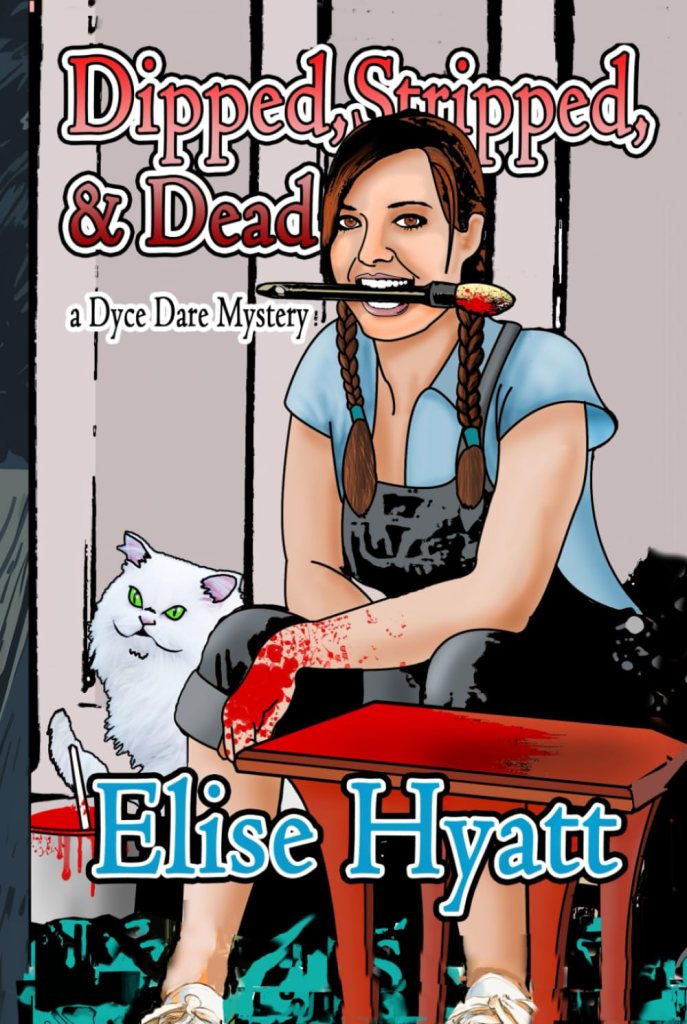
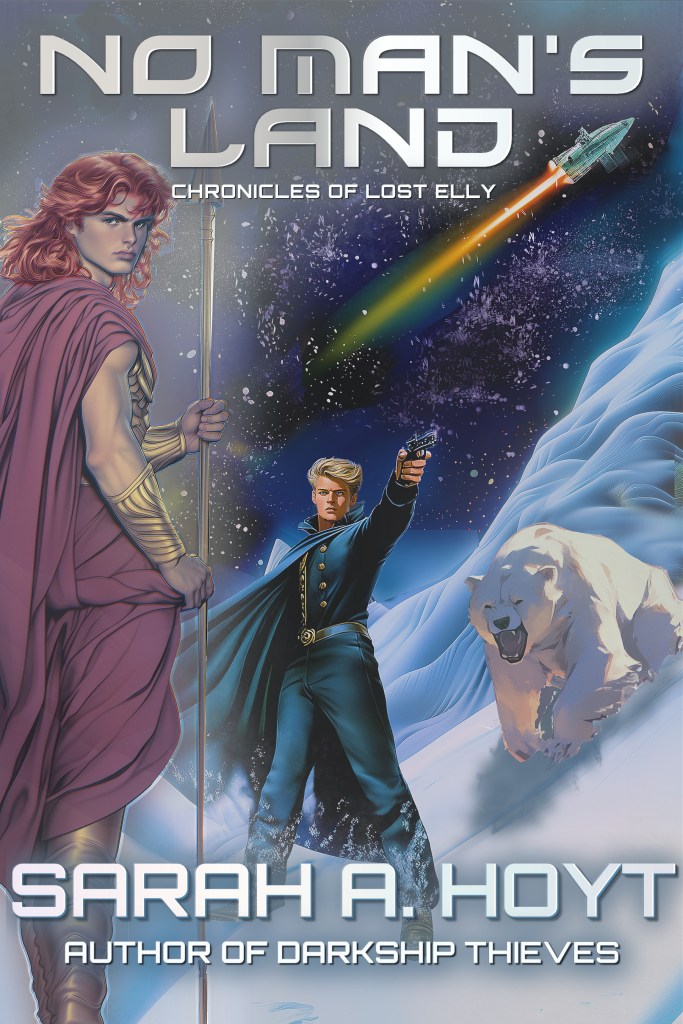
We have a new cover for No Man’s Land. I think this is the final one. And the book is inching to completion through the insanity my life has become. So, have a cover and a chapter.
Actually two chapters. This section could be called “when worlds collide.” When I’m writing I’m always writing towards the next inflection scene, and this one was the first big one in this book. I had it in my head, Skip dropping out the window, and things changing, but I didn’t know how I’d get there. Well, I did.
It’s Just A Step To The Left
Skip:
I knew the mission to Draksah had gone seriously wrong when I saw the slave.
One of those things written in unerasable letters on the walls of IDS buildings was Slave societies cannot join Free Humanity.
Now there was a ton of argument – as about everything else – about what “slave societies” meant, ranging from very subtle shadings on the power of a central state, to people who insisted ours was a slave society since we had a Queen and nobility of birth. It probably will surprise no one that this later didn’t gain much acceptance in Britannia or in the Star Empire itself.
Me? All those shadings were too subtle for me. Surely, I could see how a society with hereditary noblemen and a quiescent and obedient population would become a tyranny. Everyone could see. It had happened several times in the history of mankind. But it was not that clear cut. At our level, where the Queen and the nobility mostly existed to perform unenviable diplomatic and administrative tasks and – sometimes – to lead war, should it be needed, or have the power of ultimate decision in complex cases, I was fairly sure that royalty worked for freedom. On the other hand there was the Quan empire where eventually their sovereign and nobility would decide they no longer needed citizens of any kind.
Edge cases? Ask me. Show me the documentation. I’ll know it when I see it.
What wasn’t an edge case was a society with the existence of actual, for-real chattel slaves. As in people who had no right of self-determination at any level, and could be used and abused at will, and bought and sold as things.
The Star Empire would accept no slave societies.
Not because slavery was uniquely evil, but because slavery corrupted. Once the habit of thinking of some people as things set in, coming out the other side with a free society was difficult.
And yes, I’m aware every human society was a slave society at the onset. It was often a necessity in pre-industrial societies, simply because there are jobs so difficult and so stupidly bad for you that no free human would do them willingly. And I know that almost of all those societies eventually redeemed themselves, and came out as non slave societies. But on the way there lay the terrific wars of the 19th and 20th century, and some on the 21st too, and a couple of utterly destroyed cultures, and socio-psychologists see them as related.
Note that slavery reappeared in space for the same reason it first appeared on Earth: human workers were hard to find, and sometimes had to be forced to tasks that no one wanted to do but which were required. Also, it reappeared as an extreme form of integrating two warring societies, arguably towards the more viable. As in the loser was forced into the culture of the winner.
But that didn’t make it justifiable, nor did it make the infection benign.
The Star Empire – Britannia on High – would not accept societies where some portion of the population was kept as chattel. That was the beginning and the end of it. And though some cases might need to be brought to the attention of the socio-psychologists, the case in Draksah wasn’t one of those.
One entire section of our training – three months of it – was in identifying slaves when we saw them.
So, to recap for those not following along at home: my first assignment after graduation was to Draksah.
I was to be sent out alone. While it was unusual to be sent out alone on your first mission, it wasn’t unheard of. The team there before me – whose names I was never given – had prepared everything to admit Draksah, a level two monarchy – barely industrial, in early stage of individual rights assertion attempting to liberalize with mixed success – into the Star Empire.
The day after my graduation, I was sent a dossier, detailing several years of investigation and visits by envoys, depicting a monarchic society, fairly wealthy, which could be made modern with the use of our technology.
Look, from where I stand now? There were holes in that case history that could have hidden entire herds of elephants. Which at one time I thought is why they sent a newby, fresh off training. Of course, now—
Anyway, from where I stood the mission was a lot like Valhalla, only not as fun. Sure, Draksah didn’t have feigleire, but I went almost entirely vegetarian while there, because all the meat dishes were strange. Look, I didn’t think they were cannibals, but I still didn’t want to eat pork in a society I wasn’t sure of. And it was all pork.
However I didn’t go hungry. I was always dressing up in some very specific costume to go to banquets, or to watch some dance extravaganza.
I was told the culture was so old – ten thousand years or so since the lost ship – that there were no traces of earth customs or culture. Because lost colonies often lose tech and therefore culture. And some deliberately set out to forget Earth.
But the entire thing tasted middle eastern to me, with big men, of the kind that looked like they would as easily pull a knife on you as poison your drink, and women who were covered up all but the eyes or sometimes the face and who scurried out of sight when barely glimpsed: unless they were whores or dancers. I wasn’t sure there was a difference between whores and dancers, either.
Work got done around me, from food being served, to my room being cleaned, to clothing washed, refreshed and put away, but I never saw servants. Even the banquets had all the food laid out by the time we arrived. That should have tipped me off to something being off also, and the only excuse I have for not realizing earlier is that I was green as grass and twice as stupid.
So, I stumbled from banquet to party, and party to another banquet, and eventually stumbled into my bed. I had early on refused the girl in my bed, and then the boy in my bed. This was per protocol, but also because when I say the boy in my bed, I’m not using it in a colloquial sense, and I never had any interest in children. Also even had he been older, I couldn’t tell to what extent being in my bed was compelled, and I never had any interest in rape by any other name. And again, even had they been adults and willing, you don’t get horizontal with the natives. There were rules about getting horizontal with natives. They were complex, detailed and amounted to a big flashing sign saying “don’t.”
And then – when the official signing ceremony was supposed to happen that would bring Draksah into the Star Empire as a probationary member and let me go home – I forgot the documents for signing. It was a special paper, not only non-decaying but impregnated with something or other, likely nanites, same as the translator thingies that worked with my brain to make me understand any language. These were essential because they recorded the DNA of any person who touched the papers. Which was important for the obvious legal reasons.
So I forgot them in my room.
I know, that is a freshman blunder of the type not even I as a freshman should have been able to commit. Except of course I did.
It’s entirely possible that my father was right when he said sometimes we know things we don’t know, and that our subconscious causes accidents or forgetfulness in ways that are needed to save us, while our rational brain refuses to catch the signals.
Maybe it was that, or maybe I was sick and tired of Draksah, and of feeling like I was always watched, and always in peril and that there was stuff going on just beyond my sight, even though, rationally, that made no sense.
So, I forgot the documents, and I went to my room for them.
Honestly, I don’t know why they let me go unescorted, except that I turned around unexpectedly, then I got lost, and wandered off into something that might have been the women’s bathing room, and it’s probable whoever was watching me had some cultural taboo about entering that space.
I swore – in Valhallian, because it seemed appropriate – with “Thor’s rusty hammer” and turned and got out, by another door, though I didn’t realize that, until I noticed the corridor was not the overly ornate space I’d come to know, but a lot simpler: stucco over stone with some patches all but bare, and just worn stone underfoot. But I knew I was on the third floor, and my room was on the fourth, and I headed for the stairs.
And stopped.
Because I saw the slave. He was young, and for a moment, I thought he was a she, given the angelic, beardless face. But the body was all he, at least as much as was visible, between the slave collar and the linen kilt. And the legs below were male too, and the bare feet sure looked it, though both looked larger than I’d expect from a beardless youth.
I looked up from the feet to the face, the averted gaze, the lowered eyelids, the shaven head. I really didn’t need the tattoo on the chest, which my implants helpfully translated as “Property of the royal house of Draksah” to know I was looking at a slave.
And I lost my mind. I mean, I was outraged on so many levels, I could barely think.
I was outraged at the massive deception of myself and presumably the previous ambassadors. I was furious at the very idea they kept slaves. I was livid at the dehumanizing quality of the getup they forced the slaves to wear.
It was quite the most appalling thing I’d ever seen, and yes, I’m aware that I’d been shown films of the Daycean massacres and forced to play through some diplomatic disasters in which I and all my friends were virtually massacred. But this was different. I was not on a simulator. And also, this wasn’t—
They had lied. To the Star Empire. To envoys of the Empress.
I started to march down the hallway, and then it occurred to me I was here alone, and while I had weapons, they weren’t the kind that could take out an entire rogue planet. Not that I would know how to take out a whole planet.
I mean, if it came to that, I would try. I’d been trained by Dad. But…. Diplomatically speaking it was less than advisable. Who can you diplomat at, if they’re all dead?
I stood in that back-staircase, breathing in through my nose and out through my mouth. I wanted to grab the slave by the arm and drag him back to the banquet room, and denounce the entire travesty of a joke of an insult, of a—
I went so far as to grab the slave’s arm. He looked up, and for a moment there was something in his eyes, something deep and dark, a hint of rebellion, perhaps a warning. But my translator nanos didn’t translate eyes.
I started to pull him towards the dining hall. And then—
Look, there is a reason diplomatic delegations, at their most stripped down are at least two people. At worst, while one of them is discovering the slaves, the other can go and beam a signal to the Star Empire. A mayday. A sign that things have gone seriously sideways.
Because something was going seriously sideways. This was the sort of situation in which things went …. Violent and destructive. The type of situation where I might get sent back to my people in a box. A small box. Filled with ashes. Or maybe with a single ear in it, the rest being unfortunately lost in the fracas.
I backtracked. Still dragging the slave, mostly because, do you know how hard it is to let go of someone’s arm once you’ve grabbed it, and they’re letting you drag them? Okay, I don’t know, maybe the slave had become a sort of security blanket, in that I wasn’t in this thing all alone because there was another human being in here with me.
Though what I expected him to do was beyond me, except serve as a meat shield. Which would make me as complicit in slavery as anyone ever.
I dragged him all the way to my room. Because in my room was the last resort of a diplomat in need: the ripcord.
Okay, it was neither rip nor cord. What it actually was was a panic button. You pushed that button when your mission had gone so horribly wrong that the next step was the ear in a box, or the box of ashes, or whatever.
Yes, I should have had it with me. Same as the contract.
When you pull the ripcord, everything stops. Whatever process was underway, whether to admit the world to the empire or simply to negotiate a truce, it stops the moment the panic button is pressed. At the same time, the ships nearest the world start heading for it to extract the ambassador, or more often the ambassadorial team. Note that when things are that bad, they usually only retrieve the corpses. But all the same, the process must be followed.
So. I marched into my room….
Where there were three other slaves. Same shaved heads, same ridiculous getups, same words on the chest, same beardless, too-pretty faces. One of them looked like a Scandinavian blond, and the other two vaguely Mediterranean.
They were doing something near my bed, and looked up, in shock. I got the impression I’d interrupted them.
It didn’t matter. More slaves was just more evidence.
I let go of the arm of the one slave, who, strangely, got surrounded by the others, wordlessly.
And went for the button in my wardrobe.
I’d grabbed the box that contained it, and used my thumb to open it – it was coded to my genetics – when I caught movement by the corner of my eye and turned…
Three men stood in the doorway. I registered they were Draksalls, wearing Draksall clothing, but they had—
Blasters. They had blasters. They had Imperial armament. And they were pointing them at me. When had they got blasters? And how in hell had this gone so bizarrely wrong?
I did what came naturally. What had been trained into me in the academy, what had been part of me for so many years it might as well have been born with me.
I had forgotten the treaty. I’d forgotten the panic button. I’d forgotten just about everything, but would be more likely to go out stark naked in a place where nudity wasn’t accepted, than go out unarmed. And when I saw the eyes of the men pointing the weapons at me, I knew they meant to kill me. I got my burners from their hidden holsters and fired. I cut the first and the second, the third fired, and there was a cry of alarm, and a fourth fired too.
This is when everything got too confusing.
First, because my brain having decided I was going to die, I put my finger on that panic button and thereby invalidated the mission and called for help.
Second because two of the slaves grabbed me, one per arm. They were stronger than they seemed, or perhaps they simply caught me off balance as they rushed me to the window.
And out.
The window was on the fourth floor of the palace. As they jumped with me out the window – I registered a moment of surprise I hadn’t been simply defenestrated but that they were apparently committed to this as a suicide mission – I caught a glimpse of an ornamental brick patio underneath.
I remember thinking “Third floor so far so good”. And then the stone yard beneath my window, became verdant. Something father used to say probably from some stuffy old document and which he used when things changed drastically and unexpectedly, ran through my mind. “It’s just a jump to the right.”
And then I hit. But not the brick and not as hard as I should for the distance I fell. Oh, no. From the distance I should have fallen. I actually only fell about… six to eight feet.
I hit springy grass, at a moderate velocity. I remember thinking “Son of a bitch, there’s grass after death.”
And then I think I passed out.
The Green Hills Definitely Not of Earth
Skip:
I think I passed out, because I don’t remember losing consciousness, as such. It’s more as though my brain decided things were too silly and turned off momentarily, only to come back on, as I rolled to a sitting position on the green grass.
I became aware of myself while sitting on the grass, with four people surrounding me. They were– They didn’t look– No, one of them looked like one of the slaves, but his hair was long, and he was wearing something that covered his chest, so I couldn’t check for the slave tattoo. He was one of the shorter, darker ones.
He was not behaving like a slave at all, though, as he was arguing, in voluble gestures, and a language composed of gutturals with two other people: a huge blond man – okay, he also had a too-pretty face; I couldn’t tell if he had facial hair, but nothing approaching seven feet tall, with shoulders that gave you the impression half of him could do the work of a draft horse could be anything but male – in some kind of knee-length tunic with what looked like tights under it; and another, shorter, paler blond of more normal proportions, on whose sex I wasn’t going to pronounce, except that the not-endowed-with-breasts chest was muscular and looked masculine – look, I was confused – and who wore some kind of short tunic, pants and a blue cloak.
They were all screaming at each other like … Well, like my father’s family at the only family reunion I’d attended. And what a shock that had been for the little boy raised mostly in his mother’s bloodless domain.
My translator nanos were going berserk, probably because the volume and raspy tone of the language was confusing them. At least – I thought with alarm – if this language came from Earth. I mean, they looked human. But the language sounded like they were alternately growling and clearing their throats with some hard dentals in between for the fun of it.
You’d think, I thought, they were discussing whose cook was better than the other cook and—No. That was what my grandmother and aunt had argued about. I felt weirdly muzzy, like I had missed sleep? Or perhaps falling from a height had scrambled my brain? Or perhaps dying just wasn’t good for you.
The words that came at me were disjointed, and sounds were spit at me randomly. The nanos were catching occasional fragments they translated.
And none of them seemed to make sense. “Bring him back.” “Danger.” “Are you?” “Brotherhood.”
A soft touch on my arm and I turned and—
So, when I was fourteen, Father came and took me from the Academy at Christmas.
Oh, my parents weren’t the most horrible parents in the world. They allowed me holidays. The problem was me. I had decided to stay in the Academy for Christmas. I didn’t allow myself holidays, because I wanted to finish and be commissioned. Mostly because I hated the Academy, but I didn’t dare tell Father that.
And then Father had come and cajoled me out for a couple of days, during which he took me on trip of discovery of cultural institutions in New London, which for the season were putting on magnificent displays of the historical glories of old Earth.
We traipsed through a recreation of the Tuscany of the quattrocento and stopped to admire Leonardo DaVinci’s work, then Father took me to dinner, and after dinner he took me to—
Midsummer Night’s Dream. I’d read Shakespeare and watched him in recording and experienced him in mersi, but I’d never watched it performed by live actors.
Whoever staged that performance had made all the elves – except queen Titania, of course, though I suppose it would be play-period-accurate – boys on the edge of manhood. Well. About my age then.
And whoever did the makeup gave them a sort of unearthly beauty: eyes a little too large, features a little too soft, and hair in whatever color, styled in such a way that you imagined it just grew like that, and yet accented their faces perfectly.
I believe watching that play was when I figured out I had a problem, or at least that I wasn’t standard issue, and wouldn’t fall in love with some insipid Earl’s daughter and breed a passel of brats.
And at that moment, sitting on that post-mortem grass, confused and feeling slightly nauseated, I felt a touch on my arm, turned and—
It was one of those elves. I’d swear to it. Peaseblossom, with the green eyes, and the wavy butt-long red hair, unruly, some strands falling in front of his face, the rest in a sort of bramble-arrangement around his features. And though he looked concerned, he also still looked …. Well… not quite standard human. And breathtakingly beautiful.
He knelt, but in a way that made it look easy, and like it was a perfectly natural way to lower his height to mine. Like– Like you see among people whose culture doesn’t include chairs.
And he was looking at my arm as though there were something profoundly wrong.
I looked at my arm. And I passed out again, that time for real.
It couldn’t have been the sight of blood that covered what was left of it. In case it’s not obvious, I wasn’t in the habit of passing out at the sight of blood. It wasn’t even the realization that I was going to lose everything from slightly below the elbow down: there was nothing else to do when all that was holding half of my arm to the other half was a bit of charred bone.
I came to almost immediately, thinking that honestly that wasn’t even the problem. The problem is that I was in a primitive planet, that probably couldn’t get me home, and if too much time passed before regen, regen wouldn’t work.
“Fuck,” I said, as I woke up. And realized, with perfect timing that it had been said as a guttural two syllable sound which meant the nanos had found the way. And from the gasp from my right, I’d just committed a possibly unforgivable social solecism.
But on my left I felt a touch on my wrist. I looked. My arm and hand looked perfectly intact if perhaps a little pink. Had I dreamed my arm being burned? Peaseblossom’s green eyes looked full of concern, and he spoke, very slowly. He had a low voice, a well modulated bass that sounded out of place with his soft features. I had no idea what he was saying, but he sounded as though he was gentling a scared child.
I could practically feel the nanites running like crazy in my brain trying to make sense of the words. I can’t quite explain, but my brain seemed to be trying on linguistic matrixes for size. Finnish? Bantu? The Neu Deutshe of South Elburg? The weird amalgamation of languages of Hesperius en Haute?
No. No. Something synthetic and– It clicked suddenly. It clicked, with that weird feeling that I should have understood what I’d just heard. I knew from the simulator that this meant it had found the pattern.
“I’m sorry?” I said. “Come again?”
Peaseblossom made a sound somewhere between laugh and delight. “I said,” he said. “That your arm might still get an infection, but the healing should hold. Unless the infection is bad, you should be fine.”
I blinked. “Healing?”
The nano translation glitched. I swore he’d said “Magic.”
But I was sure he was crazy. Or I was crazy. Heck, I probably was crazy. “Ma-gi-c?” I said.
He smiled and nodded. “I am” – garbled – “brother of magicians, my power is third circle bend high power, so I can perform healing.”
I blinked again. “Peaseblossom?” I said. “I mean… elves and fairies? Magic? Where am I?”
He looked decidedly worried. He touched the side of my head with the tip of his fingers, and there was a strange sensation, like a static shock. He frowned.
“I think it’s a linguistic difficulty,” the short, dark one who had been – had been playing? – a slave said. “The star people have,” garbled. “In their heads, and it takes time to catch up with the language they’re hearing.”
“But—” Peaseblossom cut his eyes at me, sideways, like I was the strange one here, then back at his companion. “What can it have to do with blooming peas?”
The other shook his head. “The—” my translator scrambled. Spell? Setting? Program? “In their heads takes time to get the right words.”
I was both shocked and impressed that someone in what looked like a barbarian culture, at least from their attire, and the weapons I glimpsed – I’d caught sight of ankle-daggers on the shorter blond, the giant wore a sword and had a quiver of arrows and a bow slung over his shoulder, and I suspected the others had something along those lines – understood the process well enough.
So, I cleared my throat, and said, “I beg your pardon. Your…. Friend has the right of it. I don’t quite have the right words, and some of the translations seem impossible. Also I might have concussion from the fall.” Peaseblossom shook his head almost imperceptibly as if to deny it. I ignored it. Not getting in arguments with people who have full control of you, while you’re not quite yourself, is a good idea. Or at least diplomatic training said so. “But I have no idea where I am. I don’t think this is Draksah, and you are not speaking a language related to Draksall.”
Peaseblossom shook his head a little, then gave a feral grin. “Oh, there’s a lot of borrow words, including given names. A lot of the names. Though they have different meanings. Because the cultures have been at war so long, but no. We’re not Draksall. This is the world of Elly.” He looked at me, chin tilted up a little defiantly, as though he’d said something shocking and must spy my reaction to see if I would run screaming into the night.
Which I would, if I had any clue what that was supposed to mean. Elly. The word seemed familiar. There was some mention of it in literature about Draksah. Something about its being a mythical world, similar to the lost continent of Atlantis on Earth. A place that couldn’t exist, but which existed, nonetheless in legend and myth, and which kept rearing its fanciful head in the culture. There were references to it, as being a wild land inhabited by creatures not quite human. Wild creatures. I had caught a laughing reference to there being no men on Elly, too, in a conversation during one of the interminable banquets, before it was shut down.
But while my saviors – or captors, I wasn’t sure right then – were barbarians, they didn’t look particularly wild. And they certainly weren’t women.
Of course this was the moment at which my translator decided to take a cue from my thoughts and start glitching on the gender.
“I am—” Peaseblossom hesitated, then shrugged. “Brundar Mahar, third circle of the brotherhood of magicians.” I got the impression his introduction of himself had startled his companions. The giant made a sound like a groan, which combined annoyance and surprise. “And these are my—” parent/father/sire scrambled through my brain. Eerlen Troz, and my,” cousin/stepsister/stepbrother/half sister all scrambled in turn. “Lendir Almar. And this is Selbur Deharn, whom I believe you met in Draksah.”
“The slave!” I said. My brain was having real trouble, okay? And my mouth had mostly taken over. If this were a simulation, someone would have thrown something at me by now. “One of them.”
The slave-like-being’s lips twisted in amusement. “Mahar? I think it’s time we just tell him everything.”