Lies, Truth and Rats a blast from the past from August 2014

This post is late because I have an outdoor not-my-cat who loves me. He brought me something that squeaked for breakfast. He brought it back very fresh. In fact, he brought it back for me to kill. Fortunately I was in the kitchen and he was in the outdoor mudroom thing we call the airlock. I stood in the kitchen, listening to the squeak-thump and wondering if I should intervene, but the chances it was a bunny are minor. Sounded like a rat. And the chances of a desperate rat in the kitchen were really high.
Eventually Greebo (He’s just a big softy) grew disgusted with me and carried of his victim breakfast to enjoy elsewhere.
All of which has absolutely nothing to do with the post this morning. I mean, I could twist myself into pretzels and come up with something, but I’m not going to and instead I’m going to plunge head first into the post.
Imagine everything you’ve ever been told is a lie.
No, seriously. Close your eyes and picture it.
This kind of ah epistemological upheaval is very difficult. I’m telling you this as someone who found out about half of what she knew was a lie. What? Oh, little things – the first flight across the Atlantic was NOT as I’d been taught Sacadura and Cabral. “I regret I have only one life to give for my country” was not said by one of the assassins of Dona Inez de Castro before his execution, no matter how much my history book said so. (It might have been said by him TOO, but I suspect someone just thought it sounded good and stole it.) If you take more than an aspirin at one time, you won’t die. (I remember standing frozen in the kitchen when I’d complained to my host mother of a headache and she said “Just take a couple of aspirin, honey.” I thought “She’s trying to kill me!”) Other things that aren’t true that I “knew” were true: if you take a bath before it’s an hour after you last ate, you won’t die. Oh, and if you wash your hair every day it won’t fall off. Also, the entire street won’t turn and laugh at you if you go out in last year’s fashions. In fact, fashions are different in different countries. (And in the US, different parts of the country.) Things I found about the US, like for instance, it’s not all paved and built over, and Americans don’t ALL live in skyscrapers, was a different thing. You expect to find new things about a country when you go to a new country. You don’t expect to find out new things about how the world works.
Even the aspirin thing? Blew my mind. “Why did my mother tell me I would die if I wouldn’t?”
Of course, the answer is because someone told it to her. (Also mom hates meds. ALL meds. She wouldn’t even take vitamins, because she was sure it would kill her.)
I understand it was much more difficult for people like the inhabitants of the former soviet block to come out and find out that everything was the other way around. In fact, anyone who comes from a repressive and self-aggrandizing society gets a shock when coming to the greater world. For instance I’ve heard of Arabs stunned to find out they DIDN’T win the six day war.
So, why am I talking about this? We are not in a repressive society, or not that kind of repressive society. News leak in around the edges.
Except we sort of are. Our press is not in collusion because they think that the dictator will punish them (unless you mean not inviting them to parties.) But they are in collusion in order to be thought of as “beautiful people” and “good people” and smart.
And it’s amazing how much of that crap you end up buying. I mean, everyone behind the curtain knew their news lied. It was just the AMOUNT of the lies that was unbelievably large. They thought some things would be true. Same with people coming from Arab countries. I bet you if we kidnapped someone from North Korea and exposed him/her to the real world, they’d be shocked at how little their great leader occupies our consciousness day to day. Because that’s probably the part they believe. That he looms large in enmity or alliance in the west. In fact, I’ve read stories of transplanted Arabs and the part they didn’t anticipate was how little people in the west think about Islam and Muslims day to day. How their neighbors were neither resenting them, impressed nor spying on them due to their origin/religion. (Most of the time the neighbors think they’re South American :-P)
I don’t know how much we’d get “The truth” when transplanted to another country, but I’ve noticed that British newspapers (even sometimes the Guardian) sound terribly “right wing” to me. I know they’re not. It’s just compared to our press.
But American media looms so large in the world we tend to drag the rest of it at least partially with us into madness.
Still, I wonder what when we emerge from this mess – we will, though it will take a while and feel like we’re swallowing live frogs. (I’m almost sure Greebo didn’t bring me a frog.) – will be completely upside down from what we imagine.
This is relevant for what we talked about yesterday. Because I read a lot I knew of the horrors uncovered in communist countries after the fall. It shocked me – still does – that people not only still go around, proudly proclaiming themselves communists, but also that the schools are still teaching communism as the better/more moral alternative and always coming up with false equivalence soviet-style “we have homeless too.”
But what you have to remember is that MOST people didn’t sign up for the epistemological upheaval. And most humans are REALLY bad at that sort of thing. REALLY REALLY REALLY bad. As in, most can’t, not after adolescence. And some not then.
Even when I was an exchange student – a self selected group – I was one of the very few ones who socialized/had my best friends outside my linguistic group (British and Japanese, actually.) Most people would go to their linguistic group or the next one. Portuguese would preferentially associate with other Portuguese, then Brazilians, then Spanish, then Spanish colonies, and so on.
I mean, even while they were in the US. This is because that spare-time association allowed them to reaffirm at least some of their world view and to say “Americans think this, but—”
I chose to go off without this protection because I wanted to know what was true/true and what was agreed-upon true.
BUT I’m abnormal. I run towards that which scares me. (Not a survival skill.) [Okay, unless what scares me is the possibility of allowing a rat in the kitchen. And that’s not so much scares me as “ewwwww”]
For most people maintaining the imagined integrity of their world is worth being wrong. Even being wrong in significant ways.
Because of Soviet Agit Prop, the “communist” view was “popular” and “cool” in the west since the seventies and counterculture, at least. (It was popular in intellectual circles before that.) It’s probably hard for you young kids to picture, but even stalwarts on the right assumed that communism was somehow more “moral” even when it failed. They disapproved of their curtailing of freedoms, etc, but it was ASSUMED it would have better results than capitalism, if allowed to continue long enough. The right merely objected to the cost in human capital.
If this was true on the right, imagine on the left. Do you wonder that the journalists didn’t report the true horrors or reported them with exculpation. “If it weren’t for embargos against Cuba, it would be a paradise” is still believed. And as for Russia… Well, truth be told if we hadn’t sent them wheat they would have starved, but instead you’ll hear about how our insane capitalist arms race kept THEM poor.
But more importantly, once the exculpation and the nine days wonder was over, and the snide laments about the good guys losing, it was back to acting as though communism had never fallen. In fact, over time, that has mutated to a denial that all the times communism has been tried, it was in fact communism, and an insistence it’s “never been tried.” This is combined with eructation about Marx still being “right” – mostly they insist he’s right about things like literary criticism (and no, even there Marxism isn’t of any use. It’s like trying to measure elephants in light waves. It’s just that most people don’t care enough about these niches to go and show them they’re wrong, so they can protect their epistemological certainty wrapped around themselves like a blanket.)
This is typical of people under stress and whose world view is under attack to such an extent they can’t cope. They erase whatever challenged it and place it outside the discussion, and go back to repeating the cherished platitudes.
You can see the embryonic effect of this in a kid who has done something disastrous that threatens his view of himself. “I didn’t break the dish. Aliens flew through the window and broke it.” Is the first defense. The next is to pretend it never happened.
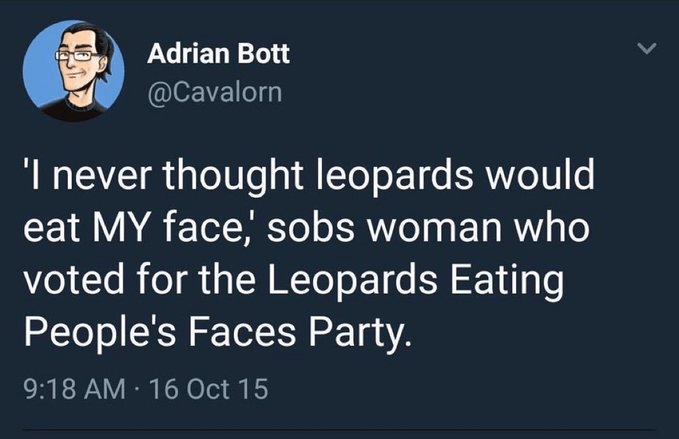
You can also see it in the white house, as our red-diaper baby president stumbles around breaking things, but can’t process it, because it would mean upending everything he’s been taught and his vision of him as “smart” for believing these things. He’s a normal human or possibly a normal incurious human. He didn’t sign up for this kind of upheaval. So he keeps stumbling around, pretending he didn’t do things, pretending things are different. Hence the insistence that removal of troops from Iraq was the former administration’s fault despite recordings of him bragging about doing it.
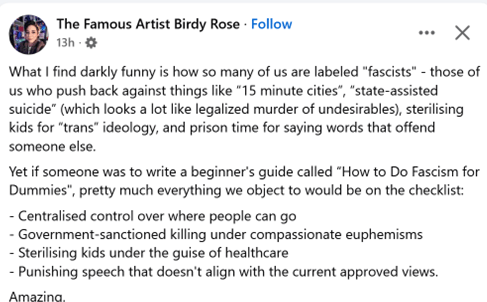
The problem is this: due to effects of a super-abundant society where people are not close to the bone – in fact are so far from the bone they haven’t seen bone in years – and the dominance of the press and academia by the far left, people’s view of reality is at least as skewed as that of people behind the iron curtain in the bad old days.
This corrupts everything, even those of us who are awake. What sounds right and plausible is twisted 25 degrees from reality. Western society is a giant bubble and a loud enough bubble that even people outside the bubble believe it. And a lot of the things propagated by the bubble are antithetical to the west and fossilized old communist propaganda, because the denial-reaction of our “elites” has enshrined that as “smart” and “cool.”
Will it take a crash to correct?
I don’t know. I think a crash might be inevitable, but whether it would correct it or not, I don’t know. The magnitude of the crash that would correct it scares the heck out of me and might not be possible, due to see how far from the bone we are.
I think what will correct over time is that technology is changing too fast for centralized anything. They’re losing the plot in each field it hits. And because of their mismanagement (Centralized is always more inefficient) the fields it’s hitting first are the ones they most control: media, entertainment, education.
We can hear that epistemological “reset” in the voices of the publishing industry’s execs as they say over and over again that their houses are better for authors because covers and editing and publicity, as though saying it made it true.
It’s possible things will right themselves as the generation that is most heartily promoting its epistemological error passes from this world. (Not long before I do, so I can’t verify that.) Kind of like the generation of the desert had to pass before the promised land could be entered.
Or it’s possible it will happen faster, as technology will change very fast. At least it seems to be on a track of not so much rapid change but “rapid change that makes a difference to normal human beings in every day life.”
It’s unlikely to stop.
And they simply can’t adapt.
This is going to make the times ahead as interesting as those thumps and squeaks from the mud room. (See, I told you I could tie it back!)
But we are at least semi-awake. So, whether we’re flexible or not (and a lot of us are, being Odd) the shock will be lesser to us.
In the end, we win they lose.