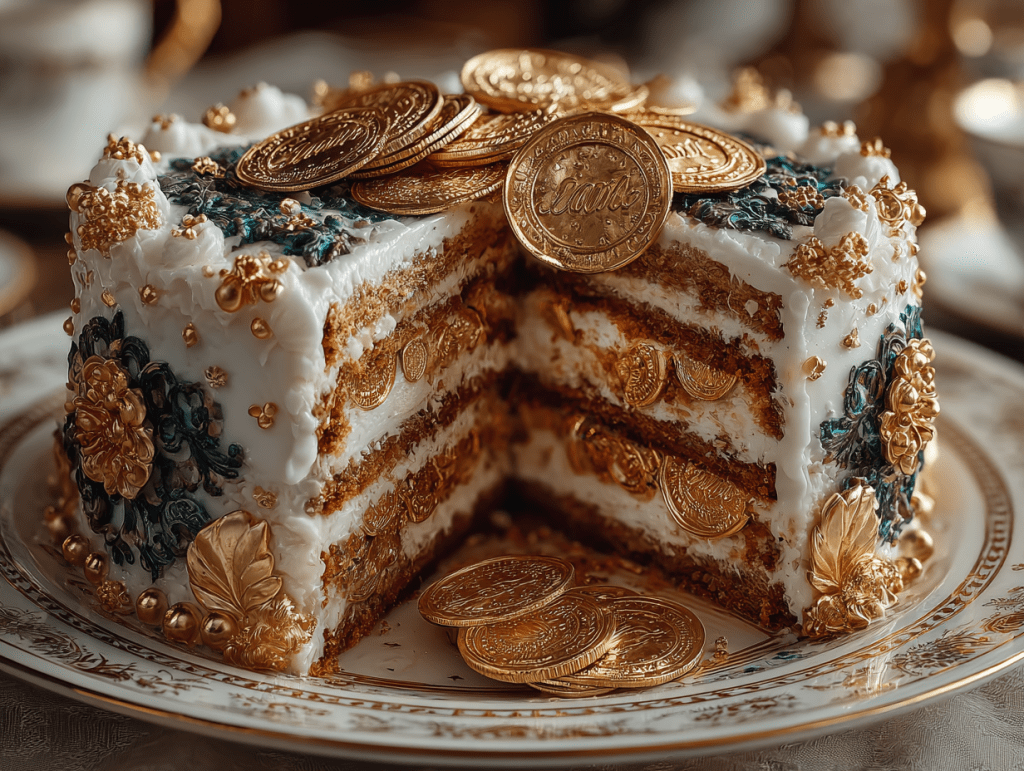
Something about Money (and cake) – Francis Turner – A blast from the past from December 2014
Money is one of those human inventions that is about as fundamental as the taming of fire. Every civilized society and many (possibly all) savage tribes of humans have some form of money. Societies that have attempted to do away with it have generally ended up both failing to and in the process killing people. Yet not many people understand money properly and, as a result, much suffering is brought into the world.
So what is money?
The glib answer from an economist’s text book is something like this:- money is a medium of exchange and a unit of account. Which is fine except that it’s got lots of words or more that one syllable and some of them have various meanings. So lets go back to basics (as the politician said to the archbishop).
The root idea of money is to store IOUs so that we can have distributed barter efficiently.
Without money, if Alice wants Bob to build her a table then she needs to have something that Bob wants in exchange. It could be that she offers to cook him four cakes. Which is fine if Bob likes cake. Alice and Bob have agreed that one table is worth four cakes and both are happy. Alice has her table and Bob has his cake.
Except that Bob doesn’t like cake but does like beer. But maybe he knows that his mate Charlie the brewer needs cakes so Bob swaps those four cakes for a keg of beer from Charlie. Charlie in turn feeds two of the cakes to his three children and offers the other two to Daphne in exchange for her cutting his hair and the hair of his cake-stuffed offspring. Daphne now has enough cake that she can stuff herself while watching some mindless romantic drama on TV. Everybody is happy (well apart from Bob because he’s got a hangover but he was happy earlier), and Alice has her table.
That second chain is where money steps in. It was only because Charlie heard Bob moaning about being offered payment in cake and then offering the swap that things worked out. Otherwise Alice would have had to offer something else to Bob or would have to have found Charlie directly and offered to trade beer for cake. And even then Daphne might have been left out except that she heard Charlie’s children griping about how they hated cake, particularly when they had to ingest it through greasy hair.
In an isolated small village (or tribe) it is possible to do this kind of barter chain with some success. It may take a while for Alice, Bob, Charlie and Daphne to figure out the relative value of cake, beer, tables and haircuts and who will do what in exchange for what, but it could be done in an afternoon in the village square. It would have been much more efficient if everyone sold things for some known unit of money (say a spondoolick). Alice sells her cakes at one spondoolick each, Bob sells tables for four spondoolicks, Charlie sells beer kegs for four spondoolicks and Daphne cuts hair for half a spondoolick a head. Now Alice simply goes to Bob and offers him 4 spondoolicks for a table. Bob takes the spondoolicks and hands them to Charlie for the beer. Charlie pays two spondoolicks to Daphne so that she cuts his hair and his children’s hair and buys two cakes from Alice for another two spondoolicks. Finally Daphne also buys two cakes from Alice for a spondoolick each and is much happier because her scissors aren’t all cakey.
Spondoolicks as a medium of exchange make things much better. Not only can we now have chains of transactions that also involve Edwin, Fiona, Gerald, Henrietta and Ian, it is quite possible for Fiona to be in the village on the other side of the hill and for Henrietta, Gerald and Ian to be in the local market town. So long as the two villages and the market town agree (more or less) on the value of a spondoolick Alice can sell her cakes in the market town on the table Bob built to Fiona and everyone is happy.
Trade occurs when the two villages and the market town disagree on the relative value of things as priced in spondoolicks. The only reason Alice takes a day to go to the market town and sell her cake is because in town she can sell them for 2 spondoolicks each, especially to idiots like Fiona who have more spondoolicks than sense. On the other hand Charlie used to hate the town because Edwin, the brewer there, sells his beer at a discount, especially if you buy 10 kegs at a time. But then he realized he could buy 10 kegs for 6 spondoolicks and sell them back in the village for a spondoolick each and even with the spondoolicks he had to pay Bob for loan of his cart he can sell beer at a profit and have more time with his children because he doesn’t need to actually brew beer any more. And next week he suggests to Alice that rather than she struggling to market with all her cakes and that stupid table, why doesn’t she just sell them to him for one and a half spondoolicks each and let him deal with the table and dogooders like Gerald who try to tell Fiona that two spondoolicks a cake is a rip off.
And this is where we get to the concept of the merchant and the idea of money as a store of value. The merchant (i.e. Charlie) acts as the middle man between people in Aliceham who need something (e.g. beer) and people in Brewersville who have too much of it. The merchant buys the excess of beer from Brewerville at a price which is lower than he can sell it at Aliceham and then in reverse takes all the extra cake from Aliceham and sells it in Brewersville.
Later, as the fame of Alice’s cakes spreads far and wide, Charlie and Ian from the land Faraway come to an agreement so that Ian buys most of the cakes from Charlie at a price of 20 spondoolicks per dozen and transports them to Faraway and sells them to would be gourmets at 10 bongoes a cake. He uses those bongoes to buy tools, spices and hops which he brings back to Brewersville market and sells to Charlie (who then resells the spices to Alice and the hammer to Bob) and Edwin the brewer and so on. As a result his initial outlay of 20 spondoolicks turns into 30 spondoolicks. Again he buys a dozen cakes but that leaves him with a profit of 10 spondoolicks which he leaves with Gerald so that next time he comes back to Brewersville he can buy two dozen cakes. Similarly when he gets back to Faraway he can save up his bongoes and buy even more spices, tools and so on.
Of course it isn’t totally clear what the exchange rate of bongoes to spondoolicks is. One way to look at it would be to use a cake-index and say that since Ian buys cakes for 1 ⅔ spondoolicks and sells them for 10 bongoes then the rate is 10 bongoes == 1 ⅔ spondoolicks (i.e. 1 spondoolick = 6 bongoes). But that ignores the fact that Ian makes a profit of 10 spondoolicks on his sale of Faraway goods in Brewersville. So perhaps a better way to get to the equal value thing would be to look at the price of hops (etc.) in Bongoes and Spondoolicks as well and then take the verage of the two. In fact probably 1 spondoolick is worth between 4 and 5 bongoes and taking a look at the retail price of cakes in both Brewersvile (2 spondoolicks each) and Faraway (10 bongoes each) 5 bongoes to 1 spondoolick sounds about right,
Of course when Daphne wants to travel to Faraway, Charlie, Ian or someone like them will charge her a commission on the trade so she only gets 4 bongoes per spondoolick and when Jessica comes to Brewersville from Faraway she finds that her bongoes are only worth 1/6 of a spondoolick when she tries to exchange them – unless of course she meets Daphne. And that of course is the point. A currency is worth what you are willing to exchange for it and the person on the other end of the deal has to agree.
We will note that in this example we haven’t yet said what a spondoolick is (or a bongo for that matter). It could be a lump of metal, seashells, leaves, pieces of paper with the words “! spondoolick” written on them or some electrons or magnets sitting in a computer somewhere. The critical thing is that we trust that a spondoolick today will be worth (more or less – famines and other major events excepted) the same tomorrow and next month. Related to that we have to be able to be sure that someone (e.g. Charlie) doesn’t produce a few extra spondoolicks now and again because his kids need a haircut and he doesn’t have any spare right now.
Historically lumps of gold and silver (and copper etc.) of known weight/purity have been a popular choice for what to make a currency from, but the temptation for someone to use slightly less precious metal than there should be (or even none at all) has also been popular. Similar issues have plagued every other way to keep track of currency though electrons (in the form of bitcoins) have generally proven to be less vulnerable although they have proven to be relatively easy to steal or lose. Either way one critical thing about money is that once we agree on what it is and what it is worth (more or less) a spondoolick from Alice is just as good to Daphne as one from Jessica, you can trust them equally and financially we don’t care about their past life (except for when it turns out the money is fake or substandard). Moreover paying with them is anonymous or can be. Apart from people seeing him sneak in the door, no one can tell that Charlie has a beer at Edwin’s place every market day. As long as he gets paid there’s no need for Edwin to care who it is he is serving and likewise no need for Charlie to care which pub he goes to in Brewersville because only one will accept his spondoolicks.
Something else we haven’t mentioned yet is “Government”. While, historically, governments have generally had a big say in money that is mostly because governments are what we trust to stop the Bobs of the world from getting away with counterfeiting money – both by setting standards for what money is and by punishing the fakers when caught. Although of course governments have also historically done an absolutely bang up job in debasing currencies themselves and a cynic might say that the reason why governments go after private counterfeiters and the like is that they hate competition. Governments are not required to do the whole thing for money to work. A number of countries (e.g. Hong Kong and Scotland) allow banks to print banknotes themselves and while this can cause problems when the bank gets in trouble or when someone tries to use, say, a Scottish banknote to buy a round of beers in London (though it probably works in Carlisle or Newcastle), it is generally not a major issue. Indeed when you consider the use of US dollars in countries like Iran or Zimbabwe, sometimes the fact that the local government has nothing to do with the currency is a major plus.
The key thing about money is that it only works when there is trust. When trading both parties to a transaction have to agree than the monetary object in question is genuine and worth an agreed amount of stuff. Similarly when storing money somewhere the person storing the money has to trust that the place he is storing it is safe and will give it back to him when he needs it. When we all stick our money in a bank and then, later, decide we don’t trust the bank that produces a bank run and it gets nasty when (as is often the case) the general lack of trust in the bank turns out to be well founded. Stopping bank runs from turning nasty is, actually, one of the things that we probably do need government for. The bank runs in the bitcoin world have been pretty catastrophic.
Mention of banks leads us to the concept of loans and interest. Again this isn’t anything complex. Alice cooks Katherine a cake today because she happens to have all the ingredients and a week from now Katherine cooks one for Alice. Effectively Alice loaned a cake to Katherine for a week. Assuming the cakes were the same then there was no interest on the deal. If Katherine’s cake was bigger than Alice’s then difference in size is interest on the loan (if it was smaller then the interest was negative and Alice makes a note to never bake a cake for Katherine ever again). Interest is a way of measuring the different value of money over time. Katherine really needed a cake today but didn’t have any flour. Next Sunday she’ll have loads of flour so she can bake a bigger cake for Alice than the one Alice cooked for her.
We can extend the example further – say Alice cooks a big cake for Katherine and in return Katherine gives Alice a sticky bun every day for a week. If 6 sticky buns used the same ingredients as a cake then that 7th sticky bun is Alice’s interest and the profit on the deal. If Alice did this a lot then (apart from becoming overweight and sick of sticky buns) she’d get called a loan shark or worse because 1 cake in 6 is 16.7% and 16.7% interest for a week works out at something like 6000% on an annual basis. Of course if she got paid one bun a month it would still be steep but much more reasonable (~30% annual rate).
Now lets assume lots of people deposit excess cakes with Alice and agree that they’ll take back either sticky buns or cakes when they feel a touch peckish. If Alice now had 30 cakes which she loaned out to Katherine and 29 other people, she’d get just a single sticky bun every day but in 7 months she’d have a 5 extra cakes (or cake equivalents – remember 1 cake = 6 buns and 30 loans of a cake for 7 buns gives you 30 extra buns). Nice work if you can get it especially if the other cakeowners who gave Alice their cake only ever want a sticky bun at a time and no more than one of them wants a bun each day. It goes a bit wrong however if one of the other cakeowners (Louise) shows up with no warning on Saturday a month down the road and demands her entire cake back now because it’s her child’s birthday party. Unless Alice has a spare cake (or can make one quickly) she can’t pay Louise back as she promised which will make her very unhappy – and of course she’ll tell the mothers of the other 5 kids who were invited to her birthday party and they’ll start wondering what happened to their cakes and on Monday Alice will have demands for 5 more cakes which she won’t have either and that news will spread and so on. That is what we call a bank run and it probably results Alice getting a load of sticky buns in places she won’t enjoy.
Now Alice could avoid this situation by not loaning out all the cakes she got (perhaps she gets 40 cakes but only loans out 30) or by writing a contract that says that you can’t get your cake for 6 months or that you have to wait 6 days after you request a cake for it to be provided to you or some combination. For example Alice might say that if you want your cake back now you get nothing, but if you leave it with her for a year you get a cake and a sticky bun. In other words Alice is paying you interest for leaving the cake with her for a fixed period of time and she might make a rule that you can only withdraw one bun a day unless you give prior notice. With these sorts of rules and with 10 spare cakes sitting in her freezer Alice can be confident that Louise will be satisfied when she wants her cake back. Alice will get a decent surplus of sticky buns even assuming that some people decide that they’d rather have a cake and a sticky bun next year than just a cake today.
But it also assumes that all the 30 people Alice loans cakes to give her a bun a month. If Maria doesn’t pay after 3 months and Nina doesn’t pay at all then Alice is out a cake and a half. If that’s all it’s not too serious. The other 28 people will pay their full amounts so instead of ending up with a surplus of 30 sticky buns Alice ends up with 19 (7 lost from Nina + 4 from Maria). But if she gets it wrong and another three are like Nina then that 19 bun profit will turn into a loss of 2 buns.
Of course Alice could solve this by paying Bob a couple of sticky buns to go around to Maria and Nina and stand over them menacingly while they cook their buns (a 2 bun loss is far less bad than an 11 bun loss) and if Bob does it right to Nina when she hasn’t paid for 2 months then maybe Maria hears about how nasty it all was and manages to pay off her loan even though she really wanted those sticky buns herself. Either way Nina and, possibly, Maria now have a terrible credit rating – no one will lend them a cake again unless they show they really have turned over a new leaf and they probably have to pay 8 sticky buns back instead of 7 to cover the risk that they don’t pay back any sticky buns unless (or even if) Bob goes around and (threatens to) beat them up..
Right now we know what money is, how it works, how loans and interest work and things like that. This is all a basis for what we need in a possible new currency. Our new currency needs to be trusted, consistent in value, storable and able to be used anonymously. Sounds easy….
—
Notes: Richard Tol in http://www.the-american-interest.com/2014/12/10/hot-stuff-cold-logic/
In a barter economy, one needs to know the price of everything relative to everything else. How many eggs for a liter of milk? How many slices of bread for a liter of beer? How many iPads for a yacht? In a monetary economy, however, one needs to know the price of everything in money only. In a barter economy, there are n2-2n prices (with n being the number of goods and services for sale). In a monetary economy, there are only n prices. That is why, at some time in the deep past, many human civilizations of diverse origins independently invented money.
 According To Hoyt
A further note on the spread of money usage (this was a somewhat later development).
In the manorial system a lot of tenants had agreements with the lord to supply various things as rent. These things were ones that they made or grew, e.g. so much wheat etc.
But the lord’s business was war. War meant obtaining lots of useful things in the correct proportions. It wasn’t useful if you were swimming in wheat but had no arrows.
So they wanted money, which was useful for obtaining stuff that wasn’t made locally. To the point where the exchange rate was depressed.
Supposedly this is where “blackmail” came from. As opposed to “white mail” meaning silver coins, “black mail” meaning goods. The goods were discounted and the money valued more because it was more wanted.
I suspect the “rent in kind” was mostly used even further back, e.g. the Roman estates. But it was more prevalent after the collapse in the west because the coins moved away or got buried (another reason for precious metals as a storage of value, it doesn’t rot if you’re even a little bit careful when you bury it).
LikeLiked by 1 person
c4c
LikeLike
The ghost of Adam Smith is smiling.
LikeLiked by 1 person
Money is a symbol of value which has little or no intrinsic value. Even gold and gems are not of much practical use, aside from our monkey fascination with shiny things. As one of my characters puts it: “What could you actually do with a flawless fifty-pound diamond? Besides lock it up in a vault and spend a fortune guarding it?”
LikeLiked by 1 person
Charge admission? And license it’s image to be used in movies and such.
LikeLiked by 2 people
Weellll, the precious metals are pretty important to some industrial enterprises, and electronics.
LikeLiked by 1 person
Nowadays, yes. But at the time, only copper had a practical use. Gold and silver were purely used for decorative purposes.
LikeLike
Gold is easy to work and non-reactive. It has all sorts of uses.
Silver can be reactive, but its chemistry is easily found and understood. Easily worked into useful things.
Their relative scarcity made them “precious. Then again, bronze (tin+copper) was very, very, very valuable. Until we figured out Iron. (it is till expensive to amke and work. its relative brass not so much). And good steel was semi-precious until Mister Carnegie figured out how to make it super cheap.
Platinum is another very useful thing. Scarcity makes it too expensive for some things. it does a fairly dandy job de-smogging internal combustion engines catalytically, which is super cool. (well, burning hot cool anyway)
Uranium, once you strip out the fizzy bits, is also quite a useful thing.
Hm. U238 coins…. hmmmm With a tiger on the face = DUcats!
LikeLiked by 5 people
Remember, when the Washington Monument was built, it was capped with Aluminum because that was a ‘precious metal’ at the time. It was a few years later that two inventors, almost simultaniously invented a new way to make aluminum metal that caused it’s price to plummet and become the common metal we use everywhere today.
LikeLiked by 1 person
Napoleon had aluminum plates, bowls, cups and tableware made for his really important guests. Lesser personages had to make do with mere gold and silver. 😁
LikeLiked by 2 people
Remember, when the Washington Monument was built, it was capped with Aluminum because that was a ‘precious metal’ at the time. It was a few years later that two inventors, almost simultaniously invented a new way to make aluminum metal that caused it’s price to plummet and become the common metal we use everywhere today.
LikeLike
For jewelry, sure. But given that coins have been around for at least roughly 2600 years, what other uses did gold have up until recently?
LikeLiked by 1 person
He listed off the things that it is useful for.
It’s not common enough to be commonly used for it, but anything you want to last is a pretty big chunk of ‘use’.
Being precious shifted it over to “things you want to last, and show how rich you are.”
LikeLike
But again, the things people could do with it 1000 years ago were *cosmetic*. i.e. making things that look nice (jewelry, gilt, etc…). The rarity boosted that, sure, but it was only really in the last century that we found practical uses that were non-cosmetic.
LikeLike
No, we did not just figure out in the last century or so that if you didn’t want something to deteriorate, you could use gold.
There have literally been gold and silver eating and drinking vessels going back over five thousand years.
https://www.smithsonianmag.com/smart-news/archaelogists-find-ancient-drinking-straws-used-to-drink-beer-180979433/
It simply wasn’t common enough for the known and valued use to be practical for wide-spread use.
LikeLike
Gold and silver table utensils for the rich. I say they were as much about ostentation as utility — much like jewelry. Pewter utensils last just as long, but they’re not shiny and expensive.
LikeLike
they say that the Russian aristos never ate a hot meal because gold is a very poor choice for plates.
LikeLiked by 1 person
1) Go read what the discussion actually involved. You’re answering an argument which was not made.
2) No, stuff where the modern selling point is “doesn’t contain medically significant amounts of lead anymore!” is not just as good.
LikeLike
Drinking vessels have been made out of lots of things over the centuries. Wood, fired clay, glass, etc…
Aside from its scarcity, gold has two problems. First, it’s heavy, which is at minimum usually a nuisance. Second, it’s soft, which means that it’s less able to stand up to the rigors of everyday use. Both of these issues mean that it’s not one of the better choices for items meant to be used every day. It’s good for ornamentation (as noted above, it’s easy to work with). It’s good for decorative stuff that isn’t meant to be moved about or handled. It looks pretty (with limits), and I think that would be the case even if we weren’t conditioned by its scarcity to view it as a valuable commodity. As such, it has value as a luxury item above and beyond the “it’s rare, so it’s valuable” part.
But for everyday items, there are likely materials that are much better suited to resist the daily wear and tear that anything used frequently is put through.
LikeLike
Thank you for finally admitting that yes, they do have practical uses, even if it’s the backwards way around of saying that there are cases where something else works better than solid gold or solid silver.
LikeLike
Are we reading the same posts?
I didn’t say “some”. I said pretty much *all* instances that don’t involve “looking nice” (i.e. a form of luxury) have better alternatives than gold.
And that’s been my point from the start.
LikeLike
I cannot read what you meant to say.
I can only look at what you did in fact say.
In the face of it being repeatedly explained that they were useful, and why those uses were useful, and even examples of it being used which predate coins.
LikeLike
My single biggest gripe with “The Murderbot Diaries,” which I mostly enjoyed, was the issue of money or lack thereof. The Corporation Rim (EVIL!) is capitalist. Uses money. The Preservation colonists (good guys) don’t. The author Martha Wells states at times that items such as food are free for the taking on Preservation… at others she states that there is some complex form of trade in the form of work credits that the locals use to obtain what they need, while at the same time somehow scraping up cash for trade with the Corporation Rim. Also, Murderbot as the main character never seems to be short of cash cards.
Basically, it’s a particularly horse manure-like form of handwavium. The books manage to get away with this because their genre is really action-thriller, set in a scifi universe, and economic theory is very much an afterthought. Nevertheless, I found it really annoying. The good guys wouldn’t have been any less good if their economy ran on money.
Ah. Better now. Thank you for indulging my rant.
LikeLiked by 3 people
Authorial ignorance of economics has ruined more SF for me than just about anything else.
LikeLiked by 2 people
I’ll remember to throw my totally-not-the-Federation characters at you to read over.
See, their every need and reasonable desire is filled.
And those who choose to leave can.
…. did you just feel that ‘need, and reasonable, judged by whom?’ and wonder ‘leave with what resources?’
Trying to make the Star Trek federation work as shown goes really dark places.
LikeLiked by 3 people
*Thumbs up*
LikeLike
“work credits”
aka “money”, usually of the company store variety…
LikeLiked by 3 people
Trade in the form of work is money. CLassical money really doesn’t exist anymore anyway. It’s all credit. Literally, we believe it’s valuable, so it is. Economics would be so much better if they simply abandoned the notion of “value.” THe Austrians have come closest, but even they still hold on to it,
LikeLiked by 1 person
Yes, but ascribing evil to the society that has money is still mental.
LikeLiked by 2 people
agreed, but both sides have money one is honest about it the other not. It’s all so tiresome. One of my basic beliefs is that people have a moral responsibility to find out what is to the best of their ability.
LikeLiked by 1 person
Yes. It IS all so tiresome. More and more so today.
LikeLike
I think it would be less annoying for me to write about space cannons that shoot out laser balls in clouds of colorful smoke.
LikeLiked by 1 person
Try the “respect” based economy of “Voyage from Yesteryear” by James P Hogan.
Whole lotta handwavium there.
LikeLiked by 1 person
The authoriteh based economy will be like social credit scores, but strident and demanding, and obviously fake.
LikeLiked by 2 people
Yes that sort of thing has annoyed me many times. Not as bad as when the author sticks in a diatribe about a current politician (usually a republican US president), but yeah it irritates
LikeLiked by 1 person
When a Japanese or Korean man is in another world with elves, I generally do not want to hear a tirade about someone who is a contemporary of the author, and that the author is more familiar with, and interested in, than the character.
But, it might come back around to hilarious if a British author from the 2010s were to write a Japanese highschooler ranting and raving about ‘carpet baggers’ and ‘scalawags’ in the politics of, say, 1880s northeast Alabama.
LikeLiked by 4 people
The whole point of using a medium which doesn’t require second party verification, and that is homogeneous, is that it’s defacto portable and thus can be used wherever someone is willing to exchange for it. Non homogeneous items such as paintings, jewels, sea shells are severely limited in utility. One other thing, the medium should remain virtually invariant in quality over time. This is in part why the noble metals are used. Scarcity also plays a role, thus the attempt of crypto currencies to use computational difficulty to limit the quantity.
I’ve got a great pair of noids and as a result refuse to depend on anything which depends on a functional internet. Right now people in Iran who have bitcoins have zero chance of accessing them. Barring a forbidden satellite link.
During WW2 and for a while after, cigarettes were currency. When the Germans eliminated the black market laws and created the Deutschmark, the economy exploded. This shows that just any medium of exchange isn’t enough, it has to have an intrinsic demand. The demand is what creates value. Gold is worthless to someone dehydrated in the desert, but potable water a totally different story.
LikeLike
The typical demand for fiat currency is that you can use it to pay your taxes. And once you nail that down, it takes something special to encourage average people to quest for an alternative.
Sidenote: an ‘exploding’ economy can be a good or a bad thing; ‘rapidly expanding’ is usually good, but ‘blown to flinders’ is usually bad.
LikeLiked by 1 person
This.
One thing I occasionally point out to people is that no matter how bad the US currency might get in the future, it will always have value so long as the Constitution still stipulates that you can use it to pay anything that you owe the government.
LikeLiked by 3 people
So the higher the taxes the more valuable the money? This does not strike me as a good thing.
LikeLike
That’s like arguing that inflation is good.
LikeLiked by 1 person
I can see an argument for some inflation being better than none or deflation. Nebulous thought goes like this:
Wealth is created by innovation and perspiration (new ideas and hard work). As we get more, newer, and better things wealth in the form of money needs to be there to support economic growth (everything from startups to mom’n’pop shops to radically innovative directions like amazon when it was a baby selling books).
Stagnant or decreasing money supply makes taking risks more impactful. Decreased loan supply or something. Means less entrepreneurs. Slight increase in money supply means, optimistically, growth.
Counter arguments exist, like wealth getting vacuumed up by zombie bureaucracy, special interest hidey holes, graft, and corruption. Amongst many, many other things.
So yeah, I can see a theoretical argument for it. BGE would be the better man to delineate what’s going on with the money supply. Or somebody with more than a passing interest in economic theory, like myself.
LikeLiked by 1 person
My feeling is that you have a cause and an effect reversed.
The numbers are an abstraction. They don’t change to allow an improvement.
Reality changes first, then there is a secondary reality that includes human psychology. That psychological state may or may not be related to stuff we can try to quantify.
I want to joke ‘see, all very simple and straightforward’.
However, paragraph three just came to me today, and I’m unsure if what I can map it to is something I can really be convinced by.
The one related experiment that I am very sure of is that if there is no humans existing, no human transactions, then we can basically say that currency, money, and wealth do not exist.
I go from there to building economics as the caloric world, and whatever else people want. (I’m somewhat persuaded of Ian’s implication that in a world of immortal humans who do not need to eat, but still linear time, there would still be an economy in having to choose how to order tasks. But I do not have that really robustly integrated into my understanding yet.)
The key next point, I am at a loss to explain. My next analogy was too weird, and it took some of my remaining oomph with it. I think the closest statement available to me might be ‘economics is really funky, because we think we can have mathematical models, but some of the best reality tests imply those are unusually funky mathematics, with numbers that maybe sometimes do not exist, or maybe never really existed, and we cannot tell.’
Apologies, but I have an early morning, and I need to be careful with my investment tonight.
LikeLiked by 1 person
The problem with mathematical models of economics is that they can’t account for psychology and irrational behavior.
LikeLiked by 1 person
In this case, I had an irrational certainty that I knew something. XD
I think that this method I had of trying to slice graduations of reality could potentially not be nonsense, but if so it can cut against me at least as much as it can cut against someone else’s positions.
‘come back when I have more writing time, and brains’ ideas can still also be useful ideas.
LikeLike
Yes. My understanding is that monetary policy generally holds that a small amount of inflation is good, as it justifies interest rates, which encourage loans, which allow for investment. Though I don’t pretend to know much more than that.
But I think we can all agree that anything more than that is generally bad.
And in any case, the inflation comment is a response to the guy above claiming that the ability to always pay your taxes in US dollars somehow means that paying higher taxes makes your dollars more valuable.
LikeLiked by 2 people
No, if you have to pay more dollars in taxes that means the dollars are worth less.
———————————
Governments can print money, but they can’t make it worth anything. They CAN make it worth nothing.
LikeLiked by 1 person
Happily, as we know, the explosion was the “German Economic Miracle.”. Fiat money is “only” 113 years old in the US, prior to 1913 many banks issued their own currency. Goldbacks from Minnesota traded as currency in South American countries. The book below is available as a pdf from the Mises Non-profit bookstore at the Mises Institute. It’s full of fascinating information about money over thousands of years.
Money And Man
A Survey of
Monetary Experience
By Elgin Gmseclose
LikeLike
#%*£?|# Autocorrect!
Elgin Groseclose.
The biggest problem with econometrics is that there are no equations in Human Action. You either want A more than you wish to hold B or you don’t. The former means a transaction will occur, the latter it won’t. It’s simple. It explains how substitutions work and why. It even explains why if you prefer apple pie to cherry pie, when offered coconut cream pie as an additional choice you might pick that.
LikeLike
When considering money as a means of exchange and a storehouse of value, we must remember that money is, in the end, a surrogate for the exchange value of goods and services available.
If the amount of specie is fixed and the production of the economy/society increases, the same amount of money represents more value. Thus prices must drop and people who hold money maintain the same share of an expanding economy, making them wealthier in real terms simply because all money has become more valuable. Newcomers must share the remainder of the fixed supply of money.
Such an arrangement plays right into the propaganda of the anti-capitalist.
We can see the effect in bitcoin. As the number of unmined coins shrinks, the value of all coins increases.
In Alma Boykin’s Merchant novels, which are based on historical practice, cities issue trade tokens, which are accepted as money in the city market. Prices in trade tokens are often discounted from prices in coin, since coin only comes from outside, and must go back outside in taxes.
In the end, matching the money in circulation to the value in the marketplace (yes, value depends on the needs and desires of buyers and sellers!) may require some form of fiat currency. Yet fiat currency is an engraved, gilt-edged invitation to corruption.
But remember that any coinage may be debased. Fiat currencies only make it (much) easier. The person who finds a true solution will either be lionized as humanity’s (second) savior or quietly murdered and unpersoned by political and economic interests.
LikeLike
There’s a way to do a cryptocurrency with physical coins, build the circuits into the coins.
If you make the coins with the right materials, I don’t know why it can’t be quantum, if store the coins in a helium cooled wallet.
Things I also don’t know: If there is any way for the mathematics to work out, and not be nonsense. If radioactive materials incorporated into the coins could add some sort of real use. If radioactive materials would kill the thing quickly. If one could make dangerously radioactive coins that still function in some sort of electronic way.
It is a joke, and clearly a joke, but I think I could have gotten start up funding when I first proposed it.
LikeLike
Just don’t collect a critical mass of those coins in one place… 😧
LikeLike
Of related interest: cheese banks
Hat tip to Caroline Furlong’s Song of Joy blog IIRC. If not: still a good blog.
LikeLike
BTW I posted this at my own substack too
https://ombreolivier.substack.com/p/ath-repost-something-about-money?r=7yrqz
Feel free to comment there too…
LikeLike
The reason they handwave past this kind of thing is because in practice this invariably involves an overseer standing over people while holding a whip, or (in more recent times) a commissar standing over them while holding a pistol.
LikeLiked by 1 person
This. All of this.
LikeLike
There’s various fantasy things you can do to ease your issues.
https://writingandreflections.substack.com/p/funny-fantasy-money
LikeLike