
We all know that Hollywood is out of ideas. I have theories about why this is — having to do with running off everyone who wouldn’t mouth the platitudes — but there is a more fundamental cause: when an industry is in a tail spin due to whatever reason, it becomes more and more risk averse. It’s a sort of mental trap: they want to make it big, but of course, they want to make it big with tame stuff that won’t startle or upset anyone.
In the case of Hollywood and traditional publishing — which are in distress due to technological innovation hitting too fast to be responded to by normal mechanisms — there is another layer to this issue, though, in that what they interpret as “won’t upset anyone” is what wouldn’t have upset their college professors or/and what won’t upset the super-loud segment of the internet population. This usually agrees with their own biases (they had the same college professors!) so it gets lots of attention (why we have sensitivity readers in the big houses) even though it has become clear that no, this segment of the population doesn’t buy the product at all. Or if they do there’s really a lot fewer of them than even I think. Because they are utterly incapable of making a project that follows their directives successful. They are also, to be fair, incapable of sinking a project. However, again the problem is that because their biases agree with the loudmouths, the people in charge of Hollywood and trad pub will listen to them every time.
However, Hollywood — and probably trad pub to be fair — think there is a way out of this trap: make a traditional story that everyone knows, but reverse the heroes and villains, and make the newly heroified villains some kind of oppressed class (at least oppressed in Hollywood’s and trad pub’s minds): independent women; people who tan; gay people; trans people.
The right tends to assume the left tries to push gay and trans onto properties to “corrupt” the young. This might be true for some of them, who more or less announced it, but for a lot of them it’s simply the only way they can figure out to be allowed to tell a traditional story that would otherwise upset the gatekeepers: make the character gay or trans, and you can get away with traditional heroics and a pallet of good and evil.
If you don’t do that, the publisher/producer wants it new and fresh, which mostly means “reverse everything.”
I have to tell you that I’ve now watched a few of the reversed fairytales (in the sense that I watch anything — Dan is watching, and I’m sitting next to him, usually working on the latest story or the blog or something –) and none of them hold a candle to richness and complexity of the original. All of them have to rely heavily on some kind of group victimhood to effect the “reversal” and that usually makes them fall into the blah dross of group virtue and group evil. Which is not emotionally satisfying enough to support the catharsis that is inherently part of a good story. In fact, they all devolve into a sort of preachy blah that just puts people to sleep. In the publishers’ and producers’ minds the movie/book is stunning-brave, but all people see is platitudes they’ve been told a thousand times.
In fact, these days the “oppressed independent woman” is a trope that I was taught in elementary school in Portugal in the sixties. Now in Portugal it had some teeth, because women are in fact (still, though not economically or professionally) culturally oppressed (they’re supposed to be great career women, yes, and great wives and mothers, BUT they’re also supposed to have feminine accomplishments, and keep an immaculate house and defer to the males in the family.) Even there, that’s less and less with every successive generation. Meanwhile the US is arguably the only matriarchy where women clamor for rights and consider themselves oppressed.
No one looks down on independent and smart women. No one. They might excite envy and backlash, particularly if they have no social skills. However, the backlash they court comes equally from male and female and is more a matter of feeling threatened by ANYONE who is smart and independent. Men get hit with exactly the same level of backlash and envy.
And the whole “Everything that goes wrong in your life is the patriarchy” has been preached for at least three generations now, and probably four. So when we come across a book that preaches the same thing…. well…. it doesn’t light up the different and interesting reactions in the normal brain.
The same to a large extent goes for people who tan or have different habits. America was never very good at discrimination on that basis, really, except in pockets, and even there it had begs (All x people are terrible, but not OUR x people.) And whatever there was left has been preached against for the last three generations and probably more. Which means coming across it in your fiction is yawn inducing.
What makes it worse is that every time I accidentally download one of these books, or find myself stuck in front of one of these movies, it’s always presented as “AH! THIS IS GOING TO BLOW YOUR MIND.” As in, it’s the reveal that they work up to throughout the book. Or the movie. You see it coming a mile away, and you go “Surely they’re not doing that. That would be stupid.” And then they do the stupid. Yep.
Look, I don’t have to watch the thing in the image here, to know that the step sisters probably have some disability or are misunderstood.
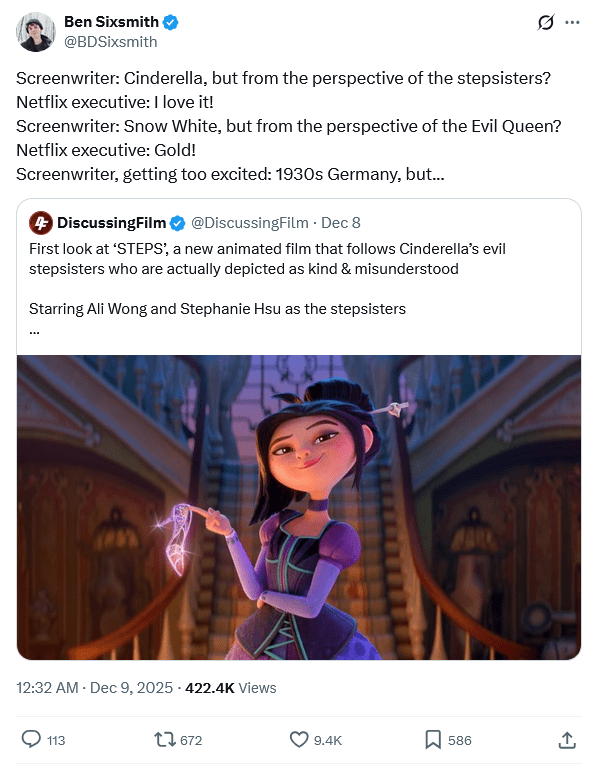
As for the “bright new idea” joke hold on to that idea. I have a story for you at the end of this.
There is another way to reverse villain and hero in a story. I’ve done it without meaning to. I think every writer worse his salt has.
Look, we love our villains. We know their reasons. Sometimes we know the horrible crap that was rained on them before they finally snapped and went bad. We might have some of the same temptations ourselves. (Particularly among Odds it’s way too easy to want to do something terrible to people for whom all the social monkey stuff comes naturally.) Sometimes we can’t help giving the villain a moment in the sun in the sequel.
As a writer, I’m here to tell you: abstain from this. No, seriously, abstain from this. You can write redemption stories. Those are immensely satisfying, actually. But abstain from making the villain “the hero actually.”
I don’t care how much they’ve been “more sinned against than sinning” they still chose to sin. And they have to atone for that. And it should be hard fought and earned. And then, then, yes, the redemption can be amazing. But you can’t just wave the magic authorial wand and go “The other side was actually the bad one.”
Which is mostly what the left (and whether creatives are or not, the gatekeepers in the mass industrial entertainment complex are all leftist, often reflexively so, and thinking they’re centrists) does, often by making the villain “actually oppressed” by being some broad category of victim. Because the problem with the left is that a belief in group guilt and group victimhood and group worthiness has robbed them of the concept of redemption. Once you’re part of group x, you’re a villain. And irredeemable. Also probably prone to infestations by rodents and losing shape in the rain, due to being made of cardboard.
Anyway, the habit of “reverse hero and villain” is also VERY old in our culture. Well, it’s very old everywhere, and even fairytales going back to the dawn of oral tradition have “opposite fanfic”: except it was neither dominant nor generally very popular.
Mostly because our ancestors lived at the sharp end of necessity, where stupid-crazy bit hard. They knew evil existed. They’d experienced it in their own villages, in their own bands, in their own persons.
But the habit of reversing the normally told story to be stunning brave when it comes to history is very old as well. In my personal experience — but going back to the 18th century and the noble savage — it started with “Well, the Amerindians were the heroes actually.”
Were they? Well, no. The entire colonization of the Americas and interaction with Amerindians has heroes — and villains — on both sides, and both sides were in the grip of blinkered cultural assumptions that meant they both treated the other side very badly — objectively — and caused unneeded bloodshed and destruction. And the only way to solve it was for them to see past their cultural assumptions which is very hard for any humans. Which both sides were.
What doomed the Amerindians (no, I’m not going to call them “Native Americans.” They were no more native than anyone else. We’re not required to cater to their delusions that they’ve always been here. And yes “Amerindian” is wrong. But everyone’s group name is wrong. Ask the Germans.) was the software in the head, because theirs was less likely to lead to victory.
Anyway, the reversal of “every defeated group were really victims and the victors are always evil” has become insane. It has led to Land Acknowledgements which are beyond ridiculous. Land Acknowledgements, properly done, would go all the way back to the time the first amphibian crawled out of the sea. Sea acknowledgements would go further back, of course.)
And most of the reversals are just plain insane, because they try to make the previous villain groups into perfect Liberal Heroes. So the Vikings become multicultural, sensitive, and accepting of women and gays and and and–
The individual reversals are even crazier. Rex Stout believed that Shakespeare had done an injustice to Richard III — about the princes in the tower — and maybe he was right. I mean, yes, I know what the DNA youtube videos claim, but none of them are compelling. HOWEVER even if Richard III wasn’t the villain he was painted — and there’s a whole apologia that can be made that starts with “man of his time” and “kings did the things they did at that time, even if they are bad to us and our time.” — there’s no excuse for the entire sub-genre of romances that make him into the perfect, sensitive liberal male. To make things worse, when you are doing that kind of thing, you eventually hit something you cannot possibly reverse or cover up. Richard III might not have killed his nephews. He might have seized the throne because he was actually the legitimate heir. He might… But yes, he had mistresses. And he was probably mean to his servants by our lights. And–
Anyway, the problem with the brain-rott of let’s reverse the story every time has to do with poisoning by story. Stories are how we learn. If we corrupt that mechanism, we learn he wrong things.
I think these eternal reversals are at the basis of “What we need is to give the homeless more money and more latitude and not arrest them for public indecency or for bothering people.” If you don’t remember all the heroic and sage homeless of the 90s I do. And what it actually does is make cities unlivable for normal workaday citizens who aren’t villains just because they work, and clean and have their own spaces. At the same time it tempts people who would otherwise avoid it to fall into the addicted-and-homeless population, since they are obviously “victims” who get away with everything.
But more importantly it erases the concept of evil. Evil in personal or even historical matters is a fact. We’ve all — every one of us — run into evil people who do evil things, because evil things please them or enrich them or whatever. These people might have suffered in their lives (who hasn’t?) but they’re not victims, and they can’t be magically be made good with more tolerance and understanding. In fact, they are more likely to become worse, the more leniency you afford them.
Telling people that if you see evil it’s just because you’re not tolerant enough, is evil in itself and actually and for real harms real, living people.
Beyond that, historically, it leads to a sort of upside down, topsy turvy view of history where the winners are always bad. Always. There is no reprieve.
The screenshot above is funny. And not.
And not because my American Culture (it was a required course) textbook in college already managed to have the colonists be bad, the Southern plantation owners be bad, and the North be bad for defeating the South, when the South became magically victims. And they didn’t even seem to notice it.
I’ve been waiting for exactly that reversal — the Producer’s play without its being a scam in any way — since my very first literary agent, in the nineties told me she probably couldn’t sell my Red Baron novel (yes, my dears, but now I need to rewrite the almost finished, because I’m a way better writer) because she’d been trying for years to sell a young Hitler in love novel and no one would buy.
Listen — ignore the fact that Manfred von Richthoffen was not that I know a monster (and I’ve read countless biographies of him, and in fact, just bought a new one) — this woman had no clue at all why a novel with a “nice” Hitler wasn’t selling. She was connected to all the publishing people, and she had no idea —
And yes, I realize I just did a story with the equivalent of baby Hitler who turns out not to be bad. BUT the operative word in that thought is “baby.” Baby Hitler might have had — probably had — the basic impulses and desires that would lead him to become… well… Hitler. But those had to be “fed” over his education, his family life, his social life, his time in the trenches, etc. etc. etc.
It’s quite possible if his parents had immigrated to America when he was a baby he would be only a mildly annoying and corrupt American politician. And it’s even more possible if he’d been adopted by completely different people at birth, he’d be a totally different person.
Sure, impulses for power-seeking or even sadism might have been present, but there are normal and even laudable people who live normal lives, despite this.
Now, writing Hitler as Hitler and trying to sell him as good, even if say (I don’t know, she didn’t tell me any more about the novel) it was his tragic love affair that made him a monster? THAT is if not evil, actually wrong. Because if Hitler was sort of okay and maybe even a victim (if only they’d appreciated his art!) he wouldn’t have killed several million people!
No, just no. I don’t know when or how, but I know he made his decision to fall to evil. And he was evil. As was Stalin. As was Mao. As were all the other tyrants and monsters of history. Let’s not whitewash them.
To make them “Actually not so bad” will just lead to calling Hitler to anyone the left disagrees with. Oh, wait, too late on that.
At any rate, far be it from me to tell you what to write. However I find the reversal of good and bad has become tiresome — REALLY TIRESOME — as in, it’s now expected.
And this has the danger of reducing our moral map to a grey directionless fog, where there’s no good, no evil, only bad categories and good categories.
Frankly, if I want to manipulate entities with no free will that belong to natural groups, I’ll do math, not writing and reading.
It’s time for us to get as loud as the loud crazies and shout back in one voice “This is boring and stupid.”
Before the moral map loses every marking.
 According To Hoyt
Well, Karl Marx abused the servants (especially the maids) and the Leftroids have damn near deified the bastard. So making a couple of vain, greedy, spiteful bitches into the heroes is just Leftroids being Leftroids.
LikeLiked by 3 people
Got the maid pregnant. She insisted on acknowledging the boy, and Marx insisted that he could only visit her through the back door, and he only saw Marx once in his entire life.
LikeLike
Ah yes. The Anne Frank story, only she’s a fiendish communist bent on causing a Jewish uprising to destroy what’s left of Germany after being brought low by the Treaty of Versailles, and the heroic Nazis frantic search to find and stop this diabolical villainess.
(Excuse me while I go talk to the porcelain throne for the next 5 minutes.)
LikeLiked by 2 people
Well, they’ve already recast her as a budding lesbian….
These people’s birthstone is a crack rock.
LikeLiked by 5 people
OOoooh. i’m saving that insult
LikeLiked by 1 person
It is a good one! *Amused.*
LikeLike
I saw that comment and remarked, “yes, teach children evil people are only misunderstood. That will certainly help them when they encounter misunderstood people later in life.”
I’m up around 50 likes, which is a lot for me. Honestly, though, these people don’t seem to understand how many stories are cautionary tales – kids, don’t do that!
The only time I’ve enjoyed a reversal it was an epilog to Mercedes Lackey’s The Fairy Godmother. The stepsisters, having been stripped of their wealth, are working as barmaids in the village inn. One of them admits, “We didn’t treat her like we should have,” and has decided to be the best barmaid she can be (the other has gone bitter, if I recall). So the local good witch takes note and decides to bless her. But now it’s a redemption story.
LikeLiked by 5 people
IIRC, in that Drew Barrymore version of Cinderella (Ever After) one of the stepsisters was a nice, kind chubby girl who also found a soulmate at the ball – and I thought that was cute.
Of course, the other sister and the stepmother received their just desserts, just hors d’oeuvres and just serving of crow – by having to work in the royal laundry.
LikeLiked by 5 people
The second stepsister’s niceness and kindness had limits, though: “You know me, Mother. I’m only here for the food.”
———————————
The King: “Did you, or did you not, lie to Her Majesty the Queen of France?”
LikeLike
Oh, there are various things you can do.
Erma Bombeck did a column where Cinderella was simply a liar, and the put-upon stepmother refused to let her go to the ball as punishment for misbehavior.
Fruits Basket did one where a group of students was ordered to put on Cinderella only the students playing Cinderella, the stepsister, and the prince were all woefully miscast, so they rewrote it with the students playing themselves. The stepmother was wicked; the stepsister she was grooming for an advantageous match was sweet and kind and not able to stand up to her; Cinderella was cool, calm and collected, but loved her stepsister; the prince was not interested in the whole ball.
Sarah Mlynowski did a whole series where fairy tales were cracked by a brother and sister who landed in them and then had to try to fix them. In Cinderella, the fairy godmother objected to the notion of Cinderella marrying the prince to get away, because the prince needed a woman strong enough to be queen and help him as such. And one stepsister realizes how bad she’s been.
LikeLike
In the original Cinderella story the stepmother is the chief villain; the stepsisters basically follow her lead. So you could have a version where the stepsisters are just weak, doing what their mother wants without really thinking about it, rather than actively horrible. That’s why Ever After and Lackey’s epilog still work; they don’t change the central conflict, just how one of the side characters relate to it.
LikeLiked by 2 people
No. In the original they are pure evil. Mom had one of the earliest translations from French.
LikeLike
Accurate, from what I recall. In the old stories, they didn’t sugarcoat pure evil, and would have be flabbergasted if anyone suggested they do so. Heck, even children knew evil was real (I mean, obviously). Stories just taught us it could be defeated.
LikeLiked by 1 person
clear throat
just to say: Frau Trude
LikeLike
Even in La gatta Cenerentola, which is probably the oldest recorded. (If you ignore silly attempts to claim that the shoe alone makes Cinderella.)
There are a number of variants of Cinderella that have no stepmother. Instead, the heroine is oppressed by her own sisters. Or by her employers. There are none where there is a stepmother but no stepsisters.
In the narrowest variants. There are the Catskin ones where the problem is her father or her brother.
LikeLike
A Gata Borralheira is precisely what the book was called. It was crunchy and full of blood and guts. very satisfying for a little kid.
BTW she convinced her dad to marry the step mother by tricks, because the step mother cooked so well.
LikeLiked by 1 person
Yeah, there’s quite a number where the stepmother got the daughter to convince the father to marry her.
It’s the ones where she convinces her to murder her mother or existing stepmother that are really striking.
LikeLiked by 2 people
There’s a Chinese variant that makes me wonder about that shoe, at least in regards to foot-binding. However, if you go back far enough, you can find antecedents of a magical shoe that will only fit its owner, which at least accounts for variance in foot size. (Though I’m sure that there was a certain gruesome satisfaction for the reader of having the stepsisters cutting off bits of their feet to fit.)
LikeLiked by 1 person
Well, I did perpetrate The Other Princess. It’s not exactly a reversal because the main character is not a villain in Sleeping Beauty, and indeed, does not exist in the original tale. But the Sleeping Beauty character is surrounded by people who insist that everyone must be oh-so-nice to her because she, poor thing, is cursed.
LikeLike
One of the things I liked best about “Princess Mononoke” was that there weren’t any real “bad guys” in the story. Everyone had clear motivations for doing what they did, and some of those motivations were just mutually antagonistic.
(Okay, the priest, he was the closest thing the movie had to a villain, but that doesn’t become obvious until the third act. Prior to that the story is pure “tragedy”, in the classical sense, ie “it cannot be otherwise”.)
LikeLiked by 1 person
+1 for loving that. Especially since all three main characters were admirable.
LikeLike
Not a lot of villains in any of Miyazaki’s works. Except for Muska. Talk about a well-deserved end! Even Queen Kushana had her reasons for wanting to wipe out the giant bugs. She just went waaay too far.
Some of the apparent villains turn out to be not so villainous after all; see Mom and the sky pirates.
LikeLike
Princess Mononoke is one of the only Man vs. Nature stories I respect, for basically that reason.
LikeLike
Wut?
How could you possibly say such a thing in a world where Shackleton exists? Or Bligh? Or even The Martian?
LikeLike
No, I mean Fern Gully and its ilk. Environmentalist fables that nearly always portray the human/industrial side as monstrously evil and nature as a pure, innocent paradise. Princess Mononoke has the same setup, but it has the courage to give both sides dignity and flaws.
LikeLiked by 1 person
Everyone had good reasons for doing what they did, and no one was necessarily in the wrong. Except the priest blah blah blah
(Sorry to double-post but I was having editor problems on my laptop.)
LikeLiked by 1 person
So some of the ‘studying theory’ psychological hits in academia come from changes in perception, or in what one sees.
Year over year, there is a temptation to conclude that seeing more things means progress.
This is a problem for creative writing coursework, because you can fill a lot of curriculum with weird esoteric stuff that does not correlate to the experience of ordinary readers.
The correct answer is that your best truth needs to come from testing stories against many readers, not against scholarship within the theory of story.
That is not the common choice of material to teach.
So creative writing winds up being one of the programs where people can get substantially worse by studying. It winds up being one of the two better textbook examples of such a program.
Pattern, symbolism, good and evil. These are different things that one can perceive in a story, and different things that curriculum can train perception of.
Good and Evil is a topic that one can study the Bible for.
Pattern? A example people cite of a pattern book run amok in an industry is the Cat book and movies.
But, before ‘all speech is symbolic magic’ and such theatrics became quite so prevalent in academia, the pattern dudes and the symbolism dudes averaged out to programs that were not quite so crippling. They still didn’t grok evil, but they were better able to crib stuff until it worked, and come up with some presentations that could sell to the general audience.
And industry is accustomed to hiring competent specialists from appropriate programs. This is basic common understandign by managers, that there are programs that teach stuff better, and you hire people for those positions from someone’s engineering or physics or sociology program.
This is a problem when the owners don’t know the business, the programs don’t know the business, and the in house experts have been from malfunctioning programs long enough that nobody in-house really knows what success or working looks like either.
This is a hypothesis that seems to explain a lot of modern corporate mass media. However, I could be and probably am missing details that clarifies that I am wrong.
One reason to infer that is that I have told a simple just-so story. Over a very large group of people.
I’ve learned from my attempts to reason from just-so stories that I often come to worse conclusions when I do that.
Anyway, audience is somewhat of an estimation problem. Big Story does show hints of having estimated so wrongly that their remaining map does not allow them to navigate back to functioning business.
LikeLiked by 2 people
Obvious it can be done well. I really appreciate C.S. Lewis’s Till We Have Faces, which is a retelling of the story of Psyche and Cupid, from the older sister’s perspective.
And I did enjoy the movie Maleficent, not enough to go sell it out and watch it again. But I think it would have been a far better movie if they had divorced it from the original Disney movie and just made it a general Sleeping Beauty story.
LikeLiked by 3 people
Lewis didn’t flip the Cupid and Psyche story, though – it’s plain throughout that the elder sister was wrong, and even she admits as much by the end. Lewis just chose an unusual viewpoint.
LikeLiked by 1 person
It is, in fact, a redemption story.
LikeLike
RE: Cinderella’s stepsisters–it’s already been done, at least in part, in Ever After, where only one stepsister was outright horrible (and it’s pretty clear that it’s largely down to she and her mother being DESPERATE to advance themselves socially and economically, but also kind of suck at it and fail to read the room, leading to their comeuppance).
I actually prefer the versions of Beauty and the Beast (namely, Robin McKinley’s two versions, Beauty, and Rose Daughter) where the sisters aren’t awful people–which actually makes a lot more sense when it comes to Beauty delaying her return to the Beast, because in the original take she’d have to be awfully stupid to fall for it.
It can work, with some stories–but it also has to be done right, and that is rare. Disney could have done something sooooo much better with Maleficent if they’d just stuck to the whole “Well, faerie, and you insulted her and broke the rules” part of the original story instead of “but ackshually the princess’s father was an evil bad white man and THAT is why Maleficent cursed an innocent baby” (which…does not send the message they thought it did…) They could have kept everything else–her cursing the child, then getting to know and care about her and regretting the curse, but the rules of faerie mean she can’t remove it, etc–but they completely screwed the pooch by deciding to go with “acceptable leftist narrative” instead of “she’s a freakin’ faerie, and they have orange and blue morality”
LikeLiked by 5 people
That was a lot to take in, but I still haven’t changed my mind.: the Empire was right an the Rebels needed to be suppressed.
LikeLiked by 3 people
I read something like that a long time ago. Darth Vader captured Han Solo and explained to him that Obi-Wan Kenobi intended to unmake the universe and create a new one in his own image. Luke was completely taken in and wouldn’t listen to the Eeevul Sith.
But there was a problem. Unmaking the universe would also unmake Obi-Wan’s memories, which were formed in that universe. He’d be creating a new universe as a blind idiot — if he even remembered to create one at all.
LikeLiked by 3 people
Certainly, when I watched Andor, where Mon Mothma was okayish but the rest of her upper class faction of Rebels, including Bail Organa, came off as complete tools, I came away with the impression that Tarkin would in the near future end up doing the Rebels a favor by blowing up Alderaan.
And, you couldn’t do this in Star Wars proper, but there’s a serial numbers filed off version you could tell, about a jaded, devious politician, maybe in the early stages of dying from something the BacT tanks can’t fix, who just gets really fed-up with the two crazy occultists running the government and lording it over him personally, and decides to make a planet full of maximum-impact martyrs in order to galvanize the opposition into getting their butts in gear. He wouldn’t be a good guy, by any definition, but one could make an interesting villain protagonist piece out of it.
LikeLiked by 1 person
The thing about obviously modeling it after the fall of the Roman Republic is that the Republic fell apart in bloody violence, and the Empire restored safety for the average citizen.
LikeLiked by 1 person
Except Mel Brooks already made “The Producers” with Springtime for Hitler.
LikeLiked by 2 people
…and there’s a Hollywood remake of that one, too. It is at least semi-faithful to the original, which raises the obvious question: Why? It doesn’t say anything the original didn’t say better.
———————————
Franz: “Hmmm. Vas dis der slow fuse, or der kvick fuse?”
[Lights fuse]
Franz: “Ah, yes, dat is vhat I t’ought. Dis ist der kvick fuse.”
[Look at each other, horrified] All: “The quick fuse!!”
KABOOM!!
LikeLiked by 2 people
The remake’s a musical, which is a better excuse than most. I did like the cast on the remake, but it’s hard to top Wilder and Mostel.
LikeLike
Alt-Hitler?
Sci-fi writer. “The Iron Dream” by Norman Spinrad.
Anti-hero, well done? Paging Clint Eastwood…
High Plains Drifter (contrast with his Pale Rider)
And best of all, Unforgiven.
Twist ending? Again, Eastwood in Gran Torino.
LikeLiked by 2 people
It can be done well, but MOSTLY it’s done stupid. So when it becomes the default, it’s stupid all the way down.
LikeLiked by 2 people
Sturgeon’s Law in action.
LikeLike
“But everyone’s group name is wrong.”
The New World colonials met some tribes who were friendly (or at least not hostile) to them. Our names for those tribes all amount to “people” in their own language. Colonials learned their languages from these friendly tribes, and their words for all the neighboring tribes were “enemy”, so that’s the name we call those tribes by.
LikeLiked by 3 people
Hollywood is like bars. After awhile, if the regulars aren’t enough to pay the bills, the bar will close.
LikeLiked by 3 people
The “flip the trope” books have gotten tired. “Woe unto them who call evil for good and good for evil,” as the Good Book puts it. People can believe that they are acting for all the right reasons, and still do evil things that need to be stopped.
And most of the books don’t seem to be well written. I really get the sense that the authors never read the source material, even Andrew Lang’s “tidied up” versions, which can still be pretty harsh and cruel by today’s standards. They are “flipping” Disney’s versions, or sweet children’s versions.
LikeLiked by 4 people
So much this. I am actually fond of fairytale retellings and inversions, when done well. When they’re Feeling of the Day, it gets pretty excruciating.
As an example, I sometimes hit up the YA section of the library for fun, and on one occasion I came home with not one but TWO variations on The Goose Girl. And one was… to put it charitably, plain awful. The other one was pretty decent. Guess what the first one had? Zero worldbuilding skills, a plot as thin as paper, and Feelings That Are New And Exciting And No One Has Ever Written About Before. Yuck. It’s as bad as the Lit Fic types who think they’ve discovered a New and Exciting science fiction concept—that was cliched to death decades ago.
LikeLike
“Amerindians” because “Got here before most, before 1600” is too wordy; GHBMB# does not rattle off the tongue? 🤷
The fairy tales whether the sanitized Disney versions, or older Germanic terror slasher bloody versions, have a lesson to impart to the audience. Be it visual (reading or screen), audible (tapes/MP3), or both (video). Lose the lessons and the product is useless. The problem with the misunderstood villain arc reversal is those putting the arc together ignore the lesson (benefit of the doubt -> don’t know what the lesson is … Yes, probably need #sarcasm tag).
LikeLike
…actually, I think a good case can be made that tales, period, have An Important Lesson to impart to the audience.
If it can’t do that, it’s not a good story.
So, like, No Man’s Land? That’s about humaning decently. My Hero Academia is about what it means to be a hero….
LikeLiked by 3 people
I prefer “First Americans,” myself. (“Americans” not in the sense of the American culture, but of the two continents).
Of course, there is more and more evidence cropping up that the current tribes are, by and large, the SECOND Americans – who killed off the ones that showed up first.
LikeLiked by 1 person
Maybe third.
LikeLiked by 4 people
Keeps getting pushed further back – so, could be. Or more – I’m seeing more credence being given to seaborne waves during warm cycles, in addition to the land waves in cold cycles.
LikeLiked by 1 person
Killed off and absorbed the survivors, enslaved the women, adopted the children under a certain age, and enslaving older children (too young to be warriors, too old to be adopted).
LikeLiked by 2 people
I am reminded of The Goodbye Girl (movie version; haven’t seen the play). Richard Dreyfus’ character, an actor, was cast in a stage production of Richard III. The director of that play wanted to portray Richard as gay.
LikeLiked by 1 person
Blink blink blink blink. THAT we know he wasn’t.
LikeLike
“Satan and Prometheus are really the same story from different points of view!”
…ok, clever enough the first time to get me to listen, but you have to do a lot of chopping down on what the surrounding story is to make it fit, and– actually, I think I have a meme for this.
It’s wordy, though.
LikeLiked by 3 people
It’s also possible that both are wrong, such as if this is carefully set up so that it is both a six and a nine- say, intersecting two different lines of numbers.
LikeLiked by 2 people
Something like this:
LikeLike
WP barfed, at least on my screen, so here’s the link without the Image block: https://images.staticjw.com/min/3932/illusion_13.gif
LikeLike
Yep!
LikeLike
lowercase g
LikeLike
Ooh, good one.
LikeLike
“I don’t know when or how, but I know he made his decision to fall to evil.”
I can’t know, but I have a theory. Mostly, he said things that people liked. Everybody was btching about getting shafted on the treaty of Versailles. This had the selling point that it had quite a bit of truth in it they *did get shafted. A blind man could see it. One could argue that they deserved it and all, but that didn’t make it untrue.
So, when he got to talking about how f*cked that was, people agreed. Got those social points for it, the likes and favs in modern terms, right there in person. Got to saying more things that people agreed with. That they were hard done by, this wasn’t right, and whatnot.
Say enough things that folks keep cheering about, you’ll probably end up keeping going down that road and saying more things like that. German people genuinely liked a lot of what he was saying, early on. Not everyone, mind, but enough.
From there, things snowballed. He got power, liked it, and wanted more. He did what he knew worked, and a bit more. The rest is history. Short and sweet, Germany got hard done by after the first war. The common German people were mighty sore about it. They agreed with the funny little guy that kept saying it wasn’t right. And on things went.
LikeLiked by 2 people
A very large number of people were saying what he did – but he said it “best.” (He was also good at cozening many of those who were also saying it; convincing them that hitching themselves to his wagon was better than trying to do it without him.)
LikeLiked by 2 people
That makes sense.
LikeLiked by 1 person
There are reports that he had cracked before hand, about Jews.
Holodomor basically seems to have put some bad potential into the culture/air, some feeling of maybe being on a literal chopping block.
He had some ability, he performed, he willingly chose evil.
LikeLiked by 2 people
Add to that a duplicitous, vicious, and very real enemy (communists), and then add to that a visible, vulnerable, and easily demonized scapegoat (Jews), and the witch’s brew is complete.
LikeLiked by 2 people
Also, regarding redemption arcs, its kind of fun to do one for the villain- a minor one, say, in his story arc, but have him remain evil after redemption. Or at least on the other side (an antagonist, at the very least).
Bad guys get their wins. It’s important to the classic storyline (the initial part where the heroes lose a bunch). Giving them their villainous virtues and minor bits of redemption is pretty good writing, methinks.
LikeLiked by 1 person
Long John Silver to the courtesy phone. Long John Silver to the courtesy phone.
Even if you write a book firmly taking France’s side during the 100 Years War, Bluebeard must remain a villain.
I don’t think I’ll ever forgive Thomas Harris for turning Hannibal Lector into a misunderstood ubermensch anti-hero.
LikeLiked by 2 people
Tim Curry’s last scene as Long John Silver in Muppet Treasure Island is actually a fantastic study in how to make a villain likable while remaining a villain, as well as the exact amount of slack that buys him in the final reckoning.
LikeLiked by 1 person
Marcone of the Dresden Files (J. Butcher). There are hints that he is where he is at the time of the books because things were worse before. Cannot change things too much, but he can direct what is happening (somewhat). One can argue Marcone can never be a knight welding one the Swords of the Cross. Marcone would be too tempted to do what is expedient VS allow redemption. OTOH neither will Dresden be a knight no matter that Dresden is a hero. Then there is the sword that was defiled and fell apart, only to be grabbed by a righteous man and reforged as a sword that can actually be taken through any security (not to give away who or how).
LikeLiked by 2 people
Reread the museum scene in Dead Beat. Then the reforging scene in Skin Game. 8 books for a major payoff to what seemed like a complete throwaway line.
And Marcone will never be *good*. He is, however a man who sets certain limits and makes *damned* sure everyone abides by them. I think that the Nickelhead who tried to take him in Small Favour might have had some problems.
LikeLiked by 1 person
I’m due for a series re-read as the newest release hits.
LikeLike
Actually we know Marcone has taken up a Nicklehead coin to “power level up”, as Marcone puts it. Dresden, thus the reader, just doesn’t know which one. Plus given who Marcone is, there is no temptation or bribery the Nicklehead can offer to change Marcone.
LikeLike
When? I honestly don’t remember that.
LikeLike
I really need a re-read to exactly when Dresden confronts Marcone. I was wrong above, it is Thorned Namsheil’s coin that Marcone picked up from Hade’s vault. Dresden originally thought Marcone had picked up the coin that Dresden originally had which would have brought information on Dresden himself.
Nook, page 371, Dresden notes that Marcone hasn’t been using Thored Namsheil long enough to ensure certain magical protections by other wizards were complete enough. Dresden is inspecting his new “old” lab, castle on the property of his old boarding house.
LikeLiked by 1 person
Just finished Battle Ground reread, found the scene. Damn, Jim is good.
LikeLiked by 1 person
Jim is good.
LikeLike
I need to start at one and read everything.
LikeLike
Just remember: POLKA NEVER DIES!
LikeLiked by 1 person
Yeah. I need to do that too.
LikeLike
There was another military broadcaster, Tony Uminski, who was at Zaragoza AB a couple of years before I was – and when he did the morning drive time, he always played a polka at 6:45 sharp every weekday morning. People listening to the station on their car radio always said that if they hadn’t hit the access road to the base by the time that polka came on the air – they were going to be late.
No, polka never dies … around in South Texas, it’s part of a subgenre of local music called ‘norteno’ – which is a fusion between middle European and Mexican folk music.
LikeLiked by 1 person
I like subplots where a lesser villain says, “Wait, you mean you’re really going to destroy the world? I’m out.”
Shows up to give heroes critical piece of info/way into the secret lair.
“Does this mean you’re on our side now?”
“Heck no! He’s planning to blow up the world – that’s where I keep all my stuff!”
LikeLiked by 3 people
Spike (Buffy The Vampire Slayer) took down a couple of baddies because “Hey, I don’t want the world destroyed. I have fun here.”
LikeLiked by 2 people
Spike was one of the sanest characters in the show.
“No, I think that’s just enough kill.” for one.
LikeLiked by 2 people
One of my favorites is from The Rocketeer where the Mob Boss realizes he’s working for a Nazi
https://youtu.be/_D-Z0AA-7vQ
why can’t Hollywood do that anymore? Of course, I know why; it’s the same reason every Superman remake since Superman I and II (we will pretend III and IV never happened) is at best MEH, that is there is no such thing as good or evil so a true paladin type figure can not exist. It’s why they LOVE all these alternate perspective movies. In their view there aren’t really “bad guys” in the world. It’s as if C.S. Lewis’ Screwtape has had the Hollywood producers by the ears for the last 45+ years and is winning. People love to point 1984 and Brave New World as the definitive dystopias, But, what we really have is Lewis’ That Hideous Strength with NICE being guided by Screwtape.
LikeLiked by 3 people
I wonder if they borrowed that one from DC; Joker realizes that Red Skull isn’t playing being a Nazi for laughs…..
“I may be a criminal lunatic, but I’m an American criminal lunatic! Stay back, boys, this creep is mine!”
LikeLike
Least believable thing in Marvel: a world where both Red Skull and Magneto are alive and in public.
LikeLiked by 1 person
Nod.
One piece of the “back-story of Magneto” was that before he became a “supervillain” he hunted down Nazis.
You’d think that when Red Skull became active (after WW2) that he’d have hunted down Red Skull.
When you think of all the times that Captain America publicly fought Red Skull, it seems insane that Magneto wouldn’t have gotten involved.
Oh, Magneto did take one action against Red Skull, but Skull survived and Magneto didn’t correct the matter.
LikeLike
Captain America and Ethan Hunt both fit the paladin archetype pretty well. We could use more, though.
(Man of Steel/BvS Superman is basically what happens when you drop a paladin into a messy world and leave him to clean things up. James Gunn’s Superman is…something.)
LikeLike
In the old Terry & The Pirates comic strip, the Eurasian temptress, the Dragon Lady was one of the main villains (among a whole raft of baddies hanging around the Far East in the 1930s.) She was the boss of a gang of pirates, of course – and had the hots for the ostensible hero — but after WWII began in earnest with the US late in 1941, she became the leader of a band of Chinese partisans fighting the Japanese occupation, and sort of an ally to the US. It was hinted by the writer, though, that she had ulterior motives, and it was more a matter of opportunity for her rather than a love of freedom.
LikeLike
But of course, the Japanese would have treated her as a Female Chinese criminal and the Americans would have worked (for a time) with her. 😉
LikeLiked by 1 person
“Particularly among Odds it’s way too easy to want to do something terrible to people for whom all the social monkey stuff comes naturally.” – *Rueful wave* Oh so much.
Particularly when being able to do the social monkey stuff means you skate by, when… not… means you get hit with fines, etc. because you don’t know what you’re supposed to be doing to signal “oh, sorry, tee hee”.
Very, very expensive, that can be. Sigh.
LikeLiked by 1 person
Is this the moral equivalent of grey goo?
LikeLike
if you keep pushing that path, yes.
LikeLike
With respect to Richard III, I’m fully on the revisionist side. Henry Tudor’s claim was weak, and he won the “trial by combat” due to active betrayal during the battle. (May Henry Percy, William Stanley, and Thomas Stanley all enjoy their well-earned spot in the frozen lake.) Propaganda was needed to shore up his support, and it was produced in job lots.
That said, for a Romance? If you’re going to argue that Richard was a decent guy, Exhibit 1 is how he treated his wife. (Her life was tragic, but Richard softened many of the blows in a most admirable fashion.) You could totally do it from her perspective, but I’m nearly certain that’s not what’s happening.
LikeLiked by 1 person
yep. Of course. On the history. BUT no, these are time travel romances, with the mary sue being wooed and … gags.
LikeLike
Every time I look at that response, it gains another layer of awful.
They couldn’t have done even the most basic level of research. There’s no way.
LikeLiked by 2 people
Right and there are multiple time travel romance series at Amazon, featuring the poor man….
LikeLike
Sometimes I have to tell myself that what Romance readers primarily want in a story with gee whiz trappings is not what I would want those trappings for.
Then there are the romance books that maybe even aren’t satisfying romance readers.
Fundamentally, for a time travel romance between a modern woman, and some dude who lives in a mosquito infested wetland, I would want the woman to procure and bring back anti-malarials. Which is too gritty for that Romance subgenre.
There are excuses that should generally be made, and there are definitely specific cases where they should not be made.
Though I fear that the subgenre calls out for a pastiche where a woman in modern times goes back and romances the early twentieth century Governor of a state like Nebraska or Mississippi.
LikeLiked by 1 person
This is a great chance to push a video I recently saw– do not watch anywhere you wouldn’t play Bloodhound Gang’s “Bad Touch,” you have been warned— where a guy, gasp, actually read the most popular TradPub Romantasy books.
And engaged rationally with why they’re popular.
He’s got a bunch of other very watchable videos, too.
That said- I could absolutely see a time-travel romance where the Special Thing She Can Do is anti-malaria treatments.
LikeLiked by 1 person
Saving to check out later!
LikeLike
Watch to the end when you do– there’s a training/”blooper” bit that is simply adorable.
LikeLiked by 1 person
I liked Galbaldon’s historical take on insects. Essentially those out of time, or partly (daughter and grandson), the insects didn’t bite. Wrong energy. Probably a combination of wrong energy and naturally does not get eaten alive by insects … OTOH does not mean the buzzing of mosquitoes doesn’t drive one nuts. (From the perspective OMG! I wish. I get eaten alive. Plus I have allergic reactions. Not anaphylactic. But heavy swelling, bruising, and too often skin infections.)
LikeLike
Given the genre, I’m sure there is gagging at some point. Almost… reflexively…
LikeLiked by 1 person
Here’s the thing, the most satisfying villain I can think of on screen is Michael Rosenberg’s Lex Luthor from Smallville. He was starting up his redemption arc in Season 1 (mostly because he *wants* Clark to like him), and then he gets an up close and personal look at an abortive superpowered invasion (Kryptonian villains).
Literally *everything* that follows can be summed up with his new obsession with planetary defense. Every *single* scheme of his in the show ties back to that somehow, either “because “unethical experiment gone wrong” or “I need power to make this happen”.
Is he a villain? Given that everything remotely related to ethics and morality goes out the window, yes. But if an invasion had happened and Clark hadn’t been available to step in, he would also have the only one with any kind of hope of saving the planet.
“Flip the script and he’s the hero” doesn’t work. But a villain needs clear goals and motivations other than “I’m a psycho”
LikeLiked by 2 people
Totally off-topic, but we just finished our small town Christmas parade. Despite the date of the parade being moved twice (weather, then the band schedule) and tonight having a brisk, cold wind, I don’t know when I’ve seen a bigger crowd. Encouraging.
LikeLiked by 2 people
If Hollywoodland had any sense, they’d be trying to make the Darkship movies…
They’d even sell us tickets.
LikeLiked by 1 person
After what they did to Starship Troopers?
Maybe if Sarah had final script approval…
LikeLike
Takes more than final script approval. JK Rowling Harry Potter control. Would add Galbaldon Outlander series control, but she has stated she doesn’t have that legal level of control over scripts. Rowling did have that level of control (what got left out was a combination of visual media limitations and length). I don’t watch Outlander (don’t have Stars) but apparently (from what I’ve read) those in charge stay as *true as they can because that is their own mission.
(*) Definition of “true” is without being told the series is Outlander, one could figure that out on their own, if you’d read the books. Star Ship troopers? At best it is “inspired by, here is the shell”. There is at least one other book that I’ve read that I saw the trailer for that I recognized, but didn’t go see. The book terrified me. No way did I want Hollywood’s rendition leaping out at me from the screen. If they’d even stayed true to the book. Which kept most the actual killing psychological and off the screen.
LikeLike
Basically, the only way you can get a truly good adaptation is for the people doing the scripts to love the story they’re adapting. William Goldman and the Expanse guys being the weird exceptions where the creators are writing the adaptation, of course.
And they have to love it for what it is. Jane Austen has some good adaptations, and some horrible “updated” adaptations. If you want to modernize it, go full Clueless or admit that you don’t love the original like you say.
LikeLiked by 2 people
Yup. Along with No Man’s Land.
Larry Correia’s Monster Hunter, Grimnoir and Lok books.
Lois Bujold’s Vorkosigan books.
Roger Zelazny’s Amber books.
Wen Spencer’s Elfhome books.
David Weber’s Manticore books.
Julian May’s Many-Colored Land books.
Ryk Spoor’s Boundary books.
John Ringo’s zombie apocalypse and Troy Rising books.
Michael Z. Williamson’s Freehold books.
John Van Stry’s Ceres books.
Piper’s Fuzzy books, Space Viking and Lord Kalvan Of Otherwhen.
I’ve read a whole lot of books that would make incredible movies. Even some that should thrill the Leftroids. How’s this: a man in his 30s volunteers to save the world from eldritch abominations by being transformed into Princess Holy Aura, a 14 year old Magical Girl, then finding and recruiting 4 more Apocalypse Maidens.
LikeLiked by 1 person
Piper’s Paratime stories would make a good limited series. Though the fact that Verkan Vall’s culture is merely “exploiting,” other levels rather than “helping,” them, might stick in a few craws.
Not to mention, “The Last Enemy,” where Vall helps single-handedly derail a Socialist party intent on taking over the local government. Mind you, the “conservative,” faction gets worked over too, because of the social chaos created by Hadron Dalla’s technological breakthrough in “proving,” life after death and voluntary reincarnation.
LikeLike
Would so very much like the epic move series, perhaps anime series, of the complete Carrera/Legion storyline, with source enforcement by Tom Kratman at nail point. (grin)
LikeLike
You reminded me of a few more:
The Last Centurion (Beware of Leftroid exploding heads)
Weber & Drake’s Belisarius series
Weber & Ringo’s Prince Roger series
The Dahak / Mutineer’s Moon series
Alan Dean Foster’s Flinx books — I’d like to see a Thranx
It’s all your fault! 😄
LikeLike
Weber and Drake never had one; Drake had two, the first one (Raj Whitehall / The General) with S.M. Stirling, and the second one (Dance of Time) with Eric Flint.
Either could be made to work.
LikeLike
Oops. I looked up a lot of stuff and got mixed up. I mean the Flint / Drake series starting with An Oblique Approach. The first few 1632-verse books would make good movies, but after the count got over 30 that’s just too many.
LikeLike
A lot of the 1632 books are the same events, just told from different perspectives. Like Mrs Simpson’s trip with Grandma to recover what is owed to the family. Know the event takes place in 1633 or 1634 (forget which) just as passing description. But (FWIW, YMMV) the event didn’t need a book. OTOH after the breakout of the English Tower, the main story follows the refugees to the English Channel for rescuing by the fleet. The other group with Julie and the others who flee back to Scotland, that one we did need (even if it wasn’t what I expected, oh well). Same time period. Different events. This is one of the reasons I haven’t read every book. The Papal Estate 16XX books do the same thing. Too hard to determine if the story line has technically been covered, and a rehash from different characters.
LikeLike
There are more.
LikeLike
Smith’s Skylark and Lensman series.
Smith’s Spacehounds of IPC is a lot of fun, but they’d have to compensate somehow for the seriously out-of-date info on the Solar System. (No, children, you can work in shirtsleeves on the surface of Saturn…)
Heinlein’s Revolt in 2100.
Sixth Column would be interesting….
LikeLike
…”can not work in shirtsleeves…”
Sorry.
LikeLike
Rumors in ~2010 were that J. Michael Straczynski of Babylon 5 fame had (after much wrangling with the various owners of the rights) gotten rights to at least Galactic Patrol. I fear it went into development hell long ago and is off the radar scope by many scores of detets.
Some of it’s issues with modern audiences could be fixed with only minimal abuse of the original. E.G. rather than a nurse make MacDougall a full fledged doctor. The fact that there are ONLY male (at least in human circles, who can tell with say a Palainian?) Lensmen is going to gall some folks. Even though ultimately 4 of 5 of the most powerful L3 level operators are human women (for some values of human). Lensman hardest issueis that there really are Good and Evil in it’s universe. The Eddorians want to control the universe(s) and will stop at nothing to do that. Hollywood does NOT believe such an unmitigated evil can or does exist.
The darn shame is that we’re probably at a point where the technical issues of some of the scenes are resolvable. This would not have been true even 10-15 years ago. That may have been part of JMS’ struggle a 2010 Galactic Patrol would have to have been an absolute blockbuster at the theater to even break even. It would also (wrongly) be viewed as derivative with Star Wars and Green lantern having borrowed freely from E.E. “Doc” Smith and gotten to screen first.
Perhaps a series of 5-10 1 hour streaming programs for each of the books? Not sure who I’d trust to do it, Netflix, Amazon and Paramount all have their own atrocities, and some like Paramount, might see Lensman as too close to their existing Star Trek Franchises.
And of course there is always the Verhoeven Starship Troopers nightmare. Yes I know some enjoyed Verhoeven’s vision and if he had NOT called it Starship Troopers I’d have been fine with it. I’d rather NOT see Lensman suffer that fate.
LikeLike
How could anybody look at the Commie-Democrat party and not believe in a megalomaniacal evil that wants to take everything from everybody and enslave us all? How do we know Klaus Schwab is not Gray Roger? Or one of the aliens from THEY LIVE!
LikeLiked by 1 person
If Hollywood had any sense, they’d stop trying to adapt H.P. Lovecraft (because the ineffable can totally be captured on celluloid), and start adapting Clark Ashton Smith.
LikeLike
FWIW, Annihilation did a good job of capturing the Lovecraft tone without being a literal Lovecraft adaptation. It’s got a knack for showing you things your brain can’t quite make fit. (Haven’t read Smith, but I don’t doubt he could use some love on the silver screen.)
LikeLike
One of my readers tried to hype things as a movie or game idea. People’s imaginations take those words and go real far with them sometimes.
Of course, once the words are on da page, it’s off to the races. I don’t control the reader’s imagination, I just nudge it here and there and let them fill in the gaps.
For movies, there’s a slightly different formula. The story beats are still there, but a lot can change, and some of it for very good reason. Not every even very good print story translates to an awesome movie. Not without some heavy editing, at least.
LikeLiked by 1 person
Fake Family History song:
“From Loss to the Golden Coast” — Original Lyrics
(Verse 1)
In the fields of Dybbøl at the breaking of the dawn,
A father stood in silence knowing he might not see his home.
Jens fell for Denmark, but his final breath said more—
“Live free, my sons, wherever you must go.”
(Pre-Chorus)
And Anna stood alone, with five young hearts to guide,
A homeland lost to Prussia, but a fire still alive.
(Chorus)
From Schleswig’s frozen mornings to the California sun,
They crossed the sea with nothing but the letters and the love.
From servants in a country that no longer felt like home,
To founders on a hillside where the linden tree has grown.
Oh, they turned sorrow into story, turned the past into a boast—
From loss and war and widowhood…
To the Golden Coast.
(Verse 2)
Two boys left first with courage burning in their chest,
Logging camps and long nights just to send the passage west.
A mother’s trembling hands received the letter and the draft,
“Come to us, Mor—come home at last.”
(Pre-Chorus)
And the Hekla carried hope across the wide Atlantic sea,
Toward the brothers waiting in the valley of Petaluma’s green.
(Chorus)
From Schleswig’s frozen mornings to the California sun,
They crossed the sea with nothing but the letters and the love.
From servants in a country that no longer felt like home,
To founders on a hillside where the linden tree has grown.
Oh, they turned sorrow into story, turned the past into a boast—
From loss and war and widowhood…
To the Golden Coast.
(Bridge)
They built a dairy on a dream, raised a home upon a hill,
Fought drought and doubt and prejudice with iron Danish will.
A memorial for the father, letters whispered from the past—
“Your sons lived free… your blessing reached them at last.”
(Verse 3)
And Anna, tired but triumphant, watched their valley fill with life,
Grandchildren laughing, sons united, California skies at night.
Her journey ended softly, but her legacy stayed strong—
In the creamery, the linden tree, the family carrying on.
(Final Chorus)
From Schleswig’s frozen mornings to the California sun,
They crossed the sea with nothing but the letters and the love.
From a battlefield where hopes were lost beneath a Prussian coast,
To a homeland of their choosing where their roots could grow the most.
Oh, they turned tragedy to triumph—
A dynasty from ghosts.
From the fields of Dybbøl…
To the Golden Coast.
LikeLiked by 2 people
There is another enormous problem for Hollywood that is simple, but I’m still trying to work out how to explain. (Once I have what feels like a full explanation, I’ll write it out and publish it as a manifesto called The Tao of Corman.)
For all the past stories of Hollywood fiscal excess, and there are plenty, going right back to the silent days (see: Stroheim, Erich von), those were, one, exceptions, and two, generally a case of the “suits” losing control of a production.
Today, as far as I can tell, all of the fiscal irresponsibility is due to the suits, the producers and executives whose job is to keep a lid on costs, and they are all (with the possible slight exception of David Zaslav) gleefully shooting the money hose at every problem they encounter. And even using it to create more problems, for kicks.
Consider Heaven’s Gate. The story of how that production spiraled out of control and destroyed United Artists as an independent company is told, with reasonable honesty, but one of the producers who greenlit it in the book Final Cut. (If you read it closely, you’ll figure out that he was basically blind to his own faults and prejudices, even in the writing of it.) The short-short version is that a director with suddenly enormous clout got a greenlight on his project, played office politics better than the newly-installed executives, and shot on location without the slightest regard for budget or schedule (spending an entire shooting day on retakes of a single shot, when they got a usable take in the first ten, for example). He set up a situation where nobody on set could tell him no, and the people who could tell him no were far away, new to their jobs, and committed to a project they didn’t realize they had no control over.
That was a creative working against the suits. That, to one degree or another, is the story of most of the famous historical out of control productions.
Now consider The Marvels. The director had one credit to her name, and it was a small indie film. She had no experience with large budgets, large crews, shooting for visual effects, or much of anything else the movie called for. She was cast, because she checked certain boxes, and despite starting with a script she had written and was finished, kept getting told to reshoot from rewrites that she had no part of. Because the producers were confident in their “scrap-booking” method of filming, despite the fact that it had already failed them several times in a row. Scrap-booking means they would shoot many, many variations of a scene, for every scene, and then basically create the story in the editing bay. (The sheer blind folly of shooting without a locked script, leaving the actors, director, cinematographer, and script supervisor with no idea what the story is about, still staggers me. That’s what you get when you stop telling stories, and start making product and content.)
That, and every other Disney money pit production, along with several other studios, is the work of the producers and the executives, since the creatives were brought in, in essentially powerless positions, to do as they were told with blindfolds on and their hands tied.
And I don’t actually know what changed to allow for that. If nothing else, the investors who fund movie production (usually a bank, not the studio itself) ought to have stepped in and stopped it, but they haven’t. I can probably sit and work out how Bob Iger, CEO of Disney, got to a place where he felt like the above was a good way to operate (despite the fact that he followed Michael Eisner, who began as a brilliant executive who could figure out how to fix a major story problem in an already-shot film with a one-day pickup and a ten dollar prop, but ended up getting removed for blithely spending money left and right without concern about ever seeing any return on investment; which you would think Iger would have taken some wisdom from, but no). But I can’t explain literally everybody else doing the same sort of thing.
LikeLiked by 1 person
It’s a fascinating question, and I wish I had more insight into it. I suspect it comes down to the success of the MCU (and Star Wars, briefly) and the belief that it could be commoditized. After all, if you’ve got a string of hits like that, it’s tempting to believe the formula is as simple as “IP + Star power + CGI budget = $$$” and not the result of a lot of smart creative decisions and/or residual goodwill.
That might explain the superhero genre (DC, Sony, and Fox) and some adjacent stuff (Jurassic World, Godzilla/Kong, action comedies, etc.). Streaming was “content” from the get-go, so no surprises there.
But the collapse in storytelling, or even the desire to tell stories, has been startling. Netflix referring to Casablanca as a “franchise” the other day pretty much sums it up. I like franchises, I’m fine with remakes, and I’d rather have a bad sequel than none at all. In a lot of ways, I should be the ideal viewer for Hollywood’s current push. But it’s dismaying that telling a good story seems to be a tertiary concern and that Hollywood seems to have eaten its creative and thespian seed corn.
I wonder how much of this is down to consolidation and money games up at the top. It’s hard to explain the last ~15 years of the comic book industry without understanding that the top two companies are now pocket-change IP farms for massive parent conglomerations. Is the same thing going on with movies? The Warner Bros. saga seems to suggest so.
LikeLiked by 1 person
Contempt probably plays a big role.
After all, if– pause, curl lip– comic books are selling that well, it can’t be that hard. Everyone Knows that kids will watch anything.
These folks still haven’t figured out that Michael Bay doesn’t just do “bunch of explosions.”
He does “bunch of explosions in the right time and place to be emotionally satisfying, and packed in with a bunch of fandom cookies.”
I don’t even know if we ever saw the crusty old Military Leader from the first Transformers movie again, but just thinking about him stopping the hacking attempt with a freaking axe makes me want to stand up and cheer. It set a standard of how much creativity and awesome background characters would be allowed, and while the robots outmass and out-tough us, we can and will dance around on the rolling barrels and never quit.
I’d pin it to a lack of belief in Truth.
If you can’t recognized, accept, and protect the Truth, then you can’t tell a satisfying story. There has to be something of truth in it, and truth isn’t determined by a popular vote.
LikeLiked by 1 person
Michael Bay movies are fun because they wear their hearts on their sleeves. The exciting parts are exciting, the dramatic parts are dramatic, the funny parts are funny, unabashedly and to the greatest extent possible. Armageddon doesn’t have an ounce of subtlety in it, but it’s a fantastic movie because it leans into everything.
The side characters thing is something I’ve also noticed. There are no bland, normal roles in Michael Bay movies. Even the smallest of parts have something going on, some bit of attitude or something they’re busy with. It doesn’t always pay off, but it means there are no shortcuts in the script where you just treat a character like a prop.
LikeLiked by 3 people
Michael Bay is simultaneously under- and overrated. For all of his (many, many) faults, he has a cinematic mind few others can ever hope to match.
He does not storyboard. He does not plan out shots and the editing in a way others can grasp. It’s all in his head, all of it, and that is a thing that is astonishing given how frenetic and frenzied his films are.
LikeLike
That’s a nice analysis. This sort of ties into the idea of one big component of art being the cultivation of taste. Bay has cultivated a particular taste, and it defines how he goes about making his movies. The limitations of that taste are the limitations of the movies. (See also: Zack Snyder/Rebel Moon.)
LikeLiked by 1 person
….wait so Michael Bay is a freaking artist!?!?
I’m not sure why that tickles my fancy so much, but it does. ^.^
(Also, I now must go watch Epic Rap Battles of History. not safe for work or small children warning)
LikeLiked by 1 person
He’s an art collector, at least. Apparently one with a fair amount of taste.
But in terms of cinema? It is entirely possible to argue that he is an auteur, though most cinema snobs will avoid doing so.
LikeLiked by 2 people
A few thoughts on your thoughts:
Putting blame on the success of super hero movies and Star Wars feels superficial to me. Not wrong, but not deep enough to explain the executive suite behavior across the board.
I will accept no sequels to Casablanca. I would accept a story inspired by the state of events after the end of the film, but don’t try to recreate magic. Instead, try to create new magic. Which is not going to happen. And I think a lot of the lack of concern for telling a good story is an unplanned outcome of the way career tracks in Hollywood have come to be structured. Back in the day, Hollywood would bring in writers who were already working writers, and were working writers because they had also lived doing other things and had some real world experience to their names. Today, you can’t get hired as an unpaid intern without all the connections, the right degrees, and a willingness to live unpaid in southern California for months or a year, somehow. In other words, the entire system is set up to create a bubble away from reality, open only to the already-wealthy. Real world experience is something they wouldn’t understand if it slapped them in the face.
There’s something to your consolidation idea, but it’s more complicated than that, and goes back much further.
LikeLike
I’ve also heard some people talk of the studios shifting to IPs over stars in the last couple of decades, but I don’t remember the argument well enough to lay it out. This was mostly in the context of the talent crisis and why we’ve got maybe four or five young stars propping up the entire industry, but I suspect it’s part and parcel with all the other changes (big budget, less creative, chasing streaming, and woke ascendency). I can’t quite put it all together.
The career point is interesting, and it mirrors what’s happened in comics. The last few generations of writers have been writers first and foremost, as opposed to the veterans, etc. who populated the ranks in the 40s through 60s. I’m a little leery of this as an explanation, since having life experience doesn’t make you a good writer and not having it doesn’t keep you from writing something fantastic, but there’s a certain amount of story poisoning going on in the industry, on top of the liberal ideological bubble. You can see this metastasize as the irony, sarcasm, and self-awareness of movies from the 2000s and early 2010s gave way to the performative self-awareness of the late 2010s and 2020s.
LikeLiked by 1 person
The death of the movie star is a bit of a red herring. That more or less happened in the ’90s (the only true stars still standing are Denzel and Tom Cruise, really). And part of the problem there is that all of the systems that used to be in place (ad hoc though they were) for training wannabe stars to act are gone. Brando came from the theater. Many comedians began in vaudeville, back in the day. By the ’90s, the organic breakout star was gone, studios kept trying to manufacture stars, and mostly failing. Some of the failures overcame their first bump to become true actors and stars, like Matthew McConnaughey. But, again, that’s decades ago.
But the death of creativity, and creative risk, that’s real.
LikeLike
The death of the acting pipeline is an interesting aspect I hadn’t considered. (Again, something similar happened in comics where the traditional pipeline for new writers went out the window in favor of woke networking.) I suspect I’m using a more permissive definition of “star” than you, since I’d include Dwayne Johnson, Ryan Reynolds, etc., but even that group is in their 40s and 50s now, with scant few to replace them.
LikeLiked by 1 person
Traditionally, a “star” is a name/face/personality that could get people to buy tickets on name recognition alone. Johnson, while recognizeable, never achieved that. Reynolds, arguably, had that with Deadpool, but nothing else.
But tell me that Denzel is doing another movie with the plot of “somebody hurts a girl, so Denzel kills everybody“, and I’m in. Doesn’t even have to be an Equalizer flick.
LikeLike
Okay, same principle, different thresholds. Johnson, Reynolds, and some others are at that level for me, but I’m also not that picky.
Come to think of it, I don’t think I’ve ever seen a bad Denzel role. He’s had quite a career.
LikeLiked by 1 person
I was not speaking of who is a star to you, or to me. I was speaking of who is a big enough star to sell enough tickets on opening day to make the movie a hit, absent any other criteria.
Any given actor has fans that will buy blind like that. Very few have enough that their star power alone will make the film bankable.
Johnson has proven that, likable as he is, he doesn’t have that much draw.
I’ll give you another example. George Clooney has movie star charisma (and to spare). But his box office track record shows that he is not a star in the sense I am talking about.
Julia Roberts is no longer a star, but was, for about a decade.
This is one of the many reasons the streaming model is a disaster. Because objective metrics are hidden, letting the producers lie their asses off without fear of being contradicted, so they can claim some nobody is a huge star, and their movie was an enormous success.
LikeLike
Interesting. I’m used to the next tier down, where the actor is enough of a draw to make a good movie a big hit, but not to carry a bad one. But I can see where guaranteed bankability would be important in Hollywood.
And, yeah, streaming’s going to take a baseball bat to the concept in all its forms.
Side note, but if you haven’t seen them, S1m0ne (with Al Pacino, 2001) and The Congress (with Robin Wright, 2013) are both oddly prescient about the possibility of AI actors.
LikeLiked by 1 person
My intuition is that my first thought is me trying to cram a pet theory where it does not belong. (Whole thing about academic management science, and an excess of certainty about specific methods having valid general applications.)
One of the things that strikes me about scrapbooking, is that it sounds vaguely like some stuff I have heard about in industrial engineering within manufacturing engineering. (Manufacturing objects is a sequence of steps, so you cannot just pick versions of steps after the fact. ICs is one of the big success stories of statistical process improvement. Bob Pease was a famous man in Analog ICs, and his columns contain more than one rant to the effect that he did not like the Taiguchi squares stats model for that stuff. I first learned about this stuff from some books that mentioned Taiguchi squares, and the company I was in contact with was a Japanese one that was absolutely not a semiconductor fab.) Statistical process control can work for widgets because the possible states the part can be in are pretty narrow, and measureable.
The engineering analogy that a ‘scrapbook’ film would be closer to is maybe closer to a waterfall/systems engineering V integration of disparate parts into a hardware system. (The software engineers will of course want to remind me that waterfall is actually really bad. For the stuff that they do. Maybe also for a lot of hardware stuff as well, I dunno.) The problem is that sometimes hardware can be measured in pieces, for reasons that do not apply to a story.
If a viewer or reader can change their interpretation of a story with the addition or subtraction of single details (and they can), then a hardware integration engineering approach to film making would be invalid.
Scrapbooking absolutely sounds like someone heard about statistics, but did not understand statistics or about any of the other processes. It is something that a particularly storyblind and technocratic engineer would try, if scriptwriting was somehow ludicrously expensive, and filming were a significantly cheaper part of the process. Neither of these is a persuasive explanation for so strong a change within an industry.
A more persuasive hypothesis is that the suits have been told that their purpose is to spend money (as some sort of fraud), and produce propaganda, or at least not conflict with the propaganda. Not conflicting with the propaganda would be really hard to know in advance for any sort of traditional writing process. But, if you abandon making the script function as a story, and if you abandon editing it into a story, then you can use scrapbooking to hamfistedly adjust symbolism so that you can distribute the film without letting the propaganda push down.
But this is far too much of a just-so story that appeals to my anger at the world over 2020.
LikeLiked by 1 person
Some of that is over my head, I’ll look into the processes you alluded to. But let me suggest a perhaps simpler explanation to part of what you said.
One of the major reasons for having a screenplay is that, even with Guild rates in full force, it is significantly cheaper than shooting endlessly and “finding the film in post”.
However, it also poses a problem for the insecure executive: it allows no room for the executive to be seen as a creative force on the picture. The writer wrote it, the director directed it, and they (mostly the director) get all the glory. Ah, but if an exec can create a narrative about how he “saved it in the editing room”, then he can accrue some of the glory to himself.
(One of the producers on the Gary Cooper flick High Noon tried this, way back in the 1950s. According to his narrative, the film was a mess and unreleasable, until it was saved — by him, of course — in the editing room. The fact that the film was written and shot to play in real time didn’t faze him at all. And at least some people bought it.)
The need for suits to be seen as creatives can be traced back to around (very roughly) 1990. Mystery movies used to be a solid mid-level genre, for decades. You could make money as long as you had relatively low expenditures. Then Hollywood gradually stopped making them.
Why?
Because you can’t change the ending of a mystery without blowing up the whole story. Which means if an exec meddled with it, the movie would fail. Therefore, no glory. Therefore, they stopped funding them and looked to other genres where they could meddle.
(It never occurred to them that the problem wasn’t the mystery structure, but the meddling.)
LikeLiked by 1 person
That makes a lot of sense. If Hollywood weren’t so fiendishly hard to break into, it feels like there’s a market niche for a studio that doesn’t do that, thus allowing it to make mysteries and other things ignored by the current machine (comedies, SFF pics that stay semi-true to the source material, etc.).
While you’re here, do you have any insight into why all the Netflix original movies feel off? On paper, they often have A-list casts and even great directors, but there’s something unsatisfying about the execution compared to a theatrical release with a similar budget/scope. I’ve heard Netflix tries to make them for unengaged viewers, but the problems feel more pervasive than that.
LikeLiked by 1 person
I’ve watched so few Netflix movies that I don’t think I have insight into that. I do think that you’re right, and they’re functionally different somehow, and that almost certainly comes from the top, either purposely or accidentally.
I came to the conclusion a while ago that Hollywood and the cinema theater system is dead. Cinema itself need not be, but it’s going to have to be a grass roots, ground-up process, where some of us plebes use the cinema making machines in our pockets to kickstart something. And the theatrical experience is right out until theaters start being willing to take no budget local work and show it. As to the adaptations, yeah, that’s going to have to start with public domain works. Luckily, there are many good ones never filmed before (or, in a few cases I can think of, filmed but the films are lost or unknown for the most part).
LikeLike
It’s really hard to describe, especially since the symptoms are different each movie, but all of them punch below their weight. They feel like they’ve got a checklist, and they’re not going to put any more effort into the movie than is required to check the next item off the list and move on. It certainly feels corporate. I wonder if it will hurt them in the long run, or if the least common denominator doesn’t care enough to find something better.
Yeah, it’s going to have to evolve, and probably not from Hollywood. I’m curious to see what comes next.
LikeLiked by 1 person
I think I get you. As an example, they’ve funded… four? I think four, Zack Snyder movies, and all of them have been deficient in terms of concept and execution.
To be absolutely clear, I think Snyder is an interesting filmmaker who would have a much better reputation if he didn’t insist on also being a screenwriter, and had a producer who wasn’t his wife and could rein in his excesses. (I have the Snyder Cut of Justice League on Blu. And I like it, to a point.) But the “zombies-Vegas-heist” movie (Army of the Dead) had a bunch of ideas, not well integrated, and didn’t amount to anything. And that was the best of those efforts.
LikeLike
I’ve gotten a similar impression from all of the “We landed a big director” Netflix movies I’ve seen. Army of the Dead was fine but not outstanding. Rebel Moon had promise but was a mess in terms of developing its characters and putting them to use. (Snyder fan, so I wanted to like it.) And even stuff like 6 Underground wasn’t Bay’s best work. Feels like there’s some oversight missing, which is odd given how much meddling (1) has caused messes in Old Hollywood and (2) seems to be hurting the production of generic Netflix originals. “Too big to edit” is a real problem.
LikeLiked by 2 people
I work in photography, on the post-production end. There used to be a saying that the photographers make money and Photoshop costs money.
The only reason it isn’t so common anymore is that the technology and training are better, so there are much, much fewer instances of “fix it in Photoshop.” Which is good, because my mental manual on “how to do Photoshop in a studio environment” used to have a chapter called “Kill the Photographer.” Haven’t had anyone inspire that particular feeling for a while.
LikeLiked by 1 person
Sounds like a fairly brief chapter. :D
LikeLiked by 1 person
Very interesting essay. This caught my (business-academic) eye:
(The sheer blind folly of shooting without a locked script, leaving the actors, director, cinematographer, and script supervisor with no idea what the story is about, still staggers me. That’s what you get when you stop telling stories, and start making product and content.)
The term product is really telling here: it reads as if the “scrap-booking” method was a naive attempt to apply concurrent set-based engineering principles to a movie production. You can produce a Toyota that way (and Toyota is really good at it), but a movie is not a Toyota.
LikeLike
…pretty sure Toyota doesn’t build engines without a functional blueprint.
Still, there’s something to what you say. Still hashing it out in my own head.
LikeLiked by 1 person
Fair clarification. I don’t think CSBE applies at the level as far down as the engine, though. It’s been a minute since I read Dyer’s work on Toyota (“The New Toyota Paradox” is the best-known example, if memory serves), but concurrent set-based engineering delays “freezing the specification” until later in the process than, say, the Big Three were doing. Components could move around under the sheet metal by as much as two centimeters (and might be chosen from a set of possible components), if it ultimately made for a better product.
LikeLiked by 1 person
Yes, and that’s something I should read up on. Point I was making, though, is that the story is the engine in a Hollywood style movie. Muck with the engine more than a little, and the movie won’t go.
LikeLiked by 1 person
True that, but some schmuck of an MBA working in Hollywood probably didn’t stop to consider the vexatious details, not knowing any better….
I wouldn’t make a movie that way either, but then I wouldn’t make a movie. What I know about movie production I learned from the movie-within-a-movie in the underappreciated (it says here) The Stunt Man (Steve Railsback, Peter O’Toole, Barbara Hershey 1980)….
LikeLiked by 1 person
“not knowing any better” and “schmuck of an MBA” are pretty synonymous. :D
And The Stunt Man is a brilliant film, but a bad way to learn about film production.
LikeLiked by 1 person
Oh, I dare say. :-)
I never wrote it, but I had the germ of an idea for a story called Dinosaur Man, about the production of an (eponymous) movie that got so bloated and convoluted that when it bombed it crashed the entire global economy….
LikeLiked by 2 people
I should also note that there are examples of films that were made without a locked script, kinda, that turned out extremely good. Casablanca famously had the actors hectoring the director and screenwriters, because nobody knew who ended up with whom in the end until, like, a day before they shot it. The Fugitive was a nightmare shoot, with the actor who originally played the villain leaving halfway through filming because he was dying of cancer, and it got to the point where they were shooting the climax, and the onset writer had to figure out how things went day by day. When Harrison Ford and Jeroen Krabbe fall through the skylight, nobody knew what happened next until the writer came in the next day with pages. So it can work. But doing it on purpose is insane.
LikeLiked by 2 people
The alternative these days is reportedly to shoot, test screen, and then reshoot completely different stuff, with mixing and matching and creative edit room fun going on right up until the digital “print” has to be transmitted to the theaters for the opening.
The digital effects houses thus have to do their effects scenes on impossible timelines to match the in-progress edits, which results in the effects-look-like-crap complaints widely heard regarding recent releases. And of course any of these blow up the production budget, so there’s no way the release can end up with a profit unless lightning strikes.
And it all could be avoided if the discipline to finalize scripts before production starts was enforced.
LikeLiked by 2 people
Reshoots, including of entire films, happened. Irving Thalberg had a movie entirely reshot in the 1930s, after it was shot and edited, because it wasn’t good enough. (The title escapes me, the reshoot also failed to become a classic.) Woody Allen (for a very different example), was so unhappy with one of his movies in the 1980s, that he redid the entire thing, too. (September, IIRC.)
But that’s a different thing (and lower budget in most cases) than doing it with an action movie heavy on CG, like the recent Not Captain America film.
So, yeah, the current situation is a big old mess.
LikeLiked by 2 people
I’m writing a somewhat AU historical mystery (basically, America didn’t enter WWI and that war played out somewhat differently) set on the fringe of the Habsburg Empire (which survived this version of WWI, albeit in a truncated form). I am afraid that if I actually make a series out of it, I am going to have to address the hitler in the room, probably by making him Shady Murder Suspect Who Turns Up Dead, in the hopes of giving the main characters a somewhat more stable 1930s/1940s.
LikeLiked by 3 people
Eh. You may have to *shudder* poke the history of the eugenics movement if you do that, if he’s not out there others will be….
LikeLiked by 2 people
I may need to do more research on that story idea than I would like, but even if I write it, I am ruddy well not going to murder the entire eugenics movement of the 1920s (tempting though it may be) just to make the good guys’ happy ending plausible to the fraction of mystery readers who worry about that level of causality. “Dead hitler” is meant to shorthand as shorthand for “things don’t turn out in their timeline the way they do in ours.”
LikeLiked by 1 person
Sorry that came out grumpier than I intended. I do get it. But at some point I have to shoot my inner researcher and plot hole obsessor and just get on with it.
LikeLike
Well, an alternative Hitler might not be a nice person, but the conditions might not be “right” for him to become a major problem.
LikeLiked by 1 person
He would probably be a “rising political agitator” in this verse if he shows up. Why he would fetch up in a place where the Prince is British (complicated Ruritania/Graustark kind of thing, don’t ask), the commoners are Slovenian, and the upper class are a mix of Austrian and Hungarian, is anyone’s guess.
LikeLike
Some lunatic art fan gives Schicklegruber a comfy stipend to paint whatever he wants. He becomes a noteworthy if smallnews gadfly in art circles of increasingly heavy/dark style, and basically expends himself in coke-fueled bed-kink-hopping and inspiring the future album covers of Death Metal.
WW2 is a straight up late-30s West/Commies fight until Imperial Japan decides to drop strict neutrality and backstab -both- otherwise-occupied sides to gain the Pacific (they better finesse the war declarations just prior to bombing the various fleets). They get jets first, but when we get atomics and demonstrate we can deliver them by sub they “decide” Stalin is the bigger threat to the home islands, closer and more rabid, so they become our grudging co-belligerents “an equitable settlement of disputes to be resolved later”
lol.
LikeLiked by 3 people
I think, absent a charismatic speaker to lead what became the NSDAP in Germany, there’s a fair argument that the extant anticommunist antisemitism based undercurrents in France, combined with a general public disillusioned about what “winning” the Great War had actually brought them, would have made the Third Republic fertile ground for an authoritarian takeover on the continent in place of the Germans.
Their first target would have been the still-disarmed and fecklessly led Weimar Germany, for which I doubt the Brits would have intervened. Once that regime went all Napoleon on Europe, Britain would have been in deep trouble.
And given the strength of the French fleet, that eventual fight would have been a lot more challenging for the Brits to survive fighting alone.
LikeLike
According to Alistair Horne’s To Lose A Battle, the French communists did their best to totally screw up French war preparations. They were strongly anti-war/pro-Germany right up until the Germans tore up their treaty with Russia. Then they became alleged anti-Nazi patriots.
LikeLiked by 1 person
Heh.
LikeLike
If the AP style book says to use Native Americans, then the J-class have to use “Native Britons” and “Native Germans” and so on in all reporting on the various immigrant issues. Or alternatively “Aboriginal Britons” etc. Fair is fair.
LikeLiked by 3 people
I note that you just described “The Acolyte” basically beat for beat, and pretty much the last Indiana Jones movie as well. Deconstructing is so wonderful that The House of The Mouse allowing idiot “creatives”to do it has effectively zeroed the balance sheet value of those franchise IPs, and they are desperately hoping the new Marvel all-cameos movie will somehow unzero the true balance sheet value of that franchise (spoiler: It Won’t).
And it’s not just Disney – the James Gunn-led DC reboot’s really out there inversion/antihero worship stuff has pretty much killed that one as well.
It’s really pretty silly theater-kid stuff – “subverting expectations” really only works if it’s somehow not expected, and even then only really impresses other theater kids. If the expectation is you have to invert everything, and inset random cardboard cutout characters of this and that types, then it’s not really subverting anything, is it?
The real subverting of expectations, then, would be actually portraying a traditional 12 phase heroes journey, wouldn’t it?
LikeLiked by 2 people
And of course I omitted the ultimate “We Hate The Fans” expectation subversion example now extant, Starfleet 90210:
LikeLike
…is…is that Stacy Abrams as a Jem Hadar?!
LikeLiked by 1 person
Clanker sez:
“The actress portraying the female Jem’Hadar character in ‘Star Trek: Starfleet Academy’ is Gina Yashere. Her character is a hybrid of Klingon and Jem’Hadar, marking a significant development in the Star Trek universe.”
Heh. “Significant development”.
LikeLike
If by “significant development” you mean “complete rewriting of prior establishment”….
LikeLiked by 1 person
But I am sure, even if it detonates all prior canon, that it will be ever so diverse, equitable and inclusive.
ParamountKurtzmanTrek had the choice to either produce the “Captain Seven of Nine” series based on the end of Terry Matalas’ Picard Season 3, or Starfleet 90210, with the decision happening before the acquisition of ParamountCBS.
KurtzmanTrek appears to me to have actively torpedoed the Seven of Nine show (the much delayed series offer to Terry Matalas was reportedly very lowballed budget, production in the Czech Republic or other Eastern European cheap production spot, with a crazy short time frame to start production on an even more compressed production schedule, all presumably so they could say they offered him but he said “No”) in favor of this dreck looks to me like active sabotage and landmine planting for the new ownership.
My guess is the new owners are letting these idiots pull an “Acolyte” so they can fire the entire bunch.
LikeLike
Gah.
Here’s a question: How do all those completely alien species — that evolved independently on different planets — interbreed? On the only planet we know of with complex life, species have to be very closely related to interbreed, and even then there are usually…issues.
LikeLiked by 1 person
Better yet, the Jem’Hadar are bred in gestation tanks, and they are all “male”, with a major plot exploration in one ep of DS9 being around the existence of the only female Jem’Hadar ever being a “mistake” due to a tank getting “contaminated” with human DNA (eww).
So what exactly was a farther-future Klingon warrior honorably doing with this individuals gestation tank?
Nevermind, forget I asked, I don’t want to know what this writers room comes up with on that question.
LikeLike
Jem Hadar didn’t evolve.
They were completely manufactured.
LikeLiked by 1 person
They interbreed with plenty of help. 😉
Seriously, in the Star Trek universe, genetic engineering is used to allow children between different species to born.
LikeLike
It’s a simple formula, really: take something wildly popular, eliminate everything that made it popular, substitute your own obsessions and hangups, and then be Shocked, Shocked! when it flops epically.
They’re trying to hijack the franchise and use its popularity to deliver unpopular content. Which in most cases is compounded by crap writing and Plank Of Wood performances. It’s all about The Message and the message sucks.
LikeLiked by 3 people
The main problem with deconstruction is what it says on the label: it deconstructs. You pretty much can do it once. Then you have to make something new.
Or, as Douglas Adams once put it: the problem with taking apart a cat to see how it works, is that the first thing you have on your hands is a non-working cat.
Making new things is hard. Mocking old things for their flaws is, relatively, much easier. And with the bonus of “deconstruction is what smart people do” cachet, you can see why Hollywood is so glued to the concept.
LikeLiked by 2 people
Depends on what you do. I mean, you could call Through A Mirror, Darkly a deconstruction. It deconstructs a super-powered plot device that falls apart at a glance.
LikeLiked by 1 person
It’s like The Murder of Roger Ayckroyd. Once it’s been done, any other attempts are pale imitations.
The only sort-of exception I can think of is in comic books. Alan Moore’s Watchmen and Frank Miller’s Batman: The Dark Knight Returns came out within months of each other (I believe there was overlap, even), and they’re different enough that nobody considered one to be an imitation of the other. And Moore had already done Marvelman, which was definitely deconstructive. And there have been others since 1986, including The Boys and Kick Ass.
And in movie westerns, there are spaghetti westerns, which are arguably mostly deconstructions, and Blazing Saddles and Rustler’s Rhapsody. But nobody’s ever going to top Blazing Saddles.
LikeLiked by 2 people
–
Blazing Saddles couldn’t be written, let alone filmed and released these days.
LikeLike
Wow, first time I’ve seen someone mention Rustlers’ Rhapsody in the wild.
Mark Millar’s deconstructions are fun because he clearly loves the material he’s deconstructing. He just wants to tear it to pieces before he puts it back together again. Kick Ass (original run) shows just how badly superheroes would work out in real life—complete with humiliation, injuries, and death—but ends up rooting for them anyway. Superior puts a really twisted spin on the old Captain Marvel formula, which makes the heroic moments shine through brightly. I’ve come to enjoy his comics a lot once I realized he always starts with “Wouldn’t it be gnarly if…?”
LikeLiked by 1 person
Rustler’s Rhapsody is such an odd movie. I love it, even though it’s much more clever than it is funny. But the fact that a parody of singing cowboy movies got made thirty-plus years after they stopped getting made is just bizarre. (I also love that the funniest line in the movie comes from John Wayne’s son.)
LikeLike
“Much more clever than it is funny” is a good way to put it. I don’t remember all that much, but it seemed to have good jokes that it didn’t know how to follow up on. Fun concept, though, and I enjoyed finding it.
LikeLiked by 1 person
One of the few “misunderstood villain is actually a hero” examples in literature that I thought was done well* was in one of the early Xanth novels by Piers Anthony. The novel went to great lengths to establish the conflict between Good Magician Humfrey and Evil Magician Trent; the protagonists were on the side of Humfrey, and Trent was “off camera” until near the end of the novel. As I recall it turned out that what Trent really was was laser-focused to the point of ruthlessness in trying to save Xanth from I forget what, but it was bad. Eventually Trent would become known as Good King Trent.
*Read it in college a long time ago; I don’t know whether it would stand up now.
LikeLiked by 1 person
See also: Brandon Sanderson’s Mistborn trilogy. The first book has a dastardly villain who is defeated soundly.
In Book Two, you find out that his protests and pleas at the end of the first book were true, and he really was shielding the world from Something Much Worse. Wasn’t a hero, even with that, but he had reasons for what he did, and the reasons were not fluff.
LikeLiked by 1 person
You’re right — I’d forgotten Mistborn! I read it, but I guess it didn’t leave enough of an impression on me. Or I’m just getting old. wanders off to yell at cloud
LikeLike
When it comes to modern Hollywood, Theodore Sturgeon was an optimist. They’ve gone way over 90% crap. ☹️
LikeLiked by 1 person
Meh. South Korean webtoon artists have already done it and done it much better. (Though it’s always isekai with a South Korean professional getting Truck-kun’d into the role of the stepmother and from there the story becomes something like “Little Women, but in Regency England”. (“Wicked Tale of Cinderella’s Stepmom”)
LikeLike