I knew someone who decided to go skydiving, and I asked if it were going to be at the local-ish place. “Have you looked at their safety record?” was the reply. Once I did, I had no idea how they were still in business.
(They are no longer in business, but it took THREE deaths to get to that point.)
The farm ownership thing is an interesting bit of definition question raising.
For starters, the Gates didn’t own it. (The claim came out during the divorce.) Cascade Investments which manages the cash for the Bill and Melinda Gates Foundation did (maybe does, hard to tell).
And the claim is that he’s the largest private owner of farm land, which can be cash, acres, original cost, or net profit.
….most farms are corporations, even if it’s literally Bob and Jane Schmitt. For the same reason that most of our authors have an LLC.
I don’t know if an investment group actually works, either, really… I’m pretty sure they just took the cash value owned by an individual and compared it to a list.
Its single largest acquisition of farmland came in 2017, when it paid $520 million to purchase 61 properties from the Canada Pension Plan Investment Board (CPPIB). This parcel — which apparently makes up the bulk of the Gates’s farmland holdings — had previously belonged to Agriculture Company of America, a real estate investment trust acquired by CPIBB in 2013.
(for those not familiar, there’s a thing where you get land classified as farmland, but don’t grow on it, applying for various programs from rangeland preservation to water management to studies of how long land can go untouched and still be useful)
Which inspired one of my favorite Jerry Pournelle quotes: “If we can pay farmers not to grow food, can we pay lawyers not to practice law? It would be at least as useful…”
There was a slew (were a slew?) of post-scarcity novels that I dragged through back in my paperbacks-from-bookstores days, where some form of “paid to not work” was assumed.
I recall one where all the characters lived in a mobile agglomeration of recreational vehicles full time, collecting their “reverse taxes” as they for some reason all drove from place to place all together, and doing basically nothing. I don’t remember why they could own their RVs but could not own some property somewhere. I think I was trying to figure out a lot of stuff behind why the author thought this was some form of utopia.
At least Star Trek makes a minor run at how post-scarcity utopian society might work, albeit hand wavey on the details and exceptions. The “basic income/reverse income tax/super welfare” stuff just struck me as something that came off dystopian if anything.
I know full time RVers. They may meet up with particular people at particular times and places, but they do not migrate en masses like the Golden Horde.
This had everyone living like this, living off their reverse income tax and spending their lives in this odd static yet mobile community thatIIRC basically rolled around to different desert places in the U.S.
SciFi is definitely a good venue for exploring something like a post-scarcity society, I just found this one lacking.
The PhD reading one, so much truth in that, depending on your specialty. There are authors who can make the American Revolution, industrial history, military history, and even the American West painfully boring and tedious. Even the environmental and business history of Chicago was a fun read (long and detailed, but fun) compared so some of those other ones.
One in particular ended up getting slipped into the bonfire at the grad student party. (I bought it used, read it, took notes from it, could not sell it back since it was 4th hand, and had no qualms about saving someone else from it. I was not alone in this, and no one saw or said a thing.)
For several years, I labored under the ridiculous illusion that if not I, someone… somewhere… could find real value in the literary theory and “how to be a scholar” tomes I had to buy in grad school. That illusion just happened to fade away for good about the same time I had bought a new Marlin .30-30. It takes a dang thick stack of paper to stop a 150 grain bullet traveling 2100 fps, but a couple of them managed it. At first. I considered it something in the nature of an exorcism. Wasn’t much left of any of them by the end. :)
I’m not sure if you meant to imply the existence of a specialty where a doctoral program does not become reading for pain at some point.
I am skeptical. I suspect that every specialty hits the point of ‘reading hurts now for some reason’ as part of that effort to prove the creation of new knowledge.
OTOH, I have heard reliably that programs/fields do have a far swing where expections are concerned.
What on earth does reasonable even mean where the literature review stuffs is concerned? Someone told me that in their specialty, a doctoral student would not be expected to read hundreds of papers.
In response, I mentioned the Frank Patrick/Patrick Frank public access paper that cited on the order of 200 things. Which was not a doctoral student paper, he had hit the end of his career, and apparently had decided to piss people off by writing offensive papers, including on the topic of AGW.
I think that maybe a lot of the review papers doing a fifty to a hundred citations, or more, are experienced scientists or teams of scientists. But I am not sure how universal that is.
I think that it sounds plausible that some projects focus more on a smaller number of books, and others focus more on a larger number of papers.
Of course, almost certainly very specific. Nash did a mathematical doctorate with two citations. One a reference, one a paper he did.
One way to figure things out might be to look at the dissertations from one’s department, and the dissertations from similar sorts fo departmetns. Maybe interview recent graduates, see what they think they read, that did not go into the dissertation.
Hmm. The way(s) that I can see that happening are two, off the top of my head.
First, using a VPN that is in a country where VAT is applied – Amazon takes that off before applying the percentage. (Say, if the reader uses the same VPN that they go through to be able to access videos that aren’t available in their territory – like some BBC programs.)
Second, using a VPN that is in a country where the 70% rate doesn’t apply, but the 35%. Right now, the only ones I think that is in are Brazil, Japan, Mexico, and India. Probably not very many in the US that use those (except maybe Bollywood addicts?)
OTOH – what if a UK or Canada user goes through a US-based VPN? Is the VAT still applied? (Maybe if the payment processor is still in the other country, or the payment source can be identified as being in that country? I used to be in the international payment processing software field, but that was decades ago – it has probably become more sophisticated since then to detect workarounds of the tax man.)
My personal experience with Amazon is that if you use a VPN, you can look, but there’s a lot of stuff you can’t do. It really doesn’t like it if you try to stream / buy video, maybe because it has to check if someone from that country can buy it?
Yeah, that’s a tough one. Like finding magazines but no gun. Could be buried vertically in a tube in the yard, could be cleverly hidden inside furniture (lots of stuff would fit inside a sofa with only a staple gun needed to reseal things if done right). I’d also check attics and crawlspaces and around the garage before any drywall exploratory surgery.
The last three generations of women in my family left stuff hidden in the houses that they told people was hidden and “you know where to find.” No one found it.
Which reminds me, I need to talk to the DILs.
My mom said she’d hidden money in the house. I asked her to tell me where she’d hidden it and she refused, saying “I’m going to beat this thing.” She died of cancer a month later. We never did find it.
I Love the Italics one. Reminds me of the one where you can take the sentance “She said she loved him” and add the word “only” and it’s amazing how it changes the story.
I also read a book in which there was a place called the “happy bottom riding club” and I realized it did interesting things if you add a dash between different words.
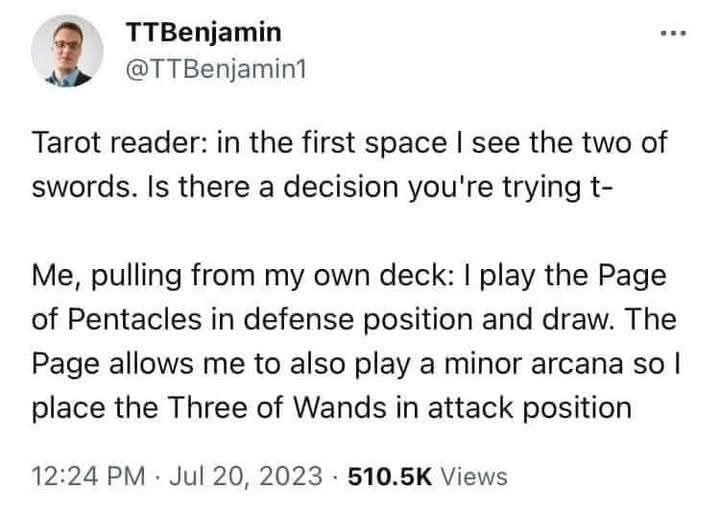
The Tarot one is funny too, particularly if you know that Tarot decks were invented to play the game Tarot, not for fortune telling.
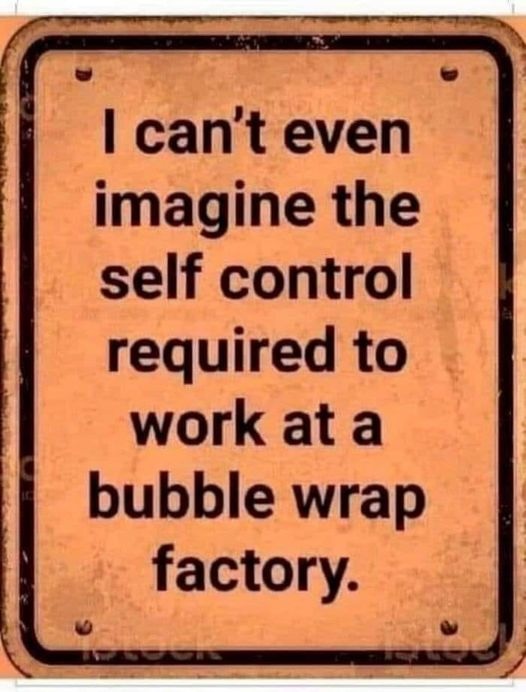
And, the bubble wrap one – Somebody (Satan himself in fact) has now invented bubble wrap that cannot be popped. It’s the worst thing ever.
Reading for pain is also called reading “The Classics”.























































 According To Hoyt
Wait a minute. No comments? On the meme post?
LikeLiked by 1 person
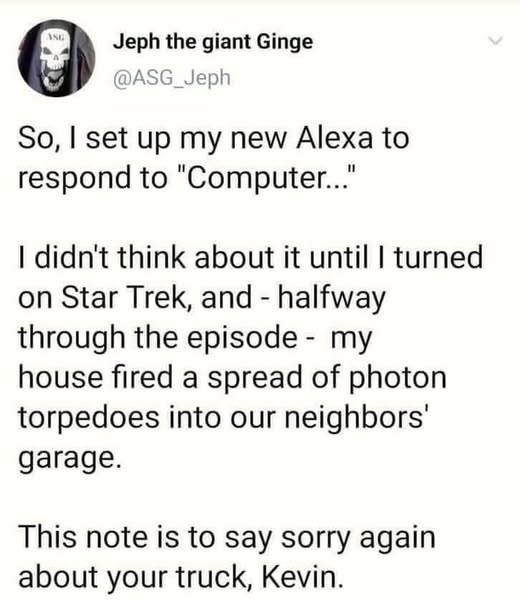
Why does the house have photon torpedoes? How does the house have photon torpedoes?
LikeLike
And more importantly, where can I get them?
LikeLiked by 2 people
Amazon Prime?
LikeLike
Ah, the other Prime Directive!
LikeLiked by 1 person
*slow clap*
LikeLike
Home Ammo Depot
LikeLike
Gnome Depot
LikeLike
well, this is where Alexa can rearrange reality.
LikeLike
Because the quantum torpedoes are STILL on backorder.
LikeLike
The Fabber made them, of course.
LikeLike
Perhaps they’re actually futon torpedoes.
LikeLike
They’re so comfy….
LikeLike
‘Bed Alert!’
but Captain, they’re all in sofa mode!
reverse polarity!
LikeLike
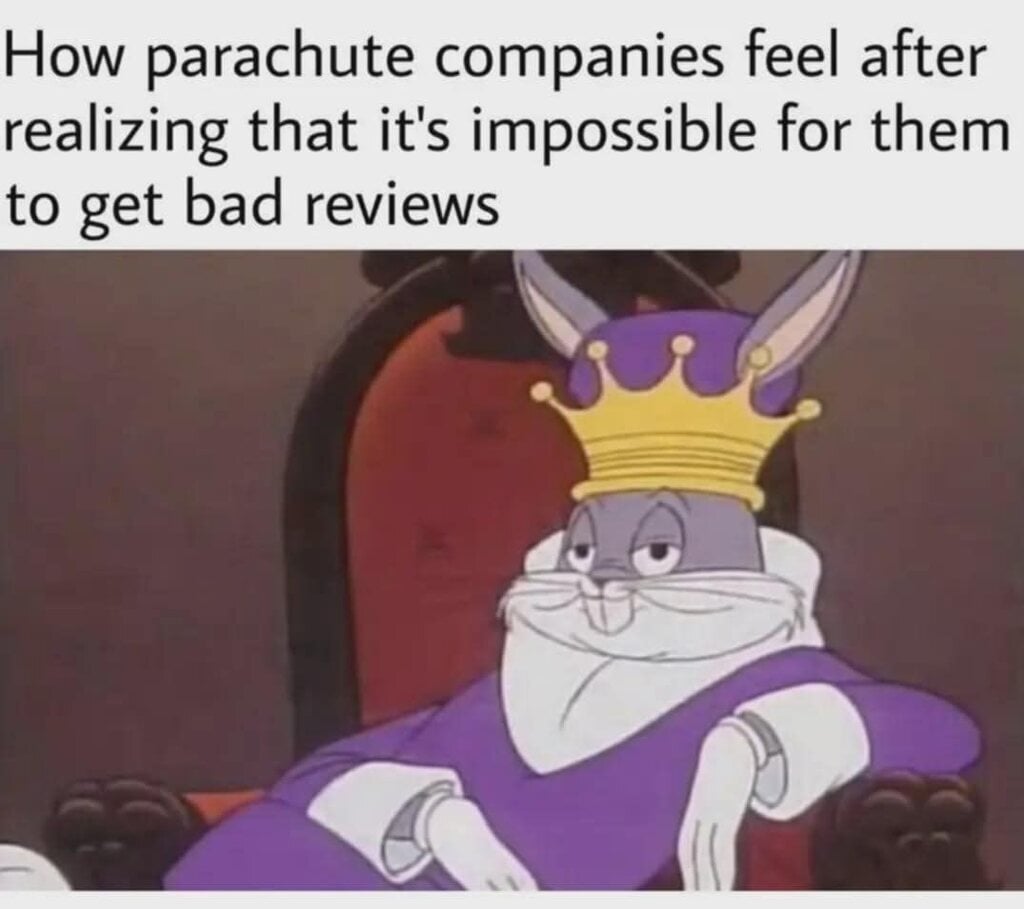
That parachute company has a very select clientele: orphaned, unmarried, and celibate. It caters to monks and nuns.
…. otherwise it would find out that it’s not just the customer, it’s his whole family…..
LikeLike
Right? :D
LikeLike
I knew someone who decided to go skydiving, and I asked if it were going to be at the local-ish place. “Have you looked at their safety record?” was the reply. Once I did, I had no idea how they were still in business.
(They are no longer in business, but it took THREE deaths to get to that point.)
LikeLike
the one in Lodi, Ca rings a bell
LikeLiked by 1 person
That’s the one, as it happens.
LikeLike
I hear they offer family discounts.
LikeLike
Trifect:
LikeLiked by 1 person
It was a rascal to get the exact right aperture and exposure time for that picture, btw. ASA 25 film didn’t make it any easier.
LikeLike
Snerk.
LikeLike
I too have pictures from 2020.
LikeLike
Socialism, fascism and communism are not the same, but they are very similar. So are the results.
Either Bruce Lee was wrong, or I still have a whole lot to learn from the pain. :-(
LikeLiked by 1 person
Brilliant as always, Ms. Sarah!
LikeLiked by 1 person
Need more coffee. 🐲🐲🐲🐲🐲🐲🐲🐲🐲🐲🐲
LikeLiked by 1 person
🍵🍵
🐈
LikeLike
Butler, Pa and CNN
That’s weird. They got scared they were bad luck?
LikeLiked by 1 person
What are the odds? 95 to 1, obviously.
LikeLiked by 1 person
I’m still amazed (and glad) that we’re on the current timeline. I don’t think anyone would have liked the alternative.
LikeLiked by 2 people
Me too. RIGHT leg of the pants of time.
LikeLiked by 2 people
So Autopen Joe’s Administration was the crotch of the pants of time?
Fits.
LikeLiked by 1 person
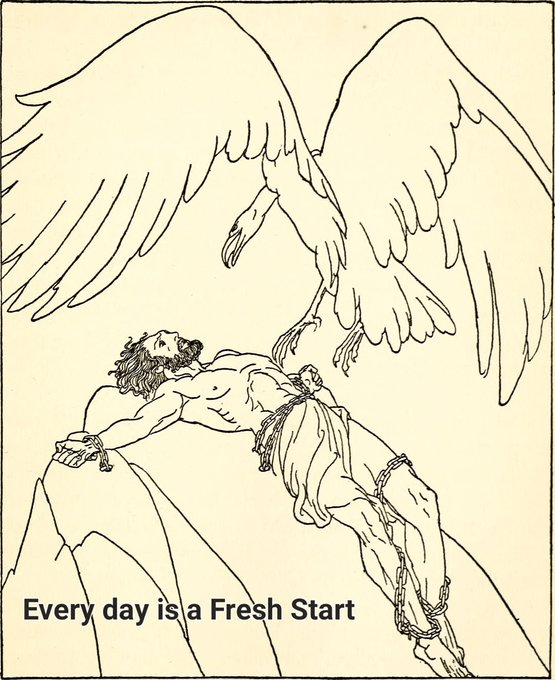
These memes are all good, but the Prometheus one really delivers.
LikeLiked by 2 people
LikeLike
Bill Gates is an idiot-savant. He’s an idiot about most things.
LikeLiked by 1 person
Billzebub never built anything. Sold products that didn’t exist, stole other people’s work and set the computer business back 20 years.
LikeLiked by 1 person
Neither do I take the culinary advice of anyone that has burned out all of their taste receptors with cocaine.
LikeLike
SFBS!
LikeLike
The farm ownership thing is an interesting bit of definition question raising.
For starters, the Gates didn’t own it. (The claim came out during the divorce.) Cascade Investments which manages the cash for the Bill and Melinda Gates Foundation did (maybe does, hard to tell).
And the claim is that he’s the largest private owner of farm land, which can be cash, acres, original cost, or net profit.
….most farms are corporations, even if it’s literally Bob and Jane Schmitt. For the same reason that most of our authors have an LLC.
I don’t know if an investment group actually works, either, really… I’m pretty sure they just took the cash value owned by an individual and compared it to a list.
LikeLike
https://agfundernews.com/bill-gates-tells-reddit-why-hes-acquired-so-much-farmland
(of course I’m poking around, I don’t trust him and this is farm stuff)
LikeLike
But was it ever active farmland, or just held fallow by the investment corps?
LikeLike
That was one of my original questions!
The main place they mentioned was a bunch of farms in south-west Washington that raise potatoes for McD’s fries. So that one is producing.
LikeLike
(for those not familiar, there’s a thing where you get land classified as farmland, but don’t grow on it, applying for various programs from rangeland preservation to water management to studies of how long land can go untouched and still be useful)
LikeLike
Which inspired one of my favorite Jerry Pournelle quotes: “If we can pay farmers not to grow food, can we pay lawyers not to practice law? It would be at least as useful…”
LikeLiked by 2 people
There was a slew (were a slew?) of post-scarcity novels that I dragged through back in my paperbacks-from-bookstores days, where some form of “paid to not work” was assumed.
I recall one where all the characters lived in a mobile agglomeration of recreational vehicles full time, collecting their “reverse taxes” as they for some reason all drove from place to place all together, and doing basically nothing. I don’t remember why they could own their RVs but could not own some property somewhere. I think I was trying to figure out a lot of stuff behind why the author thought this was some form of utopia.
At least Star Trek makes a minor run at how post-scarcity utopian society might work, albeit hand wavey on the details and exceptions. The “basic income/reverse income tax/super welfare” stuff just struck me as something that came off dystopian if anything.
LikeLike
There are people who live like that now.
LikeLiked by 1 person
I know full time RVers. They may meet up with particular people at particular times and places, but they do not migrate en masses like the Golden Horde.
This had everyone living like this, living off their reverse income tax and spending their lives in this odd static yet mobile community thatIIRC basically rolled around to different desert places in the U.S.
SciFi is definitely a good venue for exploring something like a post-scarcity society, I just found this one lacking.
LikeLiked by 1 person
Mack Reynolds: Rolltown
Ace Books, 1976
And it wasn’t a Utopia. I seem to remember that the government was hunting for rebels hiding in one of the rolling communities.
LikeLiked by 1 person
Italic – much the same with “only”.
Or ending every sentence with ‘between the sheets’.
LikeLike
ON THE TOILET! :lol:
LikeLike
The PhD reading one, so much truth in that, depending on your specialty. There are authors who can make the American Revolution, industrial history, military history, and even the American West painfully boring and tedious. Even the environmental and business history of Chicago was a fun read (long and detailed, but fun) compared so some of those other ones.
One in particular ended up getting slipped into the bonfire at the grad student party. (I bought it used, read it, took notes from it, could not sell it back since it was 4th hand, and had no qualms about saving someone else from it. I was not alone in this, and no one saw or said a thing.)
LikeLiked by 1 person
For several years, I labored under the ridiculous illusion that if not I, someone… somewhere… could find real value in the literary theory and “how to be a scholar” tomes I had to buy in grad school. That illusion just happened to fade away for good about the same time I had bought a new Marlin .30-30. It takes a dang thick stack of paper to stop a 150 grain bullet traveling 2100 fps, but a couple of them managed it. At first. I considered it something in the nature of an exorcism. Wasn’t much left of any of them by the end. :)
LikeLike
Well, Neil Renic is a PhD, so unsurprising.
I’m not sure if you meant to imply the existence of a specialty where a doctoral program does not become reading for pain at some point.
I am skeptical. I suspect that every specialty hits the point of ‘reading hurts now for some reason’ as part of that effort to prove the creation of new knowledge.
OTOH, I have heard reliably that programs/fields do have a far swing where expections are concerned.
What on earth does reasonable even mean where the literature review stuffs is concerned? Someone told me that in their specialty, a doctoral student would not be expected to read hundreds of papers.
In response, I mentioned the Frank Patrick/Patrick Frank public access paper that cited on the order of 200 things. Which was not a doctoral student paper, he had hit the end of his career, and apparently had decided to piss people off by writing offensive papers, including on the topic of AGW.
I think that maybe a lot of the review papers doing a fifty to a hundred citations, or more, are experienced scientists or teams of scientists. But I am not sure how universal that is.
I think that it sounds plausible that some projects focus more on a smaller number of books, and others focus more on a larger number of papers.
Of course, almost certainly very specific. Nash did a mathematical doctorate with two citations. One a reference, one a paper he did.
One way to figure things out might be to look at the dissertations from one’s department, and the dissertations from similar sorts fo departmetns. Maybe interview recent graduates, see what they think they read, that did not go into the dissertation.
LikeLike
Using a VPN when buying Kindle books can limit or even halve the Author’s royalties…
LikeLike
and KDP Help isn’t interested.
LikeLike
Can it? I didn’t know that.
LikeLike
My big day, as far as I can tell, was 10 August. I sold 9 ebooks to someone in Houston (I think); but Amazon says they had a non-US IP address…
VPN was the only thing I could figure.
LikeLiked by 1 person
that is, all nine paid at 35% instead of 70%… So I just need to take it and smile.
At this point it’s small potatoes; but so are my total sales… insert sad smile here…
LikeLike
😢
LikeLike
Hmm. The way(s) that I can see that happening are two, off the top of my head.
First, using a VPN that is in a country where VAT is applied – Amazon takes that off before applying the percentage. (Say, if the reader uses the same VPN that they go through to be able to access videos that aren’t available in their territory – like some BBC programs.)
Second, using a VPN that is in a country where the 70% rate doesn’t apply, but the 35%. Right now, the only ones I think that is in are Brazil, Japan, Mexico, and India. Probably not very many in the US that use those (except maybe Bollywood addicts?)
OTOH – what if a UK or Canada user goes through a US-based VPN? Is the VAT still applied? (Maybe if the payment processor is still in the other country, or the payment source can be identified as being in that country? I used to be in the international payment processing software field, but that was decades ago – it has probably become more sophisticated since then to detect workarounds of the tax man.)
LikeLiked by 1 person
My personal experience with Amazon is that if you use a VPN, you can look, but there’s a lot of stuff you can’t do. It really doesn’t like it if you try to stream / buy video, maybe because it has to check if someone from that country can buy it?
LikeLike
If there were no taxes, think how much time and effort would be saved by not needing to avoid them. :-P
LikeLiked by 1 person
LikeLike
Try again.
LikeLiked by 2 people
Now I want to find the real version of that tie…
LikeLike
Nope, I can’t dance either, darn….
*Blinks* Wow, hide and seek with drywall, a banned gun as the prize… maybe try a metal detector first? Hmm….
LikeLiked by 1 person
Yeah, that’s a tough one. Like finding magazines but no gun. Could be buried vertically in a tube in the yard, could be cleverly hidden inside furniture (lots of stuff would fit inside a sofa with only a staple gun needed to reseal things if done right). I’d also check attics and crawlspaces and around the garage before any drywall exploratory surgery.
LikeLiked by 2 people
The last three generations of women in my family left stuff hidden in the houses that they told people was hidden and “you know where to find.” No one found it.
Which reminds me, I need to talk to the DILs.
LikeLiked by 2 people
My mom said she’d hidden money in the house. I asked her to tell me where she’d hidden it and she refused, saying “I’m going to beat this thing.” She died of cancer a month later. We never did find it.
LikeLike
Look up Walabot. You can look inside the walls with your phone. I have one and use it find studs, wires and plumbing for work.
LikeLike
I Love the Italics one. Reminds me of the one where you can take the sentance “She said she loved him” and add the word “only” and it’s amazing how it changes the story.
I also read a book in which there was a place called the “happy bottom riding club” and I realized it did interesting things if you add a dash between different words.
The Tarot one is funny too, particularly if you know that Tarot decks were invented to play the game Tarot, not for fortune telling.
And, the bubble wrap one – Somebody (Satan himself in fact) has now invented bubble wrap that cannot be popped. It’s the worst thing ever.
Reading for pain is also called reading “The Classics”.
LikeLike
OMG Sarah, Your meme roll rocks!! 99% were ones I have not seen and they were hilarious! Keep up the good work, waiting for your next one.
LikeLike
I’m tripping on a shortage of sleep.
Current sound bite circling through my head is ‘Vance married an Aryan nationalist’.
(Well, akshully, Aryan is not modifying nationalist, and also the Aryan is debatable.)
LikeLiked by 1 person
LikeLiked by 2 people
No. He’s not Fang Fang. He’s Fang Fang Bang Bang.
LikeLiked by 1 person
Fool Fool
LikeLiked by 1 person
The “pile of 7.62×51” meme.
Fred the Fed can do that math too. Having a beater .308 bolt-action one occasionally shoots would have nicely covered that pile.
The linking machine is another story. (grin)
For that novel folks are writing….
LikeLiked by 2 people