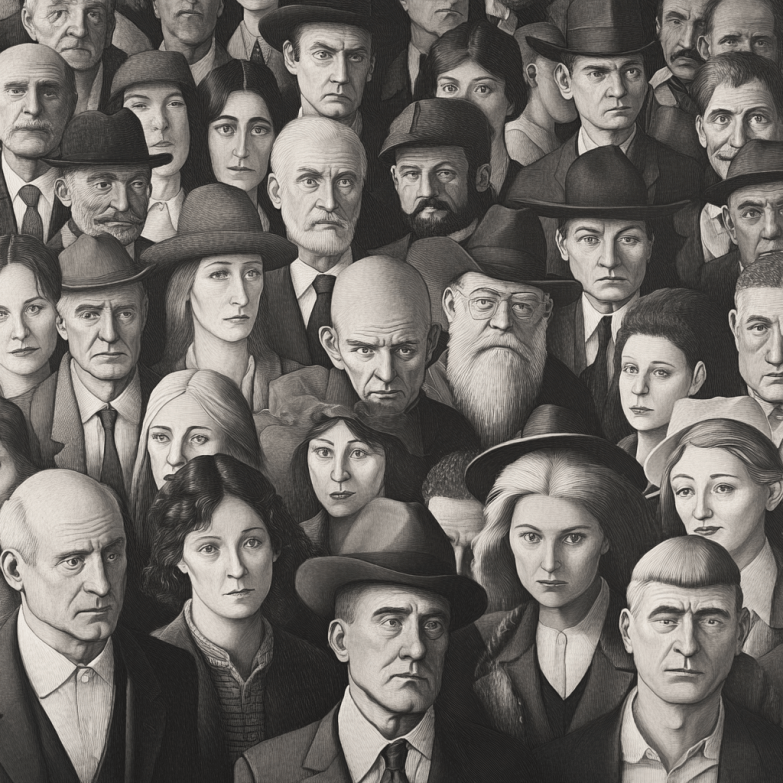
These observations are highly individual and it might be a matter of the sample choice. But there is a picture building in my head, and I’m going to put the image out there, and see what comes back from your own observations.
Almost a year ago, my husband and I were walking through a car museum and something dawned on me. those early model-T and such have tiny seats. Yes, yes, I know, we’re all soooo fat, etc. Newsflash, if you look at your family pictures, you might very well find fat people always existed. Celebrities used to be thinner, but also smaller. So, leaving aside our chest beating on weight and all, let me say I meant they have TINY seats. Not just weight wise, but everything wise. Like people were not just thinner, but smaller in all directions. (I will add here that this same change took place in my lifetime in Portugal. More on that later.)
So I started walking through again and tracked when that changed, which was…. around the late forties, early fifties. And I told my husband “It’s like a massive evolutionary step took place here.” Which when you consider those people were conceived and raised during the depression makes you tilt your head sideways, right?
Well, I kind of saw the same “step” in Portugal. There were tall people, of course. In fact the men in my family tend to peg right around six feet and they were considered massive, both in size and height when I was growing up. When I finished growing (this has changed due to illness and pregnancy which cost me two inches) I was 5’7″ which meant that at thirteen I could look down on a significant number of full grown males. (Staring at your teacher’s bald spot while he’s dressing you down turns out not to earn you friends…)
Now, while the Portuguese are Mediterranean and therefore on average not as tall as Northern Europeans, they are …. massive by the standards of people when I was little. And it’s not just weight gain, though of course, there is that too. It is the modern world. But there are also a ton taller people and … well, bigger in all dimensions.
I have theories about this, and about why it was later in Portugal, but at least one of these doesn’t work for the US, because according to the information I found on line refrigerators only became widespread after WWII.
See, I was going on the fact that when I was growing up most people were vitamin deficient, because though refrigerators existed, they were not widespread anywhere outside (possibly, I didn’t have any contact with them) the very rich and those in the big cities. So, during winter you got whatever was available and grown in your area. Though — perhaps — it has to do with transportation. I know the US got decent transportation for food earlier in the forties, and of course the US grows a lot more food. Maybe? I’m throwing this out to you guys.
I was assuming a lot better nutrition — as what happened in Portugal — caused people to get bigger. And not just heavier. Bigger in all directions.
Then this past week I found myself in a small town museum, looking through pictures of graduation classes from the early 1900s through the early sixties. And again, there was that divide. And it was sharp. It was also weird.
Okay, so I’ve seen pictures of young people from the early century, from the time there were pictures, and I never noticed this. I’ll have to say the difference here was that I was looking at an unfiltered sample. Just a lot of pictures, and the only selection was “graduation from local high school.” While most of the pictures I’ve seen before were in biographies of famous people, usually — tbf — actors.
Guys, it was visible in the men too, but it was stark with the women: Most of these girls, presumably 17 to 18, maybe as young as sixteen, looked OLD.
I realize I’m old — at 62 — and therefore I’ve been writing off my evaluation of how people look. Like, these days, most 40 year olds look like kids to me, and I’ll refer to them as “kids.” I thought it was all it was.
I had a minor shock before, watching the Columbo series (binge watching… a dozen years back when we got the series on DVD.) Because all the women they thought were young and attractive and who were treated as bombshells looked…. OLD to me. Like you knew they were supposed to be in their twenties, but they looked forty. I think I discussed here at the time and you guys said “smoking” and fair enough, there was that.
But look at these pictures of young kids in a small prairie town…. they looked OLD. Like, if you’d presented me with pictures of these girls (particularly the girls, though the boys too, just not as stark) and said “What age do you think they are?” I’d have said early forties. And not even “Forties now” but “forties when I was growing up.”
Now, a lot of that was the hairstyles, etc. Sure. No argument. But not really. Even looking at “just the faces” they looked…. old.
And then around late forties, early fifties, it changes, and yeah, sure, some were still ugly, but they looked like high school kids, graduating.
I have absolutely no idea what could have caused it. I’m just interested it was more or less around the same time, within say a five year span, just like cars changed.
My husband suggested: Antibiotics. Maybe not being sick all the time changed people. Their appearance, sure, but also other stuff.
Why this matters: for years now I’ve been gnawing away at something.
We know that kids today are maturing later. I’ve seen it. And there’s tons of explanations for that. We don’t let them get jobs early. We don’t let them try their wings. We keep them wrapped in cotton, so of course they can’t grow up, right?
On the other hand, having sons in their early thirties, you know, they have their own pressures and fight their own battles.
And yet, yeah, they ping younger.
What if it’s something biological? What if something is taking place that makes people “younger” at the same ages our ancestors were older.
Now, that kind of change taking place within less than 10 years can’t possibly be evolutionary. Evolution doesn’t work that way.
So– what is it? Nutrition? Antibiotics? And is it physical or….?
Now do I have any reason to try to figure this out? No.
But with our information streams corrupted, and our science equally messed up, I feel we should figure things out.
Besides this is the sort of thing that bothers me. Am I seeing something real, or is this a mirage?
Come on guys, sound off.
 According To Hoyt
Based on my own family, which runs a six foot fellows are short genetic profile, the pattern in women is more striking than men. Nutrition I suspect played the largest role. Why women more than men? C’mon ladies, you should know the answer. Iron deficiency. Besides making you pale it makes you look old. Dental hygiene is likely a major contributor. Chronic infection in oral cavity is a real downer when it comes to health and growth. Are we going to give fluoridation or education and better personal hygiene the credit? I guess the latter. And clean healthy water probably the major public health contributor. We take that for granted. Not just bacterial/viral issues in drinking water, but freedom from multiple parasites. Look at populations in current countries with poor sanitation. The answer is staring you in the face.
At any rate, in my family, the size growth occurred in the folks born after WWI. That coincided with many hardships experienced but a mother (my grandmother) who made sure the kids were well fed off home grown meat, fruit and vegetables since her husband was less than successful as an economic provider. And they had a good well, proper hygiene and a lot of prayer.
LikeLiked by 1 person
The water aspect would also carry over to the known effect of “big, healthy farm girls” and the classic Iowa Farm Boy.
(Although not completely, I’ve noticed born and raised in Iowa folks seem to be slightly bigger scale– not taller, just bigger, so the girls at church are built like my daughter, but four or five inches taller.)
LikeLiked by 1 person
Just reducing parasite load does wonders. When pinworms stopped being endemic in parts of the southeastern US, the kids and adults stopped being so pale and lethargic. Being able to use food for yourself instead of supporting intestinal and other parasites does wonders for child health. (And I know, right now there are a lot of arguments about the downside of eliminating all parasites and how the human immune system reacts to the lack-of-targets.)
LikeLiked by 1 person
I think it depends on the type of parasites.
LikeLiked by 1 person
“Big” farm girls and boys.
Wags hands. Define “big”. Can run from “tall” and big. To very short and wide. There be family pictures for proof.
LikeLike
Oh, it’s absolutely variable– my own dad may or may not have broken 100lb before buying his first legal beer– it’s just a known pattern recognized over a large area. Like how American GIs were notable for tendency to be above average size.
LikeLike
I think there’s something to it, but I’ve no idea what. Probably, as usual, a combination of factors – nutrition, antibiotics, the concept of “teenager” gaining strength, technology improvements in daily life tasks, etc. Although, we must keep in mind that it might be something that happened during the first “young-looking person” parents’ childhood – too late to directly affect the parents’ size and appearance, but affecting the gametes?
For irony, perhaps it’s the introduction of widespread plastic?
LikeLiked by 1 person
Hm, teenager + mechanical + time==> farming mechanization.
I was chatting the other day and when my dad’s parents were young, they were the first generation that they didn’t need most of the kids to upkeep the ag work. You still needed a lot of young guys, but going to school and graduating wasn’t a huge sacrifice. (They did tend to end basic schooling earlier for everyone, mind you, but it wasn’t a big deal to go.)
By the time dad came around, they didn’t need to do heavy labor at a fairly young age. Mechanization. And now that stuff that still needed some young guys is almost entirely done by folks who are down right elderly. Who, unlike the gys their age when I was a kid, almost all have every single finger still attached.
LikeLiked by 2 people
When mom was a kid, she was born early 50s, there were two guys in town that had all their fingers.
The doctor and the priest.
LikeLiked by 1 person
My grandmother lost the tip of her thumb (only bottom quarter of the nail left) to her brother’s attempt to use a hatchet on a chicken when she was 6 and he was 8.
LikeLiked by 1 person
Vs now, where people are amazed and horrified to find out that I lost the tip of my pinky finger as a baby, standard “finger smashed in door” accident.
The finger isn’t even deformed, just the nail, ZERO bone damage.
LikeLiked by 1 person
Back in the older days, an uncle had his thumb cut off by a lumberyard saw. He took it to the local GP doctor (a block away) and basically had it sewed back on again (none of the fancy nerve and blood vessel reconnections). Amazing, it took root again and worked pretty much as normal.
LikeLiked by 1 person
An (ex-) neighbor does up-cycling with old boards and metals. She made a mistake using a table saw. Lost the tips of three fingers on one hand. The fingers are now the same length.
Her stuff can be found locally at: https://therustyporch.com/
LikeLike
Supposedly, one of the fingers Uncle Jack lost was the ring finger– jumped off a fence, he got to the bottom, finger didn’t– and they similarly just slapped it back on, and wrapped it up. He lost the end of it years later, but still had all three joints.
LikeLike
Why hubby and his coworkers did not wear their wedding rings when truck ramp log scaling. To many examples of grabbing something to slow your decent down from top of load to the ground when slipping, and ring finger gaps getting caught resulting in losing ring finger.
I was lucky. I only slipped once. Not from the top of a load (like I was getting anywhere near an edge, NOT!) Slipped from the platform between truck and load (jumping from ramp to the platform). Really lucky. Went down folded landing on my padded asset. Did not hit my back or head on the walkway step beside the ramp and between the truck, or the truck steps jutting out from the truck. Fell 8′ – 10′ from padded asset to ground (ramp was just under 5′ high, I’m 5’4″, so ass went down to the ground that far). Also under the good news, no one saw me. Got up, dusted off, finished the truck. Latter when hubby saw the epic bruise I said “I slipped on the ramp”. Truth, just not the whole truth.
Really was a good thing I didn’t stay on that job. Another 15 or so years before the truck ramps all disappeared.
LikeLiked by 2 people
Long ago, one of my shop teachers had nothing left of his ring finger but a very short stump.
He’d been working on a car, years before that, and wanted to disconnect the battery. For safety. But, the clamps were stuck. He got a crowbar to pry them off. It worked. The positive clamp popped loose and his wedding ring hit the fender. The battery’s full short circuit current of 1,000 amps or more welded the ring to the crowbar, and the fender, and almost instantly heated it red hot.
He managed to wrench it loose in a few seconds. The emergency room doctor looked at the finger, burned down to the scorched bone all the way around, and told him, “I can amputate now, or you can wait a few days until gangrene sets in and I can amputate your black rotten finger then.”
He passed on two important lessons he learned that day:
LikeLike
Grandpa on my father’s side worked in a sawmill. His thumb, forefinger and middle finger on one hand were shorter and nailless. You could see the track of the blade in a straight line from thumb to middle finger. (Apparently he lost a tiny bit off the end of the ring finger but kept the nail on that one.)
That said, my current husband was a machinist before he retired, and NO ONE at the factory wore a standard wedding band. HE took his off for his shift and put it in his pocket. Others had theirs tattooed on or used the breakaway silicone-rubber bands. You only need to see ONE ring-avulsion injury to impress you with the necessity of avoiding it.
LikeLike
There’s a whole set of sales sites now that sell silicone rings (many of them “wedding rings”) for those folk who want to wear something that will give long before their flesh does.
I’ve also heard the term “degloving” and if that doesn’t make you want to remove all rings, nothing will.
LikeLike
Less work outside, less sunlight? Good in smaller amounts, but ages you if you get a lot of it.
LikeLike
Could be?
Also- hey! Long time, no see, GOOD to see you!
LikeLiked by 1 person
I am reading more here again, but more often a few days late so I haven’t commented much. Been having a bit too interesting few years. :/
LikeLiked by 2 people
More abundant diet is for sure a contributory factor to the size thing. It’s global but is very noticeable here in Japan where diet improved massively in the post war years and younger people are often 6 inches taller than their parents/grandparents.
I suspect it may apply to the looks old thing too, though that could also be a less stressful environment. Fewer pollutants (smoke, lead etc.) and generally less exposure to things like molds on food.
LikeLiked by 2 people
Same in Portugal too.
LikeLike
Post War Japan, administered by MacArthur, his first problem was feeding that nation.
He took the basic ration designed for Wartime England, substituted rice, and got it distributed.
The better early post-natal diet had significant effects on the childrens’ size and health.
John in Indy
LikeLike
Even to this day, in some parts of Japan, kids have mandatory milk in elementary school. They mostly dislike it, unless it is banana or chocolate-flavored, but it is a post-WWII requirement and they are not allowed to refuse.
(A fair number of Japanese are lactose-intolerant, so different methods have been proposed. But there is a lot of fear of stopping it.)
LikeLike
https://www.tetrapak.com/insights/cases-articles/history-and-tradition-of-school-milk-in-japan
A milk carton company describes the Japanese school lunch and milk program.
Lunch is traditionally served in-classroom, in elementary school.
LikeLike
My wife is Japanese and on the petite side. Despite disliking milk, she drank all she could as a kid in an effort to not end up the same height as her parents. She never reached 5′.
LikeLiked by 1 person
It also makes it so that the kids keep the childhood ability to drink milk.
LikeLiked by 1 person
Not always successful – then again I’m not just lactose intolerant but need milk proteins chewed up by cheese cultures in order to tolerate them these days.
LikeLike
I kinda suspect that skim milk makes it not work as well, but don’t have the data to back that up. It could just be that skim milk tastes so nasty nobody drinks it.
(I do not like the flavor of milk.)
LikeLiked by 2 people
I love the flavor of milk. And I can’t have the intolerance gene. Mom wouldn’t give me milk because she decided it caused my eczema outbreaks (spoiler: has nothing to do with it.) and at 18 when I started drinking it anyway, I was still not intolerant.
MOM OTOH can’t even have ice cream. Only cheese. Which I think was the point. She projects a lot of her issues onto me.
LikeLiked by 1 person
Most mothers seem to; the classic “I’m cold; you need to put on a jacket”. They mean well, so “Yes, Mom”.
LikeLike
When I was in my early teenage years, my Mom switched from 2% milk to skim milk for perceived health reasons (i.e. Fat = BAD!). I like 2% milk. But I literally could not choke down skim milk. It was just absolutely disgusting.
LikeLiked by 1 person
I don’t drink milk these days. But we’ve even dropped 2% milk. Whole milk or nothing. Also don’t care for “fresh out of the cow” milk even cold. The cream is separated. (Cousins hobby farm.)
LikeLike
I read all the time about lactose intolerance, but Japanese people drink enough milk that supermarkets have at least half a dozen brands of full fat milk plus a couple of lower fat. They don’t use it so much in cooking and usually seem to drink it straight which probably explains why they care about the taste.
I’m sure some kids don’t like it, but I’ve seen plenty guzzling the stuff down – shrug
LikeLike
Lactose tolerance is genetic. The original tolerance mutation apparently developed in Europe. But I’ve encountered very few people of other ethnicities who had problems with dairy products (and I live in LA County, so there are a lot of ethnic groups around me). So I suspect that it’s fairly widespread throughout the worldwide population these days.
LikeLike
:big grin: Keeping the tolerance when you haven’t been eating dairy is genetic.
Most humans have it as babies.
Eventually we’re going to figure out how that works, and be able to give people a milk tolerance!
LikeLiked by 1 person
If that could also knock out wheat intolerance, it would be so awesome….
LikeLike
Oh gads, yes, PLEASE I hope we can figure out all the stuff currently kinda blanket covered by “allergies”, now would be good.
LikeLiked by 2 people
I mean, seriously, they’ve been having “food for the employees” in the back for some event the past week, and… let’s just say it’s No Fun Whatsoever to realize that the amount of onion and wheat in the air from someone having hot dogs and meatballs sitting in heaters is enough to make me very, very unwell.
LikeLiked by 2 people
Aye! Over the years, I went from zero gluten intolerance to small amounts in condiments will do me in. OTOH, I can eat normal oats; $SPOUSE is flat out allergic to wheat; walking through the bread aisle in the grocery store was a hold-your-breath moment for her. Yet another reason why I’m the designated shopper.
I had to give up Chinese food; the last meal was Kung Pao Beef, with a reasonable amount of soy sauce. The results were ugly, with the lower GI system in repel boarders mode. At least I didn’t get the stomach paresis from my more memorable experiences. Diarrhea is bad enough. Sluicing from both ends, plus the pain involved, is worse.
(Apparently the trend to high gluten wheat for artisanal bread has done “wonders” for gluten intolerance. )
LikeLiked by 1 person
Hold your breath, indeed. I can still handle grocery shopping, though I avoid the bread sections as much as possible. But being in an area with flour in the air? I wish the result were only GI-based.
Long story short – I always carry emergency antihistamines now, because the idiosyncratic reaction I have to exposure is life-threatening in a way an epi-pen will not help.
And I flat-out do not eat anything I can’t read the ingredients on. This makes social interactions… difficult. I’ve tried keeping it to just “look, I have a lot of allergies, just let me smile and nod and thank you for the thought.” Unfortunately, people don’t seem to want to believe that.
(I did honestly try telling someone once, “Look, if I have a sandwich you will need to call an ambulance.” They didn’t believe me….)
LikeLike
The best case for me with a light exposure is a 5 day bout of diarrhea, usually barely controllable with Immodium AD. Worst case, likely life threatening. Don’t wish to explore.
My very first bout got me 4 nights in the hospital and another week of the runs. Hospital stay was IV only, and at time, nobody knew what it was. Took about 20 years to really figure it out; there’s a delay between ingestion and excitement, started at 36 hours, now 24. OTOH, $SPOUSE is gluten-allergic and saw what was going on. Such problems hit most of her family, while I’m the outlier in mine. Shrugs.
My statement while refusing: “I refuse to eat food that tries to kill me.” They usually get the hint.
LikeLiked by 1 person
A coworker of Japanese ancestry used to drink some acidophilus milk before indulging in ice cream. Worked for him
LikeLike
Even to this day, in some parts of Japan, kids have mandatory milk in elementary school. They mostly dislike it, unless it is banana or chocolate-flavored, but it is a post-WWII requirement and they are not allowed to refuse.
(A fair number of Japanese are lactose-intolerant, so different methods have been proposed. But there is a lot of fear of stopping it.)
LikeLike
Post War Japan, administered by MacArthur, his first problem was feeding that nation.
He took the basic ration designed for Wartime England, substituted rice, and got it distributed.
The better early post-natal diet had significant effects on the childrens’ size and health.
John in Indy
LikeLike
Even in recent years (’90’s, 2000’s), you could see the height difference in Southern California. Lots of Mexican families with really short parents and much taller children.
LikeLiked by 1 person
Human genes have not changed so it has to be environmental factors. Maybe a combination of better nutrition and longer childhood (strenuous work at young ages may stunt growth). Maximum human lifespan has not changed a bit in hundreds of years. The oldest people 100 years ago attained the same ages as the oldest people do now days. More people make it to advanced age, due to medical improvements raising the average life expectancy, but the maximum has not gone up. The downside is more outlive their brain’s useful function before their bodies give out..
LikeLiked by 1 person
Human genes have noticeably changed since the 19th century.
Severe nearsightedness used to be fairly rare. Now it is commonplace. Possibly due to multiple continental/world wars since 1850 killing off the no-glasses crowd, leaving Four-Eyes the 4F to breed..
Flu pandemics and other viral incursions on our DNA.
Vastly more hybridization of people. Some due to cheap-fast travel, a whole lot more due to war and the resultant bride/prostitute kids. Other due to vast migrations, inter and intra continental.
Vastly more radionucleotides in our air, water and soil, with resultant effects on DNA.
LikeLike
There’s also the fact that more near-sighted people survive to reproduce. MomRed would have died from a venomous snake bite as a child if she had not had glasses and seen the snake just before he tried to strike (not rattler, so no other warning).
Lots of reading at a young age will also predispose people to being short-sighted, apparently. The eye stays focused on close-in targets, and can actually reshape a little. One parent of mine is very short-sighted, the other just has a mild astigmatism. Sib has neither, I have both, although I’m not as near sighted as my parent.
LikeLiked by 1 person
Folks also previously didn’t get routinely screened for vision issues– I wasn’t diagnosed until I was in my teens, while our middle son was noted and got correction because it was a “while I’m looking at this anyways-” type thing.
LikeLiked by 1 person
Somewhat off topic, but.. when I was ten and playing baseball at the Y, the coach kept saying, “Keep your eye on the ball.” I didn’t have the sense/experience to inform him, “I can’t even SEE the ball.” I was just swinging where/when I thought the ball would be based on watching the pitcher. But I was damned lucky to hit the thing. I didn’t get glasses for two more years.
LikeLiked by 2 people
Me too. Portugal didn’t work at diagnosing astigmatism.
LikeLike
Me, with my glasses, looking at the moon in the daytime sky:
“WOW, you can actually SEE the moon!”
Mom: “…wait you couldn’t see the moon?”
Me: “I could see the shape, but you can actually see details like in the photograph!”
Mom: “But you have been reading road-signs for me for years, now.”
Me: “I’ll be able to see the letters instead of the general shape, now?”
LikeLiked by 1 person
I got glasses at eleven, and said “Wow, I can see the leaves on the trees!” Previously trees were big green blobs.
LikeLiked by 1 person
It may have been when I was in first or second grade when everyone realized that I needed glasses.
When I was looking at the “black-board”, I shut one eye and shut the other when I was doing close up stuff.
I thought everybody did that. 😁
LikeLike
I got yelled at by my second grade teacher after she rearranged the sitting and put me in the back of class. When I got up out of my seat to walk to the blackboard to read what the assignment was she yelled “what was I doing?”.
“I can’t read the blackboard from my seat”. After a couple of tense minutes where she really didn’t believe me (and me being an angel in class, really), she swapped me with somebody in the front row.
And I think then yelled at my mother about how I needed glasses. It was Amazing! Did you know your supposed to be able to see tree’s as something other than blobs? Mom told me that the next time stuff started to get fuzzy let her know.
LikeLiked by 1 person
What?! There are spots on the windshield?
All the detail was a distraction when driving, and the Iglasses messed with my depth perception.
LikeLike
I call it snake-eyes. I’m near sighted in one eye and far sighted in the other. I learned to adjust my vision to one eye or the other depending on what I was looking at. Left eye for close up, right eye for distance.
LikeLike
That’s similar to my problem at first but later I was nearsighted in both eyes.
After my cataract surgery, I hardly need glasses for things other than reading.
LikeLike
That was precisely me at 22.
LikeLike
Me, in the 7th grade, when I had sort of finished growing, and our pediatrician judged that my nearsightedness was about as bad as it was going to get.
Walked out of the opticions with my new glasses, marveling at how very clear the outlines of each leaf on the tree was, instead of one single great green glob…
LikeLiked by 1 person
Yes, the leaves!
I have actually read a complaint from a girl that she just got glasses in November, so she doesn’t get to do that “Oh I can see the leaves!” because there are no leaves.
LikeLiked by 1 person
yep. Same.
LikeLiked by 1 person
Minds me of an incident when I was pulled over driving a taxi for erratic driving. The cop twigged to the fact that the sunglasses I was wearing were not prescription as my license requires. And he demanded I tell him what every traffic sign in sight said. Got a perfect score. He let me go with a warning. Couldn’t bear to tell him I had every sign in the county memorized. I could even tell him when major thoroughfares had parking restrictions and what time of day.
LikeLiked by 1 person
Girls raised during the Depression typically developed menses at approximately age 18; Boomer girls saw that development on average at age 12, which is quite the age difference. I cannot explain that gap.
I agree, seeing photos of previous generations (emphasis on actors, simply because they were more frequently photographed) they do appear older. I can cite my parents for example, looking older than their chronological age.
Perhaps they wanted to achieve adulthood earlier because the average lifespan was shorter (I have surpassed my grandparent’s ages) – I cannot say but it’s an interesting stream of consciousness.
LikeLiked by 1 person
Things that retard the onset of menses: iron deficiency, lack of protein. Things that make for earlier onset of menses: more sugar, more protein, more calcium. There’s a clear correlation here.
LikeLiked by 1 person
Old time (radio) ads included things for “ironized yeast” – iron deficiency was something of a problem, and so was lack of B vitamins (see: Pellagra, etc.) which the yeast fixed. The popularity of Marmite and/or Vegemite in places is another case of “Behold, B vitamins!”
Adding iodine to salt did wonders for IQ. The brain has more power for itself if the body isn’t fighting goiter problems.
Better nutrition overall? Sure. Easier life with mechanization? Sure. Also sanitation – the less disease to fight, the more energy for everything else.
Better transport? Sure. Citrus, etc. all year ’round! Vitamin C.
Things were going great, until the “low fat” nonsense… that’s not the only Big Fail, but certainly one of them.
LikeLike
OK. Diet availability. Disease eradications of diseases no one would think of today. In 1910 an estimated.40% of the southern US had intestinal tract worms. The newly founded Rockefeller Foundation Did Something about that, a few millions, and changed the South.
. I should go over to the library with a real keyboard to answer better.
LikeLike
stress also makes earlier onset of menses.
LikeLike
Wait, what?! That – the only time I’ve heard of a menses appearing late was in a severely anorexic woman who now has a baby. She didn’t have her first menses until she was 29. The stresses she was putting her body under to remain thin were the reason for that, and since the Depression was so stressful… It could have been a major factor in such a delay. By the 1950s and 1960s the stressors their mothers had to deal with were largely gone, so the girls in the Baby Boom would have been able to develop their menses earlier.
But those Depression stats are still FAR later than what anyone today would consider average or healthy. I had no idea that was the typical starting point in the Depression. Goodness gracious….
LikeLike
There were a lot of “Random Thing that Sounds Good” type theories which have been put out over the last century….uh, and a half, just realized my “in the last century” is aimed at ending in the ’70s or so.
The data frequently wasn’t actually there when a secondary party went to check.
Some of them are reasonably accurate anyways, some really aren’t.
LikeLiked by 1 person
Way too much Established Medicine is somebody’s idea that became canon without anyone ever checking on it.
LikeLiked by 1 person
A to the freakin’ men.
LikeLike
A small detail now mostly lost to history is that around WW2 and after people took a look at nutritional requirements for successful pregnancies, and there was a large if somewhat subtle push to fix the deficiencies.
LikeLiked by 1 person
OTOH anyone who has it under I think 14 …. stress.
LikeLiked by 1 person
Late menses for the heroine of a regression romance novel from China. She was the only one in her class in the 1980’s (urban), because her parents were overworking her and giving the veggies and fruits to her older sister.
They sorta avoided saying outright that it was common in the 1960’s and 1970’s, lol!
LikeLiked by 1 person
Nowadays, the Chinese would likely ask, “What’s a sister?”
/sigh
(they wouldn’t really ask that; I’ve heard it’s a thing for young women over there to ask their boyfriends to call them “sister”, so the word still gets used…)
A real-life younger sibling that was ten years old in the ’80s likely just missed the start of the One Child Policy.
LikeLike
Late menses for the heroine of a regression romance novel from China. She was the only one in her class in the 1980’s (urban), because her parents were overworking her and giving the veggies and fruits to her older sister.
They sorta avoided saying outright that it was common in the 1960’s and 1970’s, lol!
LikeLike
–
That was made obvious by all the Boomers at the nearest “No Kings” protests this weekend. Looked like a pharma commercial or a ocean cruise excursion.
LikeLiked by 1 person
One of the greatest kings was Nosmo.
NosmoKing
LikeLike
Not to mention his cousin, Nodrin.
LikeLike
That bastage…
LikeLike
I’m not a broad evolutionist but what you’re describing would seem to fit generally with Eldredge and Gould’s “punctuated equilibria” concept. The fossil record doesn’t show gradual changes – it seems as though “first there was this, and then that.” Ten years would of course be pretty sudden – a generation is two or three times that – but there are outliers on both sides of the divide.
LikeLike
Never heard of “punctuated equilibria” so thanks for some new learning. I think I read about it in Genesis – you know on Day 5 God created some animals and on Day 6 created the others..
LikeLike
Agreed, Jalan. No animal turned into or gave birth to an entirely different species, but we see different ones come to the forefront from time to time, and most species adapt to changes in environment over relatively few generations.
LikeLiked by 1 person
It’s the theory to try to explain why there don’t seem to be the predicted between-point fossils.
LikeLiked by 1 person
I think you’ve hit the nail on the head with refrigeration. And to a lesser extent, the increase in vitamin consumption. Those “Flintstones vitamins” our parents set out for us gave us nutritional elements previous generations didn’t have. Thus bigger, healthier, and younger looking people. Good nutrition is the key.
LikeLiked by 2 people
Refrigeration exited long before the electric ones. In early days, a farm had an icehouse to store perishables (A local ice works used to harvest lake ice for the Soo Line railroad for cooling produce boxcars into the 1970’s). When artificial ice plants began, the cities had ice men delivering blocks of ice to residential “iceboxes”.
LikeLike
Another factor to consider as posited by Ringo in The Last Centurion would be the sheer amount of chemical preservatives in our food. I know the amount spiked during the first half of the 20th century in the US, which roughly coincides with your observed changes if we consider WWII a demarcation point. I’d have to do a deep dive, but my starting question would be along the lines of “with the advent of easy access to refrigeration and more women in the workforce driving meal preparation trends, did American diets shift sharply in a period less than ten years to include significantly more chemical preservatives?” And if that’s the case, then we have all these kids born in the late 40s and early 50s who eat nothing but preservatives (I exaggerate, of course) their entire lives…and end up looking strikingly younger in their high school yearbook photos.
LikeLike
Or it is like dogs looking like wolf puppies instead of wolves.
LikeLiked by 1 person
The Poisoning ☠️ of The World. Several chemicals spread globally through the environment at that time. DDT and C-8 are the most likely culprits. C-8 is an octane variant used in the manufacture of Teflon which was originally developed for the Manhatten Project. C-8 is similar to body fats and very hard for the body to purge.
LikeLike
Ok…… how is this supposed to be connected to everyone being much *healthier* now?
LikeLiked by 1 person
Given the extremely vague connection to reality, much less the article it’s responding to, it probably doesn’t.
Just making it so that the comment is all over the place.
LikeLiked by 1 person
I suppose in suggesting preservatives as a partial cause or contributing factor to the observably extended appearance of youth, I may have attracted it by hitting just the right keywords to suggest “hey, there’s an opening for this specific flavor of kookiness here!”
Mea maxima culpa, I suppose. I personally agree with your sourced article below re: DDT.
LikeLike
No. He’s commented here before. We didn’t have to approve him.
LikeLike
https://accordingtohoyt.com/2024/10/16/listening-for-the-bells/#comment-994517
LikeLike
:shrugs: Eh, you may have triggered it, doesn’t make it your responsibility.
Did remind me of a random thing, though– one of the common “chemical preservatives” is… vitamin C.
Which very much could help because it works with so many other vitamins.
LikeLike
I believe one type of vitamin E is also a preservative. Tocopherols, used in breakfast cereals.
…
Like many things, major changes often have a set of causes, not just one. What do we have in the 20th century?
Diet changes.
Clean water.
Proper sewerage disposal.
Parasite load changes.
Disease prevention changes. (soap and frequent bathing, vaccines, unspoiled food)
Type of labor and conditions changes.
Net sunlight exposure changes.
Wearing of synthetics.
Use of plastics for food and water.
Changes in the type and intensity of local air and water pollution.
Slaughter of a large portion of the previous high-baby-output male lineage. Abrupt high-output of war-surviving men. Very often with non-local women (officially and recreationally.) Quite a bit of new genetic mixing on a global scale.
Huge gain of radioisotopes in atmosphere, water, soil, food, etc. Increase in net mutations and genetic changes. (Net nuclear detonations in excess of 500MT, mostly atmospheric. Some of it extremely “dirty”.)
“Smaller world” = people move around more. So do accompanying pests and plants and bugs, etc. More genetic mixing, drift, pressure.
LikeLike
:eyebrow raise:
My ancestors that came over from Europe in time to get registered for the draft for WWI were a bit on the newcomer side, but not by that much.
If genetic mixing was the key, the US would’ve had it set in generations earlier.
Likewise the theory of relatively few making a relatively large portion of the members of each generation.
LikeLiked by 2 people
Not that, but…
Hormonal birth control and the rise of estrogen-shaped petrochemical products in the water and food. About, oh, mid-90s I saw a paper documenting cryptorchidism rising.
That’d get you those younger-looking faces.
So the phenomenon might be orthogonal to looking healthier, or in addition to.
Also, speaking to looking older: dress, carriage, i.e. body language can increase the perception of being less youthful, independent of health.
I noticed this both in pictures of my grandparents who were more dignified, even in candids than the generations that passed through the 70s, and in a video in which experienced bartenders guessed “who’s 21+ and who isn’t”.
LikeLike
The change was WAY before the mid nineties. SERIOUSLY. Nothing to do with what they wore. Or carriage. This is not the confidence of adulthood, either. THEY LOOKED OLD, not mature. In fact, a lot looked anxious, ill at ease, etc. Just OLD.
LikeLike
So 1960s? Early 70s?
By the time you get babies born with deformities noticible enough to write up in Science News*, the modest effects at the middle of the bell curve would’ve been had been around for a decade or more.
The faces of people in their 30s and 40s who look adolescent, now, following the trend began looking mid 20s in the 10s and oughts; their age and so on in the 90s…
And I don’t think it’s any one thing, but a lot of little things that hit a tipping point and went over.
And the timing for this 60s – birth control and plastics – seemed about right.
But not if you noticed the changes in the 60s and 70s already. So that’s out.
Another thought that came to me was where in the US you spotted this. Just like Portugal isn’t England, the Ozarks aren’t Southern California. Though Ozarkers migrating to the crops there will look the same. Might be commonalities and changes there.
*I miss them. Never forget.
LikeLike
Late 40s to early fifties. It’s in the post.
LikeLike
Yep, I read it wrong.
LikeLike
Soy also mimics estrogen, too.
A big problem with the theory is that the younger faces show up even for those who don’t have treated water, so the dosing on endocrine disrupting chemicals would be iffy.
It also doesn’t show up at the right time vs the supposed cause.
LikeLiked by 1 person
Yeah, I misunderstood the timeline.
The endocrine disruption is real andcl widespread, though. Again, it is not any one thing, but many with compounding effects.
It’d be easier if the good and the bad in this world were all Just One Thing. Except for Christ, it’s rarely the case.
Lot of littles, all adding up one way or another overall, but not on their own. Like those brain-hurting physics problems about force vectors.
LikeLike
And late forties early fifties.
LikeLike
He also engages in argumentum ad nuclearcootieum.
LikeLiked by 1 person
When people discuss the dangerous chemicals used with nuclear programs, they always forget dihydrogen monoxide.
It is by far the biggest killer, and its distribution is likewise incredible.
LikeLike
When I teach my chemistry lessons I love to distribute an article that gets students’ attention about this highly dangerous chemical. It is ubiquitous, kills thousands of people every year, and yet the gov’t does noting!!! It really makes the point that propaganda, such as using the word “chemical” or a substance’s accurate chemical name, does not mean one should fear the substance.
LikeLiked by 1 person
Oooh, ooh, Mr. Kennedy’s fruit posters!
(website to follow)
LikeLiked by 1 person
Go there, he’s got more posters, and even sells them for a very reasonable price for those science teachers who are interested!
LikeLike
I’ve heard that dihydrogen monoxide vapors can block out the sun, sometimes for days or even weeks on end. Knowing that (and also that it’s the #1 carp habitat in the world) is enough for me to agree it should be banned.
LikeLiked by 1 person
True. As proven by a bunch of environmentalists at a conference signing a petition to ban it.
LikeLike
https://onlinelibrary.wiley.com/doi/full/10.1002/ajim.23362?msockid=2bd3b750ff516b9a0683a285fed76ad3
LikeLike
DDT: A Case Study in Scientific Fraud
https://calepa.ca.gov/wp-content/uploads/2016/10/CEPC-2013yr-Feb28-Comments-AppA_Ex18.pdf
LikeLiked by 1 person
OK, that’s disgusting and despicable, but not particularly surprising. As I have noted before, ‘politics perverts science’. Government scientists report what they are paid to report by their political masters. Can anybody say ‘Climate Change’?
As I also say, “A dishonest scientist is a failure and a fraud.”
LikeLiked by 1 person
Many of us can remember how OLD our grandparents looked in their 60s. These days the average 65 year old looks very different. And I know it’s NOT just my view being different now that I’m that age too.
LikeLiked by 2 people
I have a photo of my grandfather when he was about 45 (date estimated by looking at my brother, who was a toddler). Granddaddy looked older than I am now (65). Great depression? WWII? Or more personal stresses?
LikeLiked by 2 people
Nutrition? Work?
Teen-aged boys in Victorian Britain could outearn both their mothers and fathers, because their fathers had been broken by the hard labor since they were teen-aged boys.
LikeLike
work definitely, but nutrition should have been good. Raised on a farm
LikeLike
When my kid brother turned 70 last month, I wrote on his card “How come we’re so much younger than our grandparents were at our age?”
LikeLiked by 2 people
Indeed I’m 64. My maternal grandfather was 64 when I was a toddler, but I remember him slightly older when I was kindergarten/First grade. I have far less wrinkles and far more mobility than he did at the 67 or so he was then. That said he lived a hard life, Small Dairy farmer mixed with other jobs (lineman, laborer at local chemical and makeup plants), so hard labor and much of it until the mid 1950s out in the sun and weather. He also smoked like a chimney (~2 packs a day when I was a kid and he had allegedly cut down…a lot).
I would say I am similar in appearance to my dad in his early 50’s. In fact I removed a mustache I had had for years in my early 50’s and found myself staring into a face that was my dad in say his 40’s.
In a similar fashion my elder daughter has features (other than her auburn hair) that match my mother. At just 30 my daughter looks younger than a picture I have of my mom for her civil defense card (worked for the power company so had right to be out in an emergency) at 19. Wedding pictures of my mom at 28 a similar age look FAR than elder daughter who is of a similar age.
Both Mom and Dad never smoked (other than Dad briefly in US Army in the early 1950’s) but both lived with heavy smokers and the culture had smoking as ubiquitous especially at the blue collar level they were from.
I will note stress (physical and just general) can take a toll. At 52 I was diagnosed with Large B Cell Lymphoma and did about 5 months of chemotherapy (R-chop 21, pretty nasty stuff). Pictures of me then look FAR older (perhaps 10 years+-) than my current 64. An environment with far more pollutants (leaded gas, heavy use of soft coal, VERY loose controls on heavy metals and water as well as sewerage compared to late 20th, heavy and common 2nd had smoke) probably resulted in FAR heavier exposures to deleterious compounds. That said, though we’ve contained much of that even since the 1960s we’ve added new pollutants which may be affecting other issues (e.g. long chain aromatics that bind to some of the estrogen sites may accelerate menarche and affect younger male development).
Problem here is that we have 10s to 100s of changes over the last 2 -4 generations and it may be any one of them or several in combination. The height/size stuff seems clear to better nutrition CF Japan, South Korea, and China compared to their pre WWII generations and 1950’s /1960’s generations. as always pinning one thing down with humans is near impossible as detailed controlled experiments are nearly impossible AND skate into realms of dubious morality.
LikeLike
I remember how old my grandmother looked at my age. Neither my mother nor her sister look at that old NOW.
LikeLike
Improved nutrition, especially with national and global transportation, plus refrigeration.
Antibiotics.
Vaccinations for childhood diseases.
Clean water.
Stress has to also be a factor. Compare and contrast your ghetto/gangbanger children with normal middle class school kids. You could also compare children in 3rd world nations with the same age groups in 1st world nations.
The thing is, I think it’s a factor of all these things acting synergistically. And while people may not be significantly pushing the maximum life expectancy, more of them are reaching toward it, and living healthier and more active lives to higher ages. (notwithstanding the last couple of census records showing a slight decrease in average life expectancy in the U.S.)
LikeLiked by 1 person
I knew fellow (now gone…) born in 1923. I asked him… “So.. you lived through the Worst Depression in history… and then survived the Biggest War in History… and by the 1950’s there was an imperfect peace, rockets going to space, nuclear power, antibiotics…. no wonder the music of that time was overall optimistic. You went through Hell and emerged into a Wonderland.” His response? “That’s right!”
LikeLike
We had a multitude of factors come together. Antibiotics, the vaccines that truly amazed (Polio, Measles, Mumps, Whooping Cough, Diphtheria, Tetanus), potable water becoming a widespread phenomenon, massive advances in canning and widespread adoption of refrigeration making early childhood nutrition more available, truly astounding spread of sewer systems putting most households online instead of using outhouses, centralization of garbage massively dropping air pollution from backyard incineration, electric heating massively dropping the coal soot smog indoors and out in cold weather, air conditioning meaning people spend a lot more time indoors in hot weather and not getting weathered skin, massive availability of chemical fertilizer removing a great deal of feces from our food supply and breaking the parasite chain… child labour laws, industrialization, and the post-WWII labour glut preventing the vast majority of children from entering hard labour before puberty (or even during).
Back to early childhood nutrition, you’ve not only broken the diseases, the parasite load, and the environmental extremes, and clean potable water out of the tap means that you’ve massively improved hygiene, you also have the widespread availability of milk, including canned & powdered, and of formula, meaning that children did not have to depend on breast-fed for sole source, and could regularize intake and massively increase available caloric load for growth.
Oh, and did I mention the radical increase in availability and affordability of clothing, and invention of disposable diapers, again providing protection and breaking the disease cycle?
How about the massive increase in availability and decrease in cost in SOAP as a side effect of explosives production for the first world war, that again made hygeinic conditions much easier, afforable, and available… and broke the disease cycle, as well as cut down on environmental pollutants?
LikeLiked by 1 person
Not to mention centralizing the rat population away from homes.
LikeLike
We have photos of ancestors on their wedding day. Both are young and look young but still more mature than today’s same aged people. Both died before 50. Both looked extremely “worn” in a family snapshot a couple years before the husband died. His wife survived him by onlyn3 years.
LikeLiked by 1 person
Known issue in the anthropological community. Nutrition: protein at younger ages (toddlers) means faster brain development as well as muscular development. Not getting cripplingly sick when young helps. That illness retards growth and maturation. So, vaccines and even OTC medicines. Sufficient vitamins (not necessarily optimal, but better, because there is a lot of variation in this miniscule criterion). This helps growth along.
It was known as far back as the 60s, if I recall correctly. Studies of human remains going back to before the Romans, though with severely limited sample size, put average human heights around 5’2″-5’4′” I believe. And nobles, rich folk, these were measurable taller and broader- they ate better.
It’s not evolution. That would require, say, a mutation that affects and individual that then gets passed on to the next generation, happens to be a dominant gene or the population is so f*cked that only the surviving ones have the recessive (and “surviving” means here at least surviving long enough to bonk and make babies). Evolution works on the long scale. Longer than a couple thousand years or so, for complex mammals like us, or in teeny tiny populations with rapid replacement.
My take is it is a combination of what everyone else has said here: nutrition, medicine, lack of crippling illness at young age. To put it another way: poor diet and disease during developmental years led to shorter people with shorter lives. Now, we live better and longer with the assistance of good food and good drugs.
LikeLiked by 2 people
Ah, it is not macro evolution– as in, “a new species.”
It could be micro evolution– as in, selective breeding, as with the fat content of beef cattle or the fur and personality of Russian fur foxes.
(this is mostly me geeking about HOW FREAKING FAST we have shown to be able to induce objective, stable genetic changes)
That said, to be genetic it would have to be a really freakin’ big reason, on par with the surviving note you make, and even epigenetic should have required “there is a big thing here where we see stuff that’s never shown up before.”
LikeLiked by 1 person
When I visited Europe in the 80s I was surprised at how low the ceilings were. And that I was too tall for a lot of sets of armor.
LikeLike
Gordon R. Dickson wasn’t a particularly big man. When in Europe he got a chance to try on some medieval armor whose original owner was supposed to be extremely large. Dickson couldn’t even begin to get the armor on.
LikeLiked by 1 person
I think it is healthcare in general.
We ended up living in a town with terrible healthcare for about 5-10 years, and my siblings and myself all ping about 5 years old than we are.
LikeLiked by 1 person
I remember hearing about men in Elizabethan London not being able to grow a beard until they were in their 20s which does suggest hormones were involved somewhere.
LikeLike
But that would be being “younger” not older. BUT I think that’s just a racial sub-strain. Northern europeans mature sexually slower than Mediterraneans. And there was less crossing.
LikeLike
Greeks did not expect men to grow beards until their twenties.
In classical Greece, a typical marriage was between a man in his thirties to a girl in her mid-teens. Oddly, enough, all the vases with paintings of weddings show fully grown young women as the brides and beardless young men as the bridegrooms.
LikeLike
I think important things can change drastically and significantly.
I think where health and the time scales in question are concerned, some things probably changed.
My usual speculation there is childhood mortality and autism.
I do not think I actually know enough to have an opinion about your question. At least, right now, I feel that I do not.
LikeLiked by 2 people
Regarding AMERICAN diet–remember that before refrigeration, CANNING was a huge thing. Spreads in magazines, Victory Gardens, locker space.
My mother was born in the thirties and can JUST remember the WWII rationing. Her [RURAL] family didn’t have electricity until after The War, but Grandma CANNED immense amounts AND they rented a freezer locker in town. So once a week, trip to town to pull frozen meat and get ice for the icebox.
The problem with canning everything is that the cooked-for-hours thing really strips the vitamins out of stuff.
LikeLiked by 2 people
C4C
LikeLike
I read about a medical doctor who practiced before and after the introduction of anti-biotics who said that before anti-biotics there were no “good old days.”
LikeLiked by 1 person
I read one doc’s account of things… those temperature charts at the foot of the bed were there so the patient couldn’t see his own. For pneumonia, one trend meant “live” and another meant “die” and nobody could do a damn thing to switch ‘die’ to ‘live’ And then (in the USA) in the Summer of 1946, in a few weeks… they CLOSED pneumonia wards. No longer needed when penicillin was available to civilian doctors. Now there was a switch that worked!
LikeLike
I would posit a combination of better nutrition and antibiotics/inoculation for common childhood diseases. Diphtheria, typhoid and polio killed or crippled children, TB cut a swath as well. Recall in the novel Mrs. Mike (which was a YA novel!) the heartbreaking description of the diphtheria epidemic in the later chapters, and remember – that Laura Ingalls Wilder’s sister Mary, was made blind by the aftermath of another illness, President Calvin Coolidge’s teenage son, killed in a week by an infected heel blister. Now such conditions/diseases are so rare that sometimes young doctors don’t even recognize them!
I also recall reading – and it may have come up in one of my anthropology courses — that nutrition in Japan was so much improved after the post-WWII American occupation (better and more protein generally, after years of deprivation) that schools had to replace student desks and chairs with larger ones – because the children had grown bigger, taller and generally healthier than their predecessors.
LikeLiked by 1 person
Yep. A tech sergeant I worked with told the story of his buddy the part-time chicken farmer, who tripped by a coop and jammed a splinter coated in guan.no into his hand. Less than 24 hours later the red streak was up to his shoulder and he just barely got to the hospital in time. (His coworkers had to bully him into going).
LikeLike
Hot wound and red streak moving heartward is ABSOLUTELY diagnostic of A Very Nasty Infection Indeed.
LikeLiked by 1 person
For the US, I’d guess that a big chunk is meat.
Probably some stuff like Christmas Oranges even for the very poor– that was something even folks who had trouble keeping the kids in socks got, even if it was through the local church groups.
Ability to drink milk– pasteurization makes it safer, for longer, and it’s got a lot of very important stuff for growing in it.
A breakup of the “we’ve always” because the US has so much mobility, so you get more things that work better, because it’s starting without any material so the work has to be done anyways. (It sounds nice to say folks should just figure out what works better. It is a ton of work, for something that probably won’t improve anything.)
LikeLiked by 1 person
My dad said his family switched churches in the Depression because one offered oranges.
They bounced between Baptist and Methodist.
LikeLiked by 2 people
Biologically, I think they are hitting adolescence earlier. This is probably a function of nutrition, nothing more. Though, I seem to recall some research in the late 90s/early 00s that showed girls would hit adolescence a bit earlier if there was an unrelated adult male in the home.
Socially they are maturing later and have been for some time. A century ago, or a little more, and they were marrying at 16. They left school and worked on the family farm. That is largely no longer the case. Finish high school, then trade schools or college has extended social adolescence into the twenties. Add in economic factors of rising living costs and a crash of wages in real terms, this is persisting for some into the late 20s and early 30s.
Is it a mirage? I think somewhat. The other day I looked at a faded picture of my grandparents. It was taken around 1930 when they were in their early 40s. The impression was one of older people: the dirt, the work clothes, the beaten down appearance from subsistence and tobacco farming in the southern Appalachians. But, looking closer, I think the illusion disappeared: they only looked older because as my grandparents and adults they should look older. In the picture, they were 18-20 years younger than I am now.
I’ve worked around the Army in one way or another most of my adult life. Never did I think of myself as getting old until the colonels started looking young.
LikeLike
As an illustration of the effect of parasites, this photo shows two brothers, one a victim of hookworm, another not: https://www.nal.usda.gov/exhibits/speccoll/exhibits/show/parasitic-diseases-with-econom/item/8100 It’s very striking. The Rockefeller Foundation started the campaign to fight the hookworm. https://resource.rockarch.org/story/public-health-how-the-fight-against-hookworm-helped-build-a-system/
Vitamins, vaccines, antibiotics, dentistry (braces), sunscreen, better nutrition, school lunch programs. The school lunch program was begun due to concern about underweight WWI conscripts in the US.
Also the decline of smoking.
It’s more than that, though, because it seems to me there is a lack of maturity in many modern faces. It’s not physical, more…spiritual?
LikeLike
Nutrition plays a major role. And it can have a multigenerational effect; it’s been shown that children of mothers who were malnourished will be smaller, and it takes three generations of good nutrition before they hit their genetic potential.
A good real world example is comparing North and South Koreans. In the 1950s, they averaged around the same height. Now, South Koreans are much taller and heavier than the Northerns.
LikeLiked by 1 person
Many years ago, when I was in college in Germany, a museum in a nearby town had a display of clothing going back to the 1600s. The garments were all from members of the same social class, and a few were from three generations of the same family. In the late 1700s there was a height jump, and people were taller and wider, men and women. Hello, agricultural revolution and new food crops!
The converse is also true. The French have enlistment (draft) records going back into the 1500s. The classes of 1644-46 have the fewest number of enlistees, because so few of that age cohort met the physical standards for the French Royal army. Famine sixteen-eighteen years before had stunted almost every male that was tapped for the army. (Really bad weather for several years, plus fighting nearby that endangered the farms.) Males did not return to the pre-1630 size until the 1670s, if I recall correctly.
LikeLike
No you’re not imagining things, and I think your theory about refrigeration is on track. There’s also the whole advantage, nutrition wise, of better transportation of fresh food. Prior to the 1930s or so, if it wasn’t in season locally, you either didn’t get it, paid dearly for it, (in Appalachia, even in the 60s when my wife was a kid there, a fresh orange was such a treat as to be one of the things you would find in your stocking.)
Frozen wasn’t a thing yet, and canned, while it beats nothing, still loses some of the nutritional value that fresh brings to the table.
As for Older, younger… Smoking, yes. Also environmental poisons that we have for the most part removed from our lives, and again, better diet. I don’t think anyone has done studies formally on this in the US, but one of the side effects of the second world war, is that they did a lot of formal studies on the Japanese in the aftermath of the war. Reading those is enlightening. While I don’t remember the exact numbers any more, the population grew on the order of three to five inches in height, and 50 lbs in weight in a single generation, attributed mainly to the introduction of milk into the diet at the preteen stage of development. That benefit carries through your entire life. You rarely see an American of any age doubled over in a small r posture unable to stand straight. That’s a common sight for old Orientals.
Why? lots of things, but mostly better diet.
LikeLiked by 1 person
And it’s not necessarily home refrigeration – though that certainly helps. Stores having it helps. Refrigerated rail cars? Behold, a Miracle.
LikeLiked by 1 person
That TetraPak article I linked said that Japanese girls were more than a foot taller than their predecessor generations.
Which I believe.
LikeLiked by 1 person
Both my grandmothers were born in 1913. My parents were married in 1965. In my parents’ wedding pictures, both of my grandmothers looked like “little old ladies” — but they were younger when those pictures were taken than I am now. While I no longer look quite so super-young since my bout with untreated hypothyroidism, I still don’t look “elderly,” although I’m pushing sixty.
I do think that better basic nutrition and health care, plus the mechanization of back-breaking manual labor, has to be a major factor. Both of my parents grew up on dairy farms, and both their fathers bucked bales by hand. Nowadays, a dairy farmer will have a front-end loader (often called a “bobcat,” even if it’s not Bobcat brand) to take care of a lot of those chores — which also allowed the development of the modern round bale, which pretty much requires mechanical handling.
LikeLiked by 1 person
I remember getting into shape for football and wrestling by loading rectangle 80 lb bales on the trailer and then into various barns and barn lofts.
Now with round balers and various PTO fork attachments on tractors, life is easier for those still on the farm. Front loaders really help on the farm chores as well. Add in pivot and tape irrigation to list of back savers.
LikeLike
Why does everybody in that picture look miserable? None of them look like they wanted to be there. Is that a thing with MidJourney and large groups?
LikeLike
AI drafted them. They’re sad.
LikeLike
A thing I’ve noticed in candid crowd / groups of people in the street photos of 50-100 years ago is how, to my eye, the people in them so often look miserable and downtrodden. So my reaction to the miserable look of people in the picture for this post was, “Hmm. AI imitates life.”
LikeLike
It might not be that old of a thing.
As a child sometime in the mid-1960s I realized that all the adults I had contact with were sad and/or angry.
Adulthood didn’t look particularly attractive.
LikeLiked by 1 person
Health and attitude, yes attitude, we also ditched a lot of parasites and infections, attitude because we didn’t see death everyday, how many of those families watched siblings die young? Without that mortality in your face all the time you can afford to be young.
LikeLike
From one of the 1632 books, paraphrased: “They’re all completely mad. But I will forgive them every last bit of madness for this: The children LIVE!”
LikeLike
Yes! This!
The initial shock when the downtimer’s realize that the school teacher, Mrs. Simpson, ad other uptime elders (lack of young adults because “dying town” due to lack of opportunities) are 10+ years older than “grandma” (who is in her early 50’s, I think).
LikeLike
Lower amounts of stress are also a contributor. We’ve all seen people that have “been rode hard and put away wet”, that look decades older than they are. Struggling for food, stress. Daily physical work until you drop, stress. Smoking, stress. Diseases and fighting them off, stress. Having your babies die, stress.
I’ve seen people that are 15-20 years younger than me that look 15-20 years older. And when you look at their life style, wonder how they are still alive.
LikeLike
I knew one gal online… never saw an actual image.. (Second Life…) and one night she recounted ALL the drugs she had ever taken/been on. It was like about the only things she DIDN’T take were methamphetamine and the cathinones. Cocaine, Heroine, Weed, LSD, morphine and on and on. It was seriously, “Woman, how the H!!! are you still alive?!” And one day/night she simply decided she’d had enough and, over time to avoid withdrawal, backed off of EVERYTHING… except the occasional glass of booze… and “Those d— cigarettes!” Ponder that. She got away from freaking heroin by deciding and just backing off… but NOT tobacco.
LikeLiked by 2 people
People are funny. I was in a conversation once where someone said, in as far as I could tell all seriousness, that they knew tobacco was less addictive than heroin, because they’d quit heroin once, and they’d quit tobacco several times.
LikeLiked by 2 people
One of the fascinating, if sad, things I notice as a public defender is that my clients who look my age are often young enough to be my children, and the clients who are my age often look old enough to be my parents. It’s what poverty and drug abuse does.
LikeLike
“So– what is it? Nutrition? Antibiotics? And is it physical or….?”
With cars, it’s a real thing. I have a 1947 Ford COE, meant for a delivery truck or a farm truck. 2 1/2 ton. That cab is -small- inside. I don’t fit. Also the engine and the gas tank are both inside there with you. It would have been very hot, very loud, and fantastically dangerous.
Also slow, the V8 flathead produced 80 hp from the factory. My truck has very low gearing and a two-speed rear axle. 40mph max, empty, on a good road with a following breeze.
In the 1950s the trucks got -much- bigger inside. Nowadays a truck cab is like a dance hall compared to the old COE.
Did people change size in 5 years? No.
Did people change size since 1900? I’m going to say no, my grandfather was born in Scotland when Victoria still reigned, and he was as big as I am. All my uncles and aunts were big too.
Tiny cars were originally made to be like carriages and carts. Those are -small- because they’re pulled by horses. Cars were small because wheezy little 10-20hp engines. You want more payload, not a bigger seat, so you keep the cabin as small as possible. When your V8 is 425 cubic inches, putting out 300 some-odd hp and 400lbft of torque, like a 1964 Buick, then you can have a big cabin.
Also, not to be ignored, American car companies figured out how to stamp -big- panels cheaply, so they could build a big car for the same price as a small one. Given a choice, people will pick the big car with the big engine and lots of leg room.
I’m going to claim technological progress driven by consumer demand, and post-war prosperity.
Women looking older? Eh. Hard to say, with differences in both photography and cosmetics. Maybe they lost their baby fat quicker in the old days? 2025, girls seem to keep that cute little kid face until almost 30, unless they smoke and drink pretty hard.
Could be smoking? Hard to say.
Could also be that a kid became an adult when they were 16 in the old days, and had to take up adult responsibilities. That’ll put some age on ya.
LikeLike
It was weird looking at older cars with those looooooong front ends… until I found myself driving a team of horses… “Oh.. yeah, that was EXPECTED.” Seeing the road “right there” would have been Seriously Weird. One documentary noted it took a crazy-long time to fully realize/interalize the driver of a limousine did NOT need to be exposed to the weather.
LikeLiked by 2 people
I always thought it was because the men who bought the limos didn’t want to be stuck inside the same compartment as the driver. Stick that guy out in the cold, so he doesn’t forget his place.
The long hoods were to cover the extremely large engines. Ever see a Lincoln V12? They’re immense.
Opposite end of the spectrum was the wacky 1933 Dymaxion Car. Driver ahead of the front wheels, engine in the back, monocoque construction like an airplane. Huge inside. Like a van.
LikeLike
er… people did change size. Depending on families. Look at Japan and Portugal — in Portugal it happened since the sixties.
Yes, some families defied this, but not all.
Also actually tbf these women had MORE fat. distributed in a not-baby way.
LikeLiked by 1 person
I think some families are naturally closer to the upper end of height possibility, so it doesn’t show as much.
My maternal line tends to be over 6 feet for men, over 5′ 6″ for women, going back at least 3 generations. During the time you mentioned the men did fill out, becoming much more muscular and wider, but height remained relatively stable.
On the other hand, my female cousins seem to mostly approach six feet on that side now. Mom was considered short for her family, at 5′ 6″.
LikeLiked by 1 person
–
Keyword is “some”.
Both sides of my family run the gambit, for generations. Varies from 4′ nothing (not dwarfism) to 6’6″ (a nephew). Would say the next “grandchildren” generations could be taller. Nope, we still have pixie sized (cousins grandchildren), just like their mother, grandmother, great-, and great-great-, grandmothers. Their father, grandfather, great- and great-great-, grandfathers, are not pixie (pushing 6′ to over). Granted “pixie” is taller than 4′, barely, in the subsequent generations.
LikeLiked by 1 person
My great Grand aunts where reportedly 6 foot tall, but they both did not marry, the line was carried on by the 5 and 4’11 daughters of the family. This was often put forward as to where my almost 6 foot had come from.
On the other side of the family, great 4’11 at best, ,grand 5’2-5,6 and father 5’9
Yet while I live in an atypical area I am amazed how many 6 foot or taller young women walk around. I think our last 3 female employees where all 6-6,2 in height for example, I dont think a single girl in my class at school /post school was 6 foot.
Is younger perhaps simply prettier? less makeup, no smoking and more skin care+good teeth.
I recently saw my grandmother In a photo with us kids splashing around in the water, she would have been no more then 50 even late 40 something but she was dressed appropriately for a certain age, not a swimsuit(I was 6). Where as modern women are still running around in bikinis and swimsuits at 60.
but other then nutrition and less childhood disease I have nothing for causation.
LikeLiked by 1 person
I think part of it, if only a small part, is social. I have pictures of my mother, both grandmothers and great grandmothers. When getting a picture taken was a Big Deal, you dressed for it. Perfect hair, gloves, perfect dress/gown, and if young the pictures were often touched up by the photographer.
The expectation of adult behavior, adult dress, might have made the young look much older.
My mother’s portrait taken at 16 suggests that she was very mature for her age, but at 74 she looked maybe 50.
LikeLike
No. You’re missing my meaning. This is not age by looking adult. it’s AGED. Sagging jowls, crow feet, the works. At 18.
LikeLike
No, I mean people didn’t change size so much in such a short time, the Forties to the Fifities. It’s less than ten years, these are still the same people. They couldn’t have physically changed enough to account for the difference between a ’47 truck and a ’55 truck.
LikeLike
I meant the rising generation buying the trucks was bigger.
LikeLiked by 1 person
Reminds me…
At the end of World War 2, the US Army’s light tank was the M24 Chafee. Not long afterwards, the M41 Bulldog Walker was introduced. But the interior was too cramped for the crew, and no one liked it. There were no complaints in the ranks when it was replaced by the Sheridan.
In ’65, it was decided to expand the ARVN’s tank force. ARVN was primarily relying on Chafees, but spare parts for a World War 2 tank was a serious issue. So the decision was made to replace them with surplus (and retired) Bulldog Walkers. Since the North Vietnamese didn’t use tanks (they had some T-54s and PT-76s, but had no illusions whatsoever about what would have happened if they’d tried to use them against the American forces in the South), the fact that the Bulldog Walkers were light tanks wasn’t a problem. And the South Vietnamese crews *loved* them. The interiors that were too cramped for American crews were just the right size for Vietnamese crews.
LikeLiked by 1 person
To further add on medical improvements, aspirin, and later other fever reducers became widely available, and used. Even a modest fever will set back growth for weeks.
LikeLike
“ Ziegelman and Coe are the authors of A Square Meal, which examines the impact of the country’s decade-long Great Depression on American diets.”
“And canned foods that came in every variety and which, according to the advertisers, were made from better ingredients that were actually fresher than the fresh food that you bought at the grocery store.”
https://www.npr.org/sections/thesalt/2016/08/15/489991111/creamed-canned-and-frozen-how-the-great-depression-changed-u-s-diets
“During the 1930s, in the midst of the Great Depression, canned vegetables became a crucial part of the American diet, offering a relatively affordable and accessible way to obtain nutritious food. “ [AI generated overview-Google]
LikeLike
There have been entire sections of scholarship about this phenomenon. Here’s the breakdown:
You’re not hallucinating. This is a real thing.
Go back to the 19th century (pretty much a nadir of public health in Europe and the US.) Look at the books and popular culture of the day. Note that near the beginning, when Jane Austen was writing, 26 was not only over-the-hill, it was “unmarriagable due to advanced age” (poor Anne.) Or how about old and decrepit Ruth in Pirates of Penzance, 47 years old. Nowadays, you can’t play her without makeup much under the age of 60.
What’s the big change? Our bodies don’t have to deal with daily insults. Aside from the dozen or so vaccine-preventable diseases we just don’t get anymore (each of which would, at a minimum, take a month of illness and recuperation, not to mention any long-term effects), there are another few dozen we don’t get due to better sanitation.
As for nutritional deficiencies, we don’t get beri beri, pellagra, scurvy, rickets, or any of those unnamed issues. We have iodine in our salt, so people don’t get goiters. While people still get gout, we understand it better, so it’s less common and somewhat treated.
Someone mentioned above the treatment for parasites. You know all of those old jokes about “lazy hill folk” (or whatever rural subgroup)? It’s amazing how those groups perked up once they weren’t being eaten alive from the inside.
How many of you have had chilblains, or even know what they are? How many of you have even had to sleep cold (barring a camping experience where you couldn’t manage proper gear)?
And how many of you had to deal with smoking everywhere, all the time, couldn’t escape it?
I call those all “insults” but it’s basically damage. And if you add it up, that’s a LOT of damage we’ve avoided. Even if each one counts as one apparent year, or even just a couple of months, it doesn’t take much to start looking much older at a younger age.
LikeLike
Similarly, I rewatched the first season of Charlie’s Angels about two years ago. It was amazing how normal they looked. These were the “bombshells” of my era, people put posters of them up individually and as the trio. And they certainly were bombshells. But they had creases around the eyes, skin tones that weren’t the same everywhere on their faces, even faint sunspots.
It made it obvious just how abnormal modern actors have become.
Watching The Dresden Files a few years ago, too, it was to me a combo of Kolchak and The Rockford Files. Those actors were a decade older than Paul Blackthorne and Valerie Cruz (who were in their late thirties and early thirties, respectively, at the time), but comparatively made them look like wet-behind-the-ears rookies.
LikeLike
The fellow I knew who was born in 1923? In his early 90’s he still did enough before breakfast to make folks tired just hearing him recount it. It wasn’t until 95 or 96 he slowed down. It was sad and eerie seeing him at almost 99…it was clear his mainspring had wound down.
LikeLiked by 1 person
When my grandfather was 90, he could pass for a young 70. Before he died at 95, he looked every inch of his age.
LikeLiked by 1 person
When my mother was 60, she could pass for 40. When she was 70, she could pass for 60. But by the time she reached 80, she looked it. OTOH, a broken hip at 63 and Lewy Body Dementia at 77 aged her a lot.
Heck, my bout with untreated hypothyroidism aged me, and getting on thyroid medicine didn’t get all of it back.
LikeLiked by 1 person
“Old” people are getting younger all the time – and it’s not just that I am experiencing, uh, Encroaching Geezerhood. Although there certainly is that.
LikeLike
People routinely misjudge my age by 15-30 years. I cannot recall anyone ever guessing my age over the actual, since I hit my 20s.
LikeLike
can confirm. He looks much younger than I.
LikeLike
I have had people express surprise that I have teenagers—and I had my kids in my 30s. Gray streaks in my hair and all. Mind you, I barely have crow’s feet, which I attribute to good genes, almost no midday sun in my 20s and 30s, and a bit of extra weight. (Note to Hollywood: extreme diets age your actresses. Let them have a weight greater than the 2% of the population that are natural skeletons and they won’t have to have plastic surgery so young.)
LikeLike
As many others have observed, I believe the improvements in pre-natal nutritional care have been the driver of these changes in body size. My mother’s generation wore an average size 5 shoe. My generation wore an average ladies’ size 7. My generation’s daughters average a size 9. I wonder if the next generation of adult women will wear a size 11 shoe? That is a big shoe!
Identifying the specific contributors to that improved nutrition – refrigeration, antibiotics, vaccines, sanitation, availability – was never a question I asked myself. That kind of curiosity is why I love coming to read this blog every day. I hope that the changed focus of the health agencies will ask and answer questions such as this one instead of doing things like creating new pathogens.
LikeLike
There’s also forcing feet into shoes too small for them. My mother’s shoe size went up a size and a half over a ten-year period when I was a child because she didn’t have to wear tiny little shoes to be “dressed properly.” (She also got bunion surgery to correct damage caused by such shoes, but that’s not what caused the size change.)
LikeLike
I have noticed the same thing. And it correlates with vaccines, environmental hormones, environmental antibiotics, among other things. So an environmental biological effect may be going on. BUT … it also correlates with ‘softer’ living – drive instead of walk, office jobs instead of physical labor, diets no longer aligned with activity…. so it could be behavioral biological effects. And then there is the contradictory situation of earlier physical (reproductive) maturity with later psychological maturity: the former I would suggest is diet/hormone/’softness’ related and the latter is ‘small family protection’ related.
LikeLiked by 1 person
My relatives from the late 1800’s on both sides had cheekbones and jaws that you could use to cut meat. My mother’s mother looked pleasingly plump, despite being an indefatigable homemaker, by all accounts.
Genes express tallness better if there is no famine, and if your parents didn’t have famine, at key times.
LikeLike
did anyone mention dentistry? I know that my European relatives didn’t have a tooth among them and when they took out the dentures, which are also late in being common, their faces collapsed.
LikeLiked by 1 person
I think so, in reference to keeping teeth, and not being in constant pain from bad teeth. (And toss in not dying from heart infections secondary to severe deal and gum disease.)
LikeLike
My current dentist is the SON of the guy who told me “This ISN’T Star Trek!” But compared to the medieval torturers of the 1970’s, it sure is! I astonished even MYSELF when I said to skip the -caine and just keep things cool… Yeah he didn’t diagnose with a salt shaker… but that was about all that made it NOT Star Trek. If you told me I’d “Transcend Dental Medication” before…. I’d have suggested you needed to reside in an Institution. But I haven’t had ‘frozen (half) face’ in two decades… and before that even the “painless dentist” wasn’t (though his…er.. well-endowed, and..uh…unreluctant. ..assistant certainly eased things.
LikeLike
I am very late to the party, i know. I have said several times, to various people, “Thank God for modern medicine!” Here I am, 68 years next week, and I look like I’m in my late 40s. If I dye my hair, I look younger, if I don’t, I look a lot older. I am the age now that I remember my Dad’s mother being during my childhood, and I don’t look anywhere near as old as she did. She died at 72. She and my grandfather were born in 1902. My parents were born in 1932. One of Dad’s sisters survived rheumatic fever before antibiotics. My Mom’s sister contracted polio at age 8, and had to re-learn how to walk and talk again. My mother’s aunt died of pneumonia, because all the penicillin was sent overseas to the soldiers.
i think it was a combination of medicine, not having diseases like typhoid or cholera (i.e., sanitation) although I had all the usual childhood illnesses, but my much younger siblings did not. Plus vitamins, and freezing. We got a freezer in the late 60s. My Mom froze everything she could, including corn on the cob and strawberries (!) I still remember the Christmas picnic where we has hot dogs, baked beans, corn on the cob and strawberry shortcake. (Out of season!!!)
LikeLiked by 1 person
I’ve seen it too and I’m not sure it has one cause. I do think delaying adult status beyond when the kids should normally attain it doesn’t just delay it – it interferes with it. And those faces? Don’t think unhappy. Think serious.
LikeLike
My personal opinion would be a combination of better nutrition, better healthcare, and more mechanical help with work. It all adds up to not as much life&death stress. We may put more emotional stress on ourselves, but we’re not facing death on a daily basis like we were.
LikeLike
I shouldn’t warn you since the product of the labor of your “book” fixations are our entertainment. But, that looks to me to be a at least a story on the horizon.
LikeLiked by 1 person
During World War 2, there was some actual serious discussion of landing US troops in China. It either would have involved airlifting them into the Chinese controlled areas, or conducting an Overlord-style landing along Occupied China’s southern coast. Obviously nothing ultimately came of these ideas (iirc, an invasion of Taiwan and the liberation of the Philippines were competing ideas, and obviously MacArthur wasn’t going to allow anything except for the latter option; maybe if the war had lasted until 1946), but they were seriously discussed and analyzed. One of the concerns in relation to this was that big American servicemen who were used to eating steaks from healthy American cattle probably wouldn’t do well with the in comparison meager amount of food that the typical Chinese citizen had to eat. China’s ability to feed the American troops would have been limited at best.
That’s around the time frame that you’re discussing. So make of that what you will.
LikeLike
There’s an account by a British nurse in WWI, which I saw excerpted somewhere and never could find again, describing how big, healthy, and graciously confident the nearly arriving Americans seemed compared to the malnourished French/Belgians and the brassy, kind of obnoxious and insecure (according to her) Australians.
LikeLiked by 1 person
Part of that was probably just the American confidence that the nurse describes (which everyone around the world seems to acknowledge is an American trait, even if they can’t agree on whether it’s specifically confidence, arrogance, naivete, etc…). Act confident, and you present in a much better fashion.
But there undoubtedly was a lot more to it. I wonder if the malnourishment was a result of wartime rationing? Or did it exist before the war broke out?
LikeLike
Wife says low Vitamin C levels decrease iron uptake. Low iron causes circles under the eyes and a gaunt experience. If you’re not in a tropical environment, you don’t have a lot of sources of vitamin C. It’s one of the key supplements you can take to help with aging.
A pre-refrigeration diet likely also included a lot of canned goods. The canning process degrades the B-complex vitamins as well as Vitamin C. A lot of the minerals would also leave the food and go into the liquid, which people would not drink.
Gut biotia was probably different.
Then of course you have people walking everywhere, in the sun a lot more, and also sweating more due to a total lack of air conditioning.
LikeLike
er… these people were in NO WAY gaunt.
LikeLike
Oooh.
I just thought of a conspiracy theory that could explain just about any statistical anomoly of the twentieth century, and is also something that we can know pretty reliably is untrue.
Nuclear war between 1895 and 1902.
The next step of doubling down is to insist that the Arminian genocide was the first of several cover ups.
If anyone catches the spelling, then next double down is to insist that Catholics and Protestants colluded to mass murder the Arminians.
Anyway, autism, global warming, AI, and data science were caused by the late nineteenth century nuclear war.
LikeLike
Arminians are Protestants. We just think no one can take you, but if you want to jump, you are free to go. If I had to guess about Armenians, I’d go with Eastern Orthodox.
And I wouldn’t have caught it without the hint on the spelling.
LikeLiked by 1 person
A century of trends in adult human height
https://pmc.ncbi.nlm.nih.gov/articles/PMC4961475/
LikeLike
MadMullahs are hinting about having nukes (that they were not developing yesterday).
I hope the Iranians see the wisdom of overthrowing the Mullahs. Else I suspect we may soon again see the use of nuclear weapons on cities.
LikeLiked by 1 person
It should be apparent whether or not they have nukes, since the final step in “making” your own nukes is to conduct a test detonation. Otherwise you can’t be certain that what you’ve created actually works as intended. And nuke tests can be detected (those tests can also generate false positives for distant listeners, and I’ve heard there’s a lot of speculation that the Pakistani and/or Nork tests were those).
To date, there’s been no word of a successful Iranian nuclear test. So the chances of them having a working nuke is fairly low.
LikeLiked by 1 person
France is said to have nukes.
If one goes with about the worst possible (1) interpretation, they are totally for sure threatening us with them to try to preserve Iran’s terrorist capabilities against Israel.
(1) Some would say that this is not actually a possible interpretation. They may be correct.
LikeLiked by 1 person
France conducted nuclear weapons tests in the Pacific. So they’re not just “said” to have nukes…
LikeLike
The French explicitly have nukes. The French Navy has a fleet of four boomers which feature modern 9,000 km 5 warhead MIRVed SLBMs plus ten nuclear weapon cruise missiles launchable from fighters from their carriers, and they have circa 40 more nuclear cruise missiles equipping their strategic air forces from a dedicated fleet of nuclear-capable land based jets.
Open source has French total thermonuclear warheads at 290.
LikeLike
When they first started out, they had land based IRBMs/ICBMs, but I think I remember themn being decommissioned.
LikeLiked by 1 person
I have always expected Iran to conduct it’s first. Nuclear test in Tel Aviv.
LikeLike
The Iranians need just a few to bracket the developed non-Jerusalem parts of Israel. And they might even hit Jerusalem, just to make sure.
Israel being smaller than New Jersey, and somewhat more concentrated in terms of population, , it wont take much. Thus their elaborate defenses.
But two can play the “sneak stuff in” game. And on -that- front, the USA is a very large seated duck.
I don’t plan to visit DC or NYC until this mess is resolved.
LikeLike
I don’t want to visit DC or NYC ever, but not for your reasons.
LikeLiked by 1 person
We are reasonably sure there was at least one clandestine test, 1979 in the south pacific, “Vela Incident”.
Probably others. A 15-20kt blast in from a back-of-beyond location might be missed.
And one doesn’t really have to test a gun-type device with fissile material. As long as the thing hits a certain speed of slug, and has enough tamper to “dwell” the explosion, it is going to work with a given quantity of enriched uranium. The South Africans put together eight very workable ones prior to the takeover by the ANC. Fortunately, they handed them over before the ANC Commie-loons, and the much worse hardcores, got their hands on nukes.
You can test the gun-type with the “inert” U238 left over from enrichment. If the resultant assembled slug is of proper shape and density the thing would have worked.
You (blessedly) cannot make a gun-type device work with Plutonium. However, you can indeed test the implosion process. We did so extensively before Trinity test, which is why it worked. The folks developing implosion made some very , very interesting steel shapes, and some other stuff too, before they tried Plutonium for the Trinity test.
The really hard part is getting the fissile material in a pure enough state to make a workable weapon that doesn’t promptly a) decay itself, b) fry the handlers, or c) fry the electronics. All the key tricks for the basic weapons of 1945 are out in the open now. And much more stuff about gains through boosting, tamping, neutron reflectors, etc.
All it takes is the materials, time, a freighter of cash, and a cup of hate.
LikeLike
The Vela sat saw those flashes in the Indian Ocean near the SA Price Edward Islands in 1979, and from what I have seen the fact it was a device test was confirmed by knowledgeable individuals in the subsequent Boer diaspora.
What has not been openly confirmed but is very suspected is that the Israelis helped them out with technical assistance.
LikeLike
Which also would have been a good way for the Israelis to covertly confirm that their own “We refuse to confirm or deny the existence of such weapons on Israeli soil” weapons worked without explicitly announcing it to the world.
LikeLiked by 1 person
Interestingly, Western US coal mines report their blasting to the government and international monitors. A single shot with conventional explosives in the low kiloton range looks pretty much like an underground test of a similar sized tactical nuclear weapon on seismographs.
LikeLike
Well, they dropped a video of a dude in Iranian uniform heavily fondling a model with a nuke symbol decal on it, with propaganda text along the lines of “Soon!”
The webcaster I saw it on asked the most relevant question: “If they had it, what then are they waiting for?”
LikeLike
Epigenetic effects. As the generations accumulate between people and the last trauma — like the Hunger Plan during WWII — the effects wear off.
LikeLike
BTW, is six foot, five inches tall for an Irishman? See https://www.youtube.com/watch?v=YZWE4KyTxZg&t=118s See the Chieftain fold himself into an armored car hatch.
Myself, I’m in North Carolina and grew up in the sticks, although I did live in boondocks when I was young. I’ve heard of pinworms. Being of an age with our hostess, I don’t think I’ve had them nor do I recall knowing anyone who did. I don’t remember my parents ever mentioning it, but they mostly mentioned notable causes of death and gruesome injuries as cautionary tales. (Buckshot to the head, lockjaw, whatever was going around in 1919 (typhoid?), hot water.)
I’m about four inches shorter than my dad was; but seated we were the same height. If I weren’t bow legged I might have broken six feet.
LikeLike
Fashionably late to this party because Life.
This is real. I first noted this in museums viewing original military uniforms. Late Unpleasantness generals were frigging tiny. Same with ordinary 1860s soldiers. I recall one naval uniform from the Royal Navy where the dude’s torso was so shockingly small I made sure to check the write up to confirm it was a grown man’s uniform. After noting that era I checked the few surviving Revolutionary War uniforms in their collections, and then WWI doughboys uniforms – all uniformly small at the bottom of today’s curve for size. Once you get to WWII you start to see larger uniforms, and Korea and Vietnam stuff is roughly in today’s size ranges.
And that for each period is the fittest, best nutrition-ed, guys to be found, with officers being higher social class and thugs even better fed.
Same thing for women’s dresses, through much later. There was a puff piece on someone buying a Marylin Monroe dress and the writer, on viewing it in person, exclaiming “She was Tiny!” No wonder she looked so, umm, chesty. Go back further and preserved hoop skirt type dresses are minuscule compared to, say, most of the females in my High School class of 1980 graduating class.
My guess: Medicine and dentistry and vastly better nutrition and the start of vaccinations for childhood diseases meant the evolutionary advantage to the rugged scrawny low-caloric-requirement kids went away, and better prenatal nutrition for Moms meant the epigenetic “famine switches” stayed off for more entire pregnancies.
LikeLike
Man, Autocorrupt simply hates the word “thus”.
LikeLike
It’s a little harder to tell from women’s dresses what the actual sizes were due to the survivorship bias. Simply put, if a large woman were finished with a dress, it could be cut down to fit a smaller woman. We don’t have many pre-20th century examples of women’s dresses that are large because cloth is expensive and usually re-used up until cheap clothing came on the scene.
LikeLiked by 1 person
Makes sense, but at least since photography we can scale between men and women generally given the preference for family portraits. And for the men’s uniforms, if they were reused for frugality’s sake they would likely not be uniforms anymore, so any of those were probably original.
I am sure there were outliers – George Washington was 6’ 2” after all – but the median sure seemed to be what today would be pretty far down the curve.
LikeLiked by 1 person
Apparently one of Napoleon’s requirements to join the Guard was that the individual was between 5’10” and 6′ tall. The Guard, of course, were considered unusually tall at the time (as were grenadiers in most armies of the era).
I do wonder about the use of feet and inches instead of metric, though, in post-Revolutionary France. But perhaps he preferred the older measuring system, and could get away with using it since he was First Consul when he wrote the above requirements? Or maybe the source I got it from automatically converted the measurements.
LikeLiked by 1 person
after WW2 ended, everything started getting bigger, bigger cars, bigger trucks, bigger machinery
LikeLike