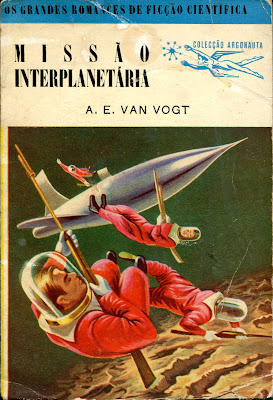
Or — they pointed WHAT at the alien?
No, you’ll wait for that. Chill. First we’ll get to the real stuff.
On what I’m doing with this attempt to reading myself back through the one Portuguese science fiction imprint available when I was a kid, and therefore responsible for catapulting me into reading then writing this crazy stuff, you can read my inaugural post.
The Voyage of the Spaceship Beagle is what I think D. Jason Flemming calls a “Fix up” (?) ie a stitching together of four stories. Which, on the whole are pretty good star trek episodes. Which we later find it was one of the inspirations for.
Actually in reading it, I could see the series of a lot of other, later science fiction.
Anyway, these are the voyages of the Spaceship Beagle, its five year mission….
The spaceship is staffed by scientists and
In each of the stories, it meets an entity. Each entity is hard to defeat, in each entity the Nexialist on board comes through brilliantly.
The book is by A. E. Van Vogt, and while discussing the book with a friend afterwards, I found out that A.E. Van Vogt was not in fact a Dutch national translated into English, something I had in my head probably from the first time I came across his writing, and which was so deeply lodged I never questioned it.
In fact, having grown up reading him (the people who did the Portuguese imprint I’m following, the only official Portuguese imprint of science fiction had a weird fascination with Van Vogt) when I first read him in English I was disappointed and — wait for it — attributed it to his translating better into Portuguese than English.
I honestly have no idea where this came from. It’s not like there were science fiction conventions in Portugal or that science fiction, that weird sub-field of fiction that most people didn’t even know existed, had biographies of its writers aired or printed anywhere. So, where did this strange idea come from? I’m going to assume it was, like a lot of other strange ideas — such as Heinlein having three sons — the result of hearing people talk while waiting in line when there was a new and popular book release. Because Portugal didn’t have organized fandom — honestly, Portugal pretends a lot but it doesn’t have organized anything unless the culture itself has changed a lot since I lived there — but it had vibrant fan gossip network. And the only thing both faster and more inaccurate than fandom gossip is…. I don’t know. I’m fairly sure it’s faster than the speed of light. And more inaccurate than…. science fiction predictions.
Anyway, it’s entirely possible the fact he was raised Mennonite and that’s close enough to Pennsylvania Dutch for Portuguese to agglutinate it all. Or it’s entirely possibly it’s a misunderstanding I came up with all on my own. Who knows?
So, here’s a linked bio of Van Vogt — Alfred Elton? REALLY? — in case you need it, or want to review it. Not Dutch. Definitely not Dutch.
I will point out that I have a very firm idea of Van Vogt as a writer acquired when I was very young — under twenty — and that is that he throws off more interesting ideas per hundred words than any other writer in science fiction, and mostly doesn’t carry them off to their conclusion because it would be impossible.
In that sense, this novel was a disappointment. And, btw, I figured out almost as soon as I started reading it, that I had in fact read it before, but did not in any way associate it with Van Vogt.
The reasons for this are sane but also unfair. Sane because by the time I read it Star Trek was running on TV, as well as stuff like Space 1999 (yes, I do know it was lame, but I felt obligated to support it, because it was science fiction, and we weirdos had to support weirdness.) And the novel sounds like a science fiction exploration series with four episodes-of-the-week. Unfair, because this was the seventies, and of course the stuff was based on this work (and others like it.) On yet the third hand — shuddup, iz science fiction — the truth is these stories, except for the outlandishness of the extra terrestrials encountered, each of which has the potential for destroying the expedition, and all but the first having the ability to destroy humanity if not stopped, read as “generic space exploration” and even the title of the book in Portuguese — interplanetary mission — conditioned me to expect that.
Anyway, so other than that how did I like the play? It was interesting enough to qualify as a “Darn good yarn” and painless to read. The ETs are imaginative and well set out and it works well as see-problem, solve-problem science fiction.
There was a fly in the ointment. Nexialism. Grosvenor, the wonder kid, the go-to-guy for solving everything is a Nexialist, the only Nexialist on board, and his “science” is so much better than all the old traditional sciences at solving these problems.
The problem, of course, is that his science is a dessert and a floor wax. It sings, it dances and it diapers the baby. Nexialism! Is there anything it can’t do? Apparently not.
The ideas I walked away with of this very weird “science” are — Weird. Like, it is a form of what Heinlein said Friday or her boss were “general specialists” — people who could take the other sciences and integrate them — this is okay as the quirks of overachieving and not quite wired correctly geniuses, but I had trouble thinking of it as a science. To justify it he had some form of trick learning, like Heinlein’s Renshawing but more so combined with learning in your sleep. The conceit being that Nexialists could mainline all of human knowledge in a few short years and integrate the whole thing, but guys, seriously? If that were possible, why would it be a specialty? Why not do that to every human? The explanation left me baffled.
I will confess that all this “learning while you sleep” which was in vogue at the time has been “discredited” but I wonder if it really was, or which one is a lie, the learning while you sleep or the thing that assures us that just makes you tired. At some point I’ll do a deep dive into this. Today is not the day.
Anyway, Nexialism bothered me, not just at the level of making no sense whatsoever, because if it was so good why wasn’t everyone trained in it, but at the level where the man used an awful lot of hypnotism, mind control and various other things that disturb me at a gut-level, not just against the various ETs but to adjust his fellow crew of the Beagle. And while it is presented as the only way to save the ship, it made me squirm.
I also disliked the classifications of civilizations that the archeologist onboard relied on. I don’t even like that whole “hard times makes hard men” BS. I think any such view of history is severely reductive to the same point as saying “there are only two plots in science fiction” or something equally zany
Of course, in a way this was a disease of the time: both the belief that the soft disciplines like semantics and history and psychology could be made diamond hard, perfectly predictive and completely useable to control and manipulate men into a perfect SCIENTIFIC society devoid of human problems.
This whole “next stage of evolution” where we will be like gods knowing good from evil was brought home to me by stumbling, yesterday, on this episode of the Why Files. If you don’t want to watch a video, even on 2x the speed as I usually do it, it is the case of Paul Amadeus Dienach. And while I fully believe he hallucinated that while in a comma (though there are doubts the person ever existed) it is more a stew of ideas that were already in the air at the time, and which informed a lot of early science fiction. (Not believable. Among other things the world is supposed to be overpopulated.)
Now, I don’t want to make that sound like I hated the book, because I didn’t. I rolled my eyes at some of the ideas because they are very much ideas of their time. But the book is still a “good yarn” and enjoyable enough to read.
I will point out this is one of the reasons for writing a “darn good yarn” and enjoyable first and worrying about whatever the ideas are later. Because the ideas will age and shift and annoy some of the readers. But the good yarn will carry it through even if people are personally opposed to one of your tricks, like, say, mind control. The story still carries the reader through.
Now, of course, it’s entirely possible that if your ideas are super dooper humdingers you will convert the reader too. But that shouldn’t be your main purpose for writing. Your main purpose should be to tell stories. If you convert anyone, that’s secondary. And it’s more likely that whatever you did will cause them to think and change their ideas but not necessarily to what you’re selling….
If you want to sell a philosophy write pamphlets. Or blogs. If you write novels, write them for enjoyment.
And Voyage of the Spaceship Beagle was pretty enjoyable.
Now, remember They pointed WHAT? at the alien?
I want to say I am absolutely, totally against (with spikes on) changing the original words of a book because they offend the sensibilities of later readers.
HOWEVER–
The good men of the Spaship Beagle carry weapons that emit vibrations. Guess what they call them. Com’on, guess!
In a way this was illuminating, because I wasn’t aware of hallucinating VIVIDLY while reading books. No, not like a movie. It’s more like an immersive hollograph. I’m there, in the middle of the action, and hearing the thoughts of the character in whose mind I am, and–
And when they pull out their vibrators and point them at the alien…
The whole scene dissolves, and I’m laughing hard enough for Dan to be alarmed. Particularly since I was reading this at night, in bed.
I think, since this is a recent ebook edition, it would be sane and well…. it would be sane for the people editing it to call them something like vibro-pistols and footnote they’d changed it from “vibrators” which has a new widespread meaning. Because now I have that image in my head. And I’ll never, ever, ever get it out. Sigh.
The book I’m reading for next week is The Man Who Sold The Moon by Robert A. Heinlein. I haven’t read it in some time, due to having been sick and stuff, so I’m looking forward to it.
The cover and title in the Portuguese collection is this:
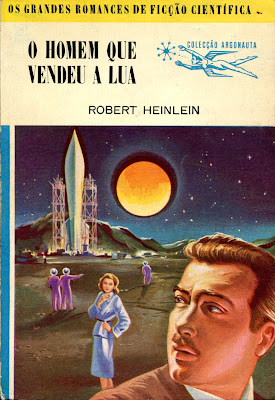
So they somehow refrained from translating it as something like “SCAM IN THE HEAVENS”, though to be fair those wild titles are later in the series and I suspect under quite different management. They also SOMEHOW refrained from giving it a cover pulled from a psychadelic dream. Heck, to my eye, they seem to have made the guy resemble RAH and the woman has a look of Ginny. (Though perhaps that’s coincidence.)
I incidentally found out that the people doing these covers were full on (many of them surrealist) painters. I hate one of them with a burning passion and have opinions which will probably be aired tomorrow at MGC. (I like some of the others, but unfortunately they don’t work for covers in the US now. However they reveal much about what the publishers thought of science fiction readers.)
While on that, incidentally, I’ve revised my position on “I don’t want these books in paper even if you guys want to give them to me.” Look, I’d prefer to borrow them and return them to you when I’m done because we’ve been seriously cutting down on paper books (except for those I think still hypothetical grandchildren might treasure). But there are too many I’m running across that are just too expensive for me to buy for this quixotic project, and too many books that are British or weird, and I simply can’t find in ebook. This will change as we get to more recent books, but not for the early ones.
The ones I’m missing so far, some of which I suppose have no English translation:
L’univers vivant by Jimmy Guieu
Tomorrow Sometimes Comes by F. G. Rayer
David Starr : Space Ranger Paul French, a.k.a. Isaac Asimov.
Antro The Life Giver – Jon J. Deegan
From What Far Star by Brian Berry
The Metal Eater by Roy Sheldon
World at Bay E. C. Tubb
Again, please don’t go and buy these to send to me. But if you have them collecting dust in some backroom, email me at bookpimping at outlook dot com, and I’ll make arrangements for you to mail them to the Vegas address, from which in the fullness of time it will make it to me, and I can return it to you when I’m done with it.
Anyway, onward and upward! We’ll continue the reading project!
These are the Voyages of Reader Sarah, her five year mission to revisit all the reads that pulled her into the science fiction circus and have got her performing with the high wire elephants!
Stay tuned.
 According To Hoyt
Beagle is one of my favorites. I believe the idea was Nexialism was a very new field, not really accepted by “mainstream,” science. Grosvenor had been included on the crew as a test to see if Nexialism was actually useful and was mostly ignored until the coeurl turned up.
The cyclic history bit was maybe from Spengler? I just saw a piece on it on X last week. But was another reason Grosvenor had been included, as the culture knew it was in trouble and was throwing all the spaghetti at the wall to see if any of it stuck.
LikeLiked by 3 people
As I said I know my turn offs, and mind control including hypnotism is one of those.
BUT I still enjoyed it.
LikeLike
Thanks for the gift of the “seashells,” Sarah. I’ve sent a couple of chapters and waiting to see what seashells thinks before moving forward.
LikeLiked by 1 person
ok, now I’m P.O.’ed! False! Tricksy! There are no Space Beagles in this story! Not even a Space Moose blasting their Igno-rays in all directions!
Un tres desolate!
LikeLiked by 1 person
Space Moose bites can be realli nasti.
LikeLiked by 1 person
A moose bit my sister once.
LikeLiked by 1 person
Did the moose survive? [Crazy Grin]
LikeLiked by 1 person
aye. but it was a near thing. And the poor thing had nightmares for years.
LikeLiked by 2 people
Right?
I was thinking something like Charlie Brown’s “Snoopy” 😃(Not really.)
OTOH, a character like Captain Jonathan Archer’s “Porthos”, yes. Sigh.
LikeLiked by 1 person
That business of predictive social sciences goes back partly to the 19th century economists with their idea of “laws of motion” for the economy (a major case of physical science envy inspired by Laplace’s clockwork universe). But I think the biggest source might be Auguste Comte, with his hierarchy of sciences working upward from mathematics to sociology. I read recently that Comte pointedly excluded psychology from his hierarchy, because psychology studied individuals and nothing about individuals could be scientific.
LikeLiked by 2 people
And it never occurred to him neither could assemblages of individuals? LOL.
LikeLike
I have not read Comte myself. But I might guess that he thought of the human species as a collective entity with a collective nature. This is the guy who came up with the “religion of humanity,” after all.
LikeLiked by 1 person
Dear Sarah – Please DO NOT reread “David Starr: Space Ranger” because you will fall twitching to the ground in an apoplectic fit, totally undoing all of the slow but steady recovery of your health that has been going on in the past month! I took one for the team, and read the entire set of the stories (available for free on OpenLibrary.org), and the primary things that Asimov did that drove ME nuts include:
– the main protagonist, David “Lucky” starr is an almost pure Mary Sue
– the other characters are very much one dimensional, and even in the full set of stories in “The complete adventures of Lucky Star” there is little to no growth whatspever in the characters (almost forgivable if we assume these were supposed to be turned into TV shows)
– the plot in DS:SR depends on good old deus ex machina to come to a satisfactory conclusion
– Asimov PREACHES, and preaches hard: Earth is overcrowded, can’t feed itself, and the only thing keeping it from totaly destruction is the benevolent hand of the dedicated scientists in the Council of Science
-the idea of central control being the only way to maximize “progress” pops up regularly, in different aspects, in every story in the full set
– Asimov doesn’t actually tell a good yarn until the last couple of stories in the series, but then adds in extra preaching that essentially says the opponents of the central planning are eugenicist Nazis which takes it back to “ugh, that is painful” level
– a couple stories in, Asimov introduces his robots, which seems to make the stories less absurd, still painful, but lees absurdly painful
The “science” in the book is, of course, truly dated. Again, I can forgive that. Science fiction authors are even worse about predicting the future than weather forecasters, so that’s not a big deal. The human behavior depicted, along with the underlying current of humanity can be eventually “perfected” is what makes it sure miss to read.
LikeLike
I read a epic poop-ton of bad fiction in my youth, but I couldn’t get through any of the Asimov juveniles. Worse than the Hairy Rodent (Perry Rhodan) books.
LikeLiked by 1 person
I don’t think I’ve ever read it! So it wouldn’t be a re-read.
LikeLike
The Asimov juveniles were reissued in the 1980’s in library editions, so you might check your county library system or state university catalog (because university child lit programs have libraries of kids’ books).
LikeLike
Well, another book on my possible re-read list.
I have an e-version of Voyage.
LikeLike
Vibrating sidearms…
…
F – U – sil
(grin)
LikeLiked by 1 person
On the later voyages they upgraded to tasps, since directly affecting the pleasure center in the brain is much faster.
Niven mind… :)
LikeLiked by 1 person
Hey, don’t nessus with my memories.
LikeLiked by 1 person
Beagles always sticks in my mind because of it’s alleged inspiration for the Alien franchise. (Fox did settle the lawsuit, so…grain of truth?)
Also, my notes from reading it back in 2011
“A disappointing novel cobbled together from several short stories with to much soft science and softer philosophy to be entertaining.”
LikeLike
Yes, very much like the Alien Franchise. The story before last, that is.
LikeLike
It may also have inspired James Schmitz’s story, “Lion Loose.” However, Schmitz took the, “alien who passes through walls and can take things with it,” and gave it a totally different twist.
LikeLike
As Tom Weaver points out in his Blu-Ray commentary for It! The Terror From Beyond Space, Alien had a lot of precursors and it’s foolhardy to single out just one “monster in a confined space/vehicle” story.
LikeLike
Well, one of “monsters” encountered in Voyage was a critter who laid it’s eggs in humans which is what the Alien in the movies did.
While that’s something that at least one earth animal did, I don’t remember it much used in Science Fiction.
Oh, in one of Barbara Hambly’s fantasies, we don’t “see it” but it is mentioned happening.
LikeLike
This.
LikeLike
A wasp. It was also used in a Kornbluth short.
LikeLiked by 1 person
That’s . . . a bit more specific. Of course, the Doctor Who serial “The Ark in Space” also had an alien wasp using people for its reproduction just a few years before Alien . . . but did anyone connected with Alien know that?
LikeLiked by 1 person
Also part of the lore in the Foglios’ Girl Genius work, though it seems to be mind control rather than larvae eating hosts corporeally.
LikeLike
F.M. Busby’s Shrakken did the same and the larva would eat its way out. But, the Shrakken used animals whenever possible, and were basically in the grip of a mindless compulsion to implant an egg if they ran out of their version of, “birth control, ” meds.
LikeLike
“Fix-up” is, in fact, van Vogt’s term for it, and he is the coiner since other people took it up. (Furthermore, I believe Space Beagle may have been his first such, though his paperback output in the ’50s was almost entirely fix-ups.)
I am now morally obligated to give characters vibrators for weapons. Probably in the Sexy Catgirls Storm the Solar System series.
You are not missing From What Far Star, you have a PDF of it.
LikeLiked by 1 person
My mind is apparently less dirty than I thought. The secondary meaning of “vibrator” never occurred to me.
LikeLiked by 1 person
I think it’s a generational thing. For the record I saw my first one in San Fran airport … 20? year ago? A woman who had been GIVEN one in the Harlequin Red Author’s party was waving it in the air while talking on hte phone and yelling “What in H*LL am I supposed to do with this?”
No. I didn’t tell her.
BUT I grew up with female acquaintances talking about them in such ways I thought for a while they were pets.
<Sticks to the Heinlein dictum. And “Lonely” wasn’t worth it.
LikeLiked by 1 person
“talking about them in such ways I thought for a while they were pets.”
Did they give them names? :-D
LikeLike
LOL. Thank you. I couldn’t find it. I’ll look for it again.
LikeLiked by 1 person
Shades of Barbarella and the Orgasmitron. (May be the only Jane Fonda movie I’ve watched, so you could say I’ve seen a lot of her…..)
LikeLiked by 2 people
Not that much, the movie does a lot of Austin Powers-ing to remain “tasteful”.
And the orgasmatron in Sleeper was funnier. ;)
LikeLike
Heinlein, in a non-fiction piece, said generalists were needed, not that they existed. And Friday had her ability due to genetic engineering.
LikeLiked by 1 person
Yes. Also I do believe it’s a mind quirk.
LikeLike
I believe he referred to it as “the crisis of the librarian”; a need for someone who could take data from two (or more) distinct fileld and combine them in such a way as to derive a third piece of desperately-needed knowledge. “Polymath” seems to sort-of fit, but not completely.
LikeLiked by 1 person
“fields” 😜
LikeLike
I don’t think it’s possible to overestimate just how much of an influence Voyage of the Space Beagle was on Star Trek. Star Dates. Five-year missions. A spaceship whose commander’s name is four letters beginning with “K”… encountering strange super-evolved beings of god-like power but very human weaknesses.
Not even getting into Alien and Forbidden Planet. As you wrote, Van Vogt threw out a lot of ideas that deserved further use, and both of those were great examples of how to steal rightly.
Van Vogt’s own inspiration would appear to be heavily from Darwin’s Beagle, which also had a five-year mission? And whose voyage’s focus was on “new” life forms and encounters that change man’s conception of what life means.
But as for the hero using “an awful lot of hypnotism [and] mind control”, I remember getting to the end of the Foundation trilogy and realizing, most writers would have made these guys the villains, and the ending a nightmare… Space Beagle was definitely a better read than Foundation, though Foundation was a better insight into the nearly alien mind of futurist writers.
LikeLiked by 3 people
The Second Foundation Must Die! [Frown]
It’s interesting that Asimov later decided that the Second Foundation was the Bad Guys.
Although, he decided that humans becoming part of a “Mass-Mind” was OK. [Very Big Frown]
LikeLiked by 1 person
I didn’t know that—I never read beyond Second Foundation, nor did I ever read about Foundation once I’d finished the trilogy. I mean, it was fascinating, but it definitely didn’t leave me wanting more.
LikeLike
I read the Foundation Trilogy, and Caves of Steel and The Naked Sun, but I belive I bounced off of the much-later Robots of Dawn (not sure I have the title right). I used to read a lot of Asmimov’s SF (and Murder at the ABA), but his work paled to what RAH was doing at the same time. (I’m not entirely fond of Job, but I like the others. Must find a bookmark and take one off the shelf soon.)
LikeLiked by 2 people
I very much like Donald Kingsbury’s Psychohistorical Crisis, which takes another look both at the political assumptions of the Foundation series and at the failure modes of the political structure it aspires to.
LikeLiked by 3 people
I’ve heard of it but I’ve never read it.
Unfortunately, it’s not available in e-format.
LikeLike
No. Kingsbury is being allowed to vanish, after writing some of the most intelligent SF novels I’ve read. I have three copies of Courtship Rite on my shelves, as insurance (including Parade Nuptial, the French translation) and one of each of his other two novels. Psychohistorical Crisis has some marvelous little jokes, including the teenage girl who reprograms Eron Osa’s brain . . . and how she reprograms it.
LikeLiked by 1 person
Courtship Rite, is a truly subversive work. The Gaian culture is horrifying, and yet, he makes them sympathetic.
LikeLiked by 1 person
Courtship Rite is probably my favorite SF novel ever. The scene where Oelita makes her confession to the God she had spent her life denying, and thanks him for saving her people from the true horror of Earth, is utterly brilliant. That’s why I told C I would like to have the French translation (it was a slow read in French, but it felt like reading a story and not like deciphering a difficult code). I’ve tried to give it a few drops of immortality in the hope that someday it will be republished (see the Black Gate website for my most recent review). I hope it doesn’t fall down the Memory Hole.
LikeLiked by 1 person
The memory hole of perfectly good authors being allowed to go out of print and drop from the public consciousness is deeper all the time. I don’t want to wait 50-70 years (who knows, maybe more if they redefine it again) for them to go PD before they’re rediscovered.
LikeLiked by 1 person
Not legally. :(
Kingsbury is a much better author than Asimov. And Wright is a much better author than Van Vogt.
LikeLike
And ordered, despite being in paper only.
LikeLike
Darwin was up to some weird stuff, and he came from a family that did weird stuff. Some of it good (like Josiah Wedgwood), but some weird weird stuff.
Apparently a lot of early autobiographical and biographical material about Darwin and his family was about covering up the weirdness.
LikeLike
Lloyd de Jongh, revealer of unsavory or unmentioned bits of history, does in fact have a YT playlist about Darwin’s unfun, unscientific features as a human being.
https://www.youtube.com/playlist?list=PL_jc4ocGMeQnnWBPpGcM90fOZMB7a_HfM
Lloyd tends to take a very dark view of history, but he’s a very good researcher.
LikeLike
Check your Goldpress email
David Starr in both epub and mobi
LikeLike
Thank you! Much preferred to paper.
LikeLike
Space 1999 was fairly lame, but it was proceeded by UFO, which if one were a teenage male, was definitely not lame, not lame at all. Gabrielle Drake, Wanda Ventham, Norma Ronald. Sigh. Made the Avengers pale.
LikeLiked by 1 person
Wrote a fair amount of fan fiction on UFO. And am now kind of embarrassed at having been a Space:1999 fan having seen an episode not too long ago.
LikeLiked by 1 person
Eh. I was too. Not as much of a fan as the rest of the misfits in the gifted class at the girls’ school (I think their fandom had more to do with a couple of characters) but you have to judge it not by what was later available but by what we could get then.
Any science fiction was better than none. A drink in the desert.
LikeLike
Yep. But I had a thing for Alan Carter -I certainly wasn’t going to have one for Martin Landau.
LikeLike
You just revived a memory I didn’t remember having. There was this big blond girl, my classmate in chemistry, and yes, one of the tragically gifted class.
I can no longer remember her name. But she had a THING for Alan Carter.
Well, we had one of those make it or break it exams in Chemistry, and the teacher was handing back tests and grades by the peculiar method of making us walk up to pick them up at this desk, so he could tell us what he thought of our efforts.
This girl — Luisa? — walked by my desk to go get her paper back. She had her left hand behind her back and it in she had the trading card of Alan Carter. Like a Saint’s image in a difficult time! SMH.
We were all such nerds and lostlings.
LikeLike
Trading card?
Imagine if the characters in the shows could have been traded to other shows, even during a season.
LikeLiked by 1 person
Yep. VERY WEIRDLY Portuguese printed and collected trading cards for various shows and Space 1999 was successful enough for that.
LikeLike
Oh, dear.
LikeLiked by 1 person
Teresa! The girl was Teresa. Heaven only knows what her last name is. I probably never used it.
Wonder where she’s now.
LikeLike
Refresh my memory; was it Space 1999 or UFO that had aliens who suffered from “hereditary sterility”? IIRC they sort of handwaved it away, but you have to admit it’s an interesting concept…”If you’re sterile, chances are good that your offspring will be too”.
Doc Smith move over; that is super-science!😉
LikeLiked by 1 person
UFO had that line.
LikeLike
I knew it was one of them; thanks. It was so clueless it stuck in my memory all these years.
LikeLike
Hey, now, Space: 1999 had Catherine Schell!
(Can’t believe I didn’t have to look her up) I did have to look up Zenia Merton.
Ya think maybe Gerry had a thing for women fighter pilots? :-P The Angels, the Valkyries…
LikeLiked by 1 person
Nexialism! The Original (TM) Techno-Babble (R)! Remember, always reverse the polarity (c)!
LikeLiked by 1 person
When I was young (pre-public awareness of vibrators) Space Beagle was my favourite Van Vogt. I liked the credulous mindset of the crew and the variation in BEMs. I am older now and my appreciation for “scientists” has soured so I now have a more positive appreciation of Grosvenor’s “Will to Power”.
Actually Van Vogt’s autocrat heroes are one of the reasons I like him so much. Absolute certainty, absolute power. He displays these traits to perfection in “The Book of Ptath”.
My favourite now is “Moonbeast”. I think it was published simply as “Beast” in the USA. A (fixer-up) novel of such raw masculine strength that the Woke would ban it if they knew it existed. More wonderfully wild ideas in that slim volume than most modern SF writers could generate in a lifetime.
LikeLike
Um…. liking autocrats is a weird kink. If pursued it leads to voting democrat and ultimately endorsing communist dictators.
To each his own, but for me and my house we prefer the chaos of liberty.
LikeLike
That sort of depends. If the story is good (“The story still carries the reader through”) it can be about the most autocratic society and still be worth reading. The Foundation trilogy is an example (the Empire and both Foundations were autocracies), as is much of Pournelle in the CoDominium universe. And much of Gordon Dickson’s work, especially the Dorsai books. The important thing is how it’s handled, and how good the story is. You don’t have to sympathize with the autocrat(s) to enjoy the stories.
LikeLiked by 1 person
Oh, as a story it’s one thing. I still enjoyed reading this. Liking autocrats in reality which it seemed to me was what this new commenter was implying…. er…. no.
LikeLike
Agreed. I just wanted to point out that a lousy system doesn’t have to mean a lousy story, and the “bad guy” isn’t necessarily a complete sh!t.
LikeLiked by 1 person
How do you get autocracy in the Dorsai books? At least the original novel said that the Dorsai were a fanatically individualistic culture, that they were one of the “loose” worlds that stood firmly against contracts of indenture, and that their Elector had virtually no real power.
LikeLike
Not the Dorsai, but the Friendlies and the science/tech worlds, Newton and (??? Cassida?). The Dorsai themselves were not an autocratic society, but their military, like all competent militaries, was; it’s a requirement. (It could be argued that the Dorsai society effectively was their military; it’s how they interacted with all the other Splinter Cultures.) But I was thinking of the others.
LikeLike
The Friendlies were insane. All the most fanatical cults choose to live on the same planet? (And that’s not even getting to propagating the culture. Massachusetts collapsed into the Unitarianism.)
LikeLiked by 1 person
I appear to have started a controversy with my first comment. To clarify, I think Van Vogt is superb at creating autocrats. The mindset, the unflinching action, the sheer glorious certainty of his characters. I don’t think any other classic SF writer is able to describe absolute power so well. What makes “Moonbeast” such a delirious thrilling read is that each of the three protagonists believes he has absolute power. Iron meets iron and the sparks fly.
I am not a lover of autocrats in the real world.
LikeLiked by 1 person
Oh. All right. Not a controversy, but you were new, and you’re not going to believe the people we get. :D
LikeLike
I recall a rather interesting short story, in which the autocratic control was a closed loop, with the ultimate controller (a rather low-level bureaucrat) himself controlled by the system and worshipping the Ultimate Leader (Garonna), who was the end of a chain of various individuals, with the “controller” at the beginning of the chain. I remember two lines from the story, “This was the day of complete control” and “Serve us, Garonna”. Neither yielded any hits in Brave search so I can’t find the title. Not an especially well-written story (but not “bad”), but I thought an interesting take on the subject.
LikeLike
Van Vogt never really reasoned out the implications of his hypotheses. He tossed out ideas which seemed cool in the moment, but there was no support structure for any of them built into his novels. I call this Comic Book Mentality, but that’s not really a fair name for it – more like kid mentality.
You didn’t mention The Weapon Shops Of Isher, and its sequel The Weapon Makers. I think I read the first about the age of 12, the sequel years later. The failures were less obvious to me at 12. Still likely the *least* oblivious example of his work – at least the Empire of Isher was aware of the Weapon Shops and trying to figure out how to deal with them.
LikeLiked by 1 person
That’s later on the list.
LikeLike
The Weapon Shop stories make no sense at all, though there are some good scenes and quotes.
“The right to buy weapons is the right to be free.”
— A.E. van Vogt, “The Weapon Shops of Isher”
“The Seesaw”, Astounding, July 1941, 54Kb
“The Weapon Shop”, 1942, 95Kb
“The Weapon Makers”, Astounding version, 1943, 390Kb
“The Weapon Makers”, novel version, 1947, 336Kb (also printed as, “One Against Eternity”)
“The Weapon Shops of Isher”, Thrilling, 1939, 195Kb
“The Weapon Shops of Isher,” novel, 1949, 360Kb
The most are from archive.org, hand-edited to basic HTML. Note the magazine version of “The Weapon Makers” is substantially longer than the novel; I’ve found that to be widely true of SF in general, most notably Heinlein.
LikeLike
I wonder if ‘sleep learning’ as a world building part could work if it is a fundamentally costly process?
I.e. it’s not really sleeping; it alternates between learning and recovery phases, which means you’re basically locked into a box for your entire program or rewriting your brain full of stuff? So you’d lose, potentially, years off of your life, and possibly have major damage to your pre-existing mind and personality, including whatever physical impact there was from being in a pseudo-coma for a couple years or more.
Not sure where I’d use it, but could be somewhere?
LikeLiked by 1 person
I listen to a lot of audiobooks for sleep, and I never remember anything from after I fall asleep, until after I’m awake.
I do advise against listening to lectures about Meso-American pagan religion, true crime, or other scary topics as a sleep aid, because either you never fall asleep, or you wake up at just the wrong time to hear something terrible.
LikeLiked by 2 people
How usage changes!
In 1998 I visited Anne McCaffrey (no relation) in Ireland. Fax machines were all the rage that era and I mentioned to her how it was now disconcerting when re-reading Dragonflight (ca. 1968) to come across the name of the antagonist: Fax. She agreed but there was nothing she could do about it. She said at the time she wrote the stories she was looking for a harsh, guttural name.
We’ve almost come full circle. Would anyone of this generation even know what a Fax is? When was the last time you used one?
Maybe in another generation there will be another device for self-pleasure and our intrepid spacemen of the Beagle can go back to using their vibrators to destroy enemy aliens. ;)
LikeLiked by 1 person
Nothing says those devices cannot be dual-use.
LikeLike
LOL
LikeLike
Kirk, from the original Star Trek with the crew visiting a recreation planet: “Set phasers to…caress”.
LikeLike
I remember that line, but I’m sure it was either a Mad Magazine parody, or a Cracked Magazine parody. I remember a Cracked Parody of first season Space: 1999. A meteor is going to crash into the moonbase and Alan Carter is sent out on a kamikaze mission to blow it up. Bergman and Koenig are watching on the monitors and Bergman says, “Just look at the meteor! Just look at the spaceship!” and Koenig replies, “My God! Just look at the wires! Can’t those guys in special effects get anything right?”
LikeLiked by 1 person
I’m pretty sure it was in a Star Trek episode; I even remember Kirk’s smile when he said it. I hadn’t read Mad or Cracked since I was in high school in the early ’60s, long before Star Trek aired.
Obviously, there was no “caress” setting; it was a comment on the “recreation” available on R&R.
LikeLike
Here it is, it’s from the 1976 Mad Magazine: Keep on Trekkin’, The Star Trek Musical. https://www.facttrek.com/blog/madmusical
LikeLike
OK, never saw that; as I noted, I didn’t read Mad after the ’60s. And this…
https://en.wikipedia.org/wiki/Star_Trek:_The_Original_Series
…shows that the series ended 7 years earlier that that Mad spoof, so it looks like Mad got it from the episode I remember. Hardly uncommon; “The Rifle, Man” was another example, along with several of the “Little Annie Fanny” James Bond pastiches. And others.
Anyway, thanks for the info.
LikeLike
Doctors are still required to fax prescriptions to pharmacies.
LikeLike
I guess Nexialism joins Freudianism and Psychohistory and Dianetics as those alleged wonder-sciences that would Solve All Problems. All we need to do is put the new priesthood–I mean the scientists–in charge and everything will be A-OK.
Sigh.
LikeLiked by 1 person
Yeah. That.
LikeLiked by 1 person
Best example I know of came from Olaf Stapledon, who had the US ruled by the Sacred Order of Scientists (SOS). It did not end well, though that was largely due to Stapledon’s British socialist biases and an utter ignorance of actual Americans.
LikeLiked by 1 person
‘Sacred Order Of Scientists’? What was he smoking? Never mind, I don’t want to know.
We’ve got our own ‘Sacred Order Of Scientists’ right here and what they’re pushing is multiple flavors of sheer bullshit. When they’re rewarded for lying, and never punished, what do you expect?
LikeLiked by 2 people
He postulated an American population hypnotized by the power of, “Science!” and scientists, sort of, who were happy to exploit it. Also, they cobbled together a “religion of science” (because of course Americans are simple, credulous people with no hint of spiritual sophistication) involving Christ returning and promising a source of infinite power, with the SOS dedicated to seeking this power out…
Yep, utter ignorance of real Americans. And zero sense of humor, other than (possibly) a touch of Savage satire.
LikeLiked by 1 person
So given the era, his business card would read “Yeshua bar-Yusef, Sales Executive, GE Nuclear”?
LikeLike
Probably, but this was written in the 30s by a British intellectual so expecting any sort of scientific accuracy is to be doomed to disappointment. He had only the vaguest idea of “nuclear energy,” and it shows.
LikeLiked by 1 person
At least Asimov stipulated that psychohistory only worked on large groups of people, the larger, the more accurate. Hence its inability to cope with an anomalous individual like The Mule.
Shouldn’t anomalous individuals be popping up all the time, though? It’s not like you could declare a planetary population to consist of ‘standard humans, 10 billion each’. There would be a few unpredictable geniuses, and some equally unpredictable nutjobs. Somebody might invent some unforeseen widget that changes everything, or blow up something major for reasons that make no rational sense at all. Unless Asimov was pushing determinism and predestination. Hadn’t he heard of quantum theory?
LikeLike
Quantum theory still gives you effective determinism once you have enough molecules to make up a macroscopic object. One mole of a substance is 600,000,000,000,000,000,000,000 molecules. Statistical mechanics was clearly Asimov’s model for psychohistory, though the size of the Galaxy’s human population was too small by many orders of magnitude.
LikeLike
van Vogt was part of Dianetics from 1950 to 1961. Then he dropped out.
LikeLike
The David Starr takes me back to 6th grade in an English-language school in southern Quebec. It was the practice that the teacher would read from novels in English class and we would discuss the reading. The two books I can recall her reading from were Daybreak 2250 AD by Andre Norton and Expedition Venus by Hugh Walters. I must have been really enthusiastic because she gave me a copy of Lucky Starr and the Oceans of Venus at the end of the year. Thanks Miss Westgate!
I’ve been enjoying Science Fiction ever since.
LikeLiked by 1 person
Isn’t that redundant? :-D
I know, not everything weird is British, but most things British are weird.
LikeLiked by 1 person
Britain’s a weird place. Lots of ghosts. Also, Britons.
LikeLiked by 1 person
So, “Britain is weird because it is full of Britons, and Britons are weird because they live in Britain”? :-D
LikeLike
If you substitute “America” it sounds pretty plausible.
LikeLike
“America is weird because it is full of Britons?” :-P
LikeLike
No, no, a complete parallel construction: … because it is full of Americans. I mean, it’s true, right?
LikeLike
A British SF author who began his career in the US pulps, while living in Britain all his life, has been on my radar for some time and there will be iktaPOP releases at some point of some of his work. John Russell Fearn. Who had a whole host of pen names, the most striking of which were Thornton Ayre and Vargo Statten. He was incredibly prolific, had a fine pulp sensibility (“The Queen of Venus”! “Survivor of Mars”! “The Black Avengers”! “Winged Pestilence”! “Nebula-X”!!!), and young Arthur C. Clarke said of him “we must admire the magnificent, if undisciplined, fertility of his mind”. Weird, but as far as I can tell, my kind of weird.
LikeLiked by 1 person
There are lots of weird old British pulp SF magazines on archive.org. Fearn shows up in most of them, and there was even a “Vargo Statten” magazine.
E.C. Tubb was also hugely prolific in the British pulps.
LikeLiked by 1 person
Trust me, I am aware.
LikeLike
I love Voyage of the Space Beagle; it’s one of my favorite SF novels ever, even considering the dated science and dated vocabulary. For what it’s worth, I picture nexialism as the opposite of specialization: where the specialist learns a lot about one subject, the nexialist learns a little about a lot of subjects, but they do it in such a way that they can see the connections between those subjects. I’ve tried to develop that ability in myself, and on occasion it’s been very useful because I see things that others don’t, or see things in a way that others don’t.
Space: 1999 was a terrible show IMHO – it tried to follow in ST:TOS’s footsteps and failed miserably because of a blatantly stupid premise and weak writing. But along the way it produced two of the most terrifying things I (at the time an eight-year-old child) had ever seen on TV: the monster in “Dragon’s Domain” and the aliens in the two-parter “The Bringers of Wonder”.
And Maya was hot.
LikeLiked by 2 people
Space:1999 was originally planned as a UFO sequel UFO:2000.
For example, the “Mark 9 Hawk” was meant to replace the “Interceptors” for UFO defense. The moon-orbiting station was a fighter base, and woukd have saved much delta-V for intercepts. Moonbase was now huge and overt. SHADO had outgrown obscurity as the Alien threat grew.
The network apparently wanted something else, and Sheiss:$19.99 resulted. Then of course, season two went lower budget for $9.99.
(grin)
Was fan of both.
LikeLike
British? How about James Blish? He solved the transporter theology problem with his first Star Trek novel (the first ever written – “Spock Must Die!”). James White – “Sector General”.
Now, I looking to see if anyone remembers any of these two Juvenile Series (I will never call books “Young Adult”.), the first is a really bad one where the hero is on a Mercury flight and has to pop the hatch and EVA to put water in his electronics compartment to cool it.
The second sounds dumb but is actually better written, a boy graduates from a Space Academy, finds his dog stowed away on his first mission. The dog has his own suit and turns out the dog is an telepathic alien who lived with the boy and telepathically shaped him. I think this was a series.
LikeLike
All Rocky Horror fans know the power of the trident shaped sonic transducer vibrator device! “The Sonic Transducer is some kind of audio-vibratory-physio-molecular transport device which is capable of breaking down solid matter and projecting it through space…and who knows, perhaps even time itself!” -Dr. Scott.
LikeLike
Nexialists vs. Null-Aristotelians! Film at 11!
The Nexialists would probably win; the “null-A pause” always seemed contra-survival in a crunch.
John Brunner riffed off van Vogt’s Nexialists – maybe; I’m pretty sure I saw the general idea in some 1930s SF – with his “polymaths.” Brunner’s version made it to the mainstream, though “Polymath” wasn’t nearly as good as “Voyage of the Space Beagle.”
LikeLike
Didn’t Heinlein have “encyclopedic synthesists” in Beyond This Horizon even earlier?
LikeLike
I haven’t read that book in… 28 years? I really should re-read.
LikeLike
Yes, and part of Hamilton Felix’s angst was he had wanted to be a synthesis.t but didn’t have eidetic memory and so was automatically disqualified for the position.
LikeLiked by 1 person
Yes. I’ve wondered if part of that was a reflection of Heinlein’s disappointment in not being qualified to do graduate work in astronomy after his forced retirement from the navy.
LikeLiked by 1 person
UFO and Space:1999 make me angry when I watch them. Gerry Anderson knew how to do an SF series right. At least, he could do it with puppets. UFO and Space:1999 probably had bigger budgets than Star Trek, and the showrunners knew SF forward and backward. The sets were gorgeous, and the special effects were far beyond anything else on television, and most movies, for that matter.
Horrible plots and lack of continuity made me wonder if they were just making things up as they went along. Either one could have been outstanding… but they’re just a mess of random “something happened, something else happened, the end.” And that was my entirely uncritical opinion watching them on TV half a century ago. Trying to watch borrowed DVD sets a couple of years ago simply reinforced my original opinion.
Some shows die on the cutting room floor. UFO and Space:1999 died of… indifference? Arrogance? It was like the Andersons had all the know-how, tools, and money, but simply couldn’t be arsed to make the effort to make the shows what they could have been.
LikeLike
From the Wikipedia article:
The necessity to telex story outlines and scripts to New York for approval caused further production delays. The incessant re-writing this brought about eventually caused Christopher Penfold to resign during the shooting of “Space Brain”, after completing his writing commitment with the script “Dragon’s Domain”. In a later interview, Johnny Byrne stated that “one episode they (New York) would ask us to speed things up, forcing us to cut out character development; then the next episode, they asked for more character moments, which would slow down the action; then they would complain there weren’t enough pretty girls in another.” Years later, Byrne and Penfold would agree that the process they worked under made “good scripts less than they had been” and forced them to waste time re-writing “bad scripts to make them acceptable”.
LikeLike
Wikipedia’s article on Space:1999 is very complete, and the odds against the production even making any episodes seem to have been appalling.
They also had only a three-day work week, because UK law at the time.
LikeLike
Whenever I read SF from the late 40s and early 50s it seems that the idea of psychology or sociology as a quantified, precision science capable of being applied like mechanics or chemistry was very, very popular among SF writers — and, one assumes, readers, as well. I can see three main reasons.
First, the WWII era was the epitome of industrial Mass Man, with everyone noted down on a punch card and big bureaucracies making it all work. And lest we forget, they _did_ make it work. The Axis were not defeated by heroic individuals but by immense coordinated activity, both industrial and military. Arguably the Axis failed because despite their ideology, they weren’t as good at actually managing mass movements as their opponents. So the idea had cachet.
Second, Marx. Of course. Especially if you’re a semi-fellow-traveler SF writer.
And finally, I think the idea of quantifiable, predictive psychology appeals to SF readers because an awful lot of us really like the idea of there being some simple algorithm or cheat code to figure out other people.
LikeLiked by 1 person