
So, the short version of this is: I decided to go on a trip through how I fell in love with the science fiction genre. My voyage was facilitated by there being only one imprint of science fiction books when I was in Portugal (though there were some fly by night imprints and the occasional Brazilian translation. Also at one time this amazing collection supposed to be read by artificial light without glare. It was light blue. Lasted like 3 books, but that was when I was in my early twenties.) Anyway, it’s not absolutely certain that I real all of these books, let alone in this order. For a look at what reading science fiction in Portugal in the seventies, at least for an oddball young girl was a different experience. I gave a fuller account here.
However, there is a chance I’ve read any book of Colecção Argonauta if not owned, at least borrowed. (I had entire friendships because my friend’s parents had a shelf of science fiction books. I regret to say I was a terrible human being when in pursuit of books to read. Truth is, my parents didn’t speak to their daughter about science fiction. I could have had a safer, more socially acceptable like pot. But nooooo. It was science fiction.)
This is the first of the books I ran into that I remember reading, and of course, I remember Ray Bradbury. Ray Bradbury was one of three authors I’d buy sight unseen, look for in every shop that carried SF, and in the bookshelves of friends, casual acquaintances and teachers. (The other two were Heinlein and… Clifford Simak.)
I selected my favorites with no particular encouragement and knowing absolutely nothing about them. The reasons I liked them was that their books gave me pleasure. Later I added other favorites, and some of them are on the list of books ahead. There were also a list of other authors marked “Sometimes like” and a list of “can tolerate.”
But those three never disappointed.
They are, of course, completely different in voice and texture, but I loved them all.
You can look his bio up, if you need refreshing. I’ll give my non-bio impressions of Ray Bradbury. He reads as wonderfully in English as in Portuguese translation (that’s rare. Though Heinlein does too. The texture of both is remarkably consistent in both languages. Again, very rare.)
Ray Bradbury is the kind of writer you read not only for his thoughts — though they’re often quite incisive or even surprising (a quality you want in science fiction) — but for the dream-like, poetic quality of his language. (Or at least I do.) He is a writer you can get drunk on. I knew enough to know he was more acceptable to high fallutin’ literature teachers and professors than my other vices. So when I needed to convert bunch of them to allow me to write papers about science fiction or include science fiction in the school library, it was Bradbury I handed them.
He’s also the graveyard of newbies. I haven’t been in a lot of writers’ groups, but in almost every one of them, there was a kid who came in who wanted to write like Bradbury, and mostly was writing very bad Bradbury pastiche.
The reason for this, of course, is that Bradbury has the bardic gift. No, hear me out. It is a condition of mind, perhaps of being touched by the divine or eternity, which makes you a little unmoored in time and a lot attuned to language and a sort of dream state that evokes deeper truths beyond what they actually think they’re writing.
No, of course I can’t tell you that objectively, but it is the internal explanation I’ve come up with for how Bradbury did what he did. And it helps understand his books at a deeper level and beyond the mere plain storytelling.
Yes you can take me to take a hike on that. And I can tell you “Fight me.”
Which brings us to The Martian Chronicles.
https://amzn.to/3GQQvRWThe Martian Chronicles
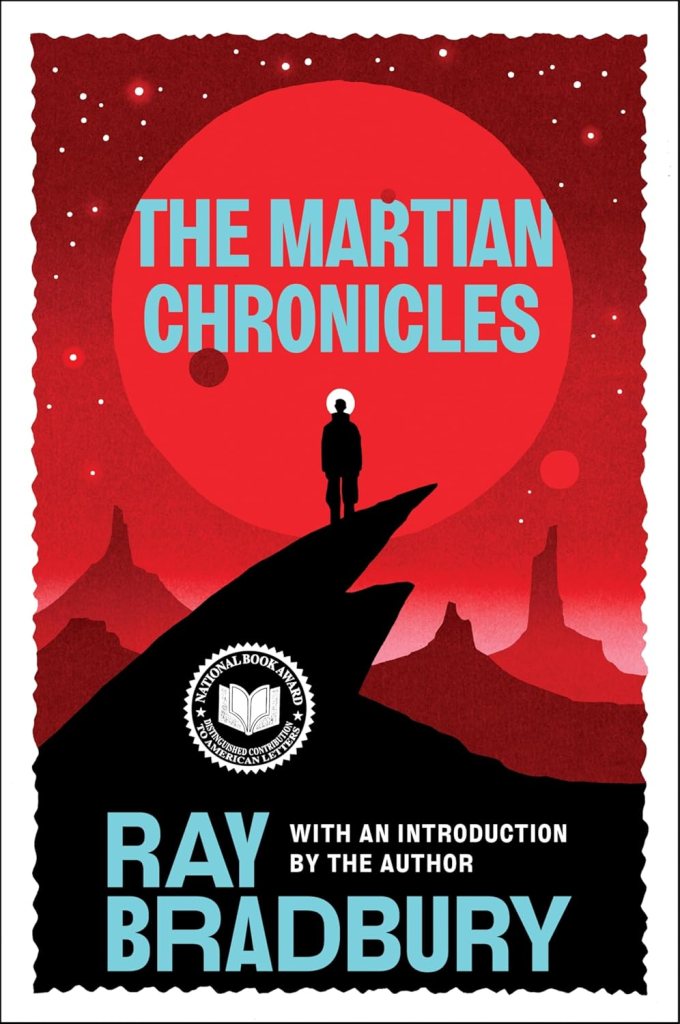
(This edition, which yes, has my associate’s link which means I win a tiny commission at no cost to you comes with an introduction by the author.)
I know it was the first Bradbury I read, because I expected something completely different when I first read it. I was I think 12 or maybe 13, and I remember reading it in Summer, because I remember reading it on the terrace, atop of my parent’s garage. And I remember I expected something very different. You see, the spine said Science Fiction, so I expected … well, calculations, and how to build a rocket, and the detailed colonization story.
What I got instead glossed over the exact measurements and the calculations and went straight into … well…. fantasy. Or at least more fantasy than what I expected.
And yet, it grabbed me right up and transported me into a world that was impossible, and which yet I completely believed. I’m not going to say short story by short story, and of course this is a novel composed of short stories.
I no longer remember how I felt about it at 12 other than “I like” but I know how I feel about it now. First of all, obviously, I enjoyed the book. Now a bit of deeper analysis.
The things he gets incredibly right:
1- this quasi-dreaming fantasy feel might be the best way to narrate the encounter between two cultures so alien to each other as humans and (this story’s) Martians.
2- He doesn’t make the Martians into noble savages and the humans into crude invaders. In fact in the very first stories, the Martians come across as pretty awful.
3- He gives us humans good and bad and makes us root for them.
4- the xenophobic idiot is the bad guy.
5- well, he’s BRADBURY. The worst story in this is better than anything I’ve ever written. He suggests things he never says, and we’ll get into that in a moment.
The things he gets wrong — in my opinion! —
1- he partakes of the belief in the nuclear war fear mongering propaganda which was quite normal in this place and time and honestly he probably couldn’t have been published without it.
2- This one is utterly baffling but I finally figured it out by noodling: He has all the new colonists abandon Mars to go back to Earth when war broke out. This broke me out of a it for a day or so, and I had to walk around to process it.
You see, I couldn’t understand it, because I am me, and I belong to my generation. Years and years, growing up I heard how the Earth was just going to break out in nukes all over, and after that it would be unlivable.
If my generation had gotten away and be in Mars for twenty years, and war broke out on Earth, and it were the kind of war where everything completely falls apart and will not be habitable for a long time? Hey, we’re staying on Mars, perhaps toasting the explosions in the night sky.
But this is not what Bradbury’s experience was. He was born in 1920, so he would have grown up on stories of immigrants in America abandoning everything to go back and to Europe and fight for the countries they left behind. And he probably saw it again in WWII, at least among the British immigrants.
Other than that, as I said, I greatly enjoyed the book, probably as much, maybe more than I did when I was a teen.
There is one hinted at thing that I think struck me the first time. I think so because at some other time, I read Dark They Were And Golden Eyed, and I agglutinated to this novel so i was convinced it would be in it.
Why did I think that. Well, of course, in DTWAGE the humans who have immigrated to Mars become the Martians we saw at the end of beginning of the Martian Chronicles.
The reason this made perfect sense to me is a story in the middle of The Martian Chronicles, in which a Martian Youth headed to a party in one of his cities crosses time-paths with a young Earth colonist headed for a party in one of his cities.
They argue over which of them is in the future of the other. And you get this sense of vertigo, like they don’t know and neither do you. And of course, DTWAGE ties a bow in that, so maybe they are both right.
Anyway, highly enjoyable and evocative and it gave me a little chance to enjoy the same magic I experienced when I first read it.
Next week, well… next week is complicated.
Next up is Tomorrow Sometimes Comes, by F. G. Reyer. The book can be obtained from Amazon, but in paper and for $30. And since I have no memory of it at all, I don’t want to take the plunge. The next book after that is even worse. Its the first book of the Lucky Starr series, and it runs into the hundreds of dollars.
With your permission — right? — I’m going to skip these two and advance right into this beauty:
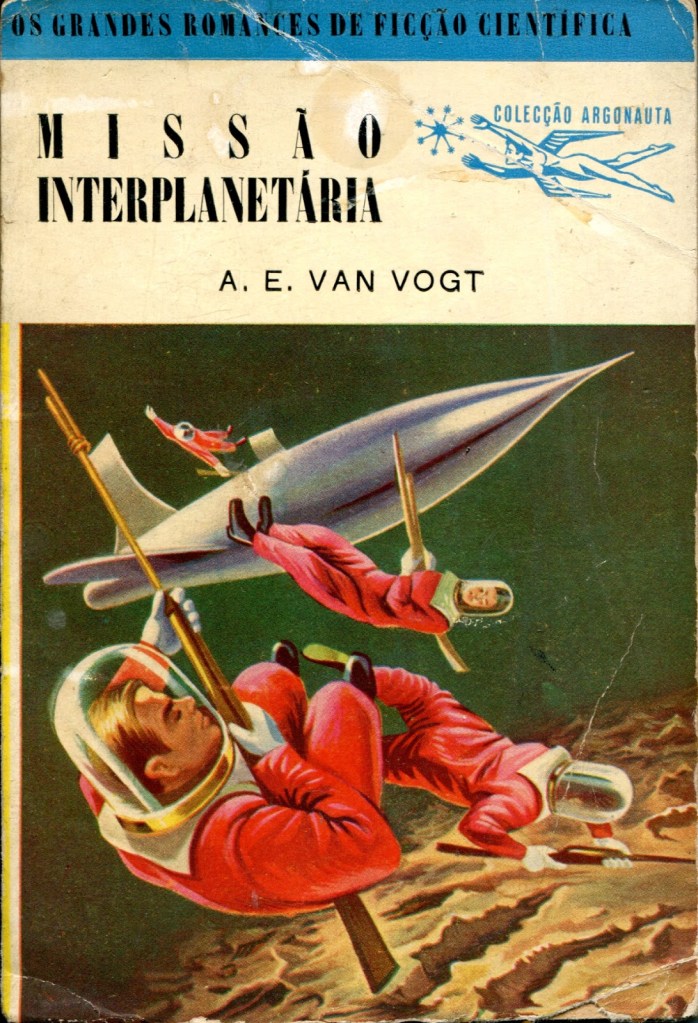
Since you probably are looking at it and going “er… what?” … well, this is The Voyage of the Spaceship Beagle by A.E. Van Vogt. (And again, I earn a small commission if you buy it through that link.)
I have mixed feelings about it. I’m fairly sure I never read it, because having read about the voyages of the Beagle in my early teens, I’d have remembered this. And I used to love A. E. Van Vogt. While not making it into the top three, he was solidly in the second tier, with such people as Poul Anderson.
However, I’ve tried to read him in English, and I haven’t been able to get into any of them. (Which, I grant you, were some of his later, more psychadelic works.)
All I can say is I’m going to try it, and we’re going to see! See you next week for our next installment of Reading The Future of the Past.
 According To Hoyt
Growing up in the midwest, I haven’t read nearly as many books in translation as you; but one of the first books like this that I read, and which may have affected me almost as much as Bradbury, was Stanislaw Lem. Memoirs Found in a Bathtub, mainly about extreme bureaucratic inertia, but filled, like most of my favorite of his books, with intense wordplay. As a teen this didn’t bother me at all, but looking back on that, and on The Futurological Congress and The Cyberiad, how in the world do you translate books like those? One of the stories in The Cyberiad, if I’m remembering correctly, is literally about the alphabet disappearing letter by letter.
When something so dependent on language is translated from one language into another, how much of the author remains? Not that I’m going to learn Polish to find out, but it does remain in the back of my mind whenever I’m reading one of his books (or Umberto Eco). I would have the same quiet uneasiness reading Bradbury if I were reading him in translation.
LikeLiked by 1 person
A lot of Bradbury remained. I think because his language use is so unique, but also, possibly, because….
You know how every language is particularly good for something? Portuguese is good for poetry. That’s it.
LikeLiked by 1 person
One of my beloved’s grandfathers emigrated from France. When WWII started the French government wanted him back. However, he decided he wanted to become an American, so he stayed.
The French government convicted him of desertion in absensia and condemned him to death if he ever came back to France.
So some of that, “returned to the old country to fight,” business might have had, well, multiple motivations.
LikeLiked by 1 person
???
Unless he was in the French military, or a retired general officer subject to recall, I can’t see how “desertion” was a possibility. Unless the French government at that time was even more authoritarian and “we own you forever” than I thought they were. Sounds a good bit like the CCP.
LikeLike
In most of Europe, forever, if you’re a male of a certain age, you’re subject to call. Failing to come means you’re a deserter.
LikeLike
Oy…
OK, even though I knew that, as the US-born son of a (naturalized US citizen) Frenchman, I was considered by the French to be a French citizen and subject to their version of the draft if I went there after I turned 18, I didn’t realize it was that all-encompassing.
Sheesh. It does sound like the CCP.
LikeLiked by 1 person
Uh. it never occurred to me. good thing I didn’t take dual citizenship, or the boys would need dispensation to leave Portugal again after we visit.
LikeLike
From what i was able to determine, the French don’t require that dual citizenship be declared; if you’re the offspring of a French citizen you are a French citizen, and subject to everything that implies. Classic “master-serf” idea.
LikeLike
Liberté, egalité, fraternité go right out the window when it comes to defending la patrie against the Boche.
LikeLiked by 1 person
Uh.
LikeLike
Yep, I won’t purchase the Lucky Starr books for that price.
LikeLike
I need to dig through those boxes of books in the back closet . . . I once had the series . . .
LikeLike
I lost my copies about a dozen moves ago. [Twisted Grin]
LikeLike
Searching for the title (David Starr, Space Ranger) brings up a hardback option, but then it offers a paperback for $7.08. Here’s the link (Not going to try a url shortener before caffeine, sorry) : https://www.amazon.com/David-Starr-Space-Ranger-Asimov/dp/0449234932/ref=tmm_pap_swatch_0?_encoding=UTF8&dib_tag=se&dib=eyJ2IjoiMSJ9.CXqX8Rfhf4NbMxArMnQS7vgCgCtg2FhANE84LvHGTZ3piuDs8D4CR8Fb4YfON2Ufhfi7_CWCc1h7tpK48ToryDyhR44dCm2oR_JZMC70T01K0gTROyeicO0Un3gzaCukHnk4lLzbwkkAnyQOR-714QvyFNFpoUdAaZbM6o1oFGYeHUBR_kDoorWWruLB6muz.NKOCypXbRuIg42Ka81HHNsFPYzqlQb0206DVewxQeKw&qid=1747216681&sr=8-2
I read a few of them as an adult. Seeing when they were published, they fit, but RAH did it better…
LikeLiked by 1 person
They made a mini-series out of The Martian Chronicles that aired in 1979 or 1980. I found it on youtube.
LikeLike
Yep. It was pretty good as I recall, though I was taken aback by the, “Mars is Heaven,” segment, which is one of the stories that show the Martians at their worst.
LikeLike
That was my introduction to it. I saw the first half, and looked up the book afterwards.
LikeLike
The Voyage of the Space Beagle is, probably, Van Vogt’s most accessible book, because the man wrote weird. (Usually good-weird, but still weird.) Space Beagle is a fix-up (Van Vogt coined the term, in fact) of… I think four stories that were originally not necessarily related, starting with “Black Destroyer” which appeared in one of the very earliest (maybe even first?) Campbell-edited issues of Astounding. It’s a bit lumpy and oddly paced because of its origins as separate novellas, but holds together reasonably well, and you can easily see the influences it had on mainstream SF that followed, to include Forbidden Planet and Star Trek.
And because it’s Van Vogt, in fixing up the stories to work together, he invented a new scientific field, Nexialism. Which is fascinating hogwash, and sort of shows why he was vulnerable to L. Ron Hubbard’s hogwash dianetics.
LikeLiked by 1 person
I never read Beagle, but I’ve heard of it because it’s the source for one of the most hated recurring non-boss monsters in the Final Fantasy series of games – the couerl.
LikeLiked by 1 person
That’s the “Black Destroyer” section, the first story.
LikeLike
He wrote PROFOUNDLY weird, and I used to love his stuff. But weirdly (?) I wasn’t able to get into it in English. For whatever reason. Of course, last time I tried (Seven steps from the sun, I THINK?) was 20 years ago, and I was a different person. Maybe I’m due to try again.
LikeLiked by 1 person
Like the Baudelaire translations of Edgar Allen Poe that have a separate fandom from the originals :)
LikeLiked by 1 person
Agree The Voyage of the Space Beagle is accessible. It’s probably my favorite Van Vogt. But Slan gives us a quintessential, “persecuted special people,” story and The Weapons Shop of Isher has its own virtues. My least favorite series would be, The World of Null-A which is, as you say, weird.
LikeLiked by 2 people
Null-A was an attempt to do something in a world without Aristotelian logic (i.e., “A is not A”). If he wrote anything weirder than that, I don’t know it, but I also would not be surprised that he managed to do it.
LikeLiked by 1 person
IIRC the Null-A universe was his try at stories showcasing Korzybski’s General Semantics, a subject I always meant to look into, but I never got around to doing so.
LikeLiked by 1 person
Yes, though arguably taking it further than Korzybski intended.
Korzybski is dense, difficult reading, and some of his ideas are… out there. But the basic premise that language and reality (or abstract thinking and reality) are two distinct, separate things, is probably his most useful insight. (He coined the phrase “the map is not the territory” to synthesize what he was getting at.)
LikeLike
Yes, that assertion (which is correct, IMHO) seems to be at the base of everything in his work. “The thing is not as we think of the thing” might be a more general way of saying what he was getting at.
LikeLiked by 1 person
When I was young I did read Korzybski’s seminal Science and Sanity. I don’t remember much these days, but Van Vogt’s Null-A was only distantly related to Korzybski’s thought.
LikeLiked by 1 person
I liked most of van Vogt’s work; Slan, The War Against the Rull, the Isher books, The Universe Maker, The Mind Cage and The House That Stood Still stand out in my recollection. One thing for sure, he did not rely on “formula”, unless his formula was “weird and sometimes opaque”.😉
Maybe it’s a “V” thing; Jack Vance and Kurt Vonnegut were similarly wide-ranging.
LikeLiked by 1 person
van Vogt’s “formula” might be summarized as: “What’s your biggest, most impressive idea? Great, I’ve got a sledgehammer, let’s see what we can do to it!”
Vonnegut’s formula is “people suck, you suck, I suck, but I’m going to add some wistfulness as a garnish to all the suckitude.”
LikeLiked by 1 person
Can’t argue with either of those, although I’d say “…let’s see what we can do with it!”; the “turn the handle the right way, but further than anyone ever conceived” school.😎
As for Vonnegut… Welcome to the Monkey House, Cat’s Cradle and Harrison Bergeron pretty well summed it up.
And let’s avoid what Harlan Ellison’s formula might have been…
LikeLiked by 1 person
My Kindle says I’m a third of the way into Isher, and it’s been that way for months. My TBR stack was getting low recently, but a handful of titles, new and old, grabbed me by the wallet.
I wanted to reread Huckleberry Finn, and I found a public domain eBook that doesn’t have the woke treatment. Decided to back up to Tom Sawyer. I caught snatches of it in odd ways (including a family visit to Hannibal, Missouri and the cave), but never read it in full. Took a while to get into it, but it’s rewarding. Perhaps Isher will get that way, too.
LikeLiked by 1 person
shoot. I should bug husband to take a long weekend in Hannibal.
LikeLiked by 1 person
You’ve said most of what I had in mind to comment, from when I read “Space Beagle” back in my teens. The other story that sticks with me is “Discord in Scarlet,” even more of a horror story (with a scientific premise, more or less). I have an ancient anthology, “Adventures in Time and Space,” that contains “Black Destroyer” in its original separate version, which reads oddly to me by not mentioning nexialism; it seems as if Van Vogt may have made up nexialism to create a thread to stitch the four stories together.
LikeLiked by 2 people
That is my belief, which I thought I had at least implied above.
Adventures in Time and Space is, I think, the first mainstream collection of SF ever published, and an important step on the path to getting the genre accepted as something more than trash.
LikeLike
You’re right, so you did.
LikeLiked by 1 person
I read The Martian Chronicles in 9th grade, I think, and while I didn’t hate it, it didn’t really grab me either. I think at that point I had settled on hard(er) sf as my preference, having already consumed every short story by Heinlein/Asimov/Clarke I could get my hands on plus Heinlein’s juveniles and Starship Troopers/Puppet Masters/MIAHM/etc. from age 10-12 (6th-8th grade). In high school I read more novels including the classics, and found Niven/Pournelle and David Drake to be the kind of thing I enjoyed most.
As for fantasy, well, I read LotR at age 10 and it kind of ruined me for most genre fantasy forever. And I don’t like mixing my SF & F. I never liked A Wrinkle in Time very much, for instance, and hated the sequels. I think the sort of soft-focus magical-realism fantasy aspects of TMC are what didn’t work for me.
LikeLike
My experience of Bradley is quite narrow. For me, his main characteristic is the sense of menace he creates. Very few authors can approach him, and he makes my skin creep. When reading him, I find it hard to keep on reading because of it. Yet I hear he was a sweet guy.
LikeLike
I met him once, for five minutes in a hotel lobby. He was a gracious gentleman, and the memory is a good one.
There was a time when fandom was worthwhile, and when writers were truly brilliant
LikeLike
Obligatory:
https://youtu.be/e1IxOS4VzKM?si=_uZzUPpUXSElZqKy
LikeLike
I waited in line two hours to meet him, but had to give up because I was scheduled on panels. That was my only chance.
LikeLike
I met him once, for five minutes in a hotel lobby. He was a gracious gentleman, and the memory is a good one.
There was a time when fandom was worthwhile, and when writers were truly brilliant
LikeLike
I apologize I have misappropriate this but…. it fits. “We were fans once, and young.”
LikeLiked by 2 people
Bradbury.
LikeLike
He uses that sense of menace and turns it on its head quite brilliantly in “The Utterly Perfect Murder”, in which a grown man resolves to murder his childhood bully.
LikeLike
Good News about Lucky Starr – you can read it for FREE using OpenLibrary (I literally started doing so 5 minutes ago, using just my gmail address). No need to pay mucho dinero for a paper copy. I will say that after the first 10 pages or so, it absolutely reads like Isaac Asimov from the early 1950s combining SF and mystery.
LikeLike
Bad News about Lucky Starr you’ll feel you have overpaid for the privilege :-) . It’s Asimov (I think under a psuedonym of something like David French) trying to write Juveniles to make some extra money. Very unimpressive for one of the masters of Sci Fi.
LikeLiked by 1 person
Even worse for “the art”, he was writing with the explicit knowledge that the stories would be adapted into a television series. It’s why he chose to write under the pseudonym of David French, so his name wouldn’t be sullied by association with such a medium.
My own introduction to SF was Asimov (guess which trilogy that was?). I will say in the late 1960s when I first read it as a elementary school student, I was enthralled. Over the years I’ve revisited it, and it hasn’t passed the test of time for me.
LikeLiked by 1 person
Yes, it’s Asimov.
LikeLike
The blurb for David Starr says Paul French.
LikeLiked by 1 person
Thank you. I knew the pseudonym was something French. My copies of the Lucky Starr series got traded back in at the local used book store many moons ago.
LikeLike
Our local used book store is a pain. I had a bunch of books I wanted to cull, but the only ones they were interested in were the newish Tom Clancy novels, and I think they wanted to pass on the older ones. I had hardbacks from Red October to the first few sharecropped ones. Said fuggitol and gave the lot to the library. If they didn’t want to shelve a book, they had rummage type sales. The donation was much appreciated.
LikeLiked by 1 person
I couldn’t figure out how to do that from the site yesterday. (I am technologically declined.)
LikeLike
And that idea’s inspired a lot of music through the years.
LikeLike
“The Illustrated Man” was a collection of Bradbury’s I read as a child that struck a cord with me, but I have no desire to re-read any of his work.
The one author that matches his “tone” in my mind is Cordwainer Smith, but I probably just read them in the same season.
LikeLike
I first met Bradbury’s writing in 5th Grade. Our Reading teacher enjoyed reading us short stories. One day he read us A Sound of Thunder. Having been looking for Sci Fi (like my lost favorite TV shor Star Trek) I was very excited. The teacher said he thought the school library had some books by Bradbury and I could look next time we went (A weekly event I think wedged into Reading class time). And indeed they did the collections S Is For Space and R Is For Rocket . I devoured those. I don’t think I ran into the Martian Chronicles until 6th or 7th grade, my copy has an October 1972 copyright and a price of $ 0.95 so thats the right period. Bradbury’s prose is really beautiful, although I kind of have to be in the right mood for his stuff. The story from Martian Chronicles that stuck in my mind most at that time was “There Will Come Soft Rains”. I know its the Atomic war doom and gloom, but that hit hard in the early seventies for an 11 to 12 year old. Thus Bradbury was one of my first introductions to “Adult” scifi.
LikeLike
_Dandelion Wine_ and _Something Wicked This Way Comes_, for me.
LikeLike
Dandelion Wine was the first book I read unabridged in English at I THINK 16? 15?
My kids ran into that copy, sheathed in plastic, because I took it EVERYWHERE and with notes in pencil above each other that puzzled me. I had to explain.
It took me six months first time through. Couple of weeks second. And then I was flying.
LikeLiked by 1 person
We did the play version of Dandelion Wine in 12th grade, and what I’m really struck by with 40 years retrospection on it is that Bradbury had the same early-20th small-town Americana nostalgia that Walt Disney did. Which to me is about as meaningful as late-19th immigrant-experience NYC nostalgia, which is to say almost not at all.
LikeLiked by 2 people
I read everything (at least, everything I could find) that Bradbury had written up until about 1974? Used to go to the Whittier Public Library, pull books off the stacks and sit there on the floor reading, then check them out, take them home, finish them, then bring them back for more. Bradbury was a first love, SciFi speaking.
Then he gave a talk at Whittier High School, which I went to. I don’t remember it much except that it was pretty mediocre. He was always rah-rah for science, but was not himself a science guy in any concrete sense. So it kind of fell flat for me, at least, because I love real science (not F****ng Science!) and so I don’t romanticize it – which is all Bradbury ever does. Great story-teller, one of the greatest, but not the go-to guy for science.
I listened from the back of the large, packed auditorium, then waited out on the street so I could say something to him. So I shouted to him as he jumped into his limo, something about how much I loved his writing. He said something like ‘that’s nice’ and rode off into the night. Short talk, took like 2 questions, then got out of there as fast as he could.
I was disappointed. haven’t read much Bradbury since. I might be being silly, but there it is.
LikeLiked by 1 person
Leigh Brackett, I think it was, once asked Bradbury if he knew what absolute zero was. He didn’t, and she had to explain it to him, because of a detail he put into a story that made no sense.
LikeLiked by 1 person
Re: “got out of there” — Apparently Bradbury had an absolute rule, that he had to write X many words every day, even if he had to stay up until midnight.
He would leave parties at his own house, to run off to his typewriter and finish his daily wordcount.
So I suspect he hadn’t been able to think of anything that morning, before focusing on giving the talk.
LikeLiked by 1 person
Yep.
LikeLike
If you search for “Bradbury” on podcast apps, many of his stories pop up. They’re either recordings of old radio programs, or fans reading his short stories. I don’t know if his prose has a distinctive turn because he wrote for radio and television, or if his work was a success in those formats due to its innate qualities.
LikeLike
The latter. He got started in the pulps, and only got to screenwriting in the ’50s. The radio adaptations are, as far as I know, all adaptations, not written directly for radio by him. (There were two excellent SF anthology radio shows that adapted pulp stories, from two different stretches in the ’50s. X Minus One is one of them, I forget the other. The radio shows are public domain, while the source stories may or may not be.)
LikeLike
There was also Dimension X (See here https://www.scifimike.com/sf-radio.html for more)
Both Dimension X and X Minus one were NBC radio, and were quite serviceable radio plays.
LikeLiked by 1 person
Thank you, yes, that was the other one.
LikeLike
c4c
LikeLike
Darn it Sarah, even in something as short and cohesive as this post, I find myself going in all different directions, so I’m going to comment on parts as I go.
“He’s also the graveyard of newbies. I haven’t been in a lot of writers’ groups, but in almost every one of them, there was a kid who came in who wanted to write like Bradbury, and mostly was writing very bad Bradbury pastiche.”
Lowers head and raises hand. My only excuse is that I got over it and tucked it away to pull out when I need it. I have 3 stories, perhaps overly influenced by Himself, the giant, comforting Teddy Bear who could scare your socks off at the drop of a hat. They are part of my sensory trilogy that I hope to put together if I can ever crack making stories about smell and taste and turn it into a pentalogy, Darkness, Darkness, The Devil’s Due, and Touch of Genius. The last might have a character you recognize.
LikeLiked by 1 person
“He was born in 1920, so he would have grown up on stories of immigrants in America abandoning everything to go back and to Europe and fight for the countries they left behind.”
I must disagree with that, not the assertion, but the reasoning. I’ve never seen that in any American. We may sing Irish and Scottish or even German folksongs (or twist them into something else), but almost as soon as we got here, we became Americans, period. The Irish community might have its antagonisms with the Italian community, but it was never about the old country, rather their piece of the American pie. As my wife’s grandfather put it to her when she was flirting with her heritage. “I’m not an Irish American, I’m an American!” Even if many stayed with their immigrant community for a generation or two, their loyalty was to America. Hence the huge, ‘keep us out of foreign wars,’ sentiment in America before both World Wars.
What doubtlessly influenced Bradbury was, as a 21 year old, seeing the post Pearl Harbor response of the American people. That was my parent’s generation. I highly recommend reading The All American Crew https://www.amazon.com/All-American-Crew-Story-World-Bomber/dp/0941936139 a biography/memoir of sorts of the author’s uncle, a Chinese American hop farmer from Northern California and his B-24 crewmates, who came from every American ethnicity and walk of life, including Irish American pilot, Jewish American bombardier, Kentucky moonshiner gunner and the rest of the crew―rich and poor, from old American families and recent immigrants―brought together by patriotism. The solidarity of the entire country from hotel clerks to movie stars to do all they could for any boy who would enlist as they traveled throughout the country to train is what, Bradbury remembered.
LikeLiked by 2 people
Bradbury is one of those authors that I want to like but don’t actually care for that much. It may in fact be “the dream-like, poetic quality of his language”; by the time I got to high school, there was a part of my brain that had absorbed the message “poetic language” = “there’s no plot, and this is going to suck.” So I think as soon as I started reading Bradbury’s language, my mind automatically braced for boredom.
I read the Martian Chronicles the summer before 9th grade. They were…okay, I guess. Better than most of the rest of the stuff I had to read, but not something I ever felt the desire to read again. I liked a couple of the stories: “Usher II” comes to mind, as does “And the Moon be Still as Bright.” And I remember the whole, “Nuclear war breaks out and everyone on Earth is going to die, so let’s all get on the first ship for Earth!” stupidity and rolling my eyes so hard that I’m not sure anyone found them under the couch until we move out. But other than that, it just didn’t make much of an impression.
LikeLiked by 1 person
I think Bradbury was the first time it occurred to me that it might be more fun to hang out with a particular famous creative person than to read/watch their output. Fahrenheit 451 and Sound of Thunder are fine, IMHO, but I never really got into the Martian Chronicles.
LikeLike
For me it’s Machineries of Joy. In particular, The Wonderful Ice Cream Suit, The Anthem Runners, and The Drummer Boy of Shiloh. At one time I had a huge collection of Bradbury that got wiped out when my temporary library was flooded.
LikeLiked by 1 person
I read The Martian Chronicles in school; Bradbury was one of the those authors who made me think “Why is a poet writing prose?”
LikeLike
“Because he had to.”
LikeLiked by 1 person
When I was about 12, my father came home from a business trip with a Permabook paperback edited by Groff Conklin, called The Science-Fiction Galaxy. It’s an amazing collection; I still have it (in a padded envelope—like too much of my large SF collection from the ’50s on, it’s falling apart). The Bradbury story is a coming-of-age tale called ‘The King of the Grey Spaces’. Bradbury later re-wrote it slightly, and retitled it ‘R is for Rocket’. I just gave a recent Bradbury collection with that story to a house full of grandkids, in the hope that they would cotton on to Ray Bradbury’s unique, as you say bardic, mode of story-telling. His style seems a bit forced to me in these latter days, but might appeal to young readers. Less so, perhaps, for The Martian Chronicles—today they verge on the fanciful, even hard to fathom, and seem dated.
LikeLike
Heck, Sarah. I can send you all the Lucky Starr books if you want them in cheap paperback. They’re fun, but not $100 fun! :) They’re just sitting on a shelf right now doing nothing.
LikeLike
I’m passing them over in this excursion. I know for a fact I never read this one (long story) and also ….. gah. My eyes are going. Reading on paper is difficult because of contrast, which is why replacing my kindle when it died was a matter of some urgency.
I CAN still read on paper, but not easily enough to enjoy it. So, don’t worry about it. I’ll pass over a lot more books as we get on with this, since there are French Authors and British Authors not available in the US. (And I think a Greek and some from Eastern Europe.)
LikeLike
I really enjoyed your post, it made me think of the first sci-fi novel I read. I was ten and my dad brought home Wasp by Eric Frank Russell. I reread it so many times it literally fell apart. Highly recommend if you haven’t read it. Wasp (novel) – Wikipedia
Holly LeRoy
LikeLike
Wasp at ten years old must have been quite the headtrip.
LikeLike
I think I was 12 or 13. My current take: Excellent story (as are all of EFR’s), but you should not give adolescent boys ideas about “guerilla war, how she is waged”.😉
I’ too, still have that copy (which is also falling apart), but I got the ebook from Amazon.
LikeLiked by 1 person
I’ve read Next of Kin so many times I’ve broken two paperback editions! Weirdly I missed Wasp until another blogger mentioned it a couple years ago. I was thinking this week about reading it again.
LikeLiked by 1 person
Dandelion Wine is absolutely wonderfully written. The perfect YA book. Good for adults too.
LikeLike
The odd thing is, I wonder if he might have been right that Martians would want to go back arm fight for their homes, yet also wrong that they would be able to.
In the 1920’s a trans-Atlantic crossing could be a matter of days. Currently, I think we expect a trip to take anywhere between months to nearly a year.
So it would probably be more like the Colonies when Europe went into one of its Continental wara. People might have been concerned, but the possibility of returning to fight, even if you set out the day hostilities started, you’d get there so late it would not matter, if you got there at all.
But sailors would get routinely sucked in because they were there, and their home countries where very far away.
LikeLiked by 1 person
I’ve read “Voyage of the Space Beagle” many times since childhood, and recently listened to the audiobook version, mostly while on the treadmill at the gym.
I can criticize a lot of things about it – the second half is notably weaker than the first – and it’s a product of its time (and van Vogt’s style), but it’s still quite entertaining.
LikeLiked by 1 person
I do remember reading Weapons Shop when I was maybe 12. It was in the adult section of the library -as was most of the science fiction back then (1956ish ?) – and my mother had to sign off for me to get an adult library card. There was also something titled Minions of the Moon – author unremembered – but that titled has stuck with me forever.
Had the pleasure of meeting Mr. Bradbury back around ’94(?) in a very small bookstore in a very small town in California. He had just edited a three volume collection of Lovecraft IIRC and I bought it (autographed of course) along with a couple of other new editions of his works . Had a really pleasant sit down with man. To this day I don’t know how he ended up in that little town in shorts and a casual shirt.
LikeLiked by 1 person
Late to this thread. The first SF that I ever read was Foundation, because it had an interesting cover (it was the Panther SF paperback). That was more than fifty years ago. Many decades later I got the time to read Gibbon front to back, and all the footnotes. Epic, both Azimov and Gibbon.
Read The Martian Chronicles not long after Foundation, mind-stretching, but I think I was too young really to appreciate it at the time.
And another one I read around then, which fits nicely between the two ends of the spectrum, was The Lotus Caves by John Christopher. I think he was an under-appreciated SF author.
LikeLike