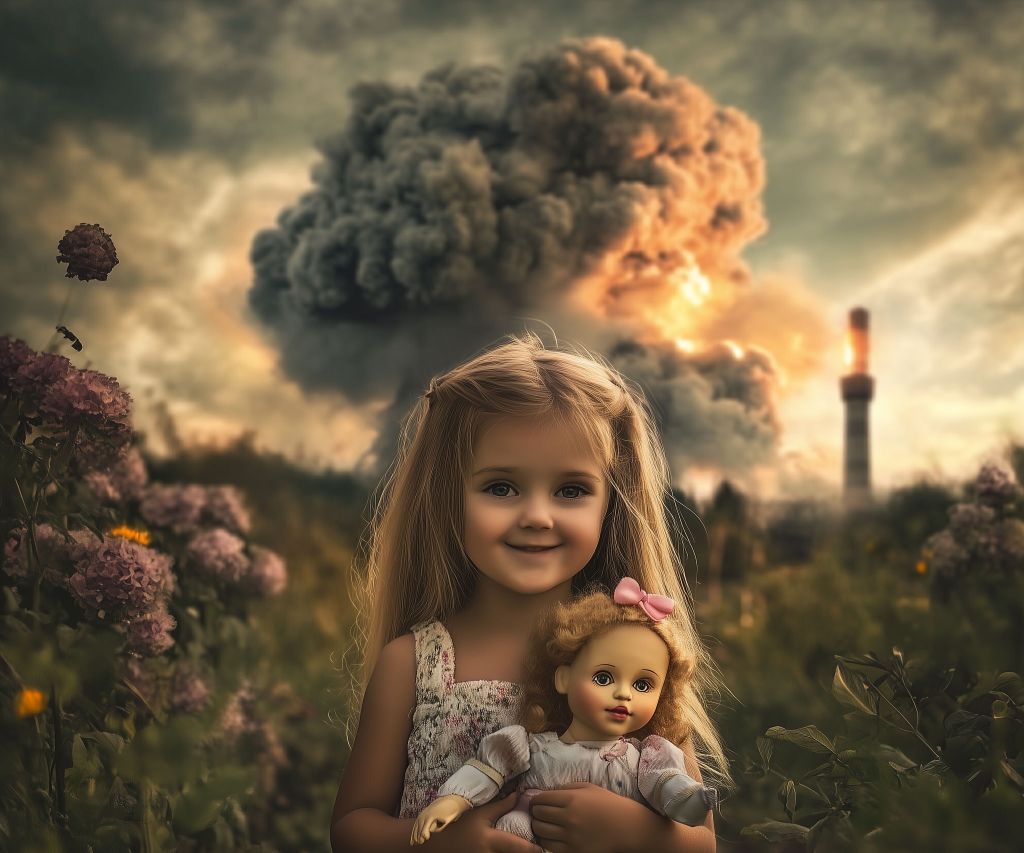
I have finished Martian Chronicles, and will give you a review tomorrow.
There are a couple of big flaws in the book, but not enough to outweigh the fact it is a bardic masterpiece in a 100 ways.
The other flaw, which I will discuss tomorrow is understandable and it’s just “the limits of a person in his/her time.” but this one…. This one sticks out like a sore thumb, because it doesn’t feel organic to the story.
Yes, of course I’m talking about the anti-nuclear-war propaganda. The “nukes are going to end the world and life as we know it.”
It might have been truly his feelings. Of course, it might. Again the “man of his time, in his time” thing, and in his time, when he wrote the book the propaganda and the fear mongering of “we’re all going to dieeeeeee” was so total and so present in everything that it was impossible to think it might be… well, paid for by the enemy. Which, yes, we now know it was.
But somehow it doesn’t feel organic. It feels like something that was inserted because at the time to publish in science fiction, you must “put in the bit against nukes” or they’d never publish you.
This, you know, is the problem with any centralized industry, much less one that is supposedly dealing in “art” or at least in expression of art-like products.
I could write chapter and verse on it, but of course there was nothing doing at the time. production facilities, distribution facilities, concentration of publishing in a few companies with large offices, (though not as gigantic as they would become) mostly in big cities, all militated to making publishing part of what the immortal Sabrina Chase calls “The entertainment industrial complex.” Which, of course, was staffed by people who’d attended the best colleges and all “knew” the same things.
What they “knew” at that time is that nuclear war would end life on Earth as we know it, including a lot of utterly senseless bs like the nuclear winter, all of it propagated by the USSR the same way the anti-war demonstrations, etc. in W’s presidency were all propagated by communist fronts. (Probably mostly Chinese financed. A lot of things are these days. Might have been Russian, though. They might have had a few pence left over from their anti-fossil-fuel efforts. Oh, heck, who am I kidding, it was probably the commies in USAID.)
But they “knew” it and were filled with urgency to propagate the danger, and therefore any book talking about the future must include at least a reference to the dangers of nuclear war, or nuclear energy or something.
Everyone, from Heinlein on was doing “urgent” stuff about the dangers of nuclear war, though most of Heinlein’s truly scare-writings were in short stories and essays. The novels just sort of waved at it.
We can argue, and will in the comments, I suspect about how real the risk of nuclear war; how real the USSR’s nukes were, how functional most of the nukes around the world (maybe even ours) are now. (Incidentally and interestingly, the last time I was at the Cosmosphere, there was noticeably a lot more cheering for “international” cooperation in space (bah) and in the cold war exhibit the quote from Khrushchev and a notable absence of the plaque saying they actually didn’t have “anything” but these large metal tubes they drove around the country to give us the impression they had more missiles than we did. If I’d known there would be revisions, I’d have taken pictures. Also, I wonder why. Ah, well, humans.)
What we can’t argue though is that the study on the “nuclear winter” was falsified, the idea that it would sterilize the ruin the land forever has been proven nonsense, and while — doubtless — a nuclear war would have been horrible (would still be horrible, if there are still more than a few functional missiles around the world) and wrecked the world for a while, but it would not be the end of the world for by any means.
And coming across stuff that might as well be underlined and highlighted “propaganda to make the US give up right now and get rid of all its nukes and quietly surrender” drives me incoherent.
But, you’ll say, perhaps that propaganda, while it didn’t make us give up our nukes and surrender to the Soviets (thank heavens we elected Ronald Reagan, people!) did it perhaps do a good job in preventing us from going head to head with the Soviets and destroying a lot of things?
Shrug. I don’t know. And neither do you. We don’t have a parallel world to run that experiment on and observe. (And now I have a plot idea!) but here’s the thing: yes, it prevented a lot of destruction. It also created a lot of destruction, because for fear of a head on confrontation we let the USSR stomp all over the world accruing mountains of corpses, misery and ruined futures in Europe, Africa and Asia.
More or less destruction than a nuclear war would have caused? Well, again, I’m out of a parallel world to run the experiment on, but depending on how real and what maintenance they had (kicks imaginary spaceship. “Russian Technology!”) it is arguable and in fact QUITE likely that we got more damage from letting the commies stomp all over the world, for fear of a nuclear war.
Heck, considering the parlous state or our art, culture, history and everything infiltrated by the covert and not so covert Marxism and hatred of our own country… a nuke might have been less damaging. (Stop shouting, and think, really think about how much cr*p we allowed the USSR and for that matter Russia and China to do by treating them as equals.)
OTOH it could be argued, and if I had a parallel world to run tests on (what if our world is where tests are run?) that having the “progressive” establishment know the US was the only super power would be very bad indeed. Would you trust LBJ or for that matter even JFK to not go completely nuts if he knew no one could oppose whatever crazy ideas they came up with. (No, I’m not going to forgive JFK for USAID!)
So, other than the crying need for a world to run tests on is this all about.
Propaganda. In hindsight it is absolutely starkly clear how much we were propagandized and how many lies were in it.
The same can be said for the covidiocy, though a lot of people remain under that panic. Just like, for that matter, there’s a lot of panic still about nuclear war. and a lot of it is hangover of that propaganda.
Propaganda, particularly that pervasive, takes a long long time to work through a society.
Cold war kids, who voted Reagan in, didn’t know that a nuclear war wouldn’t destroy the world either. We were just so tired. Our entire lives we’d been told the hammer might fall at any minute. And honestly we didn’t care anymore. We just wanted to have a chance to win, and let the hammers fall where they may.
And again, even now, not all of us are past the after effects of the propaganda. The trauma comes roaring back every time Putin stomps.
So– remember we didn’t die. Remember that the propaganda melted away when challenged.
And remember how real propaganda can seem, and how it can fool the best of us: scientists, geniuses, artists, poets, even divinely inspired bards like Bradbury. There is no shame in falling for the propaganda, but–
But we must do our best to get at the truth, and mitigate poisonous propaganda. Because in and of itself, it can create as much destruction as any nuke.
Nowadays with a more decentralized information regime, there is a much better chance to get at the truth.
And we — both the cold war kids, those who came after, and the newly minted Covid kids — must always, always, always dig to get at the truth.
Before the lies detonate and destroy our entire world.
 According To Hoyt
Re: the Big Lie, apparently somewhere in Turkey there is a Turkish Genocide Museum, which claims that the Armenians genocided the Turks. And a lot of uninformed Turks really do think that Armenians are the most evil liars and killers on Earth, even if the whole “mass graves of Armenian dead in my rural town” tends to undermine the narrative.
And apparently every time a country makes moves toward official recognition of the Armenian genocide, Turkey takes economic steps against them. Any Turk talking about it publicly is subject to imprisonment for talking unTurkishly. They literally cannot get over it.
LikeLike
Part of it is fear of having to pay reparations like Germany did for the Jewish survivors of the Holocaust. Part of it is (or was) trying to separate Turkey from the Ottoman Empire. “That was them, we’re different. It wasn’t Turks, but [other ethnic group from empire].”
Now that Erdogon is trying to revive the Ottoman Empire with himself as sultan, all bets are off on the last part.
LikeLike
Insomnia compels me to note that for all we actually know, nuclear war might be a pretty good thing.
The demerits are maybe a bit dependent on the rest of the world being wealthy and technically competent.
I’ve had a night of brooding, with sinuses and apparently also gut issues as the driver.
Anyway, using nukes might well be a preferable alternative to all the wackjobs constantly releasing biological weapons. But, I am not sure of anything, because I have gone hard against expert thinkers as proxy agents.
It is clear to me that many things are unclear, and may have changed. Also, I am probably too nuts right now to help anyone fix anything. So I may try napping some more.
I’m also farting around ideating on creative writing, but should probably me more useless than my usual at that.
LikeLike
If sinuses are the issue, sometimes a little caffeine is the answer. It squinches up your blood vessels, so it can help with pain and pressure. Also helps muscle soreness a little.
There are times when caffeine really helps a person get to sleep. I drink a little coffee, turn over on my belly, and see what happens. Even if I only take a power nap, it can make a big difference.
Alternately, take a good shower. Either you’ll feel more awake, or you’ll be able to go back to sleep.
Gut fun is no fun, though. And I don’t think caffeine will help at all. Quite the opposite. A shower might help, though.
LikeLike
Slept more. Then coffee’d.
I’ve also showered a bit.
LikeLike
I need to go do the cat boxes.
LikeLike
It’s fascinating to imagine how the former discussion prompted that. Was it Bob’s comment about biological weapons?🤔😁
LikeLiked by 1 person
LOL. No. It was the todo list and kicking myself on the butt.
LikeLike
By the way, you’re all welcome.
I sat nuclear alerts under Jimmy Carter as a B-52 crew member and scared the Soviets into not destroying the world.
Well, not just me; but a lot of people willing to stand in the gap. Insert 4th verse of Star-Spangled Banner here for those who gave their all.
LikeLike
Thank you. Didn’t sit alert myself, but a lot of my friends did (including in the LCCs). Did spend my time monitoring the other side and planning/practicing to fight it out if it came down to it. Scheduled our wedding to avoid conflicting with GLOBAL SHIELD.
LikeLiked by 1 person
Thank you! Jimmy Carter was the scariest President to me because the aircraft I flew on were all older than me and he essentially cancelled their replacements…
LikeLiked by 1 person
I volunteered to work on a nuclear drill at the Army command where I worked. The exercise went on for a week, but we were out of it either on day two or three, because as one guy put it, the weather forecast was for 5000 degree temps and 250-mph winds. (We still had to come to work, which led to a report of ravaging Cubans foraging through the radioactive ruins “above” our area a day or so later).
I didn’t do it again.
LikeLike
Thank you! Griffiss AFB was closer to -5000 degrees and cold-related injuries were more common than “ravaging Cubans”; but they did try to make sure we’d avoid feeling at home…
LikeLike
I only know of that plot being used once before: “Simulacron-3” by Daniel Galouye, back in 1964. Well, he used a computer simulation instead of a parallel world, but it was still market and political research.
I liked the book a lot when I first read it in the 1970s, and my copy has survived a several moves and a dozen cullings. It was also published under the title of “Counterfeit World”, and there was even a movie adaptation, “The 13th Floor.”
The book reminds me somewhat of Simak’s “They Walked Like Men” as far as style.
Galouye is one of those authors who wrote quite a bit, but somehow few people ever heard of. His five novels are of uneven quality, and though he wrote a ton of short stories, they’re mostly only available in the magazine collection at archive.org.
LikeLiked by 1 person
Good novel; fairly unique plot for the time. I especially remember the comment by one of the researchers, made to the ones who “uploaded” to the Real World: “Of course, we don’t have such exotic names in our world as in the simulation, such as Himalayas”.👀
LikeLike
I liked The 13th floor. Now I have a novel to find and read.
LikeLike
Heinlein used nuclear weapons as plot devices in two books and a short story. Afterwards it wasn’t mentioned except in passing, maybe due to his visit to the Soviet Union or the advent of his profitable Oedipus/DoM phase as an author.
Also nuclear doomsday preaching was waning somewhat in ’70s. Too many other topics were in the news, inflation, Nixon, Middle East, Oil Crisis, Vietnam, etc… As kids in Texas and Oklahoma, 20 times more preps and drills were spent on tornadoes than any sort of nuclear strike.
As boys it was Cowboys and Indians or Allies vs Germans/Japs than any Cold War topic on the playgrounds. And my older cousins were living more “Dazed and Confused” than fearing the foreign missles. Their parents were complaining about gas lines and import cars.
The propaganda peaked again in the 80’s with Reagan, much to the delight of the MIC and the movie makers. The collapse of the Soviet Union disappointed much of the left and a few on the right, so the neolibs/neolibs got busy creating a new market for weapons and body bags in the Middle East and Eastern Europe.
In the prepper community, it was mainly folks more scared of US governments actions than the Cold War. Yeah, smart people didn’t trust the institutions back then either. The back to the land/farm movement was more about fleeing school integration in the cities than fallout.
And you don’t have to create nuclear “winter”. Just do enough damage to collapse inrastructure and economies hard and fast. The current packages and delivery systems could cause that even with a large percentage of failures.
But Mother Nature still has us beat. Volcanoes are more likely to cause a world wide “winter” and crash civilization than nukes.
LikeLike
Ah. But why not nuke a volcano?
LikeLike
Or a few key stress points in a major fault line (San Andreas anyone?).
LikeLike
Seeing what Commiefornicatiastan has become, I maintain that Lex Luthor and Max Zorin were actually the good guys in their respective movies.
Luthor/Zorin 2028: Make SoCal Sink Again!
LikeLike
Lex Author was a visionary…/s
LikeLike
It’s not even WordPress at fault this time…
LikeLiked by 1 person
My daughter says that if a big quake ever hits a fault that runs through the USMC desert base at 29 Palms and cooks off all the unexploded ammunition buried there in the sand — there will be a whole new Grand Canyon formed. Instantly.
LikeLike
For Otisburg!
LikeLike
I live fifty-seven miles from Mount St. Helens. I lived here in 1980.
The newspapers DID publish articles featuring heated speculation in the months preceding the Big One. Including a scheme to head off the uncertainty regarding a BIG eruption by dropping a nuclear warhead on the mountain.
I was only ten, so I don’t remember whether this was published mockingly or in seriousness….but it WAS mentioned.
LikeLiked by 1 person
Longview?
Coming up on 45th anniversary, this next Sunday.
Our rental backed up to one of the drainage canals in western Longview (Mint Valley). We bought off of Columbia Heights Aug. 1980.
We were home when she blew. Barely. We were on Rainer Saturday, May 17th. By reports, not the place to be that Sunday morning (had intended to be, but for reasons chose not to camp overnight).
I am 13 years older than you. I remember the news article about options to use a nuclear device to plug the mountain. Not drop a bomb but place the device in the opening, trigger it, to plug the mountain. The article was serious, as was all the other wild speculation that was printed. Yet, none of the non-nuclear wild speculation (tamer than what happened) came close to what actually happened.
Our main concern, after the mountain blew, was would the new Spirit Lake dam plug hold, due to all the earthquakes being generated immediately around the mountain? The potential flooding and mud flow damage maps were epic. Where we were living was not the place to be. Spoiler alert. Dam held. But at the time, to my 23 year old self, the scenarios, were scary.
Not helped by the immediate speculation on how far the actual mud flows would go, and the potential damage when hit Longview/Kelso, and the Columbia.
Mud flows did go all the way to the Columbia. But, last place the mud flows overflowed the rivers banks was Castle Rock (HS lost part of their football field), took the river right to flood stage, but not out of river banks, between Longview/Kelso, and flowed into the Columbia. Blocked shipping channels. Which had a heck of an economic impact for the Longview/Kelso and Portland, the ships trapped, and ships unable to come up the river.
FWIW. We never made it to Spirit Lake before the mountain blew. Spirit Lake was one of our destinations for our first spring area exploration but closed down because of the mountain. Why we were on Rainer instead.
LikeLiked by 1 person
I live near Bucoda. The wind was blowing the other way on May 18th. On other occasions we did get some ash, and almost everyone around here has a film canister or baby-food jar of ash in a cupboard somewhere.
It is one of my lasting regrets that I never got to see Spirit Lake in the before times. Then again, in the seventies it wasn’t my decision.
LikeLike
We didn’t get any ash May 18th either. Little bit of dusting that summer. Never did pick up any ash off the ground, just didn’t get that much. Lots of dredging of ash and mud deposited, eventually.
We moved to Longview March ’79 to start our new jobs. Hubby started mid-March. I started after winter term finals, spring break week. Laid off December ’79. Back to work January ’80 (which was rare for the company). Laid off again, May 19th (wonder why?). Back to work a week later.
Later, fall of ’80 and into ’81, it was interesting to see what logs they were pulling off the mountain, that could be gotten to (they were done by the time they got *shutdown). I was working the Woodland ramp. Probably the last time anyone ever saw one log loads anywhere ever again. Of coarse they were cooked 12″ circumference, or more in. Interesting id’ing them too. Everything was a uniform white gray. Had to id via wood characteristics. We all dug out the dendrology books. All we had to go on were texture and grain. Smell, color, bark, etc., were all blasted and cooked away.
(*) Not that there weren’t more logs to be gotten. Just that the logs remaining either couldn’t be gotten to, or weren’t worth taking because blast + 18 months made them not worth getting. Might have also learned by then that the ash covered logs weren’t good to have go through sawmills or even pulp mills for paper and cardboard. IDK. Last layoff was Oct ’81. Hubby didn’t go back until May ’82. I, and 100+ others, never did go back to work for that company.
LikeLike
Wife worked a non-logging medical job in Longview many years later. The smell from the mill still permeates her memories but the beautiful view of Mt St Helens in her drive up and down 30 to get home to me in Astoria remains a solid memory. Of course so does getting stuck behind logging trucks uphill with no passing lanes…
LikeLike
I count two novels (The Number of the Beast and Farnam’s Freehold) where nuclear explosions come into play, though how much weight the attack on the Arizona cabin has on the story might be up for debate.
For short stories, I have two in mind. “The Long Watch” doesn’t involve explosions, but a successful attempt to prevent. Then, “The Year of the Jackpot” has a nuclear exchange, after LA is attacked.
I started school in ’57 and we also had far more tornado drills than “duck and cover”. (Not sure if the K-2 school bothered with either. Grade 3-12 schools had basements, and the drills were labeled “tornado”.)
Not sure how far the first school would have been from a target; it was a big manufacturing center, important in a long war, but not immediately. Later schools, were about 20 miles from a major transport/commerce/manufacturing center. Not sure how (in)accurate a Soviet missile would have been.
LikeLiked by 1 person
IIRC The Door Into Summer starts with a throwaway line about how the protagonist’s house was on the edge of the Manhattan Near Miss.
LikeLiked by 1 person
You’re right about Farnhams, but obviously the Earth was not poisoned forever.
LikeLike
Started school in ’62. We had duck and cover drills, but we didn’t use desks. We were marched to the fallout shelter at the school cafeteria. Despite Oct ’62, hurricanes (they closed the school, and sent us home!) and tornadoes are not a concern in Oregon.
LikeLiked by 1 person
They might not be a concern, but they do exist. An acquaintance lost a storage shed to an EF0 tornado several years ago. I saw the shed beforehand; as marginal as an EF0 is, it was a little bit more than the “I’ll huff, puff, and I’ll blow it down” that needed to trash the shed.
Silicon Valley had a decent tornado back in the 1990s. In February. Damaged a fair number of houses in Mountain View.
LikeLike
“EF0 Oregon tornadoes.”
Also called dust devils in Oregon fields.
Have had a few in urban settings lately too, that actually touch down. EF1 at most. One in the Lane Community College parking lot. A few more where the funnel formation was there, but never touched the ground, with the question “is that a tornado?”
Right conditions, right spot, even dust devils are not a joke. Having a very heavy ’60s era vehicle suddenly change lane without the driver using the steering wheel on I-80, is a bit concerning.
No. Not a general concern. Anything bigger than a dust devil, showing up in a urban settings the joke is Oregonians standing around pointing saying “Is that a tornado?”
LikeLike
https://www.facebook.com/reel/1061508975849641
Funnel over Eugene, Oregon … Today, 5/12/2025
LikeLike
One of my favorite factoids about the weather radar is that for a while they thought it was malfunctioning– it kept saying there were tornadoes where everyone knew there were never tornados.
Even if there were sometimes very suggestive areas of crop damage…. EVERYONE KNEW there were tornadoes!
Which is why they refused to record reports of tornados spotted in the area, no matter who reported it!
Then the dang radar went and agreed with the folks reporting what couldn’t possibly be there.
LikeLiked by 1 person
The Connecticut Shoreline was similar. There is a New England Tornado Ally that runs west/south from Worcester to Springfield to Hartford and that region gets large Tornadoes (EF3 or EF4) on about a 15-20 year cycle. It gets smaller EF0 and EF1 tornadoes at the rate of a couple every year.
But the belief was that coastal CT and Long Island Sound NEVER got tornadoes except perhaps related to a hurricane. This was refuted by a couple hundred years the locals who had often seen waterspouts out in LI Sound. That included me I’d seen at least 2 from my house which could view the sound clearly from the 100′ high hill it on which it sat at the crown. The locals were ignored/ pooh poohed by the various meteorologists. That is until Windsor Locks got a Doppler radar and small EF0 or pre tornado rotations were seen over the sound regularly when the right kinds of thunderstorms moved over LI Sound. Of course given it was over water there had been no damage unless some unfortunate boater got in the way.
LikeLiked by 1 person
You do know that Great White sharks are seen in those waters….. is Sharknado a documentary??? 😇😏😁
LikeLike
I will note that I do not believe that Great Whites were seen in Long Island Sound in my youth (now ~40+ years in the past). The Sound is basically a shallow warm water lake with two outlets to the Atlantic. Great Whites prefer the cold Pelagic depths of the Atlantic out past the Gulf Stream and like to dine on seals which were NOT present in my youth in the Sound. With seals taking up residence again in the Northeast (CF Cape Cod) perhaps the Great Whites are in the Sound.
However, there are Large schools of Bluefish (many of which spawn in the tidal portions of rivers near my home) in the Sound. They only get up to ~10-12 lbs but are horrifically aggressive. My Grandad always joked that if Bluefish were a bit larger say tuna or barracuda sized swimming in the sound would be as hazardous as swimming in piranha infested waters. Having seen the small snapper (<1lb) and harbor (1-3lb) bluefish schools terrify bait fish and even the occasional seagull chick, I believe it. That said Bluefishnado just seems far less terrifying than a Sharknado. Although getting slapped with a 12lb fish would really hurt…
LikeLike
We had interesting weather yesterday, but the NOAA weather radar for us was toes up. Either that, or the data wasn’t getting passed on; they were working on the computer systems today, and the weather radio is out.) I hate hearing an impressive thunderboomie without knowing where its buddies are located. That and Kat-the-dog has the usual border collie towards thunder: “Dad! Help! You need to make it stop!” At least she doesn’t insist on going out to check mid storm. Angie was a wonderful BC, but slightly nuts. I miss her.
LikeLiked by 1 person
I remember the SV tornado(s).
We were at one of Sun Microsystems’ smaller buildings very near Moffett Field setting up on the ground floor to shoot video for some field service-level documentation that we’d started putting together (fairly quickly moved to 3D animation using the engineering Solidworks models due to the cost of using live humans). But I digress…
There was some thunderstorm activity as we were setting up a sequence, and then the rain got really serious. As in, water was pouring out from the wall sockets around the room, quickly covering the floor. With video lights plugged in to said sockets, just before switching them on. About the same time we started hearing reports of tornados sporting around the part of the Bay nearest us and in Mountain View.
School was called due to precipitation excess, or something.
LikeLike
I was getting an allergy shot at S’vale medical clinic, and saw the green sky that afternoon. I grew up in the midwest and knew “something wicked this way comes”, to quote a certain author. Beat feet back to San Jose as soon as I could.
LikeLiked by 1 person
“The Puppet Masters” takes place after WWIII, but while it was presumably nuclear, it doesn’t actually say so.
LikeLike
According to the article, the Toba eruption of 74,000 BC supposedly generated a ‘nuclear’ winter lasting 6 to 10 years, and significantly increased global glaciation for up to a 1000 years afterwards. The year without summer (1816) supports that.
LikeLike
The messed up weather that we had for 3 years after the Hunga Tonga underwater explosion throwing beaucoup megatons of water into the upper atmosphere is also an example of volcanoes doing bad things to weather.
The French Revolution was partly due to Icelandic volcanoes screwing up the weather over France for 3 years, which led to crop failures which led to the French government putting price controls on bread flour which led to farmers not selling wheat to the mills which potentially led to the famous “Let them eat cake (flour)” comment.
On the other hand, all the nukes being blown up under, on and over the surface of the earth did… pert near nothing except raise the background radiation enough to make pre-1945 steel a valuable commodity, but other than that and some other little issues, no end of the world yet.
LikeLiked by 1 person
The Tambora eruption in 1815 ejected enough material and gas into the upper atmosphere to cause a drop in global temperatures so that people in the Northern hemisphere called 1816 The Year Without a Summer. My extensive calculations (lick index finger and hold to wind) suggest that six to ten surface detonated thermonuclear devices could potentially have somewhat the same effect. Actual levels will require some experimentation to gauge effective results.
So we now have a solution to the, by all accounts from right thinking peoples, existential threat to all human life from global warming. I think I shall name the concept “Uncle Lar’s Bend Over Here it Comes” approach to weather control.
On a somewhat more serious note, how in bloody hell were both India and Pakistan allowed to develop nukes? As for Iran it’s only a matter of time before they somehow acquire at least three such devices either by manufacture or theft. Three seems the right number: one to test and demonstrate, one for Israel (probably Tel Aviv), and one for the US (where is anyone’s guess) though they do seem to have a fixation on Washington DC and New York City.
I should probably wait for the caffein to kick in before I write stuff like this.
LikeLiked by 1 person
You should probably attend my TED Talk, “Tectonic Weapon Systems for Profit and Evil”.
:P
It’s probably easier to either nuke a few cities and watch the ants scramble around and starve as their banking systems collapse than it is to modify the weather, unlock some faults or pop the ashy mountain pimples.
Accquiring weapons systems throught theft o is easier than building them from scratch consider the success of both the USSR and Israel using this method to get a healthly headstart from the sweat of the United States brow.
LikeLiked by 1 person
Richard Rhodes’ Dark Sun: The Making of the Hydrogen Bomb (the followup to his atomic bomb book) starts with the wholesale theft of documents that were pretty much allowed to go to the Soviet Union. It’s been a while since I read it, but I recall a scene where huge amounts of documents were loaded into a transport aircraft that went to Russia.
I’m not familiar with the origins of the Israeli nuclear program, but I assume there were a fair number of people from the Manhattan Project who would have been sympathetic to them and would have contributed expertise, regardless of classified information laws. I also suspect TPTB in DC were willing to cast a blind eye on that.
LikeLike
The Lend-Lease effort was the cover to ship secrets and technology to the Soviets. There is a earlier detailed book on this by Major Jordan, don’t have a hard copy, but one that’s available digitally if you search the dusty corners of the inner-tubes.
All of the material to build Israel’s first packages was skimmed/stolen from NUMEC before the French built the countries first reactor. There is a strange dynamic between LBJ’s adminstration that allowed this theft and the USS Liberty incident to happen. Lord knows what sort of corruption our native 1st Texan presidental a-hole was up to back then.
LikeLike
I’ve read and enjoyed Rhodes’ “The Making of the Atomic Bomb” several times, but I’ve never made it far into “Dark Sun” before losing interest. It’s a very different style of writing than the first book, for some reason I find it hard to follow.
LikeLike
Doesn’t help that Teller wasn’t as fun to write about as Szilard and Oppenheimer. The early part of the book is heavy on the Soviet stuff, then it gets into the thermonukes. (I’m going from memories circa mid 1990s, so a grain of salt is advised.)
LikeLike
I believe that India mostly got their stuff from the USSR and France, and Pakistan mostly got theirs from China.
But yeah, India had smart guys. I assume the same thing for Pakistan.
LikeLiked by 1 person
As far as we know (last time I looked it up) no atomic bomb test has ever failed. The Soviets weren’t sure about Joe-1, and built a big steel sphere around it to salvage the uranium if it didn’t properly go bang. The Brits weren’t sure about their first H-bomb, so they faked it with a super-duper ordinary bomb and claimed it was an H-bomb. The South Africans supposedly disassembled their bombs without testing them, for political reasons.
And then there’s Iran, which has been working on theirs for more than thirty years. They may not have done any testing, but it would be foolish to think they don’t have some bombs stockpiled.
Same for Israel, which has no nuclear weapons to test anyway. (wink-wink, nudge-nudge)
LikeLike
I recall that the Trinity test was supposed to have an oopsie container. Was Joe-1 uranium or plutonium? I’d figure that the only hard part of a uranium bomb is accumulating enough U-235, while the plutonium bomb was decidedly more fiddly with much more oppertunity for Murphy to make a hash of things.
Vague memory says the Vela bomb-monitoring satellite spotted a suspicious flash in S. Africa at one time, indicated a possible above ground test.
LikeLike
That’s why they didn’t even bother testing the Little Boy device (U-235 gun type) because they were so sure it was going to work. Plutonium implosion was much trickier.
LikeLike
And Wiki (and the shape) says it was plutonium. That makes sense, U-235 seemed to have taken up a lot of the mass-industrial setup for Oak Ridge gaseous diffusion process and the Livermore(? I think) mass spectrograph “Calutrons”. I don’t know if Manhattan used the centrifuge process, but the other two for sure.
LikeLike
Pretty sure all the ‘production’ Calutrons were at Oak Ridge; only a few prototypes were built elsewhere. They needed to be arranged around a massive electromagnet, powered by electricity from the Tennessee Valley Authority hydro dams. Fun fact: copper was a critical war resource so they requisitioned tons of silver from the U.S. Mint and drew it into wire to wind the big electromagnet. The ‘Calutron Girls’ were much better at operating the machines than the scientists and engineers who designed them. Apparently knowing too much about how the widgets worked was distracting. The Girls were only taught to watch the meters and keep them within certain limits.
LikeLike
OK, two flavors of diffusion, gaseous and liquid thermal. The electromagnetic one was done at Oak Ridge, too. FWIW, it looks like all of Oak Ridge’s production of U-235 was sufficient for one (count ’em, one) bomb. Getting plutonium was easier. Setting it off, that’s the fun part.
Cool website for the official history of the Manhattan project:
https://www.osti.gov/opennet/manhattan-project-history/Events/events.htm
LikeLike
I figures they already have at least one nuke and just haven’t had their coming out party yet.
And I wouldn’t be surprised if they came out by hitting somewhere in Europe, though New York, DD and Tel Aviv seem like serious possibilities to me.
LikeLiked by 2 people
no, the first Paki nuke to be launched in anger will be used on New Deli
LikeLiked by 2 people
no, the first Paki nuke to be launched in anger will be used on New Deli
LikeLike
I meant Iran. I just don’t see them going the, “we blew it up in a cave so it would show up on your seismographs! Fear us!” Route
LikeLiked by 1 person
I don’t know about that one, I suspect that the actual first target of an Iranian Nuke would be Jerusalem, and the second one would be NYC (because the Arabic and Persian world, for some reason still sees NYC as the epicenter of American civilization. They don’t understand the fact that a large amount {Supermajority} of the US population HATES NYC.} but the one thing I am sure of is that they won’t hit anything that matters.
LikeLiked by 1 person
I considered Jerusalem rather than Tel Aviv, but it holds so much history for all three major religions that the mad mullahs might hesitiate. As I recall we had similar issues when Kyoto was ruled out as a target during our brief venture into nuclear warfare.
Assigning two airliners to the NYC attack is an indicator of how the jihadis feel about America, land in fact taking out both towers did have both immediate and ripple effects on the country’s economy and psyche.
LikeLiked by 1 person
Blowing up al-Quds would probably get Pakistan to nuke Iran.
LikeLike
yes it did, just not the ones they were planning on.
LikeLike
If you’re talking about Iran, I’d say that their first target is Tel Aviv. I’m not sure if they could get their nuke (or nukes) to US targets. Targets in Europe are a possibility but I’m not sure what they think about Russia.
LikeLiked by 1 person
Yeah, the mad mullahs would likely be hands-off on Jerusalem; don’t they need an intact Dome of the Rock for the return/appearance of Issa or the 12th I am or something? Tel Aviv, OTOH, would likely be ‘fair game ‘.
And you don’t need a missile to transport instant sunshine; any cargo container could hold a fair-sized device. Which fact, I’m sure, gives port security personnel worldwide the heebie-jeebies.
LikeLike
12th Imam! Stinkin’ autocorrupt.
LikeLiked by 1 person
I Am Not An Islamic Scholar™, but I suspect they would say the 12th Imam just needs the Rock, not the Dome thereof.
LikeLike
Container ship to NY harbor.
LikeLike
Put the bomb on a small cargo ship and send it up into South Bay between NY and NJ. Cheap, and precise delivery right where it will do major damage.
Alternates: up the Potomac in DC, up the Mississipp, or any of the major shipping ports like Houston, New Orleans, San Diego, San Francisco, Seattle, etc.
A ground burst isn’t as effective as an air burst for most things, but it would still work just fine for messing up shipping.
Second alternate: load your bomb into a big crate and load it aboard a commercial cargo transport plane. Fly it over whatever your target is and set it off at the optimum height.
LikeLike
And lets not forget the great propaganda scheme of the 90’s and all the 00’s, 10’s, and up to day: Global Warming. And all the damage done because of it, too, the killing of whole sectors of the economy for one, and the mass experimentation that is doing more harm than good (such as Britain’s idiotic announcement they are going to spray aerosols in the atmosphere to create more clouds to block the sun and cool the earth – where’s the international outcry on that?!!!!)
Meanwhile, we just got a front row seat show of what happens when a country tries to go completely “renewable energy” in what happened on the Iberian Pennisula this week.
Global Warming (rebranded as “climate change”) has been nothing but a propaganda piece used by socialists around the world to try to trick the masses into accepting policies that would in fact usher in socialism in democratic countries. And sadly? It’s been working.
BTW: @Sarah Hoyt – I was in a conversation with John Van Stry a bit ago about my husband’s sci-fi series, and he mentioned I should reach out to you, saying he thought you put up reviews or recommendations for books on your website? I didn’t know how to contact you so I’ll put it here – hopefully you can see my email address on this message! Otherwise, I can send you a substack DM if you have that turned on.
LikeLike
For book – See yesterday’s post. I do indie promo posts once a week.
ALSO on substack. I need to deal with that today. I don’t think I have it turned on. We’ll figure it out.
LikeLike
The “parallel Earth as experimental ground” idea has been done, though maybe not that prominently. H.G. Stratmann wrote “Symphony in a Minor Key” in 1996 for Analog, and the experiment they run is, or starts out, musical.
A researcher studying a duplicate, parallel-world Earth gets permission to go back in its timeline (yeah, they can do that) to secretly cure/prevent Ludwig van Beethoven’s terminal illness so he can create more music. He does, and Beethoven’s Tenth Symphony* becomes a liberal nationalist anthem that the movements leading to the Revolutions of 1848 take up as a rallying point. Thus united and strengthened, the revolutions succeed and remake Europe.
*A wholly different composition from the one that musicians and AI turned into their version of Beethoven’s Tenth Symphony a few years back. Stratmann has Beethoven discarding that for his more epic brainchild.
The eventual result is a Euro-American nuclear war that wipes out the human race. (Yes, it always seems to come back to that.) The horrified researcher then has to go back and stop himself from saving Beethoven, to save those other billions of people.
As often happens in science fiction, you are urged to be careful what you wish for.
Republica restituendae, et, Hamas delenda est.
LikeLiked by 1 person
The “Science of Discworld” series (comprising four volumes) seems to qualify, although a) I have not read all of them, and b) the experiments seem to avoid sociopolitical topics by and large.
LikeLiked by 1 person
I bounced off the first one because they could not stop making philosophical cracks that clearly demonstrated their ignorance of philosophy.
LikeLike
I know it’s been done and it’s sometimes accidental. (They think it’s a pretend universe, but…) I just can’t remember any titles, because I’m OLD.
LikeLike
I remember a story about a time traveler going back to kill Hitler (I know, old cliche) and finds him to be a pleasant and reasonable fellow. Starts to really question his mission.
Then another time traveler bursts in and shoots Hitler. No questions, no hesitation, just BANG BANG BANG.
THEN — the Reichstag decide that with how unstable Germany is, the Chancellor’s death will bring chaos. They’ll have to replace the real Adolph with a double, a paranoid maniac they’ve been trying to keep out of sight…
LikeLike
Yep, I remember that one. These all seem to converge on “Be careful! What you get may not be exactly what you want. Or even close.”
But time travel is so much fun to play with, from “The Men Who Murdered Mohammed” to “The Apocalypse Troll”. And there’s always that Connecticutt Yankee dude…and many more.
LikeLike
I LOVED The Man Who Murdered Mohamed. And the character did get what he wanted. Just not what he aiming for.
LikeLike
LikeLike
There was a story about multiple time-travel attempts to kill Hitler, and as each one failed Hitler was left more and more convinced that he was a Man Of Destiny who was being targeted by The Dark Forces.
The last time traveler finally got rid of Hitler by going back to when he was a teen and handing him an art scholarship.
I can’t recall the author or title of the story.
LikeLike
Heinlein’s very early short-short story “Successful Operation” got intp similar territory, though you have to assume that a pitituary gland transplant moves the entire personality. (Story in the Expanded Universe book.) The Leader’s mind is swapped to a concentration camp inmate, and the guards at the hospital were just following orders.
LikeLiked by 1 person
I read, somewhere on the early internet–mighta been Usenet–somebody’s summary of a story in which the Time Travelers went back in time to kill Der Fuhrer. They succeeded, but it only created a vacuum in history. When they got back to their (new) “present time” they found they’d made everything way worse; the Fuhrer they killed was replaced by some no-name nobody that nobody ever heard of, some Austrian art school washout named Adolf Hitler…
LikeLiked by 1 person
What’s somewhat chilling is, if you start reading about the fringe parties of the Weimar era, the National Socialist German Workers’ Party looks downright reasonable compared to some of them.
LikeLike
As to Bradbury, it’s been a long time since I’ve read The Martian Chronicles, but nuclear war must have been such a small part of it that I don’t even remember it. In SF any catastrophe will do as background of course. I do remember one story where a family is vacationing in Mexico when The War happens, and, as they lament, the events, their Mexican driver just smiles and laughs off the ideas of doom, saying he doesn’t read the newspaper until two weeks later when everything in them seems seems trivial. I also remember hearing Ray speak in the mid 70’s, talking about how nonsensical it was to believe the USSR could compete with the US. He viewed freedom as the ultimate antidote asking how anyone could compete with a country with a million people with pilot’s licenses.
I love seeing your writer’s brain kick in with every alternative scenario you posit, but this one is the one that stirs my imagination.
LikeLike
The There Will Come Soft Rains….
LikeLiked by 1 person
So true, and one of my favorite stories. I’ve read so many of Bradbury’s stories in all different places that I didn’t even realize that one was in The Martian Chronicles. Checking over the table of contents, I realize my memory was faulty, and yours is correct that nuclear war figures more prominently in the book than I remember. My memory may not be what it used to be, but, “Old age hath yet his honour and his toil,” and I hope to see life shaped more by The Toynbee Convector.
LikeLike
It’s okay, I thought Dark they Were And Golden Eyed was in it. I will speak to that tomorrow.
LikeLike
I thought I had read the Martian Chronicles, but nothing comes to mind. I’ve read The Illustrated Man, Something Wicked This Way Comes, and of course, Fahrenheit 451, but for some reason, Bradbury didn’t speak to me as loudly/clearly as RAH did. (The Door Into Summer was an important book to young RCPete.)
LikeLike
Oh, not as loudly as Heinlein, but different moods….
LikeLike
Heinlein’s short “Solution Unsatisfactory” covered the fear of “nuclear wars” as well as a US government wanting to use the “Peace Force” as a tool in US foreign policy.
LikeLiked by 1 person
Click The Box!
LikeLike
We don’t have a parallel world to run that experiment on and observe. (And now I have a plot idea!)
Um. Cruel (to the folks in the parallel world), but probably would be effective.OTOH if those folks caught on and figured out how to get some of their own back, now you’ve got a real plot!
LikeLike
I’ll speak strictly on nuclear weapons, because that happens to be where my experience lies. What experience? Sleeping next to a third stage physics package for most of 20 years.
For those of you not familiar with the technology, that means I slept next to hydrogen bombs.
Our bombs were real. They worked. We used to randomly get something called an FCET which if I remember correctly, stood for “Follow on Commander in Chief’s Effectiveness Test.” That means that we would randomly pick one submarine every year or two, that was out on strategic deterrence patrol, order them to pull in, allowing them to conduct no maintenance, they (we) would pull into “the barn” the Explosives handling Warf, which was covered against spy satellites. Once there, we would pull the real warheads from two or four, or in one case six missiles, and put instrumentation warheads in their place. Then we would go out, and await the order to launch, followed by sending the SLBM down range, to impact the MIRVs at the target range either in the Maldives, or the Atlantic target range. It’s worth noting that we always used the oldest missiles.
I participated in three of these. The missiles worked.
On my first boat (a fast attack) I may or may not have slept next to one of what may or may not have been a couple of SUBROCs (a torpedo tube launched rocket with a nuclear depth charge as a payload.) How do I know it was real? Well my radiation exposure, and the fact that we had to recharge the tritium bottle on one of them leads me to believe so.
As to the Soviet gear, one of my shipmates was picked as one of the guys that were part of the START inspection teams. He went to mother Russia regularly to inspect their nuclear warheads.
Were they radioactive? Oh most assuredly.
Would they go boom? Good question.
Where the rockets operable? Even better question.
At any given time, at least 1/3 of the Soviet gear was down, not operable. That was their estimate, not ours. I would put it closer to half.
Of the stuff that would work, how much of it would “squib?” (low order detonation) An even better question.
Thankfully, we don’t know. How much of their gear works now? I would be surprised if ¼ of it launches now, and if ¼ of that actually works as designed.
V/R
William Lehman
LikeLiked by 1 person
While no doubt Russian maintenance is pretty much the antithesis of “gold standard” for proper upkeep, I’m somewhat leery of the notion that because their functionality is questionable they can be ignored, as I’ve seen argued in various places regarding Ukraine and Russia. Even if only 1/3rd of the warheads and their delivery systems work, that’s still not an insignificant number of Instant Sunshine(tm) devices.
I’m not saying “don’t do anything because the nukes”, but to outright dismiss the issue is not, IMO, the smartest strategy.
Then again, a lot of those dismissing it completely are living in places where they can be fairly certain that they won’t be targeted, and the worst they have to worry about is a rather unlikely possibility of a warhead going off-course into their back yard.
LikeLike
They never had as many as they claimed, period. AND their maintenance is not the problem. their corruption is. It is highly likely all fissionable material has been stolen and sold.
Look, on the serious, I also thought they would still have a lot of operational ones, but I very much doubt they THINK they have any at this point.
One simple reason. Putin would have used it.
LikeLike
No, Putin will only use or attempt to use his nukes as a “last ditch, Hitler in the bunker” move. 1) He’s probably not sure himself if they’ll work. 2) I’m sure that it’s been adequately explained to him that if he pitches, a whole lot of other countries will be throwing things at him.
He is the type that would have the “if I’m going down, then I don’t care if anyone else is alive” mind set (true sociopath) but he’s not about to attempt suicide if there are other options.
The reason I don’t think anyone has stolen or sold the fissionable material is that; if someone had sold the stuff, some raghead would have attempted to use it by now.
Maintenance on the other hand, the circuitry of a bomb degrades over time and exposure to gamma radiation. After enough years, the simultaneity required for a conversion from fission to fusion fails, we’re talking a Pico second or two here. The circuitry probably has not been maintained to the level required to keep from being a squib.
To the gentleman who discussed not living in target areas… Well, I am moving, however right now I live less than ten miles from the second biggest US Nuclear warhead repository in existence. Strategic Weapons Facility Pacific. I’m pretty sure that’s in the top ten of everyone’s hit parade. Add the Puget Sound Naval Shipyard: the only west coast aircraft carrier repair facility, Bangor Subbase the west coast trident port, Naval Base Bremerton the home of two aircraft carriers and several submarines, Keyport Naval Weapons Station, and just down the road, we have Boeing, and Joint Base Lewis McCord. If there were a nuclear exchange, I’m pretty sure that the Puget Sound would become an inland ocean, and Kitsap peninsula would be a shoal.
LikeLiked by 1 person
Of course, who they sold the fissionables to might be important information.
LikeLiked by 1 person
I would bet that Putin knows that his arsenal isn’t entirely functional, but I’m skeptical that nothing is in those warheads, for the same reason Mr. Lehman mentions in his reply regarding “alternate” usages of the material. Aloha Snackbar types that can be patient for a multi-year plan (a la bin Laden) are somewhat thin on the ground, while financing for the less patient is not. (That, and I doubt that Comrade Missileman is all that expensive to buy. It doesn’t take a lot of money to improve a Russian’s lifestyle.)
Putin may not be entirely rational, but he’s not completely irrational, either. Ignoring the accuracy of the numbers for a moment, he knows the US has a higher total number of functional warheads and delivery systems. I’m pretty sure he doesn’t want to be ruler of radioactive rubble, which is an entirely plausible reaction if he were to start tossing nukes around, even in a “tactical” use (the distinction between tactical and strategic nukes is silly, anyway).
LikeLiked by 1 person
Does he though? Remember totalitarian societies have information problems. everyone lies every step of the way.
LikeLike
The nuke refurb program he started in 2019 (IIRC) suggests he’s at least aware of the possibility, even if lackeys may be (okay, probably are) blowing smoke up his butt about how much is actually being done.
LikeLike
The problem is every step of the way up is CYA. This is the issue with totalitarian societies. ALWAYS.
LikeLike
We can deduce that the Soviets didn’t trust that their missiles would work because during the times of brinkmanship they were the ones who blinked.
LikeLike
Oh, of course OUR bombs were real and worked. The damage to the world in general was exaggerated.
My only doubt of our arsenal is whether they’re still in working trim after…. Obama, Biden not to mention Clinton….
LikeLike
And apparently, at least once, tests went even farther toward realism; as in, full-up live fire test.
Operation Dominic / Frigate Bird, May 1962.
Quoting from the excellent “Nuclear Weapons Archive” at:
https://nuclearweaponarchive.org/Usa/Tests/Dominic.html
“Frigate Bird was the only US test of an operational ballistic missile with a live warhead. This test involved firing a Polaris A1 missile from a ballistic missile submarine. The missile was launched by the USS Ethan Allen (SSBN-608) at 13:18 (local) from a position 1500 nm east-northeast of Christmas Island. The re-entry vehicle (RV) and warhead flew 1020 nm downrange toward Christmas Island before re-entering the atmosphere 12.5 minutes later, and detonating in an airburst at 11,000 feet. The system tested was a combination of a Polaris A1 SLBM, and a W-47Y1 warhead in a Mk-1 RV. The Mk-1 RV had a beryllium heat-sink heat shield, and with the 717 lb warhead had a gross weight of 900 lb. The missile/RV demonstrated an accuracy on the order of 2200 yards…”
(This is an amazingly comprehensive site. Need to try to guess what an airburst might look like on Mars, at roughly 1% Earthly air pressure? Your first hint will likely be high-altitude tests at about the same pressure… of which there are actually a few. With pictures and stats, on this site.)
LikeLiked by 1 person
I wasn’t aware that we had done any such tests.
I’ve mentioned here before that the Chinese did one such test with the warhead in the missile. According to my source on it, everyone involved was convinced something would go wrong and kill them. But everything worked properly.
According to.my source, that was the *only* time the Chinese tested that missile and it worked. Every other test of that missile failed one way or another.
LikeLike
I would have to go shelf surfing but I remember a Heinlein essay that advocated dismantling the large cities by force if necessary so that there would not be easy targets for the Commies. He also advised prepping for the same reason. There was a point where he fully bought into the narrative. When he went to Russia he was disabused of the population myth but I’m not sure he ever disbelieved their military stats.
LikeLiked by 1 person
Yes. His essays and shorts were QUITE scary. But yes.
LikeLike
In The Long Tomorrow, Leigh Brackett had just such a dismantling as a reaction to nuclear war.
LikeLike
As for radiation poisoning the earth for hundreds of years …
In the late 1950s, my father (the research biologist) was part of an effort to systematically survey the aftermath of atomic testing in the Nevada/Utah wilderness areas. (Operation Plumbbob was what this was called – Dad had some small souvenirs, including a little sealed plastic box with a slightly radioactive chunk of murky greenish glass created by sand fused by an atomic explosion.) Anyway, Dad’s part of this project meant that he and his fellow researchers searched out animal burrows in the area of the atomic tests which contained radioactive materiel blown into them, or brought in by nesting critters. Dad always said that they never found much radioactive contamination in the burrows or affecting desert animals. I wonder now if it was the same with the animals in the contaminated area around Chernobyl – against all expectation, the wildlife thrives.
The contamination from the tests did affect humans, in the long run, though. There were anomalous clusters of cancers in humans after the atomic tests in Nevada and Southern Utah. The John Wayne move about Genghis Kahn was filmed in an area where radioactive dust had blown after the tests, and quite a large number of cast and crew developed various cancers afterwards.
LikeLiked by 1 person
Length of generation probably has something to do with it. All the groundhogs and other critters probably got all their anomalous cancers out of the way in the first five years max.
LikeLiked by 1 person
WPDE. I’ve submitted one comment which disappeared into the bit bucket (2 tries) and one which yielded “This comment could not be posted”, nothing in either to suggest a problem. Whatta buncha maroons.😒
LikeLiked by 2 people
And this one, supposedly a top-level comment rather than a reply, shows up as a reply. Sheesh…
LikeLike
Per a gent at Texas Tech who went every year to Ukraine and Belarus to check, the wildlife around Chernobyl was very healthy. Amazingly healthy, with overlarge rodents (not Them large, just top 5% compared to Ye Basic Model). His thought was that the lethal mutations died out in the first two-three generations, any that actually lived to be born.
LikeLiked by 2 people
RUS? They have RUS?
LikeLike
Statistically unusual, not know-off-your-leg RUS. At least, that he’s found so far …
LikeLiked by 1 person
In his Mars Novel, S. M. Stirling had RUS. Some were larger than average but others were smaller than average (still dangerous). [Crazy Grin]
LikeLiked by 1 person
So three Raj-bites instead of one? 😇
LikeLike
I grew up in the middle of Nebraska. SAC on one end of the state, NORAD and Nuke Silo’s on the other. Always figured if the balloon went up the Russian nukes were going to drop right on my head due to targeting control issues, and if they did hit where they was aimed the fall out would get me.
Had that conversation several times with my Dad around the firepit on some summer weekends.
LikeLiked by 1 person
I grew up in Anchorage, Alaska, home to an air force base, an army base, a major airport, a regular port, and a rail depot. We were probably targeted by at least three warheads. Had our own Nike/Zeus battery and everything. In the 1970s I would sometimes look out the window and wonder if I’d be able to see the missiles coming in.
In college my parents offered to pay for me to do a semester in Europe, but I declined because it was 1985 and I seriously thought the Soviets might start a war.
LikeLike
That’s if they only wanted to hit one of those targets.
LikeLiked by 1 person
Megatons on soft targets means you don’t have to be accurate.
LikeLike
Several of those aren’t particularly soft targets, one of which (the railyard) requires a direct hit with a groundburst. Even if we wave a magic wand and assume all of them are close enough to get wiped by a single warhead (not happening) there is still guidance failure, warhead failures, booster failures, and getting through defenses to account for.
Each one of those increases your warhead and booster count to get an acceptable probability of a kill.
LikeLike
Accuracy by volume?
LikeLike
Close only counts in horseshoes and hand grenades and city busters.
LikeLike
Having been on the receiving end of several MIRV deliveries, I can tell you that despite what Hollyweird will show you you won’t see incoming missiles. What you will see is basically a three- to ten-ball Roman Candle, unless the package contains chaff in which case the balls will be interspersed with little blobs of sparkly dust.
LikeLiked by 1 person
I grew up near SAC Headquarters, then Pantex (where they assembled the glow sticks). I never worried too much about it.
LikeLike
“…under their desks in an air raid drill.”
Interesting reference. Itself very likely propaganda. A good, subtle match.
LikeLike
Actually now they think unless in the “unsurvivable zone” under your desks will in fact save you.
LikeLiked by 1 person
“Duck and cover” became a black joke due to thermonuclear weapons on the one hand and “we’re all gonna diiieeeeeee” propaganda on the other. Instapundit pointed out at least ten years ago that in the age of the rogue nation fission bomb that duck and cover started to make sense again.
Also, if you’re not in the fallout plume, you mostly have to worry about getting smashed by flying/falling/collapsing debris, so earthquake drill isn’t entirely inappropriate.
LikeLiked by 1 person
In college (started 1970) I had the “in case of atomic attack” poster, that ends with “kiss your ass goodbye”. Most likely at U of Redacted, the Soviets would have run out of bombs before getting to the useful targets nearby.
I now live 25 miles downwind (depending on the jet stream) of an F15C training base. Same consideration: I doubt there’s enough nukes to try, and we’re well out of the way of the likely fallout plumes for the more important targets. OTOH, dealing with refugees could get sporty. We’re not that loaded with resources. At least the edible ones. Fast moving metal pieces, that’s probably covered.
LikeLiked by 1 person
–
Wags hands. Too easy to blockade all easy accesses by vehicles into your area (heck with infrastructure and resources interrupted, lack of fuel will stymie many). Distance and terrain, the Cascades (west), Steens (SE), and northern Sierras (south), are no joke (there is a reason why I-5 uses the Applegate Trail, most the distance, through terrain not originally considered “passable”). This terrain will deal with (kill) most refugees. Then too in general refugees are going to be wandering up and down I-5.
LikeLike
Huh, I had not known that. (I’d been referring to the song anyway, but the things one learns…)
LikeLiked by 1 person
Yes, the song is what came to mind when I was writing the post.
And heck, what we’re hard to is SCARE. At least gen x and adjacent (which I am) because we were at the end of a long trail of “BE SCARED NOW” and our reaction seems to be “no.”
LikeLiked by 1 person
Actually, I think that’s our response to just about everything.
LikeLiked by 2 people
Eventually it gets to the point where even fear is exhausting and humans do weird things at that point so the fearmongers should remember that.
LikeLiked by 2 people
They would have to consider second-order effects to do that, and we know by now that leftists never consider second-order effects.
LikeLiked by 1 person
Heck, sometimes they don’t get first order effects.
LikeLiked by 1 person
yep
LikeLike
And heck, what we’re hard to is SCARE.
This was actually my reaction to the title itself — something very much like “Cold War kids are hard to kill, really hard to scare, near-impossible to panic into doing What You Want.”
When I was much younger, I used to wonder exactly why people like my father were (usually) next to unflappable. Then I heard some of his stories (desk duty in the Army Air Force, all over the US, for all of the war) and experiences (like his hearing about the Pearl Harbor attack, or the Battle of the Belgian Bulge), not to mention the whole Great Depression thing, first.
Oh.
Now, after the Faucist Panicdemic and Covidiocy, the Bideylaw and the Red Rant, Grand Theft 2020, and all the rest of it — it’s far more an internalized thing for me, too.
Many people (present company likely mostly excepted) forget that one of the big reasons the “Old West” was what it was, amounted to lots and lots of Civil War Between the States veterans. “Oh, you’re gonna point a gun at me? My, that’s novel.”
And every time you try to scare us — oh pundits, pols, and prevaricators — and it turns out to be nothing dressed up as something, it amounts to screaming “Wolf!” at us, one more stinkin’ time.
LikeLiked by 2 people
Not only that, but the extras for the DVD set of “Deadwood” pointed out that most of them had what we would call PTSD today, which would probably explain a lot of the outlawry and crazy risk-taking.
LikeLike
Yes; and likely amplified by selection effects, as in “if I still had a life to go to back to Back East I’d’ve never come Out West” or similar.
IIRC the contemporary term was “soldier’s heart” post ACWBTS; compare “shellshock” post WW I, or “battle fatigue” post WW II. My (very much wartime) long-vignette from last Friday never had good reason to mention a 2700s equivalent term; but I’m pretty sure future wars will have their own particular name for the same old horrible human thing.
(ACWBTS, American Civil War Between the States)
LikeLiked by 1 person
Take this recent “Reeeee” regarding wall street. Let’s work backwards:
Not the first downturn in the last 46 years. That is just since when I’ve been paying attention. Won’t be the last.
Panic? Will it do any good if we did?
LikeLike
Yeah, outside a certain radius the thing most likely to kill you is the World’s Largest Shotgun, a.k.a. flying glass shards from the windows being blown in, and/or other debris being thrown through the window. Being under the desk would protect you from that.
… I see Turned Fourthing has already pointed this out. Oh well, hitting Reply anyway. :-)
LikeLiked by 2 people
I wasn’t from generation under desk. I came after and they just told us it didn’t work and we were allllll goiiiiiiing to diiiiiie.
LikeLike
Somewhere on the intertube there is (what looks like) nanny-cam footage of a toddler, upper-screen-right, next to a whole wall of floor-to-ceiling windows, watching the pretty orange poof of kilotons of exploding ammonium nitrate. A woman darts in from lower-left, snatches up the baby and hauls ass out-of-frame barely ahead of the blast. A hundred-plus square feet of shattered glass shredded everything in the room. I hope they made it.
When I was a kid in Target City, I remember one (1) duck-and-cover drill. Somebody must have thought it through about the half-dozen 4×6 windows in each classroom, because subsequent ducking-and-covering was done in the windowless corridors. Tipping the desks over as shields might have helped a little, but just hiding under those spindly things wouldn’t have done jack. The only shielding would have been provided by the kids with window seats.
LikeLike
In part, it would depend on the range from the blast. If the fireball doesn’t get you, then the blast wave becomes the most immediate concern. Diving into a ditch or hiding below the top of a wall that’s sturdy enough to absorb the blast will help with that.
There’s the story of the guy who was confirmed to have survived both the Hiroshima and Nagasaki bombs. He was burned in the Hiroshima blast, and had bandages over large parts of his body. But he lived until 2009, when he died of stomach cancer. Was the cancer affected by the bombs? Quite possibly. But he still lived for another 64 years after the blasts. And lots of people get stomach cancer without being exposed to high levels of radiation.
Reportedly, when he got home from Hiroshima, he told his wife about it. When Nagasaki was bombed, she saw the flash and immediately jumped into a ditch. As a result, she survived. And after the war, she had two kids.
LikeLiked by 1 person
A full fledged nuclear war might not permanently destroy The World. But it would surely destroy the world as we know it, and all of Civilization as we have known it. There might not be a fully fledged Nuclear Winter, but it would surely be a devastating Winter for Humanity.
You have, previously, warned against any civil conflict in the US or the West in general. Correctly so. (Though it may in fact be inevitable. That’s a different conversation.) Any nuclear conflict at full scale would do the same, and worse.
This is not the same as the lies of covidocy. Not even close.
To be wary of propaganda is of course the right call. But don’t overcompensate in the other direction.
LikeLike
Would it though? How do you know? Other than propaganda.
All wars destroy one world, and another is born. That’s no always a bad thing.
LikeLike
Yes. And even similarly for some not-war massively devastating events.
Our whole civilization and culture — us, our great-grandparents, farther — is downstream of the Black Plague (with its truly scary mortality and morbidity statistics). Yet, how much of what we have today, would we have if that had never happened, or hit Europe later and/or less hard? (And, IIRC, one of its initiating events was a biological-warfare attack on Europeans in the Holy Land, plague corpses catapulted over the walls during a siege; but I’m too lazy to check down that rabbit hole just now.)
And if someone asked which I’d rather live through — a 1960s World War III, or the Great Plague back in its day — I’m far from sure which it would be.
The last Ice Age(s) were pretty clearly devastating to many species, and quite a survival challenge (it seems) even to ours. Yet would we be recognizably (to us) human, without the Long Winter?
How many of us, here, today, would even exist in a history without the Great Depression, or World War II? Without that war, could we be on the threshold of (perhaps, at last) setting foot on Mars?
Fate and destiny are strange things indeed. And vigorously hostile to lazy thinking and cliches.
LikeLike
“plague corpses catapulted over the walls during a siege”
Tatar siege of a Genoese fortress in Crimea. Supposedly. Always sounded like a just so story to me; I think it’s much more likely to be “rats sneaked onto a Genoese ship”.
LikeLike
From a distance–in rigidly-optimistic imagination, happening to somebody else, somewhere else, some other faraway time–it’s not so bad. While it’s happening? To you and yours, to an eviscerated loved one for whom the coup de grace might be the only help available? It is a bad thing. Always. The only good way–say rather “the Least Bad way”–to avoid it is to be believed when Assuring Destruction to whomever needs killing. (Looking at you, HamAss.)
This.
LikeLike
Note I pointed out it’d be bad for millions. NOT THE END OF THE WORLD AS WE KNOW IT though. And these things matter.
LikeLike
Also, for the record, yeah, sure the nukes would SUCK, but what happened to the coutnries behind the curtain for 70 years sucked just as bad. It was just without a bang. And if you don’t have a strong stomach, DO NOT READ on what happened in Cuba, Central and South America and Africa, poor fucked up Africa.
Because “deterrence worked” and we never took on the USSR and told them to stop despoiling countries to keep their elite in gold watches.
Seriously.
Was it better or worse? I DON’T KNOW. But don’t go pretending there was no cost. That just p*sses me off. A large part of the mess that engulfed my adolescence was courtesy of the US being too namby pamby to say boo to the USSR.
And if we’re going to discuss costs: It cost us our universities. it cost us our education system. It cost us our youth.
Sure, we might turn this around and come out of it unscathed. BUT don’t pretend there was no cost and lives weren’t wasted/destroyed just because it wasn’t a nuke.
Let’s talk about the children never born, marriages that never happened, people dying alone because we let the Marxists run around propagandizing. Let’s talk about sacrificed progress and destroyed wealth (which is ultimately human lives.)
Sorry. No. The propaganda was wrong. Sure maybe “it saved even one life” BUT how many did it COST?
LikeLike
I reject the “if it saves even one life…” argument too–there’s no need to reduce it to absurdity, because it’s absurd to begin with. I also reject the “let’s have a polite war” idea that underlies the Geneva Conventions. War does indeed suck; the G.C. (to the extent they’re followed) make it suck less. Reducing the cost of ANYTHING increases the demand for it, war included.
None of us can know “what woulda happened if…” But I think we thwarted a much better timeline by not delaying the VE Day celebrations until after we’d imposed Pax Americana on the USSR–NOT for how they treated their own conquerees, but for the cultural sabotage they had already inflicted on the US before WW2. (We missed another good boat when Dubya failed to MOAB the Middle East into unconditional surrender on September 12.)
Somebody pointed out that wars don’t really end until one side abandons the will to continue the fight. Total surrender by an utterly beaten polity will do that. So will extinction. Anything less is just an intermission between acts. (Still looking at you, HamAss.)
Still, the “we win, they lose, their bombs won’t work and their boys are all pussified only-child Little Emperors and we’d win in a week, shut up, you defeatist” rhetoric irks me–possibly on an irrational, aesthetic level–because it seems to push us toward Find Out territory. A hundred percent of guys who Step Outside To Settle It are sure they’ll win. Fifty percent of them are wrong.
LikeLike
“let’s have a polite war”
It’s not so much “let’s have a polite war” as “let’s set up rules for our own protection”. We don’t want Them to torture and murder our soldiers they capture, so we promise not to torture and murder their soldier we capture. We don’t want them deliberately shooting our unarmed civilians, so we promise not to deliberately shoot their unarmed civilians. Et cetera.
The fact that the Conventions have been twisted out of all shape in order to endlessly incriminate America doesn’t actually change their purpose. On this, I propose a corollary to Conquest’s Second Law:
“Any international agreement not explicitly and constitutionally pro-American/pro-Israel will sooner or later become anti-American/anti-Israel.”
LikeLiked by 1 person
The (original) Geneva Convention reduced the price of fighting like a decent human being, while raising the price of things which are agreed to be indecent, or which make either peace too costly.
There is a lower cost to giving peace a chance when it’s less likely that your entire civilization will we wiped out; it is more costly to … basically be “Palestine” for tactics … when it removes your protections via making it acceptable for everyone else to attack.
Which is why there’s so much effort done to undermine the things that make bad behavior costly, while demanding those who behave decently pay more and more of a cost.
LikeLiked by 1 person
Most people know about the plague after WWI, and how the body count for that was comparable to the lives lost in combat.
What most people don’t know is that there was something similar after WWII: due to the war, few fields had been planted, so there was very little food. And then the winter of 1946 was freakishly cold, with the infrastructures providing natural gas, coal, electricity, or even firewood still mostly non-functional. Medical care was also pretty primitive in most places. The USA delivered a buttload of food and medicines to Europe for a few years after V-E Day, but we have no idea how many lives we saved, or even how many people died, because record-keeping wasn’t high on the list of important things for the people concerned, particularly the ones who wound up on the wrong side of the Iron Curtain.
LikeLiked by 1 person
This is part of what I mean, though. The people behind the curtain might have lost/suffered more than they would to nukes.
To run around with ones head on fire over nukes, tot he point of letting very bad things happening is not something that should be encouraged without careful weighing of everything.
Careful weighing is impossible in the face of pervasive propaganda that STILL PERSISTS in people’s heads.
LikeLike
So hey, remember all the post-apocalyptic novels from that time period? Emergence by David Palmer was one of my favorites. I had to read Z for Zachariah in middle school (note: this is when the USSR had just fallen apart and Yugoslavia was on the verge of separation, so at least no longer relevant) AND we “got” to watch a depressing little movie called Testament which basically tracked a small town in the aftermath of MAD and by the end, it was implied through flashbacks that everyone died of radiation poisoning. Fun times!
Post-apocalyptic novels have taken off again, and note that the central conceit is no longer nuclear annihilation but repressive governments. The one exception is the Wool/Silo series by Hugh Howey, which honestly feels like those classic late 1970s-1980s post-apocalyptic novels. (Technically, the Fallout TV series does too, but that’s specifically set in an alternate universe based on a game, where there was more than one nuclear war.)
Anyway. I credit my childhood with being chill about various and sundry panics. Once you realize that the end of the world didn’t come, it’s hard to get stressed about lesser issues. (Though there are plenty of people my age who do.)
LikeLike
Yeah, once they have tried to scare the beejezus out of you with global thermonuclear war, nuclear winter, global warming, global cooling, overpopulation, future-shock … you get kind of blasé about things like Y2K and the Covidiocy…
LikeLiked by 1 person
Yep
LikeLike
My husband was working as a computer tech during Y2K and received a computer in afterwards that wouldn’t work. He eventually figured out that the owner had not done a proper shutdown (remember when you had to do that?) prior to the end of the year, and when he started it up again after January 1st, it ran a scan and detected errors. And then the guy hit the “Yes” for the “fix errors” prompt.
Which overwrote the hard drive.
He called the techs around so that they could gaze in awe at the honest-to-goodness Y2K issue.
LikeLike
Somewhere in January 2000, I saw a document dated Jan X, 19100. Seems the programmer had a hard-coded century field, and a variable year field. Good times.
LikeLiked by 1 person
My own personal fave was the Microsoft solution: they had 4-5 products that could store dates in the Office suite at the time, and of course they used 2 digit years. Their solution was “pivot year”: if the stored numbers were less than a certain value, they assumed century 20; if greater, it was 19.
Then the geniuses managing the individual products picked different pivot years for each product, so dates in Excel transferred to Access, for example, just might switch centuries. This had interesting effects on billing cycles, etc. 🙄🙄🙄🙄🙄🙄🙄
LikeLike
And people wonder why there are no Windows boxes in the RC house…
LikeLike
Somewhere in the Archeological Filing System I have a cash register receipt from a local grocery store. It shows I bought some “rutabagas”. I have no idea what a rutabaga even looks like; I suspect the cashier fumble-fingered the code for garlic, because I’m pretty sure I was making spaghetti for New Year’s.
The reason I kept the receipt was the date:
December 32, 1999.
LikeLiked by 1 person
32? LOLOLOL
LikeLike
Testament is romance-novel level of scientific accuracy, and I know, I’m insulting romance novels. I watched it without quite talking to the screen, but it was close. Basically, everyone in town (aside from a young couple who hit the road and are never seen again) sits down and waits to die.
Threads, out of Britain about the same time, was probably more “realistic,” in a dark, British sort of way (the bureaucrat who lies to his wife, leaving her to die while he goes to a government shelter only to be buried alive with no way out being an example).
Weirdly, I guess The Day After was probably the most optimistic of that batch of nuclear war movies; the US has been wounded, there are millions of deaths and there are firing squads working to maintain order, but the implication is there is still some sort of future.
The night after seeing that one, we had a thunderstorm. Bright flash of light, huge explosive sound….you betcha I levitated out of bed before my forebrain said, “That’s thunder, good.”
LikeLiked by 3 people
A good “we can make it” story is Dean Ing’s novel(la?), Pulling Through. Hard science (well, the Lotus acting as a hovercraft is a bit of handwavium :) ), and the book has articles about shelter, cleaning air, and just plain living. Some very clever low tech solutions to shelter issues. I believe some of this came via Oak Ridge Nat’l Lab. The story features one of the MCs in a few of Ing’s short stories, and how he and his manage to survive, and eventually to get to a better place to make a living.
His Ted Quantrill trilogy starts with a nuclear war, and the changes that occur to the US as a result. (Also, how to make an unexploded nuke useful…) The series starts with Systemic Shock, with Wild Country and Single Combat finishing the trilogy. More future technology, and yeah, the land isn’t poisoned.
I have no idea who wrote the novel entailing the use of radioactive dust to take out an enemy’s land. It’s been way too many years, and might have been a serial in Analog.
Crash of ’79 also got into poisoning the enemy’s land, in this case, Iran.
LikeLike
It wasn’t a novel but Heinlein’s “Solution Unsatisfactory” used radioactive dust/waste as weapons of war.
In the story (written before Nukes were developed), an American general (believing nukes weren’t possible for decades) convinced the US President to use radioactive dust/waste to stop Hitler.
It worked but then the problem was that it was too easy to create this radioactive dust thus the world had the problem of this “dust” being used to “destroy the world”.
LikeLiked by 1 person
Ant that was the story I couldn’t place.
LikeLike
I have that and I tend to carry it around. I was disappointed Baen’s e-book The Rackham Files didn’t include the survival articles.
LikeLike
We were assigned Nevil Shute’s “On the Beach” in high school. Put me off Shute for decades.
LikeLike
almost five decades so far for me….
LikeLike
Z for Zachariah in High School (to see what the fuss was about. ick), a number of novels about nuclear winter, and one kinda fun series about Merlin and King Arthur reincarnating, except Merlin survived WWIII, and the nuclear war brought magic back into the world. More about “modern” intrigues and stuff than nuclear war, except for the very ending. Looking back, the “nukes are bad, war is bad” propaganda was pretty heavy, but the author made the rest of the story pretty entertaining. The British stuff seemed darker than US books, although some of the not-YA nuclear holocaust novels … Ick. And then there were the Horseclans novels, which were straight-up guys’ adventure novels. With giant talking cats.
LikeLiked by 2 people
Was the Merlin “survived WWIII” by Pamela F. Service?
The first book was Tomorrow’s Magic.
LikeLike
That’s it.
LikeLike
Empire Of The East by Fred Saberhagen. Two machines intended to prevent nuclear war interacted and the world was irrevocably changed. Nuclear fission was out, magic was in. A thermonuclear explosion caught in the effect mutated into the king of all demons.
LikeLike
Empire of the East included some of the most effective (to me, anyway) descriptions of what being around demons might be like.
Ardneh’s World, its sequel, wasn’t as good as Empire for me.
LikeLike
The ‘# Book Of Swords’ series is also set in that world. And then the Books Of Lost Swords.
LikeLike
Forgot about those. The which are likely buried on my phone, which helps me pass the time if I’m early for appointments…
Nope. I’ll have to find out where they’re stored now.
LikeLike
I have all of them as hard copies; I should check the availability of ebooks.
LikeLike
I don’t think I ever read the books of swords on paper, so most likely from Baen.
LikeLike
My copy of Empire Of The East is an Ace paperback, and all the Books Of Lost Swords are by Tor. Pretty sure the Books Of Swords are in a box in the attic so I can’t check. Wikipedia says they were Tor too.
LikeLike
My copy of “Empire of the East” is also an Ace paperback, but my omnibus “Complete Book of Swords” is an SF Book Club edition published by Nelson Doubleday, as is “The Lost Swords The First Triad”. My copies of “The Lost Swords The Second Triad” and “The Lost Swords: Endgame”, however, are both Guild America books. All of them except “Empire” were published by arrangement with Tor, so I guess Tor held the rights.
LikeLike
Those would be the SFBC ‘omnibus’ editions. The original single volumes are from Tor. Actually, Empire Of The East is an omnibus/revision of The Broken Lands, The Black Mountains, and Changeling Earth published by Ace, Ace and DAW respectively.
LikeLike
I remember that. I had a copy of The Broken Lands when I found the omnibus, and since it included all three I gave away the single.
LikeLiked by 1 person
Of course, all that was back in the days when Tor was still a book publisher, rather than a money-laundering front for corrupt politicians.
LikeLike
Also ended up as the back story to Saberhagen’s Book of Swords books.
LikeLike
There was a more recent book that I was enjoying right up until the end. It was a fantasy set in modern times, and there was a puzzle that was going to be fascinating to solve—except the author didn’t, and decided to have “nukes fall, everybody [except the protagonists] dies.”
As in that was the LITERAL “solution.” “Everyone’s too warlike, we need to start over.”
I rarely write poor reviews; I usually don’t bother. But that was a bait & switch promise from the author. And I will never read anything from her again.
(Name? I don’t remember. The central conceit was the Apple of Discord, but searching on that term brings up other books, not the one I’m thinking of.)
LikeLiked by 1 person
The bad thing about wiping a bad book from your memory is that you might someday buy it again…
LikeLiked by 2 people
Nah, I just wiped the title. The description should give me enough notice, and I borrowed it from the library anyway.
LikeLike
What gets me is the insistence that any nuke of any size going off anywhere will inevitably lead to a massive superpower strategic exchange. I ran into this the other day on X on a thread about India/Pakistan. Somebody was saying, “oh, they’re nuclear powers, we need to intervene to keep the peace otherwise, you know, end of the world and all that.” And I was like, “How? If they nuke each other it will be a Very Bad Day for millions and millions of people, but what possible interest would any of the other nuclear powers (even China) have in throwing nukes of their own?” The other person said I was naive. [eyeroll]
I’m firmly convinced that the “inevitable escalation” thing is a myth resulting from KGB propaganda via front orgs like the CND.
LikeLiked by 1 person
I heard too much of “it’s in the end of the world” regarding Iran and North Korea. [Frown]
LikeLiked by 2 people
THIS
LikeLike
Current Fiction “Nuclear War”, by Annie Jacobsen, published by Dutton in 2024.
Has N. Korea launch a rocket targeting the pentagon. A 1` megaton bomb. Everything goes “well” for them, including our interceptor rockets in Alaska miss. Then a Korean sub launches another at the California nuke power plant. The Russians think we are targeting them when we launch a strike on N. Korea, so they launch a retaliatory full attack.
Definite fantasy to frighten the ignorant. End of world. 3 Billion die. Nuke winter. So “Nuclear War is insane.”
The local San Jose library has it, but not Larry Correia’s latest books in the Saga of the Forgotten Warrior. Shows the local priorities here in Mordor west.
LikeLike
It’s fantasy to think that a North Korean missile could REACH the US East Coast.
One of their missiles Might be able to reach the US West Coast.
LikeLiked by 1 person
Oh, her.
She went on Joe Rogan and some other podcast I follow with her whole weepy “it’s unthinkable, it’s maaaaaadness!” bit.
All I could think of was what Truman said about Oppenheimer.
LikeLiked by 1 person
THIS
LikeLiked by 1 person
Well, the nuclear war that wipes out humanity in On the Beach, was started by, “something in Albania,” so the tropes of inevitable escalation has been there a good, long while.
That book is why I have never read anything else by Neville Shute.
LikeLiked by 1 person
Maybe he was just updating “some damned foolish thing in the Balkans”.
LikeLiked by 1 person
People use “history” without paying attention to context all the time. The more they’re educated, the worse.
LikeLiked by 1 person
I’ve read a few of his after being forced to read “On the Beach” in school. Most are in a stodgy old-British style, sort of like John Creasey. However, I can definitely recommend “Trustee from the Toolroom.” It was the last book Shute wrote; it was published posthumously.
It’s about… a writer, really. An elderly British pensioner who made projects on a lathe in his basement, and wrote articles about them for a “model engineering” magazine. For valid reasons he had to travel immediately to the South Pacific… but he was poor as a church mouse and didn’t know anyone who could help him.
But people all around the world knew *him* from his writing, and enough were willing to help him a step or two on his journey and pass him off to someone else closer to his destination.
All of the other Shute books I read were basically doom and gloom, but “Trustee” was an epic win.
LikeLike
Alas, he was not much of a futurist, and that book of his was particularly depressing, so I don’t blame you for giving a miss to the others. But when he went to tell a simple good story in the present, he was very readable. A Town Like Alice is the one that I liked best, but Pied Piper, Most Secret, The Far Country, and Trustee From the Toolroom are very good.
LikeLiked by 1 person
The United States nuked… the United States. Almost a thousand times. Utah, Colorado, Nevada, New Mexico, Alaska, and even Mississippi got whacked, though most of the tests were underground.
The Nevada Test Site was only 65 miles from Las Vegas. Casinos would hold rooftop “bomb parties” for above-ground tests, so the customers could watch the flash and mushroom cloud.
I’m somewhat jealous I never got to see the light of ten thousand suns uncorked somewhere.
LikeLiked by 1 person
The one thing that impressed me about nuclear weapons when I was trained on them, was how unimpressive they were compared to what I came to expect based on the propaganda narrative. Still Not Good, but not on the scale we had been sold.
By the 90s our conventional weapons had improved to the point were most targets previously designated for a nuke could now be taken out conventionally. The only real “gotta nuke it” targets nowadays being bio war labs.
LikeLiked by 1 person
I kinda sorta almost wish that Putin would throw a battlefield nuke, so that
(a) everyone in the world would turn against him, including Xi, and
(b) everyone would learn that they’re not really useful weapons, anymore at least.
LikeLiked by 1 person
And the nonsense of On The Beach notwithstanding, a NATO/WP nuke exchange would have been largely a northern hemisphere thing.
From a B-52 EWO I knew: “The biggest fight of WWIII will be the battle for ramp space at Buenos Aires international airport”
LikeLiked by 3 people
I always wonder if the Soviet Union believed that nonsense but I’m sure that the Soviet people never got to read that nonsense. [Twisted Grin]
Note, in H. Beam Piper’s Future History, there was a nuke war but only the Northern Hemisphere was “destroyed”.
IE It was the nations of the Southern Hemisphere that reached the stars.
LikeLiked by 1 person
Soviet doctrine was that a nuclear war was fightable and winnable. They (officially) considered nuclear weapons to be nothing other than Really Big Artillery. Also, there was nothing in their doctrine to show that they ever accepted Mutual Assured Destruction as a valid concept. I think that was the single scariest thing I learned in Poli Sci 3xx “Nuclear Policy & Strategy” in 1985.
Again, officially, the USSR maintained a large base of bomb/fallout shelters right to the end, long after the US and other western nations decided it was pointless to try to survive (“we’re all gonna diiieeeeee” again) and let them rot into uselessness.
LikeLiked by 1 person
Poul Anderson also wrote a future like that.
LikeLike
Drak Bibliophile beat me to it. (Shoulda scrolled down before posting)
LikeLiked by 1 person
L. Sprague de Camp wrote several interconnected series (the Viagens Interplanetarias) in a future history like that, where Brazil was the only extant superpower by virtue of being the most advanced country not nuked back into the stone age.
LikeLike
That was the backstory of H Beam Piper’s Terro-Human Federation future history. The nations of the northern hemisphere nuked each other, and the nations of the southern hemisphere kept civilization going, and soon headed out to Mars, Venus, and the stars. (With oblique mentions of reclamation projects and pacify-the-barbarians wars in the north.)
Then there was Doc Smith, who being Doc Smith had two world-wrecking nuclear wars on Earth, in Triplanetary. The first one sank Atlantis…
LikeLike
Most of the land on the planet is in the northern hemisphere, and mostly on one side at that.
So any big war is probably going to be mostly a northern hemisphere thing.
LikeLike
Propaganda of the most insidious variety, hmmm…
I found this yesterday. It appears that Thomas Kinkade is the most hated artist in America.
They hate him so much he’s the George Bush of the art world. Maybe the #OrangeManBad of the art world. They really, REALLY hate him.
His crime, you ask? Well, he made a great deal of money painting pictures of comfy little houses in warm, comfy landscapes. The type of thing you’d expect Hobbits to live in. Oh, and he was a Christian. That too.
That’s some insidious propaganda right there.
LikeLiked by 2 people
His stuff, and the pictures by Terry Redlin, are too saccharine for my taste, but I don’t hate him. (A regional museum has one of Kinkade’s western landscapes. Dang, when he did straight up western art, he was good.)
LikeLiked by 2 people
The theme I keep seeing throughout art, particularly painting but also sculpture and other places, is that you are NOT ALLOWED to created or depict anything comforting, nice, attractive, sensible, moving, or Heavens forbid triumphant.
The permitted modes are ironic, mocking, ridiculous (but not funny!), grotesque, and/or depressing. Bonus points for blasphemy against Christianity.
This is what we all rebelled against with Sad Puppies, right? Nobody reads the Hugo nominated crap. They vote for whatever ticks off the most virtue boxes, and no one even remembers anything that was nominated two years ago.
This is the same thing, but with pictures. Does anyone really want to live with Munch’s “The Scream” every day, in their living room? 99% of people would rather have the picturesque farmhouse with the nice crops and the team of horses. Because it makes you feel better when you see it.
But what do we get when we say what we want, and slap hard money down on the counter for it? Lip. That’s what. From pencil-necked poseurs who barely know one end of a brush from the other, having fits of the vapors because Kinkade -dared- to paint a comfy farm house.
LikeLiked by 1 person
I HATE the Scream. I never understood why people keep talking about it being their favorite blah blah blah
LikeLike
It perfectly matches my response to seeing too many modern art pieces….
LikeLiked by 1 person
As a picture that captures existential horror and despair, I can accept The Scream. Munch expressed it well. I’m happy that it hangs in a museum (somewhere very far from me).
As something to hang in my living room? No. Dare I say, hell no.
About the only properly framed ‘painting’ I have ever personally bought is a big print of a curtained sliding door overlooking the ocean. It’s pretty common, I’ve seen it in a couple of stores over the years. Don’t know who did the painting, all I know is it’s big, it’s blue, and it is restful. It evokes relaxation and comfort.
I do have some anime prints done by struggling local artists I got at ComicCon or whatever in Toronto. Slide the starving kid $20 for the 11×17 RWBY homage they spent freaking hours on, you know the drill. Also figurines of some of my favorite characters, One Punch Man, Kirito, Ichigo from Bleach, Rimiru and Shion from Slime, that sort of thing.
This is the current form of accessible and ‘vernacular’ art that we get these days. What the market is pleased to call “fine” art was hijacked by Leftists decades ago and lingers on as a vehicle for Leftist propaganda and also money laundering. Who can see a banana duct taped to a wall sell (at Sotheby’s!) for $6.2 million dollars and still pretend it isn’t a scam?
LikeLike
The current fad for public “art” of an ordinary woman (preferably of a favored ethnicicy) in sloppy clothes, such as the one in NYC commonly referred to as “Big Tish” is way too much of a thing. No shock that the ordinary people hate them.
(A college in the Midwest had a statue/fountain featuring a Greek goddess. Beyond the soap suds, occasionally she’d be dressed in school colors. I can imagine the bronze getting dressed in a classic prison garb, either orange jumpsuit or the retro striped prison outfit.)
LikeLiked by 1 person
IT could be worse:
https://dailyhive.com/calgary/public-art-calgary-yyc-travelling-light-public-blue-ring
The much hated blue ring of Calgary. Almost $500K worth of blueness. Who can see that and not feel like somebody is pulling a scam on them?
LikeLiked by 1 person
I see your blue ring and raise you San Jose, Calif’nornia’s Quuetzacoatl sculpture, AKA “it looks like poop”.
https://www.kqed.org/news/11668265/the-serpent-statue-in-san-jose-that-people-think-is-something-else
Searching on “san jose public sculpture” does not feature this one, though there’s competition for ugly.
LikeLiked by 2 people
A quick web search shows a *whole bunch* of “poop” sculptures scattered across the United States. Most of them paid for out of tax money, apparently.
LikeLiked by 1 person
The office of the place where my CPA used to work had original art on the lobby walls, including an early Kinkade. A Texas landscape, and quite pleasing. Not much like the later and commercial stuff. I liked the landscape – a kind of impressionist style, but interpreted the place very well and pleasingly.
The usual modern art experts hated him because A- lots of people liked his stuff, and B – he made money selling it to them directly.
Ordinary people want something on their walls to look at, day in and day out, which pleases and satisfies them. For myself, I have a lot of scenic Japanese block prints by Toshii Yoshida. Yeah, the art experts would sneer and call them one step above scenic postcards, but I love my Yoshida prints, and never get tired of looking at them.
LikeLiked by 1 person
Tim Cox, the western painter. I love his clouds and skies, and the land’s pretty good too. Not fancy, just working ranch horses and people, but he gets the skies. I also have some pieces I picked up at LibertyCon, and at a local art center. Because I really like them, not because they are “deep” or “serious.”
And because the Ghent Altarpiece is a wee bit big to fit into my luggage and bring home to have in my living room. Ditto some Rembrandt portraits. And any Jan van Eych. And some oil prince got Dürer’s Ecce Homo, alas. Not that I could have afforded even the starting bid on that one.
LikeLike
“NNnnoooo…! He’s doing it WRONG!”
Proper artists get their money from grants, and force their “art” on people whether they like it or not. Preferably not, I suspect.
LikeLiked by 1 person
coughs. don’t make me tap the sign.
“An artist who receives government money is a whore. An incompetent one.” — Robert A. Heinlein.
LikeLike
It seems a bit unwarranted; it’s not like anyone is being forced hang his art in their homes.
LikeLiked by 2 people
It’s enforcement. Kinkade was simply not allowed to make so much money from art, and he was most certainly not allowed to comfort the people who looked at his paintings.
Art must -afflict- the viewer you know.
LikeLiked by 1 person
Most of the “art” that “experts” swoon over seems to me to be the visual analogy of a comment I read once: “The wail of an oboe over the inexorable pounding of a bass drum”. Maybe Damon Knight captured the mentality best in “The Big Pat Boom”…
LikeLiked by 1 person
Heard a rumor that once he got successful, he farmed out his painting to underpaid apprentices and put his name on them. Could have just been jealous people spreading lies, could be something to it. If true (and I have no knowledge), it would lessen my opinion of him.
But then, I find the practice of ghostwriting books unethical too: the guy who did the work should get to be credited, darn it. If someone is hired to be a ghostwriter so that someone else’s name is on the cover, they should be allowed to have a credit on the back page or something, “Written by George Ghost under contract to Famous Author” or something. So the famous author gets to put his name where it’ll sell books, but the ghostwriter gets to claim credit for his writing. Secret ghostwriting contracts are, IMHO, lying.
LikeLiked by 1 person
In which case, you would have to diss pretty much EVERY famous painter in the Western canon, since all of them are known to have engaged in that practice once they got good or famous enough to attract students/apprentices.
Indeed, there’s an argument to be made that the entire “master/apprentice” relationship is based on it.
“Come to my workshop, and I’ll teach you what I know in exchange for your labor making things I can sell under my business name.” Cheating?
LikeLiked by 2 people
Under this heading, I’m about to majorly cheat younger son, as we move forward with our joint space opera series. Okay, his name will be on the cover. The whole point is to help launch HIS career (supplementing his job, mind.)
But yeah, it’s apprenticeship.
LikeLike
And it works. IMNSHO I believe the “Master-Journeyman-Apprentice” system would work far better than the current credentialism for almost all skilled trades, from doctors to engineers; some of my most productive undergrad classes were taught by actual professionals rather than “educators”. Some safeguards to protect apprentices from becoming permanent unpaid labor, but that could be worked out.
LikeLiked by 1 person
YES!
LikeLike
Going off of the electricians I know?
And my own attempts to be certified, after doing the job for years in the Navy?
You’d need to massively redo the existing “master-journeyman-apprentice” setups while you were at it.
I’d suggest a lot of allowing folsk to test out of training.
LikeLike
Most of my sources are … master electricians who have been practicing since I was a toddler.
Several of whom were electrocuted by the improperly done work of other, newer masters.
LikeLike
While I’ve seen a couple of instances of that, most of those I’ve had occasion to use did their jobs competently. I’m not sure, but since licensing is state-level, requirements would vary. I’d suspect that in some cases the only requirement is paying for the license; no real testing (sound familiar?). A true master-journeyman-apprentice system would require that all certification be done by the master (or group of masters; effectively a guild. Or both). In that case it would be in no one’s interest to allow incompetents to style themselves as either journeyman or master.
I realize there’s no perfect solution, and that the system described would almost certainly have its own set of abuses, but I still think that would beat the current “credentialism” CF.
LikeLike
Nowhere will let you test in, much less pay a fee. Apprenticeships are required.
https://www.servicetitan.com/blog/electrician-license-requirements
Some states will have additional requirements.
At least it’s not mandatorily through IBEW?
LikeLike
I was unaware of that; thanks! I thought all licenses and licensing requirements were by state, with adherence to national codes being (strong) recommendations only.
As for the IBEW, I don’t want any union setting standards.
LikeLike
Cue the entire blog breaking the 4th wall to look at the camera, and saying “Like doctors.”
LikeLike
…or lawyers, although both the AMA and the ABA are closer to the classic “guild” than are any of the trade unions; AFAIK the former are composed of actual practitioners of the “art” (medicine or law, respectively), while trade union officials aren’t, or at least aren’t required to be. Probably varies somewhat with the union; each has its own rules.
LikeLiked by 1 person
Don’t get my husband started on “investment advisors,” either.
I get why folks like the idea of an apprenticeship.
I… uh… would prefer it become a “many routes, one destination” option.
LikeLiked by 1 person
Sounds reasonable to me.😎
LikeLike
Interesting article related to this subject today:
https://amgreatness.com/2025/05/17/uniformity-inequity-and-exclusion/
LikeLike
It’s a half-truth– he trained and paid the artists that did the “add paint to prints” work as if they were artists, although not on par with what he made per picture. And you could even meet them, if you were at one of the stores at the right time– obviously, a lot of them painted their own stuff as well.
I don’t think you were required to talk, I saw a couple of different folks doing the apply-paint-to-a-print thing who were focused on that and not customers. I’s guess it was mostly to show that it wasn’t Chinese slaves doing it for maybe getting fed today, as is more common.
Probably still do this now, part of why his death didn’t slow down production a whole lot. I believe the ones that matched the style in their original works are sold as “Kinkade Studios”? It’s been a while.
Which meant that he made the stuff he painted, which people wanted to buy entirely of their own free will, available with very little barrier, included what looks like one of the “cost several thousand dollars” prints for a couple hundred, framed.
You can’t feel smug because you’re liking something most people don’t, you can’t feel smug that nobody else– or at least very few others, see the runs of 150 paintings that are fairly common– has it, you have to actually have artwork because you ENJOY IT!
Quickly, to my fainting couch.
LikeLiked by 2 people
This is what they say in the video, Kinkade Studios employed people to add paint to the prints so that it looked like a proper painting. Very openly, to be sure, no deception involved.
Looked up some of the on-line hate, it hasn’t abated with his death. Pretty sure its a question on art school exams: “Who was Thomas Kinkade, and why must all his works be destroyed by fire?”
LikeLiked by 1 person
It’s safe to be mean to him.
He makes pretty stuff that nobody can say you “just don’t get,” and his fans are Christians. Also largely female, and largely older, and married or widowed.
So one spins that he did a non-evil version of what is bog standard but sometimes exploitive, and then lie to include “and that’s not even his art” by conflating the original paintings with the expensive prints that look like a “real” painting and both of those with the smaller artists who are under “Kinkade studios”.
LikeLiked by 2 people
If there was no deception involved, and they gave tours so that people weren’t under the illusion that they were buying something personally painted by Kinkade himself, then I have no problem with it. And indeed, most of the people who bought his paintings bought them because they wanted something that looks pretty hanging on their wall, rather than because they wanted to have an authentic (famous artist’s name) hanging on their wall.
So basically, what I heard was a distortion, as Foxfier pointed out. Good to know.
LikeLiked by 2 people
Got me wondering if they still have the walk-in studio things in malls– they do! Not near us, but next time I go visit the in-laws, I’m dragging some of the kids.
The middlest was nearly in tears from finding out where the things come from, it’s just Stuff That Is There.
They also have a page with all the master-level painters and their bios on it.
…maybe that’s the issue. It’s artists actually able to make a living, off of folks who seek them out, and that’s horribad.
LikeLiked by 1 person
But- but- their Artistic Vision is so terribly constrained! They have to make Art that people actually like, and want to buy! O the horror!
LikeLiked by 1 person
There aren’t too many pieces of art that I would buy, even if I had the money. One would be the painting of a lateen-rigged ship on the cover of early editions of “Raiders of Gor.”
The other is a painting of Castle Neuschwanstein done by a young Austrian guy in 1907. The artist was good enough to make a living at it, which most aren’t, but he abandoned his art career to go into the military, and then politics.
LikeLike
You are a BAD man.
LikeLike
“Abandoned” in countries with conscription is always a fraught term….
However, politics….. might have been a natural progression:
“War is a pretty dirty business, but politics…. by Gum!” Field Marshall Montgomery
LikeLiked by 1 person
I’ve heard of an art professor who used to show that guy’s paintings in his art class. Had people look at the painting, critique it, find its good points… then he told them the artist’s name.
How he managed to keep a straight face during the first half of the class… I would have been hard put not to chortle while anticipating the students’ reactions.
LikeLike
“Art 306: Separating The Art From The Artist”
LikeLike
I have my Carl Barks lithographs. Because they brought me enjoyment. My kids can worry about what to do with them in hopefully some decades from now.. They were for me.
LikeLiked by 2 people
I gave both boys the collections of Carl Barks work for Christmas, 3 years ago.
They’ve appreciated ten times what I paid. I’d think you’re leaving your kids a substantial inheritance.
LikeLike
Same.
Only instead of “kids”, we just have the one child.
Most of it is either hubby’s framed photos, or art prints (wolves). The rest is grandpa and great-grandma’s art. Grandpa’s isn’t worth anything, except to family. We don’t have that many compared to some cousins. We’ll get some more, or rather swap some that we have to nieces and nephews, with son’s input (after all “the kid gets everything”), when mom dies.
Great-grandma’s, paternal, might be worth some money. Selling artist before and after marrying, but before they moved to Montana. Problem is mom isn’t sure of maiden name or spelling (Virginia Fontane, or Fontone. Really need to look for the family bible, I think mom has it?) East coast. Google foo. Charcoal and chalk pastels. I now have 7 pieces. Aunt (mom’s SIL) decided for her children, grandchildren, and great-grand, that they “would not want them”. Asked mom if any of us would. Mom said I would, and I said “(Hell) Yes!” Need new frames. Nothing fancy that Amazon won’t work for. As far as “value”, would like to know to put with “it is your problem now”, personal property section. binder, so son is informed … Same with other personal property whose accumulated value isn’t much, but items were (from son’s view) – grandpa’s, and great-great-uncles (we know)/great-great-grandfathers (we think).
LikeLike
I am stealing your term for the death pass-down data collection, that’s great.
LikeLiked by 1 person
Steal away.
Not unique to me. There is actually a company on FB promoting a binder called “It is your problem now!”
The other quote should be recognized from “Second Hand Lion”.
LikeLiked by 1 person
Agree.
Writers continuing established series. Or series where the author is a generic name for the series written by multiple authors, by design. First two examples have “big author’s name” + author who wrote the book. Like this because I can decide whether to get because continuation of series or not based on who actually wrote. Tom Clancy, haven’t read any where I’d exclude the author. 1632 series, there are authors I avoid. Last example, because I know the author name is “fake” but somewhere in the forward/afterward the actual author name is noted (usually), the series is just fun/popcorn/formula. Some better than others, none “bad”.
LikeLike
I got tired of Clancy’s work after the start of the Junior books. Read one, started the next, and quit. Gave the books to the county library (local branch; not a huge stock, but the books were in excellent shape and not out of date). I liked the earlier books, but (to borrow a line from John Brunner’s Shockwave Rider), “they filled my mind”, and I could let them go.
The librarian was pretty happy with the haul.
LikeLike
Asprin’s Myth series. (First book Another Fine Myth). After he died, series continued by Jody Lynn Nye. First couple books, where she continued from his incomplete manuscript and/or notes, credited to Robert Asprin & Jody Lynn Nye. Later books had only her name on the cover. No deception there.
LikeLike
Being Old, I can’t recall who wrote this, but in discussing parallel worlds, someone Godwin’s Law’d it to death. Something like
LikeLike
As a result, they can’t do anything else, which is why we don’t see them. Depending on just how finely split the timelines are you could end up with uncountable numbers.
LikeLiked by 1 person
Timeline Wars series by John Barnes
LikeLike
I liked those quite a bit. His other stuff… mostly not so much.
LikeLike
I remember as teen in the late 70s getting ahold of Herman Kahn’s, “Thinking About The Unthinkable”, and discovering that while a nuclear war is terrible, so is trench warfare killing an entire generation of men, or burning a metropolis of mostly wood and paper buildings. But the trope/meme was nuclear war = human race extinction. It took a silly little game called Wasteland and some cheesy fun Mad Max movies to help crack the universal meme into a cliche.
This, as always, is just my humble opinion.
LikeLiked by 2 people
The problem with nuclear war is there are no winners. The threat of such a war is more useful in steering society, and those with the power to start such a war have to face the reality some idiot will set one off accidently. That, and the reality nuclear devices are constantly being bombarded with ionizing radiation, the damage is constant, and the most advanced device may be only be as useful as dropping a Prius on an adversary’s city.
LikeLike
And that’s why Nagasaki is a well known wasteland that no-one can enter, marring a huge chunk of the country of Japan.
…..
Oh, wait, it’s the international airport and ground zero is a well known park.
It took piles of Soviet screwups with a power plant to get anything that looks like the standard issue “nuclear war” aftermath, and even that is questionable.
LikeLiked by 2 people
Not quite a half century ago, a co-worker mentioned that her mother was a Hiroshima survivor. She (co-worker) had to undergo various tests to look for potential problems, she was well within ANSI spec limits for $STD_HEALTH. Any tendency to not suffer fools was also the norm for the department.
LikeLiked by 3 people
One of my friends as an exchange student was the daughter of survivors….
LikeLike
What is up with that one ARCH in Nagasaki, it survived the nuke and the tsunami, I think it is still standing?
LikeLike
Not to mention Godzilla. And it’s still standing.
LikeLiked by 1 person
Speaking of Godzilla, the Wearing The Cape series had “mad scientists” creating a Godzilla plague.
While a few hit sea-side cities outside of Japan, for some unknown reason Japan has gotten most of the Kaiju attacks.
The Japanese Defense Forces got very very good at fighting them. While they routinely kill the attacking Kaiju, there’s always more. [Crazy Grin]
LikeLike
Kaiju have to return to their spawning place to breed, and the main one isn’t far seaward from Tokyo. The ones who don’t manage to mate get cranky and sometimes wind up on land, taking out their frustrations on whatever looks breakable.
LikeLiked by 2 people
Makes sense to me!
LikeLike
LikeLiked by 1 person
First off… that’s not the same torii gate or in the same place.
Second… those are stone torii gates instead of the usual wooden ones.
Third… torii gates are indeed very tough to destroy.
LikeLiked by 1 person
There’s actually several arches, the only one that’s famous (beyond memes) is the one-legged arch– Sanno Shrine. It was something like 800 feet away, and lost one leg. Is still standing.
The arches tended not not get knocked down because they’re very sturdily built with a relatively small surface area, wooden (thus flexible), and the ones that were standing at the time had usually gone through quite a few hurricanes with possible tsunamis to boot.
There’s a lot of photos of them with destroyed houses for the same reason that Paliwood guys have bright red bikes or dolls with them– the color is attention getting and works really well against rubble.
LikeLike
https://japancitytour.com/sanno-sanctuary/
Wooden are I think most common in water, and stone up mountains. But it’s not entirely consistent.
LikeLike
I understand they had the streetcars running in Nagasaki two weeks after the Big One dropped.
Tsutomu Yamaguchi survived -both- nukes, and so did ~160 other people according to Wiki. Lived to be an old man too.
LikeLiked by 1 person
“Oh, wait, it’s the international airport and ground zero is a well known park.”
Now dammit, Fox, you simply must stop injecting reality into peoples’ delusions! The poor dears will have nothing left!
I tried posting a comment elsethread which included a discussion about the mythical “high-level radiations which last 10,000 years”, but apparently WP (which DE) didn’t like it. :-x
LikeLiked by 1 person
See The Chrysalids by John Wyndham, in which Black Coasts, Badlands and Fringes areas still persist 3,000+ years after ‘Tribulation’. They’re gradually shrinking but still deadly.
I’m writing a fan-fic alternate ending, where I explain it by saying the various belligerents ground each other down over a span of years, using ever cruder and dirtier atomic bombs until they were finally reduced to using conventional explosives to disperse the longest-lived radioactive isotopes they could get their hands on. “…each group tried to render the lands of their enemies permanently uninhabitable, while those enemies did the same to them in turn. All of them nearly succeeded.”
LikeLike
I got seriously PISSED when I realized “wait a minute… this thing that Everybody Knows… is not just not true, but, like, violent opposed to what they would’ve known at the time.”
LikeLiked by 1 person
I hear you. And since it currently happens all the time the best thing for your health and sanity is to try to ignore that still, small voice urging you to “Kill all of them; Satan will welcome his own”. :-x
LikeLiked by 1 person
See, that’s why I fight it by pointing out– hopefully with some amusement– what snapped me out of mistaken beliefs.
LikeLiked by 1 person
Good way to handle it; if you can keep your sense of humor most things are usually possible; the “flies-vinegar-honey” maxim.
LikeLiked by 1 person
To be fair, I believe the “omg radiation poison earth forever bad” mantra came after people heard nuclear scientists speculating about cobalt jackets and whatnot, not that such devices were ever built.
https://en.wikipedia.org/wiki/Cobalt_bomb
LikeLike
And now that I read the Wikipedia article all the way through, I see that the plot device for On the Beach was indeed cobalt bombs. And thus we come nearly full circle.
It’s also the plot device for Dr. Strangelove and Beneath the Planet of the Apes. :-D
LikeLike
Might be the emotional logic of “WWI gas was horrible and scary, radiation is horrible and scary, so it MUST be able to do the same stuff, but bigger.”
LikeLiked by 1 person
“The problem with nuclear war is there are no winners.”
Well, that’s the Narrative but I wonder if it’s actually True.
LikeLike
Technically we’ve had exactly one nuclear war. And there was a winner.
LikeLiked by 1 person
But that’s not actually true. It’s the propaganda. And the only one restrained was the US. See the other comment on this thread.
This is what I mean by fossilized propaganda.
LikeLiked by 1 person
And if someone does set one off accidentally?
Well, if it’s in a populated area it’s going to really suck for a lot of people, but probably not really more than an epidemic or a Cat 5 hurricane or a 8.0 earthquake would have 80 years ago.
But the point is that it’s not Armageddon. Even if North Korea managed to nuke San Francisco and we turned them into a glass parking lot, it wouldn’t be Armageddon. People saying otherwise want you to be afraid of the bully because you might get punched in the nose if you stand up against him (because they’re actually working for the bully whether they realize it or not).
LikeLiked by 1 person
Accidentally???
It’s not a suicide vest being construsted by tribal inbreds in a goat bridal shed…
LikeLike
Trying to figure out how one could accidentally set off a nuke. Mistakenly, sure, but accidentally? The damned things are hard enough to trigger when you mean to do it.
LikeLike
Yep. AFAIK the only ones (relatively) easy to trigger are gun-type U-235 fission bombs; no exotic kryton switches or critical timing needed, just decent machining and the equivalent of a shotgun shell. The only really hard part is getting the U-235.
LikeLike
I finally saw a schematic of the U-235 bomb. Always thought a slug was shot through a ring, but it seems to be the other way around; the cylindrical slug is fixed and the ring is shot to it.
LikeLike
Either one would work; I saw a graphic of the “slug fired into donut” version. But supposedly it won’t work for PU-239; the word is that it reacts so fast that it would melt before the slug could penetrate and results in a sub-critical (because of shape) puddle. Or maybe a fizzle; just not a bomb. Plutonium uses implosion-to-criticality with kryton switches simultaneously setting off the shell explosives.
LikeLike
I find it amusing that the majority people being reported on in the news speaking to the press against Trump and the Trump administration, are Nut-burgers, and mostly Nut-burgers of color. Almost as if the Commies running the Demonazi Party are trying to marginalize their people of color. It can’t be because no one will ridicule them, they are constantly being ridiculed by everyone, even their mouth demons ( lying whores ) in the press.
LikeLike
The nut-burger protesters I see are upper-class twits, mostly white. Maybe because I see them on Fox?
LikeLiked by 1 person
nah, they’re like that everywhere.
LikeLike
Including driving by
LikeLike
There was a “don’t bomb Iran” “no blood for oil” protest at Flat State U back in … 2003 or 2005. Anyway, it was all wealthy faculty members, retired faculty, and the professional protest/faux hippie/peaceniks.
The rest of us were wondering who had said anything about attacking Iran. Or trying to get to class/from class.
LikeLike
I’ve said it before and I’ll say it again, Nuking Hiroshima and Nagasaki saved the Japanese people from extinction. Had they fought like they did on Iwo Jima and other islands the population would have been decimated to the point they no longer would have a viable breeding population. Whole families jumped to their deaths. They were training children to fight in the streets with sticks towards the end.
LikeLiked by 2 people
IIRC the target list for the 20th Air Force (LeMay) had expanded to third-tier cities and towns since they’d pretty much flattened all the first- and second-tier cities. If the war had gone on much longer nothing in Japan would have been standing and most of them would have starved even if the US had never invaded.
LikeLike
I believe Saipan had it worst for civilian suicides (not discounting duress, either).
A decent fictional take on the invasion of Japan is Alfred Coppel’s The Burning Mountain.
(Dad was originally trained in Chem Warfare with the 8th Air Force, but broke a collar bone and ended up as a draftsman. He went with the 8th to Okinawa (General Doolittle, commanding) and was relieved that the war ended with the bombings. My SWAG is that if the invasion happened, Dad would have ended up back in Chem Warfare, with reduced chances for my oldest brother to have siblings.
LikeLike
11 year old Japanese schoolgirls were being trained to battle the U.S. Marines on the beaches with bamboo spears. Would have been maximum suckage for everybody.
I maintain that the nukes gave the Emperor a way out. There was no shame in surrender when faced by such horrific weapons. And they didn’t know we only had 2 bombs. They were looking at losing one of their remaining major cities every few days, with no way to fight back.
“They hit us twice, with two very different bombs! They’ve got two production lines going! We’re doooooomed!!”
Because by 1945 they’d already seen our mass production gear up to crank out an entire Army, Navy and Air Force every month.
LikeLiked by 2 people
They tortured a pilot to get him to confess about the atom bomb. He truthfully told them he knew nothing, they tortured him some more, and he confessed that we had dozens and that Tokyo and Kyoko were on the list of targets.
LikeLiked by 2 people
MacArthur swore he’d been told there was a third ready for use, and more available within a few weeks. Groves said that wasn’t true, and demanded to know who had told him that, but MacArthur never answered.
LikeLiked by 1 person
Well with MacArthur, he may have just told himself that there were three and obviously he couldn’t be wrong. [Very Big Sarcastic Grin]
LikeLike
From everything I’ve read, I believe you’ve captured the General’s mentality perfectly…😉
LikeLiked by 1 person
H. Beam Piper had Verkan Vall in the Paratime series say the best thing for our timeline would be a series of nuclear wars, but he had bought the , “overpopulation,” myths and figured nuclear war would starve the population down to size.
LikeLike
I wonder if AI will end up being this generation’s equivalent to “the inevitable nuclear holocaust”. I do see problems arising from the tech, like people treating it as a magic oracle in place of their own reason, but I’m not convinced by the robot apocalypse idea. I’m not totally convinced we’ll have sapient AI any time soon, frankly (but I could be wrong).
LikeLiked by 2 people
It’s not the artificial “intelligence” that scares me, it’s the natural stupidity of the people using it.
LikeLiked by 1 person
TBF
LikeLike
THIS. * 1000.
LikeLike
I remember this trend. Back in college, I took a course on Sci Fi, and it feels like every single one of the books we read began with, “After nuclear war destroyed the world…” I just wished we could have read one book that wasn’t miserable.
LikeLike
Not with computers as we know them, anyway. Binary digital computers will never be capable of independent thought. Every binary digital logic gate in the computer is absolutely deterministic — for any given set of inputs it will always produce exactly the same outputs. Computer engineers go to great lengths to ensure that they do. Any gate that produces the wrong outputs is broken. All of our procedural programs are dependent on the computer executing every instruction exactly the same way every time. There is no room for uncertainty. If one instruction is executed incorrectly one time, the program will almost certainly crash. The whole computer could crash.
LikeLiked by 1 person
And then there’s Windows 95 running on an early Pentium…😜😜😜
Jokes aside, you’re correct, of course, but software can be written to make a deterministic system seem capricious. And unless the “We can think because of quantum effects!” crowd is correct (which they might be; we know very little about it), our brains are also deterministic. Which the behaviorists firmly believe to be the case: “All your decisions are predetermined by the state of the hardware in your skull, shaped by your history”.
LikeLike
Cortical neurons seem to be more probabilistic than deterministic. Which means they produce the same outputs most of the time.
Lots of speculation that the microtubules in neurons are small enough for quantum effects to be significant, and influence the cell’s function.
LikeLike
Yep, that was what my reference to “quantum effects” was about. Could well be; I’m certainly no expert. The one thing I’m certain of (I may be wrong, but I’m not unsure) is that the behaviorists’ arguments are as untenable as any other form of predestination.
LikeLike
Almost for sure. Not nearly as scary as it’s painted.
LikeLike
It’s about scaring people into accepting communism. The same people who spend decades demanding unilateral disarmament to avoid nuclear winter are the same people screaming “climate emergency” and pushing insane ideas of putting stuff in the air to block sunlight (while demanding we all use solar power), you know, like a nuclear winter from nuclear war would have. Never mind the logical inconsistency and outright hypocrisy.
All of it, and I do mean all of it, is about creating a neo-feudal system with a small ruling elite that exercises absolute total control over society, “for our own good” (i.e. for the good of the rulers and to the detriment of the serfs). In other words, the only thing that matters to these people is power, especially over others. O’Brien from 1984 is their role model.
LikeLiked by 1 person
London just had a blackout. No word as to cause yet, aside from “global warming,” er, “climate change.”
LikeLiked by 1 person
But what if Trump did it?
He could have used a bunch of the CIA’s deniable cut outs to bribe UK politicians and electrical engineers to procure a bunch of substandard power supply capacity. Or maybe he had the Department of Energy’s clandestine direct action principality hack the EU.
Or he asked Musk to do it, and Musk was too wired on insomnia and energy drinks to say no.
In seriousness…
I do find myself a little surprised. However, if human factors are involved, lots would make sense.
LikeLike
Can we have a January 6th type of Commission to investigate every City/Mayor/Politician that is openly defying Federal Immigration Law? And charge the bastards with Sedition than hang them from the gallows once convicted? Please?
And Rhino’s why the hell not, you love the government being in control, right bitches?
LikeLiked by 1 person
We start alphabetically, with the Demonazi’s.
LikeLike
Forget nukes. What is chilling are impact events. Long ago, I did a term paper for a Paleontology “Mass Extinctions” class looking for evidence of antipodal impact events. The theory is that the earth will act as a spherical mirror focusing shock waves from a large enough impact at a point directly on the other side (there is some evidence of this from the Moon). Earth has some very large craters. The impact energy can be estimated from the crater diameter. Using a continental drift model (freeware from all places the Deep-Sea Drilling Project), The large crater location would be driven back in time to the “event”, the antipode lat/long determined, and driven back forward in time to find where it should be now. Then I would look for any evidence on topo maps and ariel photos (not knowing exactly what I was looking for). A fascinating exercise, even though I didn’t find anything definite. What was sobering was that I had to give the megaton (TNT equivalent) impact energies in scientific notation, because there were too many zeros before the decimal point.
LikeLike
If you find it, you should name it the Contrecoup Crater.
LikeLike
What you’d find would be earthquakes and volcanoes where the shockwaves converge. They’d echo ’round the world multiple times before finally damping out. Then all the millions of tons of rock blasted into suborbital trajectories start raining back down, burning up, heating the upper atmosphere to 700° or more. Meanwhile, the 100+ mile wide crater floor would be exposed red-hot rock. If water poured in, there would be a column of superheated steam blasting into the stratosphere and spreading across most of the world for weeks or months. If the ocean, it would rain salt water everywhere.
LikeLike
I used exactly that scenario for a planet in my GURPS/Traveller campaign 15 years ago: the Downfall War involved throwing asteroids around, and this one planet got hit just hard enough to vaporize the entire ocean but not crack the crust, and now several hundred years later had cooled down enough to be habitable but it was still raining (constantly, everywhere), making rebuilding an ecosphere very difficult, but at least there were lots of ultratech pre-war artifacts to be discovered and puzzled over. Of course it was called “Rainworld”. The PCs had somewhere else to be, but it was a fun couple of sessions on their stopover.
LikeLike
That header image is straight out of the uncanny valley.
LikeLiked by 1 person
I remember reading “On The Beach”, and thinking “Radioactive fallout doesn’t work like that.” And I was just a kid. Later I thought that Shute was really writing about a society facing inevitable doom and just latched on to ‘nuclear war will kill us all’ as the means because that was what everybody thought at the time.
LikeLike
Ah! I am late to the thread, my more usual position. Simon and Garfunkel, those two Jewish boys who made such sweet music together, were not always sincere, witness them singing “Go Tell It on the Mountain” on their earliest album _Wednesday_3_A.M. But they certainly new the zeitgeist! There is another song on that album sung in their sweetest style about a hot summer’s day in the park, say Central Park, “The Sun Is Burning in the Sky”. The song tells of children playing, bees buzzing about the flowers, lovers holding hands – waiting for the sun to set. Then just as the sun is about to set, the children thinking that it’s time to go home, the bees returning to the hive, the lovers anticipating the evening, Simon and Garfunkel sing, in the sweetest dulcet tones, of how the sun has come down to earth, and rushed up in a mushroom cloud… It just gets worse from there, but the two keep singing about it so very sweetly. Yes, everyone that lived expected to die a horrible death like the Hiroshima and Nagasaki victims, only worse, and people who lived in the country expected a slow lingering as in Nevil Shute’s “On the Beach”. It was a frightening and expected doom. I can’t tell you how relieved I felt when the Berlin Wall fell and the Soviet Union began to dismantle itself. No more certain Götterdammerung! We might live on to settle other worlds! But that expectation we had seemed so real, so unavoidable! It’s hard to remember it now.
LikeLiked by 1 person
Ach! Could have used some proofreading in that last comment, but I think you can understand me anyway.
LikeLiked by 1 person
The biggest reason for Russia not to use nukes: They only have a few cities. Moscow and Saint Petersburg are the only major ones. Take out those two and Russia will cease to exist as Russia.
America is not like that. Take out any two cities and we’ll barely notice as a long-term, practical matter. No doubt we’d be furious and retaliate but the damage would be mostly phycological. Added bonus for NY or DC as targets: The fallout will be over the ocean.
LikeLiked by 1 person
Phycological? Either of those would definitely have an effect on the pond scum branch.
https://www.merriam-webster.com/dictionary/phycology
LikeLike
Added added bonus: We’d be rid of NYC and DC!
That’s why I’m so sure that nobody who hates the US will ever bomb either one.
LikeLiked by 1 person
Akshually…phycology is the scientific study of algae.
LikeLike
Did I typo?
LikeLike
No, it was a comment from Mark (I replied to it).
LikeLiked by 1 person