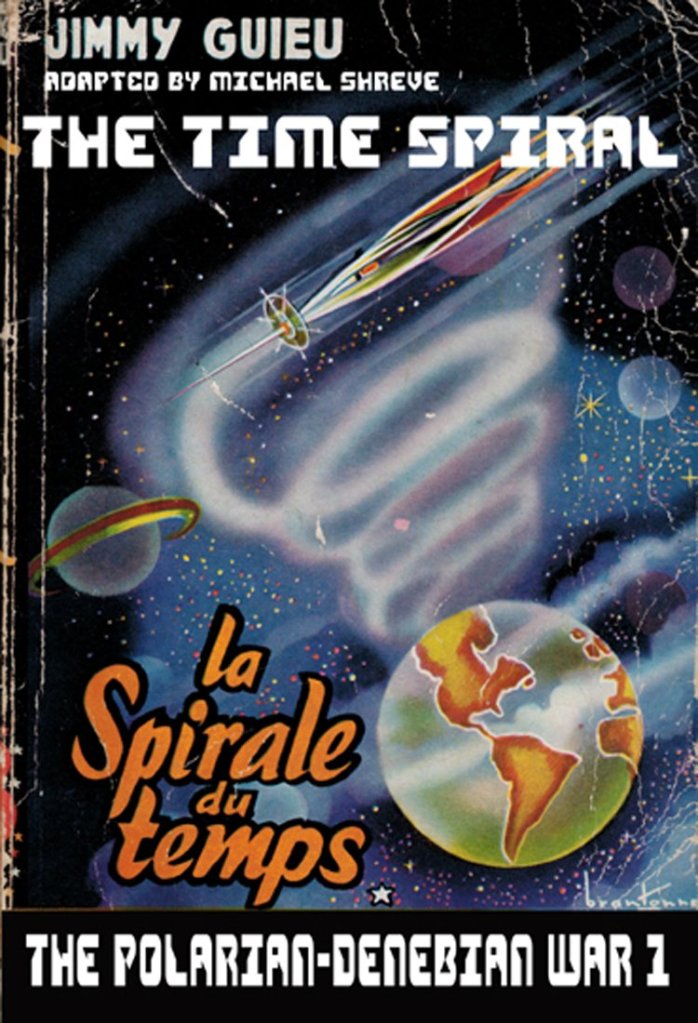
For those of you who have no idea what this is about or what I’m doing, I’m reading back through THE Portuguese collection of science fiction, the one I read and which pulled me into this crazy fandom and eventually this crazy profession. (I might have come into it to write mystery, maybe, but considering how ill mystery was (yes, worse than sf) when I started, I doubt I’d have stuck it out.)
Anyway, if you missed it, the full explanation is there: The Future of the Past.
This week is kind of weird, because it should have been this book: L’Univers Vivant. Which would translate as “The Living Universe”. They didn’t get creative with the name, either. They called it O Mundo Vivo in Portuguese.
Des galaxies en collision ; des milliards de mondes volatilisés : un chaos a l’échelle cosmique progressant vers notre Voie Lacté… et l’escadre spatiale de Jerry Barclay lancée vers l’Infini pour tenter de juguler ces cataclysmes… et découvrir alors le fantastique secret de l’univers.
Roughly: Galaxies in collision; millions of worlds vaporized: chaos on a cosmic scale progresses towards our Milky way…. and Jerry Barclay’s space squadron launched towards the Infinite to try to curb these cataclysms… and then discover the fantastic secret of the universe.
To be fair this sounds like it would be more fun and not get caught up in the author’s private obsessions. The author’s private obsessions? you say. Hold fast.
First, what happened: I couldn’t find L’Univers Vivant in English, and while I could read it in French it would be rather baffling to throw it at you if you couldn’t also read it. What if I really loved it?
Anyway, so I went to Amazon and I found a series by the author. I picked the first book.
Now, this series, from what I can tell started later, and the writer fell more and more under his particular obsessions as he got older.
So, let’s get into the author: Jimmy Guieu was the pen name of Henri René Guieu who mostly wrote as Jimmy Guieu. (Incidentally the only time I had a touch for a translation in Portuguese, they wanted me to use my “English name” for the Musketeers. Eh.)
Sorry, I know from Wikipedia, but…
Henri René Guieu (19 March 1926 – 2 January 2000) was a French science fiction writer and ufologist, who published primarily with the pseudonym Jimmy Guieu. He occasionally used other pseudonyms as well, including Claude Vauzière for a young adult series, Jimmy G. Quint (with Georges Pierquin) for a number of espionage novels, Claude Rostaing for two detective novels and Dominique Verseau for six erotic novels.
I have a weird feeling I read at least one of his erotic novels. (My best friend stumbled onto one and shared. I found it was not my thing.) Weirdly, I’m fairly sure I never read Time Spiral. (I might have read L’Univers Vivant, but if so it didn’t leave a mark.) See that ufologist thing? Yeah, the more Jimmy Guieu wrote the more he started viewing his novels as channeled (more or less) non fiction in which he wrote to “evangelize” his ideas on UFOs and Ancient Aliens.
They think by hooking up into the UFOlogists and Ancient Alien people he got more readership than he would otherwise. This strikes me as odd, as it’s weird for UFOs and Ancient Aliens to have more readership than SF, but France is a strange country and there was a cottage industry in Chariot of the Gods like books. So, it is possible.
Anyway, Jimmy Guieu is the best selling science fiction writer in France, in all times, sort of like their Heinlein. They gave him his own imprint. So–
Perhaps I’m judging him too harshly, as the time spiral was published in 1952. Perhaps my reaction to it has to do with my having been ill and underslept and at the beginning of recovery. Or maybe the ideas in this book rubbed me particularly wrong, part of it due to the ancient alien stuff rubbing me very, very wrong.
A quick summary, with some spoilers, but trust me, if you decide to read it you’ll still find surprises… (and how.):
Jean Karaven who has theories about the origin of mankind is called upon by his friend in… Caltech? (I don’t remember. None of the American setting rang “right”) who has invented a time spaceship. The mechanism for time travel is weird, but not unheard of, if you read a lot of weird stuff. Anyway, it takes a spaceship and it travels backwards. They travel with military personnel, since this is a government research project, and they first go back to Lemuria — shut up — where they hook up with the party of aliens there to civilize the natives. There, improbably, a pair of identical twins fall in love one with Jean Karaven and another with an Austrian engineer who is along for… reasons. They fall in love with them so hard that they end up returning to the present with them. While there they have adventures, mostly relating to a tribe of hairy red cyclops. (Oh, I have words on the origin of those.) Then they go further back in time to where the first “alien teachers” have come to Earth to teach the natives who are…. golden hermaphrodites. These golden hermaphrodites are descended from, for lack of a better term, spirit jelly fish. Don’t go there. Don’t even. The adventure in that time is curtailing a would be space Lord who if he lived would cause da eeevile on a massive scale. Then they undo a snaffu in Lemuria where Karaven’s girlfriend got killed, and unkill her. This inexplicably (or perhaps explicably, but by that time I was not tracking very well) required them to kill their time doubles, which they do with no compunction. And then they come back to the fifties,with their brides.
The main problems I had with it:
As some of you know I’m semi-nutty on there having been ancient civilizations. I am sure there have been, at least at the Greeco-Roman and perhaps at the 17 century level. We really can’t DISPROVE their existence in the vast, unrecorded years of human presence on the planet.
This is based on my belief that building civilizations is as natural to us as building dams is to beavers, and that the present civilization is only 10k years old. 20k if you want to go to first traces.
HOWEVER I do not believe in Ancient Aliens. Look, I have an issue with aliens to begin with, it’s why I don’t tend to write them much. However I’m agnostic on whether aliens exist and whether they’ve ever visited the Earth.
What I don’t believe in is these “helpful, advanced aliens coming to teach mankind.” That makes my teeth hurt. I read a lot of those books (yes, a lot of them French) when I was young, and I still read them sometimes because anything touching traces of ancient civilizations will eventually end up in that and make me ARGH. Because even reading them as a kid, I got the contempt for mankind, the desire for someone more “enlightened” to come and help us, etc. The need for someone perfect to rescue us from our imperfection. Look, guys, I already have a religion. Which is what this seems to be to me, groping for religion and refusing to consider the traditional ones, out of spite.
I hate it for other reasons, like the assumption that humans are the slow children of the universe. (I much prefer the idea, mooted in Have Spacesuit Will travel that Humans are the old ones of the Galaxy. No reason, but I’m human, so I’ll cheer for the home team.)
As a plot (or life theory) device, it ends up becoming deus x machina that explains everyhiting, solves everything, etc.
In this case it was bizarre, because while the aliens supposedly looked down on us because we’d got into war, etc. the aliens themselves have wars, and take gleefully tot he suggestion of using virus weapons against the cyclops in Lemuria, and to pre-kill someone before they commit a crime. In fact the aliens have amazing weapons (disintegrators) and are ever eager to reach for them, etc.
All of that seriously upset me. It might have upset me less if the book came right after Lost in The Stratosphere, as it’s only a reasonable bit worse than that. But after last week’s this was a big letdown.
More minor things that I disliked intensely: the treatment of women. Note this is me speaking, okay? It’s so bad that I wondered whether the cardboard character women that so annoy feminists in SF are picked up exclusively from foreign novels? I mean, these female aliens are leaders of their groups, blah blah blah, but go head over heels for these guys, despite the fact, btw. that they’re 7 feet tall and these guys are just over six. And the fact that they’re supposedly much further advanced aliens. They go for them so hard in a few days acquaintance that they abandon their mission and everything they trained for to go to a time they know nothing of and marry these guys.
Now, can you make that fly? And make everyone human? Sure you can, but Guieu DIDN’T. It’s like they take a look at the Frenchman and the Austrian and man, oh, man, they’re in love forever. I could make crude jokes, but I won’t.
A giggle-worthy point that might be a mistranslation, the first time the main love interest — Layla — shows up, she’s described as blond and pure. I don’t know how they get “pure” from visual, but cool, whatever.
Evolution. Oh, dear, evolution. Evolution is supposed to work linearly and always make species better. Oh, also the aliens guide our evolution. (If you just saw me with middle fingers aloft, you can see through space. Because ARGH. We’re not livestock.)
The action was not told in slow enough motion to matter. The people never seem to have an internal life.
Really minor stuff, and might be translation. The beginning particularly is filled with brand names for everything mentioned, from cars to guns, and always by the formal name. Thompson guns, not Tommy guns. Etc. etc. etc. It felt wrong and unnatural.
Anyway, I didn’t like it. which is me and might have as much to do with where I am right now and my own particular sensitive points, but well, I’m glad I added knowledge of this author to my arsenal, since he seems to be the most influential sf writer in France. (He only died in 2000.)
Fortunately (?) the next book on the list is an old friend, though one I haven’t read in a long time now.
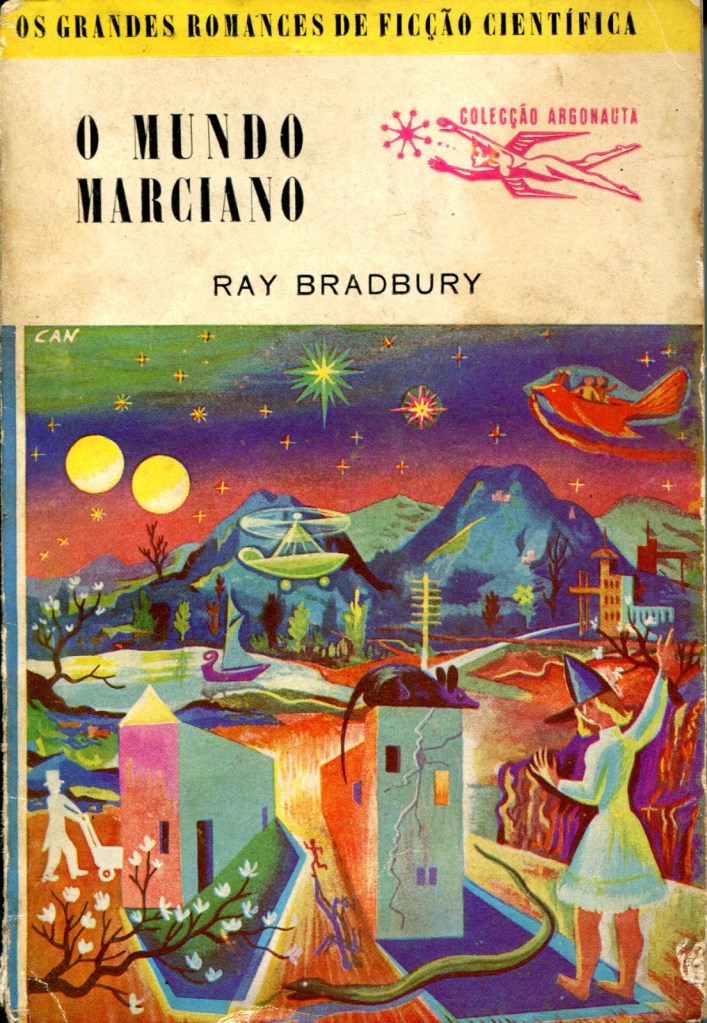
Yeah, that is the Martian Chronicles by Ray Bradbury.
I remember being mildly confused by it when I first read it partly because the Portuguese title promised more of a hard sci fi about the colonization of Mars or something. (The title is literally translated as The World of Mars.) However, even confused, I remember loving it.
The last time I read it was when the older boy was going through a Bradbury thing…. Oh, dear, 20 years ago. (He had to pick an author for a project in English and he picked Bradbury.) I was of course a very different person.
I’m looking forward to getting reacquainted with it and seeing how it hits me now.
I’ll report next week. And sorry for being so scathing on this book. It’s entirely possible I’m unfair, but there it is.
 According To Hoyt
Meanwhile, Exhibit 1 million for the “Elections are useless and believing otherwise is as cargo cultish as anything we’ve seen from the Left” file:
https://twitchy.com/brettt/2025/04/23/judge-orders-trump-to-bring-back-voice-of-america-n2411793
LikeLike
Let the judge be the conductor between the driver and final?
LikeLike
Oh, let him be part of the SWR meter. Might be rough on the final, though.
LikeLike
He wants to modulate the USA’s message, he can step up to the plate. All the way up.
LikeLike
So many RF puns; so little time. And so few carp launched…😎
LikeLike
The carpapult crew showed resistance to carp propagation. They were at Fluffy’s barbeque singing “Ohm on the range”.
[Prepares for backup carpapult crew.]
LikeLike
They waved as they were guided to the barbecue.
😁😁😁
LikeLike
I used to work at a TV station. B++ for the final amp tube plates was 50 KV. I think that would be enough. :-P
LikeLike
From your description, L’univers Vivant does sound like a lot more fun: galaxy-spanning space opera; dumb fun if nothing else.
There is certainly a theme in science fiction of alien women who find Earth men irresistible, but it generally comes from the cheaper sort of American movie productions, especially from, yes, the 1950s. Perhaps that’s natural. American men do like having their egos stroked, and movie producers know that while galaxy-spanning space opera is expensive, women are not, at least at union scale.
Haven’t gotten to your Murray Leinster yet, but it’s on my reader, and I should be done with my current book by sometime tomorrow.
LikeLiked by 1 person
In contrast, there’s Brin’s take on ancient aliens in his Uplift setting. Ancient aliens helping (and enslaving) more primitive races is the norm in the galaxy, and humanity (which is in the process of uplifting chimpanzees and dolphins) is a “wolfling’ species that has somehow managed to develop starflight on its own. And this fact drives many of the other alien races absolutely nuts.
It also causes at least one alien race to set up a secret human society that believes those aliens started humanity’s uplift before being forced to abandon humanity for reasons(tm).
LikeLiked by 1 person
I haven’t read those for a while. I think the Uplift view of Ancient Aliens is
“Ancient Aliens is Asshoe” Heh its even vaguely alliterative…
LikeLike
Some yes, some no, like people in the real world. The problem for humanity is that the races most interested in an upstart wolfling’ species are the ones that tend to be the most zealous and/or fanatic. As an example, one of the alien races (the Thenanan, IIRC) have religious beliefs about the older races that affect their thinking regarding humanity. But they’re otherwise decent, and eventually end up allying with Earthclan after accidentally becoming the sponsor of the gorillas.
LikeLike
On Ancient Aliens, it’s an out-growth of the “those natives couldn’t have built that” nonsense. [Wink]
LikeLike
The original “You didn’t build that”?
LikeLike
Yes. My summary of the Von Daniken type theories has long been: “I can’t figure out how to <build certain ancient large engineering project>, so certainly those primitive slope heads couldn’t. Must have been aliens”
LikeLiked by 1 person
Yep, the perpetual whine of the incompetent. De Camp wrote a book, Ancient Engineers, that addressed a lot of that idiocy with real info about real engineering techniques, from the first cities until the Renaissance. I need to re-read it.
LikeLike
Hey, I have that book.
Also a friend who has a Phd in art history (No, he’s ours, and fairly smart. Just a matter of passion) starts foaming at the mouth at the “big rocks” evidence for ancient aliens.
…. It’s funny to watch so I wind him up all the time.
WHAT? Did I say I was NICE?
LikeLike
🤣🤣🤣
Hey, take your fun where you can get it!
LikeLike
There are some amazing YT videos about old-school masonry techniques, which basically explain all the “inexplicable” stonework, and show people still doing it today without machine tools.
The NYC guy who started explaining how he would set up.a work.crew to make an Egyptian sarcophagus was probably my favorite. (He was honest about preferring the machine tools, but he also had been trained to do things the old way.)
But the Indian guys building a temple in Hawaii were also pretty awesome.
LikeLike
There are some amazing YT videos about old-school masonry techniques, which basically explain all the “inexplicable” stonework, and show people still doing it today without machine tools.
The NYC guy who started explaining how he would set up.a work.crew to make an Egyptian sarcophagus was probably my favorite. (He was honest about preferring the machine tools, but he also had been trained to do things the old way.)
But the Indian guys building a temple in Hawaii were also pretty awesome.
LikeLike
I read Chariots of the Gods when it came out in English, and to my mid-teen brain, it felt like he used “obviously” as his form of handwavium. Helped to start my internal BS-detector, he did.
LikeLiked by 1 person
Did you ever read Weber’s Mutineer’s Moon books?
The pretense there was that humans were the ancient aliens; they’d had a mutinee, you see.
That one also broke the ‘Hitler was uniquely human’ trope. In that one, he was one of the various attempts by the mutineer faction to try and conquer the world. I thought that was interesting.
LikeLike
I LIKE the humans being the ancient aliens. The old ones of the Galaxy. Feared to such a point they say our name with fear.
LikeLiked by 1 person
Gordon Dickson and Alan Dean Foster both wrote shorts (novelettes?) about that subject; both quite good. I’m sure there were others I don’t recall or never read. And IMHO the Mutineers’ Moon series was very good adventure SF.
LikeLiked by 1 person
The Foster book had an interesting conceit that I wish he had gone into more detail with-to the galactic community, Earth is a death world. Highly geologically unstable. Very wet. Wildlife tends to be dangerous, with a few places (cough Australia cough) being terrifying.
The end result was that human civilians working as a military auxiliary were terrifying. Actual human soldiers were the nightmare of both sides of the galactic war.
LikeLike
OK, that’s a different one; I was thinking of “With Friends Like These”.
LikeLiked by 1 person
This one is Foster’s “The Damned Trilogy”.
LikeLike
OK; thanks. Missed that one; I read most of his early work, including the first few Flinx books, but I sort of got away from him after that. I might take another look; I didn’t start disliking his stuff, it just got shoved to the back of the queue and I never seemed to get to it.
LikeLike
I wonder if that’s where the whole HFY, “Earth is a deathworld” trope came from, or if it was already floating around when Foster wrote it.
LikeLike
I suspect now it’s a reaction to “we are uniquely bad” and “voluntary extinction” types.
LikeLike
Dahak, are you playing around on the internet again?
LikeLike
Colin? Is that you?😉
BTW, if you haven’t seen it, this is worth reading; a pastiche of multiple series by David:
https://www.forums.davidweber.net/viewtopic.php?t=4078
Enjoy!😁
LikeLiked by 1 person
Hah!
”I wonder if it’s fanfic when the author does it?” asked David Weber. No, really, he wrote that, about more words he wrote afterwards.
LikeLiked by 1 person
*Notes turn of phrase for story inspiration.*
LikeLiked by 1 person
“We promised to be peaceful, to mind our business, to hold our temper.
“And yet, you came and tried to destroy us. You damn near succeeded.
“Now, what do you think is going to happen?“
LikeLiked by 1 person
Yep.
LikeLiked by 1 person
One of the solutions for the Fermi Paradox is we are in fact the first.
If you run down the math on those earlier hotter stars, it is unlikely they allowed habitable planets long enough to get life going, let alone sentience or civilization. The slightly later stars are slightly less bad, but not really all that different over long time periods and often periodically radically unstable, so any rocky worlds get lots of rads, which makes things tricky.
Our star being so boring and stable for such an extended period is apparently a relatively new thing, and we lucked out with Jupiter outsystem soaking up comets, and the Moon in close sweeping up asteroids, so the probabilities stacking that way, we might really be the first to make it this far.
Add on the various “then they blew themselves up” options as civilizations gain tech, and if we do make it out there (knock on wood) we could easily find we’re either actually the first to do so, or any others might be really really far away.
LikeLiked by 1 person
Read SF where the premise that our solar system is is at the end of a dead end arm of the galaxy far far away. That any alien civilization finding earth either was running from something, or more likely had a navigation oops. Then are surprised to find something.
LikeLiked by 2 people
Well, we are in the middle of a “weirdly empty” section of space, the “Local Bubble”, which our sun wandered into about 5 million years ago. Maybe that lack of instersteller gasses means warp bubbles or hyperdrives or magic beans don’t work right around here?
Cool article at Space.com:
https://www.space.com/what-is-local-bubble-solar-system
LikeLiked by 1 person
Heh: “instersteller”. Autocorrect goes one strike for that one. Nice.
LikeLike
There are a number of conditions required to produce a planet that can support life. A star that will remain stable for several billion years, a planet at the right distance, which must be of the right size and composition. That’s critical. The planet must contain heavy elements: carbon, nitrogen, oxygen, phosphorus, sulfur, sodium, calcium, potassium, iron…most of the periodic table, in fact. That means it has to form from the remnants of earlier supernova nebulae. Life couldn’t develop until the universe had been around for a few billion years to produce those elements.
LikeLiked by 1 person
That would be interesting-we are the Elder Race out there, it’s all up to us to try and make this universe a better place in general and in specific.
Scary thought.
LikeLiked by 1 person
Heinlein nods at this in Have Spacesuit, during the trial. Incidentally his dismissal of autrolopithecus (Sp_ as “not the same race” was so prescient.
LikeLike
Rush said it….
LikeLike
Makes the “stay in the cradle” crowd look like the shirker cowards they are.
LikeLike
In Tau Zero, Poul Anderson has his humans deliberately try to time things to be the Elder Race in the next universe.
LikeLike
I once read a short story in which both Hitler and Churchill were plants by an alien race to influence Earth’s development.
The story ends just as they’re deployed, but obviously it didn’t work out as planned.
LikeLike
I vaguely remember a Keith Laumer story where aliens repeatedly try to influence Earth’s development and it keeps going wrong, due to humans obstinately reacting in ways not predicted. (One example was the western allies aiding the USSR against Nazi Germany, rather than neatly going along with the alien plan of letting the two evil nations fight to mutual destruction.)
LikeLiked by 1 person
Sometimes the “alien plans” went wrong because the aliens didn’t know everything.
IE In one such story, the pre-WW2 aliens didn’t notice Lenin on his way back to Russia and that ruined at least one of their plans.
LikeLike
Let’s not forget Unnatural Causes from Callahans Crosstime Saloon
LikeLike
On a message board I sometimes lurk at (which has slowly been taken over by woke moderators and thus is not as much fun as it used to be) some dolt posted the other day that if humans invented warp drive tomorrow, our “betters” would have the moral duty to exterminate us. I always find it amusing that lefties assume advanced civilizations will be more moral, and moral in ways that align with whatever lefties happen to believe in that exact moment.
LikeLiked by 1 person
Yeah, there is no evidence in all of human history, the only set of history to which we have access, that “befores” must = “betters”.
LikeLike
IMO it has nothing to do with the “age” of the Alien Civilizations.
It’s because they “aren’t human”.
The modern left hates Western Civilization and sees “aliens vs humans” as “aliens vs Western Civilization”. ☹️
LikeLiked by 1 person
THIS THIS THIS THIS THIS
LikeLike
Obviously we must invent warp drives ASAP and spread to multiple planets before they realize we’re there.
LikeLiked by 1 person
Andre Norton’s Star Soldiers. Humans break into the solar system, aliens show up. Can’t be aggressive out there, don’t ya know. So humans contribution to galaxy is by being galaxy mercenaries. Except humans only appearing to go along to get along. Aliens civilization patting themselves on the back as human population winds itself down to extinction. But surprise. From the beginning humans have been sending out colony ships and creating hidden colonies. Instead of extinction, expansion, and dominance (eventually).
LikeLiked by 1 person
jic – c4c
LikeLike
Excellent stories, those!
LikeLike
They think they are Delenn or Sinclair. In reality, they are lesser Besters.
LikeLiked by 1 person
That’s an insult to Alfred Bester. 😉
LikeLiked by 2 people
More like lesser Byrons. I encountered the actor at DragonCon one night as his minders were pouring him into the elevator. The petulant character he played wasn’t exactly a stretch.
LikeLike
Byron was so insufferable.
LikeLiked by 1 person
Nah. They’re Clarks. Bester was at least working for something bigger than himself. They want to take over or destroy what they never had the capability to create.
LikeLike
It may not be seen as a moral duty, but more like the Kazin in Larry Niven’s Man-Kzin Wars. An alien race with a whole different set of morals.
LikeLike
My only issue on vanished ancient civilizations is not physical, as time is vast, stuff is not durable at those time scales, and anything ever found in any dig which is incongruous is much more likely to be quietly trash binned than documented as an “out of place artifact” and thus jeopardize the holy funding flow.
No, my issue is that any remotely successful civilization should have left traces of it’s expanded population, and a resulting extra genetic diversity, in the DNA of modern humans, unless some extra flexible gymnastics are performed to somehow keep that entire population completely out of the modern genome.
This is in part why the Denisovan stuff is so interesting. If you ask yourself what impact a small shipwrecked crew from a “thank deity we got off that darned rock” extra-terra human civilization might have had if stranded back here, one could argue it might look like the “Denisovan girls are hot” stuff we are seeing discovered recently.
LikeLike
A civilization at 17th century level is going to leave quite a large pile of artifacts. Terrain alteration occurs. Species impacts are huge. Coins and other trade items Genetic signatures…. Look at all the Romans managed to do, and how much of it is multi-millennium persistent.
A pity we did not figure out the Roman recipe for concrete before we built our Interstate Highway system.
Such an anomalous civilization-before-ours is unlikely to remain hidden from our tendency to dig everywhere.
LikeLike
We’ve been through ice ages. No way anything survived. The coast has changed and underwater archeology is rare. etc. etc. etc.
LikeLiked by 1 person
Rome is 2kyrs back – this would be 50kyrs to 250kyrs or more. I was just reading something recently that laid out how long stuff would last – anything not stone has a hard time getting past 10kyrs or so, including concrete and steel and glass. The only metal that would not fully corrode is gold, and even it would get mangled under a glacier.
Finally if any Carthage or Rome-level civ happened to rise when a glaciation period was running, their most heavily populated areas would be out on what today are the continental shelves, so we’d have to be looking under a lot of water and a lot more mud to find their stuff.
There’s a lot to be said for “if there were, there are reasons we don’t know”, especially in deep time.
LikeLiked by 2 people
we have all sorts of fossils and artifacts from pre glaciation proto humans. The ice didn’t get all that far south, and vast areas of pleasant climate were ice free.
And 17th century, even 5th, is plenty to move away from advancing glaciers.
combustion ash traces from such a civilization would likely exist in icecap ice cores from Greenland and Antarctica.
LikeLike
We keep going further and further back, though so some of those are no longer proto humans but doomed side branches….
LikeLike
Flint tools. Decent arrowheads and spearpoints were -huge- early trade items, that moved hundreds if not thousands of miles. They were the coins of the neolithic. The really good ones traveled far. The “meh” ones that were widely distributed imply someone had some other good that was popular, thus driving “coin” circulation.
Earlier stone tools moved around, also.
Worked flint is an excellent value transport. Stable, reasonably durable, reasonably precious, useful for purpose, lightweight, and highly portable. Worked flint for firearms was still a significant European trade good in the 18th century, and arrowheads in the Americas. Fifteen years ago, I bought a bulk package of one hundred “good English hand made gun flints” for my flintlock rifle and pistols. They remain a trade good in the 21st century. (And those are far better than the commonly available “sawn agate” factory-made things.)
LikeLike
A more compelling argument against ancient civilizations than what we haven’t found, is what we have found. Coal, oil, natural gas, salt and rich ores were still in the ground as of the 18th century. Any industrial civilization would have dug up such resources and used them. Nobody dug up all the fossils and put them in museums. Even if all traces of a dam crumbled away, the lake it formed would have left unmistakeable evidence.
LikeLiked by 1 person
Not if they were in areas now glaciated/under water.
LikeLiked by 1 person
Don’t you mean in areas then buried under glaciers or at the bottoms of lakes? Which the Middle East and South American oil fields were not.
There’s also the matter of invasive species. Everywhere we go, we take animals, plants and germs from one continent to another. Pigs, cows, sheep and rats from Europe to the Americas; corn, peppers, tobacco and syphilis back to Europe. The land masses were essentially isolated from each other until the 16th century.
LikeLike
If there were 10k years in between, it would muddle things. Or more likely 20 with wandering in the dark for a while.
LikeLike
Rats would have survived. There were no rats in the Americas until they got here on European ships in the 16th century. The American horses went extinct long before humans made their way here. America remained horseless until Europeans brought theirs.
LikeLike
That western hemisphere-only mass extinction event has always looked suspicious to me, but it’s too recent for the absence of artifacts if it were related to an unknown civilization more advanced than knapped-flint level. The bolide impact theory has more sense behind it to me.
LikeLike
Not only the Western Hemisphere, as it turns out. The best known megafauna extinction is North America, but Australia and New Guinea also had a rapid megafauna population collapse. A few bits of Europe seem to have lost the big beasts, but others hung on as smaller island dwellers until 4KYA (thousand years ago).
The “overkill theory” was developed in the 1960s and a lot of researchers latched onto it. However, as we have more and more data, it appears that for North America, the climatic shift at the end of the Pleistocene came faster than a lot of people assumed. The northern Great Plains seem to have gone from taiga to forest to temperate grassland in a century or so. That’s a lot of fast change to adapt to or find a refuge from. Add in humans 15KYA or so, and the combination might have been too much for the critters. YMMV.
LikeLiked by 2 people
Also there may have been a comet impact. Experts argue about it.
LikeLiked by 1 person
The White Sands footprints are now dated to 23kya, and they keep finding hints of even older human presence in the Americas, so the “evil humans killed them all when they arrived” seems to be getting weaker.
But pile together that much longer time frame to let human hunters get good at their job, the “shock-synthesized hexagonal diamond” layers being found at various places in North America that date to 13kya pointing to a comet impact event, that then driving a very very bad couple of years weather-wise on top of the ongoing post-glacial climate changes, and you could easily get the habitats eliminated and only remnants left, which the humans then ate.
LikeLiked by 1 person
If something disrupted normal human husbandry/hunting/agriculture, then the big walking barbeque guests become a primary food source.
Some other catastrophe may have induced overhunting. An example in the 19th century is plains tribes driving a bunch of buffalo over a cliff to get meat. One buff is a banquet for a small tribe. But the things run in herds, so, the easy low-risk stampede method gets supper, at the price of the whole mob.
Recent studies indicate the buffalo were in significant decline way before guns/railroads/meatmarket/industry/Army finished them off.
LikeLiked by 1 person
The contrast between the African grasslands, which while they have crazy vast herds of wildebeest a couple times a year as they go back and forth on their commute, they also always feature water buffalo and giraffe and elephants all the other myriad of herbivores, along with all the different predators and scavengers, and the pre-European US Great Plains, with effectively a monoculture of only insanely huge herds of buffalo and maybe some deer, with no major predation on the buffalo herds that I know about except by opportunistic grizzly and humans, only ever made sense to me once I found out about the mass extinction of all the variety of critters that used to be in North America.
No large predators at all working the monstrous horizon-to-horizon buffalo herds is a major tell of something really big changing radically pretty recently.
It used to be nearly as diverse and varied in this hemisphere as the African plains, with multiple large predators and a vast variety of herbivores, even with humans running around the place grilling up the critters made of meat. But nearly everything all died out, pretty much all at once.
The old overhunting theory has humans suddenly becoming way to environmentally influential, a sudden change that does not make sense..
The comet impact(s) evidence fits the scope of the sudden change way better for me.
LikeLike
–
Or super volcanoes. Even the relatively small blast from Crater Lake, not a super volcano, would have impacted the N. America mega fauna. N. American US section has 3 super volcanoes. Super volcanoes do exist outside of the US boundaries, but percentage of land involved (other than Australian continent) is a lot smaller.
LikeLiked by 1 person
ALSO a recent study found that there were evidence exactly from fossil fuels and were things we mine were found that there were three? Four previous high civilizations. If you want to confuse matters further? One was before we evolved.
LikeLike
Nods sagely. Time travelers…. ;)
LikeLike
The tricky math for time travel enthusiasts isn’t the temporal displacement part, but rather the spatial displacement part, as the rotation of the Earth, the Earth’s movement in orbit around Sol, Sol’s movement along it’s path in the local group, the local group’s movement in the spiral arm, the spiral arm’s movement around the core of the Milky Way, and the Milky Way’s galaxy movement in intergalactic space, plus the random passing microsingularity, all add up to it being far more likely the homebuilt TARDIS will materialize in deep space half a light year away from that quaint Roman villa aim point that the intrepid timenaughts were sitting next to the ruins of when they hit the big red button.
LikeLiked by 1 person
…than otherwise.
LikeLike
”Making a temporal jump ain’t like dusting crops, Boy!”
LikeLiked by 1 person
But, but Gaia! They must have been the original green paradiseans!
[Is the /sarc tag really necessary? Didn’t think so. :) ]
LikeLiked by 1 person
Well, if they were, that may be the Major Reason that they’re Gone. [Very Big Twisted Grin]
LikeLike
I want to endorse the opinion of this there dragon.
LikeLiked by 1 person
Sigh. Hon. If we went through the bottleneck we went through and SURVIVED that’s a sign of higher civilization.
We COULD NOT survive unless that remnant were HIGHLY genetically diverse. Say, a remnant left over the US, even with only, what was it? 45 fertile females? Will have people of enough variance that over time we survive.
In a small neolithic village where they’re all cousins? NOT A FRIGGEN CHANCE.
It’s one of hte reasons I’m morally sure of past higher civilizations.
Weirdly recently tripped on another. Cheetahs. If they were our pets and bred for…. whatever the heck we breed dogs for, it would explain “Too screwed up to breed on their own.”
LikeLiked by 1 person
That bottleneck-pass observation is fair, but if the civ were in a hominid branch that only left peripheral traces it would make more sense.
If the observed “Denisovan girls are hot” breeding ended up being from the very rare outsiders who managed to qualify for a work visa visit to Atlantismuriashangrila and then eventually smuggled out their kids, that could work for the DNA record, if somehow there were absolutely no native survivors when Atlantismuriashangrila fell. Or alternately when Atlantismuriashangrila fell only very few survived, who ended up being captured by the neanders and hom.saps, the captured males eaten and the females bred.
LikeLike
The bottle neck was in our main branch, supposedly.
LikeLiked by 1 person
Oh, yes, it was, and it was major, though people get confused on what the numbers coming out in the papers mean. If they say “only 1,200 breeding pairs” or suchlike, they mean the bottleneck let through to continue making babies only the descendants of that small pool of 1,200 pairs, whose descendants kept breeding and not getting eaten by all the badgers. If a larger group of pool descendants were living along the shoreline and all got zapped by a tsunami, they are right out even though they made it through the prior narrow bottleneck.
LikeLiked by 1 person
Look, I’ve argued this with a lot of people. And it’s ALL weird.
If you go “deep time” even species dissemination doesn’t matter.
I simply have the weird feeling birds got to fly, fish got to swim, humans got to create civilization. It’s a “hunch.” Usually if I chase those down, like with the Covidiocy thing, I find out WHY I have it and if it’s right.
In this case the stream is so polluted by “There’s this stuff out of place and REEEEEE Age of Aquarius, ancient aliens, Republicans are evil” that I can’t chase it enough or rationally.
LikeLiked by 1 person
No one has explained the stone walls and structures found on the completely uninhabited Hawaiian island chain by the Polynesian explorers who first discovered them only a thousand years ago. Deep time is pretty much hopeless.
LikeLiked by 1 person
Before the Polynesian folks came along, the Austro-Asiatic folks were all around the Pacific. That’s known, from archeology. Now, it’s not clear if they just left, died out, etc., but there was a lot of climate change. Also a lot of intermarriage. So if the cultural markers stopped, it’s not clear why, although everyone can make guesses.
The Lapita culture came from the Philippines, and they seem to have gotten most places first. But they also fed into the ancestry of the Polynesian peoples.
LikeLiked by 1 person
Social behavior, brain size, erectus.
As far as I am concerned, though, the megafauna extinctions could be an argument against. Only so much carrying capacity for humans, depending on how much of the upper trophic biomass is megafauna. Have to hunt the megafauna populations down before the carrying capacity can support a lot of agriculture and city building.
REcent glaciation could have been the first time that happened.
Or maybe it could be first time, north and south America.
Issue is, fossil record probably can’t reliably give us numbers of mega fauna living at one time.
So could have happened a dozen times over all, and three in north America, for all I know.
That said, not a critical question for me, so my two questions about the idea are a) can I tell an interesting story with it b) can I troll people with it?
LikeLike
Megafauna are reportedly a major problem for agriculture in Africa, as Ellies generally go where ever they want, knock over whatever they want, and trample whatever’s in the way to get to water or what they want to eat. Much of the support for the nature preserves was apparently from farmers to keep the tourists coming but have a big enough place set aside and fenced robustly enough to keep the elephants far away from the crops.
Of course that was before, now agriculture has bigger problems, at least in SA.
LikeLiked by 1 person
Never ever underestimate commies — much less racialist commies — as a problem.
LikeLiked by 1 person
They saw what all of that did to Rhodesia right next door, and instead of saying “Okay, yeah, nope,” they said “Hold my beer!”
LikeLiked by 1 person
Problematica! OOPArtifacts! WEEEEEEE!!!!!
:turns on Coast to Coast AM, since that’s where folks don’t care if it’s mainstream acceptable… which means a lot are crazy:
LikeLiked by 1 person
The cheetah had a much worse bottleneck. Possibly one female. They survive.
Humans are more adaptable. Plus, humanity persisted in areas not glaciated. So apparently did Neandertal.
LikeLike
I think there is much confusion between an Ice Age and the “Snowball Earth” period. Ice Ages just mean North-where-it’s-cold is a bit more south, and even where it’s warmer the mountains never stop being white, and of course there might be glaciers coming down where uncle Fred says there used to be a village on a river. But there was still an equator and still big and small critters to hunt and still springtime and summer, just a lot shorter up north, and kinda sorta in a more narrow band towards the equator.
I think someone living at the equator might only notice the weather being different than grandma said it used to be, and the shoreline was further out than where she said her own grandma said it used to be, but she’s almost 45 summers, and you know how old people get…
LikeLiked by 1 person
Maximum glacial extent in the -recent- glaciations was mid latitude North America. Pennsylvania for example has “Moraine State Park” which is full of edge-of-glacier-terminus stuff.
Florida was never ice-covered in eras with hominids. Nor fully inundated in interglacial.
The hypothesized “snowball” planet-covering glaciation was preCambrian, around 750 million or more years ago.
Much of Europe, Asia, and the Americas were ice-free during the worst of the Pleistocene glaciations (from 2.58Ma BC to recent) Humans did fairly well in this era, spreading globally, if rather slowly. (also assimilated our cousins the Neanderthals, who were probably better cold-adapted.)
LikeLiked by 1 person
There are now real, respectable paleontologists saying humans might be a million years old or more (functional modern humans, whatever variant.) Just FYI. Things have CHANGED since we were in school.
LikeLike
Denisovans have a lot going for them as shipwrecked planetary expats – they apparently thrived at very high altitudes and cold climates, which an adapted-to-somewhere-else offshoot could do if their adopted new home were lower pressure and colder as well. And they seem to have had only a couple of “hot Denisovan girls” interactions with the spreading waves of Neanderthal and H.Sap. showing up in the DNA records feeding into later genome, and only in a very limited geographic area, such that Denisovan genes only show up in modern Asians. So the Denisovans get shipwrecked, rapidly fall to stone knives and bearskins level while they try and survive in the closest environment to the one to which they have adapted, up in the high valleys in the Himalayas, and some of their daughters get captured by the lower altitude hoomans and contribute to the modern genome, while maybe the rest eventually get rescued, whisking them away from their distant ancestors awful genetic homeworld.
LikeLiked by 1 person
James Blish wrote a, “species sending out ships to save some of the race from a nova,” novel that had its moments. The culture was a patriarchy because a generation or so earlier they’d learn to select for sex and everyone wanted males, so females became rare and powerful (as opposed to chattel/prizes, but oh, well). In the survival setting the men regain primacy, though they don’t find a new world until near the end of the Book. Their ship can’t go on and they disperse….and yes, the new world is Earth. The book ends with the comment that “the miracle (humanoid genes) is sleeping in (obviously Chinese man’s) genes.
Denisovans, by coincidence?
LikeLiked by 1 person
I said, “matriarch.y,” darn it.
LikeLike
Thompson guns, not Tommy guns.
To be fair, “Thompson gun” is a lesser used version of the name.
See Warren Zevon’s Roland The Headless Thompson Gunner
LikeLike
Yes, but what I meant was the ENTIRE first part reads weirdly formal and brand dropping. Like he gives a three part name to the Jeep. I no longer remember what, but it was like “Jeep blah blah, modification x” when it didn’t even vaguely matter.
It read like “I did my research and you WILL suffer for it.”
LikeLiked by 1 person
Well, the official(?) designation was (something; Vehicle?), General Purpose, with General Purpose usually shortened to “GP” and pronounced “Jeep”. He does sound like a bit of a pedantic jerk.
LikeLike
There was a character in the Popeye series named Jeep and a lot people think the vehicle was nicknamed after that and the GP thing made up later to cover it.
LikeLike
Could be. But “Vehicle, General Purpose” would be typical military nomenclature, and “Jeep” from “GP” would jibe with most mil slang derived from nomenclature I encountered (“Prick Six”, for example, or “Jerk 27”), so barring actual evidence I think I’ll go with The Razor on this.
LikeLiked by 1 person
“I went down that rabbit hole, you’re going too!” :-P
Sometimes I do a lot of research that boils down to a sentence or two, or even just a few words. But they’re the right words.
LikeLiked by 1 person
Yep. Same.
LikeLike
Regarding the 6-foot vs. 7-foot issue…
As soon as I read that, the stupid movie “Attack of the 50-foot Woman” popped into my head, along with the quip it spawned: “Take me to your ladder; I’ll see your leader later”. Gah…
LikeLiked by 1 person
Ancient Alien chicks: 7 feet tall, and worth the climb!
LikeLike
I <3 you.
LikeLiked by 1 person
I mean, hey, at least they aren’t American feminists.
LikeLiked by 1 person
Lemuria + ancient civilizations + ancient “aliens” = blame Blavatsky, that charlatan. Theosophy, gah…
LikeLiked by 1 person
Yeah, I kind of laughed my way through ’80s “New Age,” aside from enjoying the music and some of the self-help boo,s.
LikeLiked by 1 person
I’ve seen “clair” used to mean light hair color, and also “teint clair” used to mean a clear complexion (no blemishes like acne), so my first guess at where “blonde and pure” came from would be some kind of double play on “clair” in the original language that the translator didn’t entirely “get.”
The Aryan aliens are by far the most boring concept going on in Ufology. I remember first reading about the birth of the legendary Persian hero Rustom in an Ancient Aliens tome. I was all stoked to find out that Zaal, Rustom’s father, summoned his magic bird foster mother, the Simurgh, to help Zaal’s wife who was having trouble giving birth, and basically the Simurgh performed a c-section with some kind of burning herbs as anesthetics. Oooh, cool bird-aliens! I thought. I turn a few pages and the author is going on about how the Ancient Aliens were tall blonde people in feathered headdresses…which is a lot less cool. Bah.
LikeLiked by 1 person
Can’t be bird-people in an ancient aliens UFO book – that’d be crazy-talk.
LikeLiked by 2 people
LOL, true. That is how they think.
LikeLiked by 1 person
With the beautiful alien women, there was an amusing short story of a spacefarer finding such on a planet. They actually were plants that had evolved into attractive female simulations and emitting scents to attract humanoid males to mate with them. Their method of ensuring pollination. He returned with several specimens and began to develop new varieties, having a green thumb so to speak.
LikeLiked by 2 people
ROFL.
LikeLike
I noticed the cover says (at the bottom) “The Polarian-Denebian War I”. Does that mean that this was the first in a series?
Oh boy…
LikeLiked by 1 person
Yes. there are like 10 or more on the series.
LikeLike
Ot: meanwhile, India and Pakistan are rattling sabers for all they’re worth. Kashmir, of course.
LikeLike
The Lashkar terrorists managed to kill off Christians, Hindus, other Muslims, and a honeymoon couple, thus torquing off everyone in India. Pakistan was insufficiently helpful.
So India stopped working on the water project to send Indian water to Pakistan, and they ordered all Pakistani citizens out of India.
LikeLike
You shouldn’t assume we all couldn’t read it en français, but, eh bien, you are probably right about most of us.
LikeLike
French is “Mock Latin”
borque borque borque
LikeLike
Oh, hell no. French is Latin strained through Gaelic and sprinkled with German.
Portuguese is basically “Legion and slums of Rome Latin.” Including dropping all casus but accusative for convenience.
LikeLike
I didn’t assume all of you couldn’t. Heck, one of the friends who regularly reads but doesn’t comment bests me both in fluency and number of languages used with ease.
I just didn’t think the majority would be able to come along.
LikeLike
Off Topic Public Service comment.
A while back, there was a discussion about how to download/de-drm Kindle eBooks to the PC.
I was able to inform at least one Hun about how I do it with Epubor Ultimate.
However, a couple of hours ago I had problems downloading a new Kindle eBook (an Apr 25th release).
I had to contact Epubor about the problem and got the following response.
Quote
Recently, Amazon changed something and enhanced its protection for newly published Kindle books after April 23, 2025. If you can’t download the new Kindle books with 2.4.0 Kindle for PC, you will not be able to decrypt your Kindle books with our Epubor Ultimate now.
Please don’t worry, our team is working on this issue. Once there is a solution, I will contact you as soon as possible.
In this situation, do you have a physical Kindle e-ink device? If yes, you can download your new Kindle books on your Kindle device, then connect your Kindle to your computer. Next, launch the latest 3.0.16.360 version of Epubor Ultimate, and the downloaded books will show up under the e-reader tab, and you can drag and drop the books to remove DRM.
Please give it a try, here is a detailed guide: https://www.youtube.com/watch?v=HB2ZzAqPRFM
End Quote
I’m back and I want to kick Amazon in the rear-end. [Wink]
LikeLiked by 1 person
This affects hacking the kindles as well. I need to check again, but the last update also stopped unlocking of Kindle devices and installing software that downloads the books and does not allow ‘zon to delete or change them in any way. I was going to unlock my paperwhite and back up my library to the PC. On hold until they find the work-around.
LikeLike
At least the Kindle for PC still allows you to download then copy the books to an off storage device, and load into Calibre (sometimes the *”free” decrypt script works when if import the books if installed). May not be decrypted but can save off the files. Can with Nook books too, just a lot harder to find them.
(*) Free. But by the time you’ve fought with it more than once because of Amazon or Nook, it is just easier to pay for Epubor!
LikeLiked by 1 person
okay, I see they have a bit of a work-around (vid is 3 days old and I last looked Sunday)
LikeLike
I try and stick to drm free books. I don’t really like kindle.
LikeLiked by 1 person
I use Kindle for PC. No Kindle device. So the work around won’t work for me. I finally created “2-Jail Break” collection for anything bought new that Epubor Ultimate can’t free currently. Wish I could say that the problem of switching DRM schemes is limited to Amazon Kindle, but Nook does this occasionally too (can’t say about other sources). Difference is that Epubor typically figures out Nook problems a lot faster than Amazon’s.
LikeLike
I envy you the ability to make this trip. Between grade school and high school I lived in 3 countries and have no idea where all the books I read came from. Occasionally I can dig up an old scifi book I read, but I’d love to be able to find the ones I forgot.
LikeLiked by 1 person