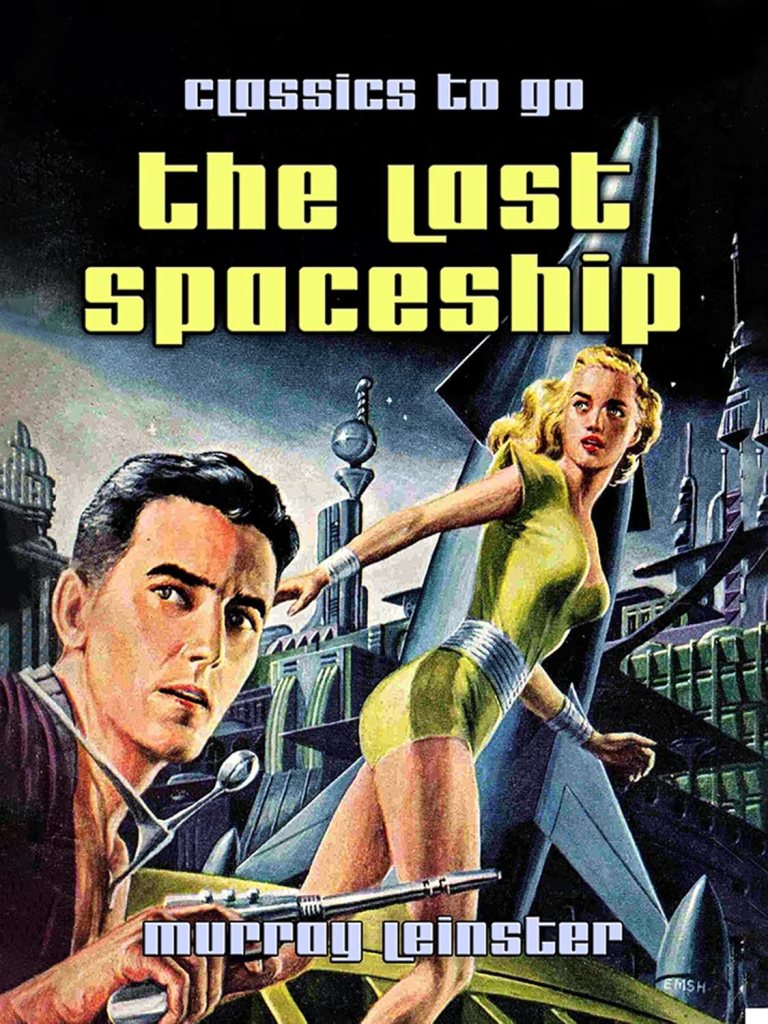
Today’s book is The Last Spaceship by Murray Leinster.
For those wondering why I’m doing this, I have an explanation here. I am following as a kind of guide the one Portuguese science fiction imprint, mostly because it’s likely to be stuff I’ve read before, or at least it is guaranteed some of this is what pulled me into science fiction reading. (And inevitably writing.)
This is the rough list I’m following. And by the way next week’s is an adventure of sorts. The book is by a French author, Jimmy Guieu L’Univers Vivant which translates roughly as “The Living Universe.” Problem being, as far as I can tell L’Univers Vivant has not been translated into English, and even if I were feeling adventurous enough to translate it, the author died relatively recently, so the rights are still in the hands or … relatives? friends? agents? I don’t think I want to play “find the rights holder.” So, with some trepidation and because I think it will be interesting to look at a foreign title — I’ll be honest, I don’t remember liking much of the foreign sf, except Pierre Barbet, and I don’t know how that will hold up now — I decided to try Jimmy Guieu’s first book in his available series in English. That is The Time Spiral (Polarian-Denebian War Book 1). It’s a bit of an adventure, since the reviews are meh, but hey.
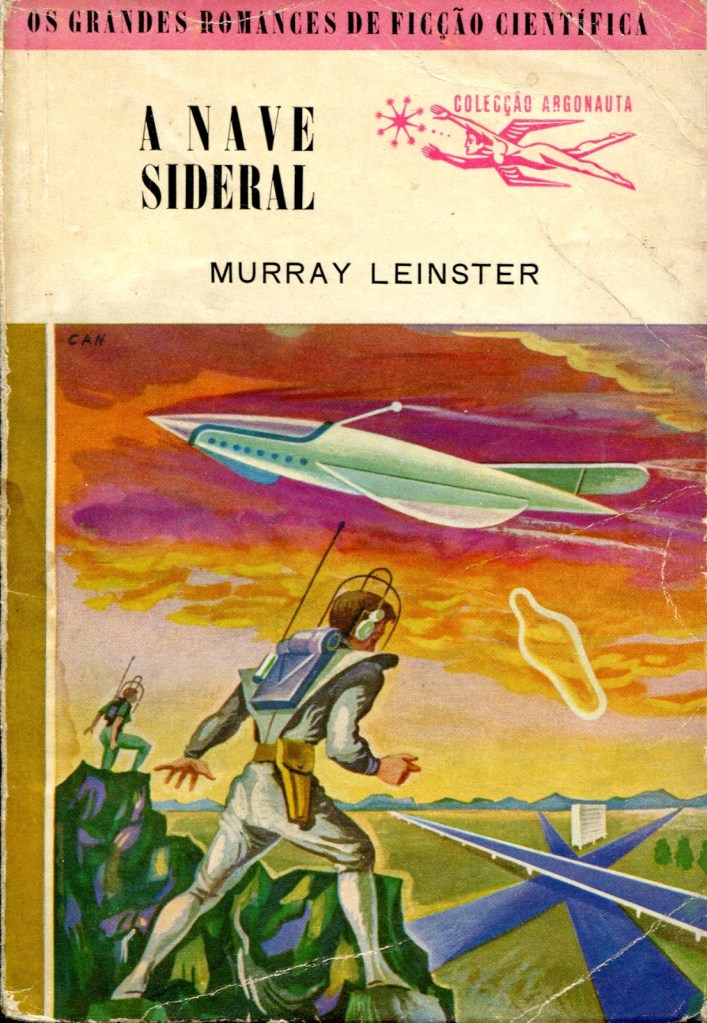
So, that’s next week. Now for this week’s book, let me show you the Portuguese cover, which struck me as very cool.
Murray Leinsters real name was the strangely respectable William Fitzgerald Jenkins. I have absolutely no idea why he used a pen name, except that at the time science fiction (or writing for the pulps in general) was considered not quite respectable. So, it would be like taking a name to be a stripper at night, while being a suburban mommy by day. More or less, though I think the prejudice against the pulps was being considered low brow, not indecent. (This by the way is the reason many female authors used pen names, and not some imaginary prejudice against female writers.)
From wikipedia, on how he came by his pen name: “Murray” is a reference to Leinster’s mother’s maiden name (“Murry”), while “Leinster” alluded to the connection between his middle name (“Fitzgerald”) and the Dukes of Leinster. (By this principle, Dan’s pen name would be Seymour. Though if it comes to that I’ll hold on for the archaic St. Maur.)
Murray Leinster was born in the 1890s and there’s some confusion about where he lived in childhood. Though he and his parents were born in Virginia, the census has them living in Manhattan in 1910. He was a high school dropout and first published in the pulps before WWI.
He wrote for every genre of pulp and broke into science fiction in 1926.
Because his is a grand resume of the sort you expect from a science fiction writer, he was also an inventor, and again, quoting from wikipedia:
Leinster was also an inventor under his real name of William F. Jenkins, best known for the front projection process used in special effects.[7] He appeared in September 1953 on an episode of the educational series American Inventory, in which he discussed the possibility of space travel.
From what I can understand, The Last Spaceship was first published as a novel in 1949, but it was earlier published as novellas in Galaxy.
First overall impression: I liked it. Really, really liked it.
Second overall impression, and please keep in mind that this is me writing this, okay: there were times in reading this book that I was going “Woah there, Murray. You’re really hitting me over the head with the libertarian philosophy. Don’t make it so on the nose!”
It is a series of problem plots. or if you prefer, an increasing spiral of problems that the hero — Kim — and his girlfriend/wife solve on the side of liberty.
It starts with the idea that future worlds have something called a punisher circuit which can block you from places, block you from commerce, hurt you, paralyze you or even kill you. Kim has been declared persona non grata due to his having found a way to get around the punisher circuit. They took away his means of avoiding it, and have put him under punishment. At the same time his girlfriend is locked in her apartment as a means of softening her up so she’ll fall into the clutches of one of the local oligarchs.
Kim reclaims his ancestor’s spaceship, the last spaceship that ever flew before the culture switched over to matter transmitters. This way he avoids being exiled to a space penal colony.
His first problem is how to go as far as he needs on almost no fuel, which he solves with much can-do and ingenuity.
By the end of the book he’s figured out how to circumvent the game of oligarchs and despots, and he and Donna retire to a new planet. I’ll just say that, without too many spoilers, okay?
Finding out it had been originally published as novellas explained the only complaint I had about the book: that sometimes, in the beginning of a chapter, it starts with an interesting scene, then backtracks way back to explain who these people are and the entire situation. Obviously those chapters are where the novellas started, and they had to explain everything in case a new reader didn’t know the previous novellas. I could do some belly aching about how this could have been smoothed over by editing, but seriously? It was eminently readable anyway.
Oh, as part of all this, I particularly liked this story because Kim is the technical expert, but Donna is sort of a generalist thinker, and suggests solutions to him by saying “if we could do this,” often with analogies. This is very much how Dan and I work, and their interactions reminded me of our interactions.
Leinster also has an unblinkingly realistic view of women, and says things that would probably get a man torched (literally) in the current day. Things like pointing out an aging, not very pretty woman who has no hope of getting a man is obligated by psychology to convince herself she hates males. Or that women tend to dramatize tragedy in their own lives. Or that no woman will willingly take her husband and settle in a world with a surplus of women.
He very much refused to believe that women were purer or kinder beings and doesn’t try to convince me of some mythical “sisterhood” of all females that I never encountered in real life. Perhaps I’m jaundiced, but his observations on women agreed with mine, and he doesn’t portray them as either children or angels but as fully competent human beings shaped by social and evolutionary pressures different from males.
I very much enjoyed The Last Spaceship and its hopeful view of the future and it only took me a day to read because I was sick, and reading it around trying to work (which of course I wasn’t actually up to doing.)
Once I’m done reading next week’s experiment, I’ll probably go poke around for more Murray Leinster science fiction and see if it’s all this decent.
Oh, yes, as a side observation: since I’ve been reading these books kindle has stopped trying to sell me romances — note they’re not quite sane. The only romances I ever read are Jane Austen fanfic. And yet they try to sell me Mafia romances — and is now trying to sell me science fiction.
I’m not sure if this is reflective of the current market, or of the people who pay to promote the books. I’ve noted for some time that practically the only space opera remaining is mil sf because Baen kept the lights on through the long night when no one else would publish space opera. This is an impoverishment of the field, and I sometimes feel like I’m the lone ranger trying to resurrect the other sub genres of space opera, and I’d appreciate if some of y’all got in the game, because it’s my favorite sub-genre. (I am, mind you, exaggerating for comic effect. Periodically I stumble on very decent non-mil-sf like Arthur Mayor’s Space Station Noir.)
But being pushed mil sf doesn’t annoy me. It’s not my favorite, unless the writers have the skill of Weber and/or Ringo, but it doesn’t actually annoy me.
However, 9 out of ten “science fiction” books pushed at me are “dystopian.” I didn’t like dystopian fiction back in the eighties when it was practically all you could find, and I like it no better now. As I said I grew up under the assumption that we would be getting hit with a nuke and there was nothing I could do about it. And I was determined to survive and make the future back from the past. I have yet to see a reason to doubt my decision.
File that under “old woman yells at cloud.” And do try The Last Spaceship. You won’t regret it.
 According To Hoyt
so, Murray Leinster predicted modern China, Social Credit, and the dreams of the western would be oligarchs. Chalk up another for classic Sci Fi.
LikeLiked by 1 person
I have to reread “The Last Spaceship”. I’m sure that I have a copy in my e-Library.
LikeLike
I got out the ladder and pulled my copy off the top shelf; 9′ bookcases can be a PITA. It’s hardcover, copyright 1949 (“MCMXLIX”) by Will F. Jenkins (although the author is shown as Murray Leinster), publisher Frederick Fell Inc.; logo “Fell’s Science Fiction Library” around a vertical rocket. Dedication is to Joan Patricia Jenkins (Wife? Mother? Other?). I think it’s a first printing, although there’s nothing to say so. I need to check for an ebook; reading older print ones, even with care, tends to do damage.
LikeLiked by 1 person
Public domain, on Gutenberg.
LikeLike
Yep; found it right after I posted. Gutenberg has about 60 of his stories. Not Gutenberg’s “Science Fiction (Bookshelf)”; it only lists 5 of them.
LikeLiked by 1 person
They dropped maintaining the “shelves” years ago. And some of the Leinster stories are the novellas that make up the novel.
LikeLiked by 1 person
Yeah. I picked up a copy of, The History of the Saracens by this guy named Gibbon ( collaborating with Simon Ockley), with a note in it dated 1875 and broke the page holding the front cover to the book. It is not on Gutenberg, darn it.
LikeLiked by 1 person
I checked Amazon. They have it, but only as hardcover; no Kindle version.
LikeLike
Found it here:
https://www.forgottenbooks.com/en/download/HistoryoftheSaracens_10085495.pdf
As you see, it’s a pdf, but Calibre can convert it.
Enjoy!😉
LikeLike
Update: It’s a pdf, but as Jason mentions below it’s a page scan. Before I realized that I ran the conversion to AZW3 in Calibre; it ran for at least 15 minutes, and the result was, to put it mildly, not very readable. In fact, it gives a whole new meaning to the word “gibberish”; I’m surprised Calibre didn’t kick it out as unconvertible. Bottom line, you can read it in Calibre (or for that matter, in Adobe Reader) as a pdf, but AFAIK not on a Kindle or Kobo. And this version, from ForgottenBooks, has a “Buy to unlock this page” every dozen or so pages.
Sorry ’bout that…
LikeLike
I can’t get to it anytime soon, but PDF page scans exist.
https://archive.org/details/dli.ministry.22355/
LikeLike
That one works, and lacks the advertising.
LikeLike
Yeah… but I like making usable ebooks, and sourcefiles that can be used for any format, at least in theory.
LikeLike
Agreed, which is why I tried to convert in Calibre. But that requires a “real” pdf, not a page-image file.
LikeLike
Even that is iffy. Calibre is a great program. People who slap PD books into PDFs are generally not great, either as people or at what they are doing.
LikeLiked by 1 person
PD books?
LikeLike
Public domain.
LikeLike
Aha! Duh. OK; thanks. I was trying to guess what subset of “pdf” it might be, and getting nowhere beyond “Portable document??? What’s the meaning in context?”😜
LikeLiked by 1 person
No worries. I should have spelled it out.
LikeLike
A distressingly large part of my library has deteriorated until the pages are likely to break when reading.
The usual paper-making process involves sulfuric acid; it takes time and money to wash the residual acid out, and the quality of the end product is related to how well it was done. Cheap paper retains enough acid to react with humidity over time, until the pages turn brown and crumbly. I live in a high-humidity area, unfortunately.
It’s not an issue with better-quality books. A few years ago I grabbed a book on European history from one of the piles for something to read while I went to lunch. If I take a tablet to lunch I can’t leave it on the table when I go to the buffet; nobody is likely to bother a book.
There were some forehead-wrinkling passages in the text. It was translated from German, so I expected the viewpoint to be different, but after a while I flipped to the title page to check the publication date., which I don’t remember offhand, but volume I had was from an 1872 printing.
Oh. I might want to minimize the greasy fingerprints, then.
LikeLike
I concur with BGE: some of that book sounds quite modern, even if it really isn’t. What it is, is relatable. Similar mindsets of oppression; similar aspirations for liberty. Some things don’t change, or at least don’t change fast.
Just so happens that I finished my current e-book this morning, so I have an idea where to go next. Yay, and thank you!
Republica restituendae, et, Hamas delenda est.
LikeLiked by 1 person
You know, it’s kind of funny these ancient paperbacks. I remember scooping up and reading lots of them from old, abandoned houses, pulling them out of recycling bags during paper drives, or even scavenging them at the local dump (before the nanny-staters forbid such practice.) Project Gutenberg is such a nice place to dig out a lot of these.
LikeLiked by 1 person
I was lucky to be born to a family of book pack rats. Most of the books (though not SF. My brother discovered that) I read as a kid I found in the potato cellar, in suitcases in the attic, in the old horse leanto then being used to store broken stuff and firewood, and in the uppermost shelves of grandad’s workshop.
I mean, to this day when looking at houses to buy, I want to go into the crawl space and see if they have valises of books.
LikeLike
Oh, good Lord. I just realized that I have some gym bags and large closed baskets with books in them. I swear, I was going to transfer them to cardboard boxes, but I didn’t yet.
LikeLiked by 1 person
I just checked our bookshelves and found a Baen edition of Med Ship, and two elderly paperbacks: War of the Gizmos and The other Side of Here, which is half of an Ace double (the other half is One Against Eternity by A.E. Van Vogt). I know I’ve read Med Ship but not recently and don’t think I’ve read the other.
Med Ship is fun, definitely non-military space opera.
LikeLike
Leinster was a favorite when I was a child and teenager. He remains an enjoyable read today. I scooped up most of his books in audio and e-book format in this century. Loved listening to his work when I had a 45-minute commute in the early 2010s.
Too libertarian? Not for 1950s-1960s USA, when he was writing them. A lot of people actually believed in a benevolent government looking after everyone back then. Even in the US. (Of course I grew up in a liberal college town – Ann Arbor – filled with conservative natives. This was before all the conservative natives migrated out.) So when I read his stuff 6th grade through 12th grade I cheered that on.
LikeLike
My favorite Leinsters are Operation Outer Space and the Pirates of Zan/Pirates of Ersatz. I also like his Med Ship stories.
LikeLiked by 1 person
It starts with the idea that future worlds have something called a punisher circuit which can block you from places, block you from commerce, hurt you, paralyze you or even kill you.
C’mon, Sarah, that’s just absurd! No society like that could ever exist!
What do mean, my social media is suspended and my bank account is frozen?
LikeLiked by 3 people
Murray Leinster may have been the author that got me into science fiction. It was either that or Raymond Z. Gallun; their Ballantine Best Of collections were among the early books I bought on my own at the local supermarket. It was the covers that drew me in. They were among the most evocative covers of a series that has great covers.
The Best Of also included “A Logic Named Joe” which I ran across again while writing about Tex Avery predicting modern social media!
It looks a whole lot like the modern Internet, right down to fears that people could look up porn and how to commit mayhem; crowdsourcing information; and one major use of the information databases being looking up people you’ve lost contact with. It was published just eight months after Vannevar Bush’s “As We May Think”.
LikeLike
The reason Leinster used a pen name was actually kind of funny, and nothing to do with SF stigma. As a teen, he sold several pieces to respectable magazine The Smart Set (edited by H.L. Mencken), and when he told the other main guy at the magazine, George Jean Nathan, that he was going to take a few pieces to other mags. Nathan, possibly as a joke that Leinster took seriously, asked him to use a pen name for any “lesser” publication, so as not to “stain” the Smart Set with the association.
LikeLiked by 1 person
Things like pointing out an aging, not very pretty woman who has no hope of getting a man is obligated by psychology to convince herself she hates males
Bollocks. We can convince ourselves that we’re not worthy of that kind of love and that there’s no point in ever hoping for it instead. No need to hate men at all.
LikeLike
But if you’re playing the odds, “hating men” is the way to go.
LikeLiked by 1 person
Hmm… I think it depends on whether a woman has a Higher Purpose, or at least, an absorbing thing to do. Especially if it is something bigger than oneself.
So if one has a non-toxic religion, or a strong cause, growing old without a man is not going to cause hatred of either men or of oneself.
OTOH, someone who feels desperate and empty, and also doesn’t have a guy or anything else to focus on, could easily end up blaming all men.
That said — I think generally women who blame all men for all bad stuff, are women who have some legitimate beef against at least one man — and by that, I mean that somebody bedded them and treated them badly, or did something equally nasty without actually bedding them. (And sometimes it’s child sexual abuse or even parental sexual abuse, or narcissistic abuse, or all kinds of bad things.)
If the woman cannot, by the rules of her society, blame that particular guy for everything, it has to be spread over all men.
Which is why Leftist women, who are often treated badly by Leftist men in the name of feminism and freedom, tend today to be the women who hate men.
LikeLiked by 1 person
I’ve known very religious man-hating women.
And at least some women who blame all men for bad stuff are just psychos who are forever in need of new “enemies” to blame everything on.
LikeLike
“nontoxic religion” was stipulated.
LikeLike
Toxic people can twist anything to their purposes. And given the nature of religion as essentially inarguable, possibly that goes double for it.
LikeLike
As Ace of Spades HQ once wrote “Leftist women think the worst of men becuase leftist me ARE the worst of men.”
LikeLiked by 1 person
As Ace of Spades HQ once wrote “Leftist women think the worst of men becuase leftist me ARE the worst of men.”
LikeLike
As Ace of Spades HQ once wrote “Leftist women think the worst of men becuase leftist me ARE the worst of men.”
LikeLike
Same thing with misogyny, of course. Very rarely are men going to brood over the evil of all women everywhere, without having been messed up by at least one woman somewhere.
LikeLike
um…. in this case for in story reasons there were NO MEN.
LikeLiked by 1 person
“Obligated” may be too strong a word, but the “Sour grapes!” reaction is a commonplace, and is by no means limited to women. Same goes for “I’m not worthy!” Either one can be adaptive; either one leads to Very Bad Places if over-indulged.
LikeLiked by 1 person
I’ve seen enough bitter GenX/Boomer dudes online going on about all women being wh*res to feel like that the female of the species does not remotely have a monopoly on the sour grapes thing.
LikeLiked by 1 person
…or the “I’m not worthy!” thing either. Although they don’t put that one online so often.
LikeLike
“…at the time science fiction (or writing for the pulps in general) was considered not quite respectable. So, it would be like taking a name to be a stripper at night, while being a suburban mommy by day. More or less, though I think the prejudice against the pulps was being considered low brow…”
At least some SF writers were working scientists or engineers and apparently SF was considered somewhat declasse as you correctly observe. For example, William Tenn was the nom-de-plume of a physicist named Philip Klass.
LikeLiked by 1 person
I had the privilege in 1986 of taking an English class on SF from Prof Klass at Penn State. He told us stories about L. Ron Hubbard including the bet that resulted in Scientology along with the rest of the class syllabus.
I do not think he had a degree in physics, I think you might be thinking of Phillip J. Klass the UFO researcher.
LikeLike
Murray Leinster is pretty amazing. There’s a lot of his stuff on Gutenberg and I sort of slurped it all up a number of years back. One novel (which grew significantly from a pulp novella called “Long Ago, Far Away” when it was novelized) I particularly liked was Four from Planet 5. The novel title is somewhat disingenuous, but don’t let that bother you.
LikeLiked by 1 person
Further comments:
The Last Space Ship is available on Gutenberg.
The novellas were published in Thrilling Wonder Stories and not Galaxy.
Leinster may have been libertarian, I don’t know, but I do know that “solar system wide dictatorship” was a very common trope in the ’40s, possibly in subconscious response to FDR’s many tramplings on liberties, along with the war of the first half of the decade. Leinster’s The Black Galaxy had a prequel story wherein the hero defeats such a dictatorship through engineering, and the novel begins with that hero In Trouble With The Authorities because, well, he deposed An Authority, and was therefore Not To Be Trusted. The keen obsession with social controls becomes less pronounced in his works in the ’50s, though there are flashes of it here and there. Gateway to Elsewhere (aka Journey to Barkut) features a 1950s man who chafes at the impositions of 1950s society, and basically walks across the multiverse till he gets to a world where Djinn are real and a man can be a man.
Depending on what, exactly, you consider to be space opera, it has always been there, even outside of Baen, though admittedly things could get sparse now and then. Iain M. Banks’s “Culture” books were all space opera, albeit SO written by a socialist with a literary bent. Brin’s Uplift series is all SO, even if Startide Rising is the only one really worth reading. And while I’ve not had time to explore the indie space the way I would like to, I can’t but think there’s a plethora of SO there.
LikeLiked by 1 person
My parents’ SF library was founded (as it were) in the early ’60s and grew from there, but it was mostly made up of works from authors who were active in America in the ’50s. It occurs to me that Leinster was very prominent among them. Others might include Gordon R. Dickson, Fred Pohl, Poul Anderson, and Frank Herbert.
LikeLiked by 1 person
I don’t like “dystopian” either.
On the other hand, I have this writing project where the demands of the Story and the setting call for women to be a sisterhood, even though I know it’s unnatural and unrealistic. The most I can do is feel vaguely guilty about it, along with making sure the various female characters aren’t complete saints.
LikeLiked by 1 person
Obviously there are times when large numbers of women can act as a sisterhood. There will tend to be a lot of internal pressures, but it can be done and has been done.
Remember, most women in the US used to be in clubs and sororities. Clubs made of women.
LikeLiked by 1 person
Bridge clubs, gardening clubs, social clubs, etc. However, many of the members in such clubs would have been married or widowed. And at that time, there were more all-male clubs.
LikeLike
My favorite dystopia is where dystopia is getting kicked where the sun don’t shine.
LikeLiked by 1 person
Oh, I love Ringo’s Black Tide. And technically DST is a dystopia. But the term these days seems to be for books that WALLOW in it.
LikeLike
Pulp dystopias are there for a conflict worth the name. Which is why they can lose.
Literary dystopias are the awful warning, and always win.
LikeLiked by 1 person
Another one to put on the list – and I don’t think I’ve read it in the past. Yay!
By the way, can you repost the link for Tiffany’s Give Send Go? When I saw it on InstaPundit the other day, I was annoyed that I couldn’t do anything – but then $SPOUSE$ came home yesterday to tell me that her dental work was fully covered, so I have some funds to reallocate. Can’t find it again over there now.
LikeLike
Never mind… Finally managed to get Instapundit to show me more than the most recent 50 or so posts. Sent some off to her fund.
LikeLiked by 1 person
Am trying to read War With the Gizmos, which seems to be horror crossed with SF. Including a female biologist who is almost a Sir Austin Cardynge in her complete disregard of personal danger and her gloating desire to prove she’s being scientific, not letting her imagination run away with her.
(The Gizmos are immaterial/gaseous beings who fasten onto the faces or puzzles of organic creatures, including man, and suck the breath out of them).
LikeLike
Sounds familiar. Do they call the invisible gas critters “Muskies”? Is an enhanced sense of smell a plot item? Are the critters highly inflammable, thus the humans have pistols loaded with incendiary/tracer ammo?
I think the one I remember it was in Analog magazine in the late 70s or early 80s.
LikeLike
So far, the small group that realizes they’re dealing with a gaseous life-form call them, “Gizmos,” which was slang at the time for radar traces without an obvious cause. They seem to live on the gases of decomposition, which means animals/people they kill don’t rot and don’t smell, but the Gizmos stink horribly when they’re killed. Fire kills them, but I’m not at a point where anyone has considered using tracers. The culture as a whole has been told by the experts that it’s a plague that’s jumped from animals to humans, so stay calm, stay away from animals and wait for a vaccine. Fat lot of good that is.
LikeLike
Well, the “Muskies” story that you remember sounds like a Spider Robinson story with a male POV character.
LikeLike
Telempath. Yeah, that was a good one, though I think I liked the short better than the full novel
LikeLike
It is a Spider Robinson story. I believe the title is “By Any Other Name.”
LikeLike
The one with the Muskies is by Spider Robinson. I was gonna write that I can’t remember the title when “Telempath” popped into my head…? Maybe?
It’s Robinson, for sure.
Whatever happened to him, anyway? The last thing I read from Robinson was a novel he wrote based on an outline of Robert Heinlein (PBUH) that was… OK. Can’t remember that title either.
LikeLike
Note to self: Refresh the $&^% page before jumping in all helpful-like!
LikeLiked by 1 person
The Wikipedia page for him says he quit writing around 2008 due to health issues after having a heart attack.
Interestingly, Rick Cook said the meds the doctors gave him after a heart attack stifled his ability to write fiction, and Peter Grant noted a similar problem, though he’s still writing.
LikeLike
“Muzzles,” darn it. M.uzzles.
LikeLike
I read The Last Spaceship eons ago, and I will never forget the character the Mayor of Steadheim. That was apparently his name, because that’s how he was referenced every time.
For example: “The Mayor of Steadheim cocked a suspicious eye upon him.”
And: “There’s trouble,” growled the Mayor of Steadheim. “Bad trouble. It couldn’t be worse. It looks like Ades is going to be wiped out. For
lack of space-ships and fuel.”
LikeLike
c4c
LikeLike
Finished War With the Gizmos, and it is SF with a horror element. It notes the human capacity to believe two or more incomparable things at the same time, and it wraps things up very quickly. You also get two competent females, one who is good-looking, intelligent, courageous and quick-wittet….and not a girl boss, but someone willing to both take orders and expand on them.
LikeLiked by 1 person
Interesting idea on the pen name. Mine is taken from an intersection we lived near when I was in college.
LikeLiked by 1 person
My humble contribution of favorite stories: Eric Frank Russel (1958) “Men, Martians, and Machines” and (1957) “Wasp”. The latter is a hilarious spy classic of one-upmanship.
LikeLiked by 1 person
Oh, yes. And “The Space Willies”, “Allamagoosa”, and “Sinister Barrier.”
Russell is another of those guys who churned out decades of good stuff, but never got the “major promotion” nod from a publisher.
LikeLike
I quite liked “The Wailing Asteroid.” That one even made it to film, though it seems to be largely forgotten.
Leinster’s first sale was “The Runaway Skyscraper” in 1919. It’s a Gernsback-era pulp story, but entirely readable even more than a century later.
LikeLiked by 1 person
The film of The Wailing Asteroid, called The Terrornauts, was literally just released on BluRay by Vinegar Syndrome. Review here. Of note: the screenplay was written by John Brunner.
“The Runaway Skyscraper” is, technically, pre-Gernsback era, having been published in Argosy in 1919. Gernsback’s Amazing Stories launched in 1926.
LikeLike
I’m in my seventies and, aside from Firefly, haven’t had time to read SF since my teens. Thanks for the memories. At your instigation, I’m well into The Last Spaceship this morning, having left my more urgent work hanging until I finish it.
I’m struck by the technical knowledge shown by Leinster’s inventions. He obviously felt that his readers would expect and understand enough math and physics so that errors would make things unbelievable. Modern (screen)writers get away with a lot that older audiences wouldn’t tolerate.
One question I have for anyone who can answer:
He gives an equation: M/y, yV=E that I do not understand. Specifically, the comma after M/y. This is apparently a math operator, but it is one that I have never seen. This is supposedly derived from MV=E, so I’m guessing the comma may mean multiplication, but that is just a guess. Is ‘,’ an obsolete math symbol from the early 1950s or is it just a typo?
LikeLiked by 1 person
I’m in my seventies and, aside from Firefly, haven’t had time to read SF since my teens. Thanks for the memories. At your instigation, I’m well into The Last Spaceship this morning, having left my more urgent work hanging until I finish it.
I’m struck by the technical knowledge shown by Leinster’s inventions. He obviously felt that his readers would expect and understand enough math and physics so that errors would make things unbelievable. Modern (screen)writers get away with a lot that older audiences wouldn’t tolerate.
One question I have for anyone who can answer:
He gives an equation: M/y, yV=E that I do not understand. Specifically, the comma after M/y. This is apparently a math operator, but it is one that I have never seen. This is supposedly derived from MV=E, so I’m guessing the comma may mean multiplication, but that is just a guess. Is ‘,’ an obsolete math symbol from the early 1950s or is it just a typo?
LikeLike
Re-reading those two paragraphs where Kim is explaining the formulas for velocity for normal space, overdrive, and matter transporation, the only thing I think that makes sense is to think of something like you SUBSTITUTE (M/y) for M, and SUBSTITUTE (yV) for V. Then it would end up as (M/y)(yV) = E. That make any sense?
LikeLike
Yes, it does. I thought of that, though it would make the y’s cancel out in the product. Perhaps he did that intentionally, for a warp drive that doesn’t actually exist.
LikeLike
I know I’m a day late here. but didn’t get to read it until today.
Some years back I know I read a couple of Murray Leinster books from Armchair Fiction, and the only thing I remember is that I was kind if dissapointed in that they were not as “good” as some of the other authors I had read. Maybe I was in a different phase of what I was looking for in SF.
This one, “The Last Spaceship” is fairly enjoyable. Mostly it grabbed me at the beginning with the two main hooks of the technological advances of the Disciplinary Circuit and Matter Transporation, and how societies might develop with them. (Unsurprisingly, due to the basically unchanging nature of human beings even over thousands of years, they developed into various forms of authoritarianism.)
It’s basically a “smart engineer uses his brain to invent and/or jury-rig devices to get him out of his current predicaments, which ends up changing all of galactic society and the oppressive governments” story. And unlike some protagonists in stories like these, Kim is constantly exposing himself to physical danger and taking risks. He’s not going to engage in fisticuffs, but facing down death rays and the dangerous side-effects of his own inventions is far more dangerous.
LikeLiked by 1 person