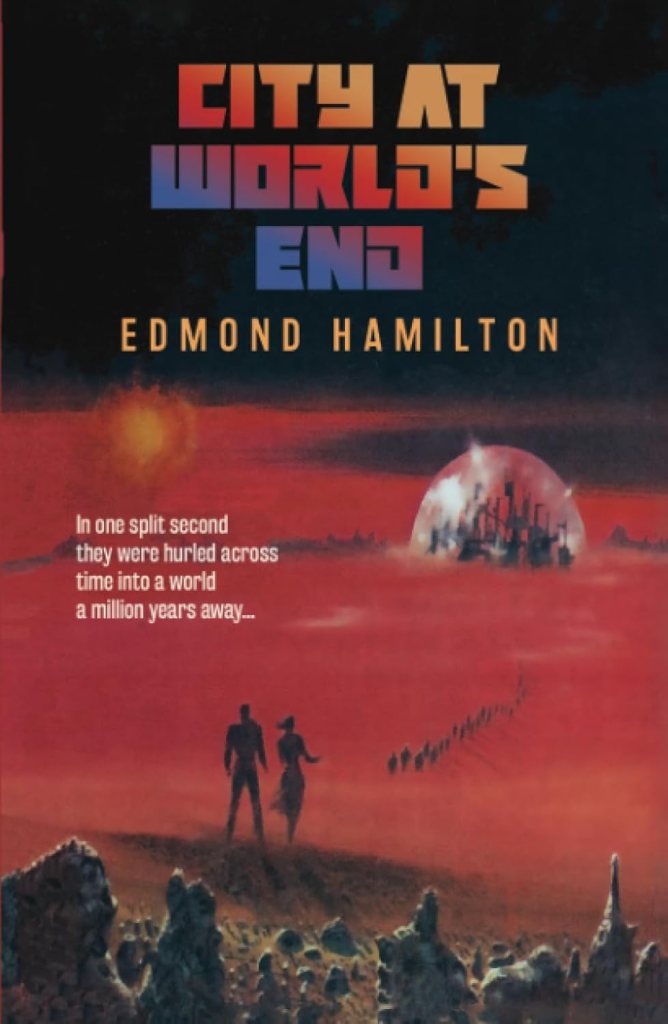
You guys really must tell me if my trips back into the memory lane of science fiction bore you to death. I’ll continue making them, and probably keep notes — because I’m old and have hit my head a bunch of times — but not inflict them on you.
For those who are not aware of what I’m doing, this is the initial post.
The short version is that I was introduced to science fiction via a friend of my much older brother’s. His friend had a real library and all the books of the only dedicated Portuguese science fiction imprint, the storied Argonauta. This imprint was so formative for me that when I established my own press I looked to see if I could name it Argonaut. Unfortunately at least at the time there was a gun/war oriented imprint by that name in Colorado, and I couldn’t use the name.
However I didn’t read the books in order, and might never have read all of them (again, having been hit on the head once too many times my memory is no longer eidetic so I don’t actually remember.) In Portugal the print runs were always too small and there were no reprints. This meant that finding the books after the initial distro depended on luck: someone else’s library, used bookstores or the spinner rack in some tiny tobacconist in a forgotten village. (Where I found a treasure trove of Heinlein’s in the 70s.)
Having found the listing online back in 2016, I decided I would read it from the beginning and blog it, and then…. Well, by the time I got around to it it was 2018, we were in severe financial distress, our older kid was getting married, I got ill and and and–
Now here we are. And now I don’t have any more kids to marry off, so the time has come to do this, unless you guys say I’m putting you to sleep, in which case I’ll still do it but not inflict it on you.
Today’s victim is Edmond Hamilton’s The City At World’s End. Next Week’s is Murray Leinster’s The Last Spaceship. (If you buy through these links I get a tiny commission. Just so you know.)
So, the City At The World’s End: first, what a lovely evocative name, isn’t it? It just gives you shivers, like science fiction was supposed to.
Second, I loved the writing style in this book. That probably sounds strange. But I absolutely loved it. It’s spare and tight and stark and beautiful. Reminded me a lot of Clifford Simak when he was on his game. In fact it reminded me so much that when I looked up Edmond Hamilton I was shocked that he was not a journalist. But no, he seems to be one of those rare science fiction writers — then or now — who was just a writer and didn’t have an arm’s long resume of weirdness to lean back on.
The book itself is weird. I enjoyed it a lot, but it could be argued and other reviewers have argued that it’s fractured, and seems not to cohalesce front to end.
I kind of understand them, because it’s a deeply philosophical book (also reminding me of Simak) but the question it explores is not the same it begins with. And yet… And yet, the book is almost a collection of the fears, the mind set of the mid-twentieth-century. It might at that have resonated more with me because I’m a cold war baby. Born too late for anyone to believe in duck and cover, I was told someday the hammer would fall out of a clear blue sky and then our choices were die or die. (Rest assured privately I’d decided I was not going to die, just to spite them. Which is, basically, the story of my life.) Honestly, it’s a wonder any of us, the kids from that time, grew up to be sane. Those of us who did, it’s like we blocked out the doom and gloom and just decided we’d do well and that was that.
Anyway, the book opens with our nightmare back then. John Kenniston, (Ken) works in a laboratory in a small town on the prairie (Middletown) where he does war-related research of some sort. The locals think it’s just an industrial laboratory. These locals include his girlfriend/fiance, Carol.
On a fine morning, Ken is on his way to work when a Super-Atomic-Bomb blows up above the town. This is told in an absolutely passionless way.
In the aftermath, people are shocked to find that they are alive, there is no radiation. But their entire town has been moved millions of years into the future to a time when the sun has become a red dwarf and the Earth is barren and frozen.
They find a domed city on the plains, an abandoned city of their future which allows them to survive. But they’re obsessed with the idea they’re the last of the humans of Earth. So, they blast out a call “Middletown calling”.
Eventually they are answered from the stars, where humans have gone and found other sentients too.
From that point on we are exposed to the overweening might of a Star Federation which decrees the stranded humans must leave the Earth, since it’s dying. They have autocratically moved other populations before. It is not well received by the people of Middletown, who’d rather die on their own terms than be ordered around by distant, faceless authority.
Enter a genius, who has some process–
I will be honest, I’d much prefer if this were a process someone from Middletown — preferably our hero — comes up with. Yes, it would be more implausible, but also would make for tighter and more satisfying plot. But this might be just me making a critique as another word slinger. It’s probably not valid, really, because “I would do it this way” doesn’t mean it’s how it should be done.
But there’s a trip to Vega, there’s a blond from the stars, Varn Allan, there’s weasely bureaucratic scheming, and the romance isn’t even forced, really, even if it’s truly embryonic as it ends, and the “Because you were warmongers” isn’t overloaded and no one really acts like we humans of the 20th (well, I was made then) are inferior. Not really.
I really liked the way the Americans of the plains of the US tell the Star Federation and their incontrovertible laws and commands to put it in their pipes and smoke it. I liked that the rebellion isn’t looked down on.
Because to me, ultimately, this was a collection of the knotty problems of the 20th century. I think the novel escaped the author, as his subconscious decided to work through some stuff. This is so much how my own best work happens, that I’m not going to throw stones.
The fear of the bomb collides with the then popular idea of world-government, only this time on a larger scale, with the peacenick idea that war is primitive, with a lot of ideas that festered then and that we now are fairly sure were always bokum.
Oh, yeah, and in the end, improbably, the individualists of the small town USA win which is just perfect.
I will add this was probably more bittersweet to me, because I have been in love with small town USA in the mid twentieth century long before I came to the US, having fallen hard for it through the stories of Clifford Simak.
And though the cities we lived in were larger than that, Colorado Springs when we moved in still retained the small town feel and the small town occasions.
This was particularly bittersweet as for most of my time in the US these cities have been dying. Now? I don’t know. It’s entirely possible the seismic (“world revolutionary”) changes of the last few years and the next few will change that.
I hope so. There is a dignity, a strength, a community that doesn’t crush the individualism characteristic of America, in these small towns. I’d love to see them flourish.
Anyway — Despite its possible flaws, or maybe because of them, I greatly enjoyed The City At World’s end, and will be looking for more for Edmond Hamilton. I’m sure I read him before, but weirdly, I didn’t remember his name at all.
Next week, onward to The Last Spaceship.
 According To Hoyt
I enjoy them. Please continue the series.
Thx!
LikeLiked by 1 person
Agreed. I liked the current offering, and also next week’s. That one may have been the first SF novel I ever read; my mother had a first printing hardback (which I still have) and let me read it, when I was about 7 or 8.
LikeLiked by 1 person
Ditto!
LikeLike
Very enjoyable. When I saw the cover I remember reading it myself. My Dad, probably to his shame, had at one time a very large collection of sci-fi including very old Galaxy mags and Astounding etc. I think he had subscriptions to them all and had saved them. I discovered them when I was about 8 or 9 and became obsessed with the genre. Fired up my very young male mind.
Your exploration and journey as a reader mirrors mine in so many ways. Thank you and please keep it up.
LikeLike
The husband of Leigh Brackett. Published seventy novels.
LikeLiked by 1 person
Yep. And I liked this one enough to feed my kindle.
LikeLike
I’m now picturing your kindle as a mimic that literally eats books.
LikeLiked by 1 person
Also crossed with The Luggage from Discworld.
LikeLiked by 1 person
Please continue. It’s adding to my TBR pile. (You and Cedar are evil that way). Anyways, I may not always comment, but I enjoy the critiques.
LikeLiked by 1 person
Please continue the series!
If you are taking requests, Jack Williamson’s “The Humanoid Touch” would be a good one. The only book I’ve had a visceral reaction to and teleported across the house into a wall at one point. :o
(Readers may uderstand why…)
LikeLike
I’m following the Argonauta pub date. I don’t remember that one.
LikeLike
“it’s a wonder any of us, the kids from that time, grew up to be sane.”
I have it from multiple leftist sources that I am most definitely NOT sane. I also have it from some sources that if it weren’t for my sense of humor, I’d be downright terrifying.
/shrug
LikeLiked by 1 person
/shrug is correct. I suspect that if I weren’t a (mostly) cheerful nut, people who manage to irritate me sufficiently would do well to keep their heads on a swivel. And indefinitely; I’m told that “best served cold” tends to resonate with my nature.
LikeLike
And I am a harmless loveable peaceable …… (Busts up laughing)
LikeLike
Who would I even trust to certify I’m sane?
LikeLike
Sanity is overrated.
LikeLike
Eh. I’ve learned enough patter and lingo to pass as normal in social situations for brief periods. There is a sort of verbal handshake between men greeting each other, a nod to each other that acts as a “one of us” kind of signal. My knowledge of it is distinctly Southern, so much flavored in that form.
I am not, however, entirely sane.
Cold eyed rationality, the kind that looks at abortion as infanticide (which is what it is, without the artful trappings of modern sentiment), is quite sane in my book. Sane is looking at a thing and seeing it as what it is, as well as what it seems to be from the color of whatever other lens you might look at it. But sanity is also doing things which have the inevitable and expected outcome.
Writing is, on the face of it, not entirely sane. Writing is, quite often, lying. Entertaining lies, if one does it well. Statistically speaking, a writer is much more likely to win multiple lotteries in his lifetime than to have great financial success as a writer.
But lies are part of communication. Everyone that speaks, lies. Sometimes intentionally. And writing, narrative, storytelling, and entertainment as a whole also supports sane living, in a way. It is stress relieving, edifying, stress causing (that being the good kind of stress), and can teach us things we would otherwise never know.
My insanity is believing in impossible things. Incorruptible laws. Honest legal experts and the someday theoretical possibility of governmental entities being honest, if they are well monitored by the people. The rose tinted view of the past, also less sane. And being able to discern the proper intentions of other people.
Practical knowledge proves these things to be unlikely, if at all possible. Other people are as I, possessed of the inherent ability to do evil just as much as the spark of grace. I have a rather low opinion of strangers, until proven otherwise. Sanity might put the odds of bandity personalities to be localized in concentration and low otherwise, but experience says “wait and see.” Human emotion and motivations can often be opaque.
Plus I believe that all human beings are inherently redeemable. The evidence against this is as big as the world, and the proof for it is small as a pinhead. But I believe the cost of losing the possibility of that pinhead to be more. Even the most certain, committed of Communists may yet see the light of his or her mistakes, one day.
But sanity to most is relative. To my eyes, we are all varying degrees of sane on a continuum wherein we may shift position day by day, over time. My own views of it have evolved as well. Such is life.
LikeLiked by 1 person
“It’s a Good Thing that I am Not Evil.”
“You sure? You just said ‘Cobalt-60 glitterbomb’.”
“It’s not like I’m making one.”
LikeLike
Edmond Hamilton had a nickname of “World-Wrecker” among the SF community during his time, due to having some stories with large scale wars involving hurling planets and such at the enemy. He was a wunderkind who graduated high school at 14, then dropped out of college due to boredom.
As to this story, I am much more aware now of how much the galactic government reminds me of something like current European Union bureaucrats. “We have decided it is for your own good and you must obey!” They have such an echo-chamber mindset that it is pretty much inconceivable to them that anyone could think differently. They only want the best for everyone!
This story has a bunch of themes about the abilty of humans to adapt to circumstances, but there are limits beyond which a community will not go. We are not creatures of pure intellect or machines that always do what seems the most logical thing. The people of Middletown just wanted the choice to decide their own fate, even if it would probably result in their deaths.
The science elements are in a sort of transitional phase from the earlier pulp space operas, but remember that this was only a few years into the atomic age and the explantions of things like solar fusion are not exactly how e would phrase them today 75 years later. This was written before the first H-Bomb, but the concept of a “super-bomb” was being bandied about, and the unknowns at the time left room for speculations such as punching a hole in spacetime and sucking a city through.
In some ways I am almost dissapointed that the personal relationship angle ended up the way it did, although I suppose the SF trope must be adhered to in order to sell stories. Although in real life things don’t always work out between two people who seemed a good match.
LikeLike
I too hated the galactic government and cheered that they got poked in the eye.
LikeLike
RAH did his as a nuclear device detonation side effect in Farnham’s Freehold, reading as if he wrote it a lot earlier than Stranger in a Strange Land or Glory Road, which both preceded it to publishing. Though as I recall in Freehold he used multiples going off basically overhead of their fallout shelter.
LikeLiked by 1 person
It was born in 1962. I am definitely not entirely sane.
LikeLike
There are times when I think I’m the sanest person around… and I know I can be crazy at times. 😉
LikeLike
Best year. Best vintage.
LikeLike
(Raises hand and nods, while not looking up from reading a book.)
LikeLiked by 1 person
c4c
LikeLike
There is a lot of this era SF available on Gutenberg.org
Edmond Hamilton: https://gutenberg.org/ebooks/author/26787
Murray Leinster: https://gutenberg.org/ebooks/author/7321
Clifford Simak: https://gutenberg.org/ebooks/author/25185
LikeLike
Checking my list, I find my SF anthologies include one story by Hamilton, “What’s It Like Out There?” a piece of grim realism very different from the common impression of Hamilton as a titan of space opera. It was originally published in 1952; I have it in Damon Knight’s anthology A Century of Science Fiction, where it accompanies Robert Heinlein’s “Sky Lift,” another memorable bit of grim realism (though in a characteristically Heinlein way, it’s also about actual heroism).
LikeLike
There’s a marked difference between the early, pulpier Hamilton and his later, more mature works. The influence of his wife, perhaps?
LikeLike
The name Varn Allen resonates with me so either I read this or he reused the name.
LikeLiked by 1 person
I blinked and went back and reread your comment, since the Van Allen belts were part of my recreational reading in childhood.
LikeLiked by 1 person
Ot, but WP is nuts. It won’t let me comment on yesterday’s post now without making me log in over and over. But it took my comment here at once. (Beats head on table).
LikeLiked by 1 person
They’re really thrashing this site. Sigh.
LikeLike
Try going through the reader function, rather than directly on site. That usually works.
LikeLike
If the comment block shows you logged in, before you start try logging out and then logging back in there. That has worked for me to stop the “login again you mystery entity” loops.
LikeLike
A person or group of persons displaced into the future and being stranded on a dying earth was a common trope in Hamilton’s works. He did a pair of “foreign legion of time” stories in Weird Tales (the recent Baen anthology Time Troopers has the first of them). He also used it in an issue of Superman, “Superman Under The Red Sun”. The idea obviously held a lot of appeal for him.
And no, you are definitely not boring us with these. They’re a nice change of pace!
LikeLiked by 1 person
It was the same growing up in the US, with “no hope no chance everyone dies” a la “On The Beach” being the standard background noise. From HS acquaintances I am told “We are all going to die anyway when the inevitable nuclear war happens so let’s just do it now” actually worked on some young ladies.
But then I did some research and stuff. I know, in the library looking up nuclear weapon effects instead of plying young women of malleable virtue, no wonder I turned out the way I did…
The “H-bombs are so big there’s no use in anything especially civil defense” was of course a Soviet disinformatzia propaganda point. While it is certainly true that if you are within the much larger uhoh radius of a fusion device that goes off correctly, outside of that radius, not standing in windows looking at heat pretty flashes and instead taking cover, and then being able to stay out of fallout would indeed save many lives, and no, afterward the world would not be Mad Max. Bad times indeed, but not as bad as the way the KGB really wanted the West to believe. Main counterpoint was the USSR had a robust civil defense program through their fall.
LikeLiked by 1 person
One data point local to me: During the Cold War up in the Santa Cruz mountains, visible from all of Silicon Valley (which back then was just changing from Prunes and Apricots Valley to Lockheed and FMC, and just new, Fairchild Semiconductor Valley) there used to be a USAF radar station, Almaden Air Force Station, which featured a humongous AN/FPS-24 radar antenna, rotating all the time looking for rooskie bombers. If WP(DE) cooperates I’ll include below a photo from back then – the antenna is now gone, but the concrete building that rotating antenna was on top of is still there in what is now a hiking park at the summit. It is about 5 stories tall, so that huge dish was visible from the entire valley.
I toured the station on a school field trip back as a kid, and about ten years ago was at a talk by a group where a veteran assigned there spoke. I asked him about the fate of the antenna if any of the many strategic targets in the SF Bay Area was nuked. He said it was expected to do just fine. The dish would clutch out and free-turn away from the blast, but as soon as they came out of the blast shelters and could restore power and re-engage the drives they expected to get it back up and running without much of a problem.
LikeLike
WPDE indeed – it showed up in 4th edit and not in the published comment. Trying again:
LikeLike
“Pulling Through” – By Dean Ing
Entertainment, with a major load of how-to survive.
LikeLiked by 1 person
We lived a bit south of that facility for several decades, and could see it if we took a little hike in the hills east of town.
Haven’t thought about it for a while.
LikeLiked by 1 person
Read this years ago when I borrowed a copy from a buddy who had a garage-turned-bedroom that was mostly bookshelves and plastic models and all sorts of vintage stuff. He had a collection of old SF that was to die for. Not a bad book to spend an evening with.
LikeLike
Welp, stock market is down again today. Greed has given way to fear.
China is playing Tariff Chicken with Trump. Problem for them is, they’re driving a rickshaw and Trump is driving a big truck. Will not end well.
LikeLike
Perhaps a ….. Garbage truck?
LikeLike
The CCP’s Wang isn’t big enough to get in a whizzing contest with us.
LikeLike
I used to think I was joking, using grade-school metaphors for “adult” behavior. “You’re projecting [like an IMAX]!!!” is just the Grownup version of “I know you are but what am I?”
But, damn. Trump and Xi might be those two big boys on the playground who can’t back out of their fight because the girls are watching.
LikeLike
The stocks I am looking at are down only about half as much as they were up yesterday. What is the market vernacular opposite of a “dead cat bounce” where a stock, having seen a giant upside, falls back a bit?
LikeLike
Please don’t stop. I was looking forward to this.
Growing up, I read a fair amount of sci-fi, both Russian (novels) and foreign (mostly short stories, as they were published in a few monthly magazines). I loved them, because what boy wouldn’t.
And then, when I was a teenager, one of those monthlies serialized The Star Kings. And that got me hooked on Space Opera for good. Yes, it is pulp, shamelessly so, but boy, was it a breath of fresh air in the grey depressing Moscow of mid-to-late 1980s.
Of course, when I got here, I found out that nobody has ever heard of Edmund Hamilton. I still managed to find most of the short stories and other works, and fully accept that some of them are much deeper than the adventures of John Gordon and Zarth Arn. But the Star Kings (and Return to the Stars) will always have a special place in my heart.
Interestingly enough, I recently gave a copy to my teenage boys. And they loved it, too. I guess taste is hereditary.
LikeLike
I also love space opera best. :)
LikeLiked by 1 person
Oh, hon, I wish you could have met some of the older guys and gals from the earlier sf fan generations. They would have loved to discuss Edmond Hamilton with you.
He was super, super-popular back in the day. And when I started being able to read his stuff that was reprinted, I could see why. He’s great.
But yeah, it used to be very, very difficult to get hold of Hamilton reprints, or the original pulps. Because the people who bought them kept them.
LikeLiked by 1 person
It is even difficult to find some of them now, when everything has already been digitized and basically free to sell.
For example, I just looked at my (ebook) copy of the Return to the Stars. I am almost sure I got it from Amazon, but they don’t list it anymore (why? It’s just a few kilobytes, for crying out loud!). And Baen is selling some reprints, but the Star Kings saga is not among them.
Which brings me to another subject, which I am sure Sarah has covered a million times before.
A lot of books and authors that had attained cult status overseas, read and loved by millions of people for generations (at least when I still lived there), are completely and utterly forgotten in their home countries.
Maybe it was because access to foreign books was so restricted in the Soviet Union, that people were hungry for the selected few that were allowed to be translated and printed. But books were forgotten by natives and celebrated in places like Tzarist Russia even before the Bolshevik coup, when it really was honest competition with abundant choice.
Who in the English speaking world still remembers Thomas Mayne Reid? Yet Nabokov of all people called The Headless Horseman “the favorite adventure novel of his boyhood,” according to wiki. It also says Teddy Roosevelt “credits Reid with being a major early inspiration.” I am guilty of loving that book, too. But nobody knows about the guy anymore, and from what I understand, that was the case all the way back from about 1880s on.
Fenimore Cooper? The name might be remembered by some, but is there anyone around who still reads him? Except Russian kids? Jack London even? As a kid I was swallowing both as fast as I could get my hands on them.
One of my all-time favorites. O.Henry. Forgotten here, still popular abroad. In translations, of course, which is a crime, because the language of the original is just sublime.
My children read some of it because I am there to point it out to them, and, like Hamilton’s space opera, they love it (what kid would not love the Headless Horseman?), but that is because of me having grown up where I did. Otherwise, they wouldn’t have even heard of any of these writers.
What a weird fate, for a writer to be completely forgotten at home and in his own language, but for his memory to be kept alive by people on the other side of the world, and in translations. Better than oblivion, though.
LikeLike
I think some writers appeal more to the national character of other nations.
Sorry “National character” is a misnomer, but to the “National ethos” perhaps. Nations have personalities.
I know Clifford Simak is riveting to Portuguese. He’s one of the greats, over there, or was when I was growing up. Part of it is that he had a magnificent translator. But part is that he lends himself well to the national personality.
LikeLike
I know what you mean. I usually call it “national mentality.” And it is very different in different peoples, which our “hearts and minds, democracy in every pot” “betters” never get. But that is an unrelated rant.
It is interesting that a people (Russians/Soviets) whose “national character/ethos/mentality” is basically being serfs (to which they faithfully revert every chance they get) are so drawn in literature to adventures that are wildly individualistic, like the heroes of Hamilton, O.Henry or Boussenard, for that matter (I wonder if anyone still remembers him outside of the xUSSR, even in France? “Le Capitaine Casse-Cou” used to be my favorite book hands down around elementary school). And then they close the book and go back to being dutiful dull little occasionally-murderous sheep. Then again, maybe that is precisely why they long for those books. Maybe they have more need for escapism than people who are free do?
And yes, translators matter. Some of the Russian ones were great writers in their own right. And some were just… right for the book they worked on. For example, in my favorite translation of “Three Men in a Boat” the sole malady J. does not have is “puerperal fever.” Now, the original “housemaid’s knee” is funny, too, but I think the translation relates the lunacy of him being offended by not having it even better.
LikeLiked by 1 person
P.S. I think I need to clarify that in Russian the condition is called simply “birth fever.” I just googled the translation and came up with that medical term. “Puerperal fever” doesn’t have the same effect.
LikeLiked by 1 person
It almost got me after first son, weirdly.
LikeLike
In Tudor England it was called white leg. Not sure why.
LikeLike
I read London in junior high (short stories for class), Cooper because of the movie and from reading Francis Parkman (early US historian), O. Henry stories as well (school and then found a collection in the school library). But I was an Odd who read The House of Seven Gables for fun, and read all of Moby Dick and enjoyed the whaling parts more than the English-class parts.
Robert Service is loved in parts of Canada, not so much the US I don’t think. People in India read Kipling and appreciate Kim and some of his other work, while he’s almost banned in the UK establishment and US academia.
LikeLiked by 1 person
“The Cremation of Sam McGee” has been one of my favorite poems since my mother first read it to us when I was just a little kid. I can still recite almost the entire poem from memory. ;-)
LikeLiked by 1 person
Yeah, The Star Kings is great. Also has protagonist out of his own time, via very different means.
LikeLike
I can’t believe I haven’t yammered at you about Ed Hamilton before. He’s one of my favorites, and not only because he married Leigh Brackett, another one of my favorites.
I will say that his writing in the ’50s is markedly different from his early writing. His early stuff isn’t bothered by mere trivialities like subtlety and character, it goes for the throat with big ideas and splodey-explosions, the bigger the better.
And he was impressive to me in his business acumen, too. In 1929, a year when zero science fiction novels were being published as books (unless the author’s name was Verne, Wells, Burroughs, or [weirdly] Ray Cummings), he got four novel-length works published in the pulps. (I’ve published two, and the other two are a-coming.)
In the ’40s, he paid the bills by, first, writing four Captain Future novels a year for the eponymous pulp, and then by selling to the much higher-paying(!!!) comic book market, which he continued through the mid-1960s. By the ’50s his SF, which he wrote because that’s what was fun and interesting to him, had matured in the telling quite a bit, even as he stuck to gosh-wow ideas most of the time.
LikeLike
Comics paid better than pulps? That explains why so many pulp writers moonlighted.
LikeLiked by 1 person
Single issue comics in the ’40s sometimes sold three million copies. That dropped a lot in the ’50s, but DC’s publisher statements in the ’60s showed that they were selling in the hundreds of thousands again that decade, and that’s on a non-headliner title like Legion of Super Heroes (which Hamilton was writing).
Though even in the ’40s, it’s probably closer to true to say “comics paid better than the SF pulps”.
LikeLike
–
I have the same attitude. Asked by someone sarcastically “what if you are wrong?” A: “Oops. Well sh*!” Not like I can do anything about a catastrophic event I can’t survive. FYI, got that answer from an atheist who dies and finds out God is real. Since I can’t stop an unknown, live my life.
I am a tad older. Started school in ’61. A few years there were we did the duck and cover drills. By ’64, after we moved to our final house, the grade school was a fallout shelter. When the sirens went off we were fire drilled into the cafeteria in the concrete basement of the original school building.
LikeLike
it didn’t help that, while a small child, I saw and memorized one of the parody “what to do” posters.
During a drill at elementary school, when Teacher asked class, “now what do we do?” of course I called out, loudly:
“Place your head firmly between your knees. Then, KISS YOUR ASS GOODBYE!”
(Grin) -so- worth it.
LikeLike
Someone once told me, “-Your- spirit animal is Bart Simpson.”
LikeLike
I forget which book, show, movie, where the crew is about to do something on the hail mary spectrum. Act only takes one or two people to maybe pull it off, but their survival is far from guarantied. If the most of the crew participates the positive results odds go to certainty, and the crew survival margins. Crew given a chance to not participate. They all decline to bail (of coarse, hero crew and all that). As they get underway to pull whatever, someone quips “I’m too inflexible to kiss my own ass good bye. Any volunteers?”
LikeLike
Then there a few lucky exceptions. As I remember, there was a Japanese traveling businessman in Hiroshima that survived just outside the blast area. He returned home (to Nagasaki) a badly shaken man. He was telling his family about the new American weapon “First there is a bright blue flash” Just then there was bright blue flash outside. Hustling his family to shelter, he was one of the very few people that knowingly took shelter from a nuclear attack.
LikeLike
Well, I just wandered out into the hallway and discovered we have a battered, beaten copy of City at World’s End, reprinted in 1953. Guess I’ll have to re-read it now.
Meanwhile, I went looking for it on Gutenberg yesterday (not realizing we had it) and found two Craig Kennedy novels I had not read. I can now report that in a book published in 1919, I found the term, “limousine liberals,” along with, “parlor socialists,” and “boudoir bolshivikis.” Plus mention of, “the new morality,” which the protagonist notes looks a lot like the old immorality. The more things change….
(The book is, “The Soul Scar,” and while it relies a bunch on, “Freudian psychology,” it’s still quite readable and the mystery is resolved on the last page. The other Kennedy novel, “The Adventuress,” was readable, but more or less falls apart at the end).
LikeLiked by 1 person
That reminds me. I need to jot down the soul shard novella soonish. The one with the soul of the saint that never absorbs other shards versus the soul of the homonculous, that does. Has to be a novella, because the “what it means to be human” gets a little heavy handed if not, I think.
LikeLiked by 1 person
There’s a saying, that Sigmund Freud was an expert on the hang-ups and obsessions of…Sigmund Freud.
I wonder, would he have made such an impact if his name had been Bob? Somehow, Bob Schultz and Schultzian psychology just doesn’t make the same impression.
LikeLiked by 1 person
Al Stremp was friend of the family. At one point we joked how History might have been different had Tupper been beaten by, or named, Stremp. Can you imagine Strempware and Strempware Parties?
LikeLike
Freud I know, but of Bob Schultz… I know nothing. Nothing!
LikeLike
Jungle had his problems too, but on the whole I prefer Jungian psychology.
LikeLike
Welcome to the Jung,
We’ve got fun and games.
The world will ask you who you are,
and if you don’t know,
the world will tell you.
In the Jung, welcome to the Jung, ah-ah-ah-ah,
watch it bring you to your sha-na-na-na-na-na-knees!
LikeLike
LikeLike
They are not revolutionary. They are the establishment.
LikeLike
Rumor: the left has some protests planned for Saturday the 19th.
Coincidence? That is also the 250th anniversary of Concord and Lexington.
LikeLiked by 1 person
Yay! Getting to ones that I remember reading back in MY dim past… I’m going to reread them, though, before getting your view.
LikeLiked by 1 person
Aside, an unrelated oddity: At COSTCO today about two hours ago there are zero eggs in stock. Big spot for them in the DAIRY cold room, but of eggs, none to be seen.
They have been available recently at local supermarkets, so not sure what is what.
LikeLiked by 1 person
Our Costco was out of eggs for about a month. Have them back in time for Easter. Fred Meyer (Kroger) has had eggs but really limited in quantity.
LikeLike
Yesterday, when I started work, they had a several full pallets of their name-brand two-dozen packages in the dairy cooler. When I got off shift, it was down to about two layers on four pallets.
So I got my eggs after all.
LikeLiked by 1 person
Late vote, but please continue. I find the older stuff fascinating. I think I write more toward that style. Not that I write much now, but a couple readers say I write like the pulp writers.
LikeLike
This is not boring. This is fun. Even Gunner liked it.
LikeLike
My older brother left “The Haunted Stars” by Edmond Hamilton laying around. I loved it, still count it among my favorites, but it introduced me to a lifelong love of science fiction. Perhaps it is good to once again remember our past and once more dream to live among the stars.
LikeLiked by 1 person
I think it is important to do this, for me, at the very least. BUT–
I also think it’s important for our field (as writers or fans) Maybe eventually I’ll collect this as “Argonauts of Science Fiction” and publish it as an erratic guide.
Because we’ve been told a lot of lies. Like that women were simply side characters and ornamental when right here, in this book the main commander of the advanced humans is a woman and we’re told she got there by being competent.
LikeLike
No. Definitely keep doing this.
LikeLike
Ditto.
LikeLike
This was the first “adult” science fiction book I read. It was one of my parent’s books and I was ready to upgrade from the Mushroom Planet and Oz.
Loved it so much. Recently studying up on the usefulness of a liquid iron planetary core for a protective magnetic field reminded me of the gimmick they used to revitalize the earth.
Please continue this series, because the building blocks SF are more important today than ever
LikeLike
Here it is: https://archive.org/details/Galaxy_Science_Fiction_Novel_18_Edmond_Hamilton_City_at_Worlds_End_1953/page/n7/mode/2up
LikeLiked by 1 person