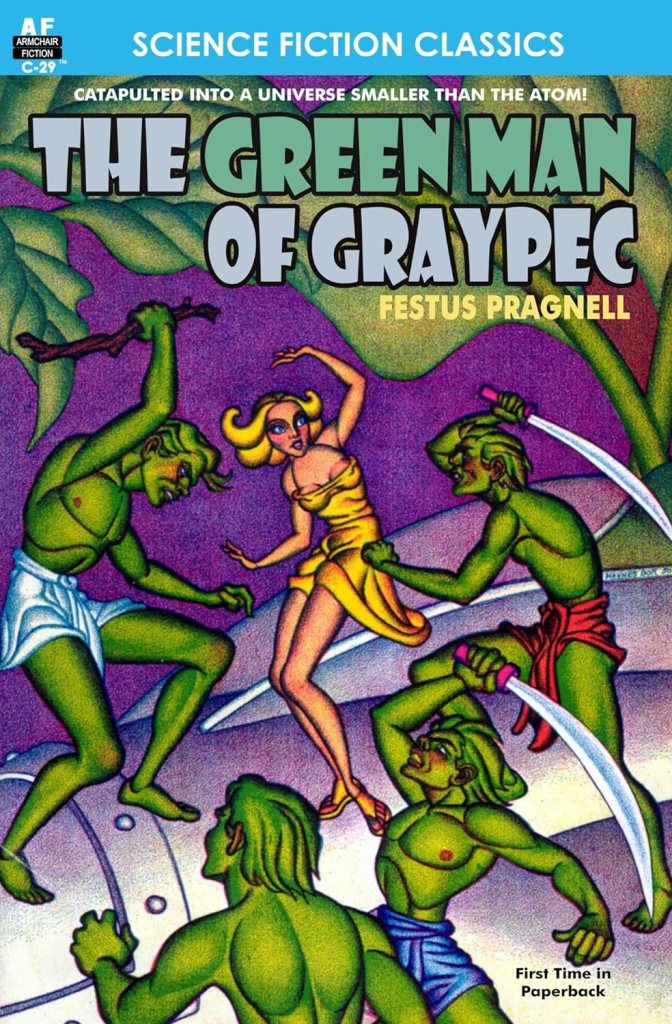
And in my reading myself back through my own origins in science fiction, we now come to number two in the Coleccao Argonauta that formed my childhood reading: The Green Man of Greypec.
Before I go any further let me point out that the next book up is City At World’s End by Edmond Hamilton. Tuesday or Wednesday next week, depending on the state of revision, snot, etc.
So, now we’re to the Green Man. When i revised it in 2016 I was profoundly upset by a bit in the book about eugenics and socialism. This time it didn’t bother me at all. See, before I read (re-read, though i only had the haziest memory) it I read the author’s biography and found he was an enormous fan of H. G. Wells, so of course he would pervaded by early 20th century socialism.
To get past the intro: the book was first serialized in 1936 (and bears the marks of it) but revised in 1950 for book publication. I’d say still being in print almost 100 years later, and people (not just me) still talking about it is a good run.
The book was written by a British police clerk. Festus Pragnell, the author, actually wrong under his father’s name, as I guess he thought Festurs was more distinctive than Frank William Pragnell. And he’d be right. Though weirdly, he went by it in real life also.
Working name of Frank William Pragnell (1905-1977), UK police constable, clerk and author who was known all his life by his father’s first name, Festus (even in the 1911 census, his wedding banns and his own will: “Frank William, known as Festus”).
So, you know, science fiction writers have always been weird, one way or another.
Anyway, the fact that he was from the UK is germane for the very weird things he does to the character, who is of course — for coolness (I thought it was mandatory when I was young, to be fair) an American — and they’re the sort of weird things someone from Britain who didn’t know a heck of a lot about America would do. For instance, his character’s name is Learoy Spofforth and he goes by Lea. This doesn’t seem to be an attempt to mock the character, just what he thought was a good, convincing American name.
Now, I will grant you all I know about the America of the thirties is from reading biographies, but even so that struck me as a fairly bizarre name to give anyone. Add to it that this man’s profession, and the reason he’s “well known in America” is that he’s a “lawn tennis champion” and I’ll give you a minute to roll on the floor laughing or at least scratch your head and wonder how big tennis was in the America in the thirties. And again, I’m right there, scratching my head along with you, but in all the books written in America at that time, I hear them talking about baseball, occasionally football, but mostly baseball. I don’t know if there was enough of a golf fandom. But I can honestly say never have I heard of tennis as a sport that fascinated people or made someone nation-famous. Eh. Perhaps he just assigned this guy the first sport he could think of.
Anyway, the book opens with a bang. Poor Lea is waiting trial for having bashed his brother, Charles’, head in.
He tells us he’s 28 but lived 80 years. And then he talks about his brother being a scientist and discovering worlds in atoms. From there we go to his brother saying he’s found life in one of these worlds, human like life. And his machine should be able to send a mind into the mind of one of the humans in the atom.
After various alarums and excursions poor Lea finds himself in the head of a green man. Now if you’re thinking green men after a lifetime of the culture talking of little green men. This green man is not little but a sort of massive green primitive ape, living in a green primitive culture that has caves lit by electricity speaking either of a greater culture or a decayed one.
The green ape, Kastrove, is in the middle of a raid to capture a woman who has landed in a flying machine, and who has yellow hair and looks fairly elfin. The minute Kastrove, or Lea perhaps, sees her he’s taken with a great desire to have her.
He does in fact capture her, which leads to various things including fights in his tribe, but he takes her for a mate and keeps her.
Now, since we know we’re going to be going through sixty two years, I hope you don’t expect a carefully introspective romantic relationship. We are in fact told that she comes to love him because he’s so kind to her, and they have a baby who looks — he tells us — as a normal human.
She comes from an elfin culture that lives in the ruins of an ancient, decayed civilization and no longer knows how to use any of it.
When a supervisor/agent of the larbies — the overlords over both apes and her people — comes to greypec, Kastrove’s village, for reasons of primitive politics, he takes Kastrove and Issa his mate with them to be trained as soldiers. They also take Kastrove’s and Issa’s son to train as a village leader as he grows. That’s the last we hear of them.
Throughout there are mentions of Gorlems, the enemy.
The training of Kastrove makes it obvious most of what’s happening is the Larbies mind controlling the apes and the elfin creature by hypnosis and mind control.
After several adventures, Kastrove helps a Gorlem prisoner (they’re sort of a wizened humanoid) escape.a The escapee dies in the escape, but Kastrove ends up working with the Gorlems to help them win the war against the Larbies.
The Larbies btw are intelligent molluscs and utterly ruthless.
Kastrove’s mind — Lea’s — retains all the science subconsciously, and when the Gorlems extract it, it allows them to win.
Anyway, Kastrove gets Issa back and they have a passel of kids, and then he gets back to his own time and world. I can’t say that is a spoiler, since of course the book starts with him back in Britain.
I won’t tell you the resolution which at any rate I really didn’t like as it falls under “strange psychobabble nonsense.”
So, it’s less outdated than the Adrift in the Stratosphere book. I wonder if I did read it as a kid, because I remember thinking of the atoms having worlds, and of a universe being born every time I struck a match, then dying when I blew it out. But of course there have been other book with those ideas. Curiously, his view of the atom is more current than what I was taught in middle school, but never mind that.
Most of the science fiction in the book is… well, space opera intensive. The guns fire both pellets and green gas; the cars are interesting and of different kinds; there are ruins of a greater civilization; the Grolems are what you’d expect of an “advanced civilization” as seen in the 30s.
There is the bit about how their civilization got in this trouble, because they didn’t have socialism and racial hygiene, but those were just the ideas in the air at that time.
One of the more curious ideas I found that strikes me as a distortion of the concept of evolution was his belief that given time all animals in a world would evolve sentience and intelligence to some degree.
Another point that amused me is that I might have found the “Women don’t do anything” book that allt he feminists go on about. And even here it’s not true. Yes, Issa serves as a prize of sorts in a bunch of sections of the book, but she also gets trained as and serves as a soldier (even if indoctrinated) and she chooses Kastrove, in the most unlikely romance.
The advice given about women is so quaint it’s almost hilarious. We get a bit of funny early 20th century advice from Kastrove’s father who says you shouldn’t count on getting good at relationships until your fourth. And then the end punch is kind of highly complimentary and silly about how women work.
Meanwhile really I do understand why this would upset feminists nowadays. Because most of the action is in a man’s world, so to put it, with women as accessories of sorts. But part of this reflected the world the author lived in. I figure police work at that time was mostly a male thing, with some women but not enough to impinge too much on the consciousness. Even married men lived in more separate spheres from women than men today. This is something we underestimate now, how sex differentiated society was back then.
And they were writing for men, mostly. Not that women didn’t read, but then (as frankly now, except for some side sub-genres) they didn’t read much science fiction. So to an extent it was written and read by men who lived in very male spheres.
They had women in as prizes, as unattainable goddesses, and when they were in they were often brave and valorous. But they were peripheral to the main action.
However to not see the difference between that and the current fiction, which is almost obsessively female centered and keep harping for more and more is sort of like winning lottery and keeping whining that you need more money for a cup of coffee.
The story itself is a rollicking adventure of the sort you might find in any pulp magazine, not deep thought and not pretty words, but entertaining nonetheless. And again, he must have done something right as there were at least four foreign language translations that are easily found, and he’s still read today.
To the extent it is unsatisfying is that it reads, to modern eyes, almost like an outline. There is no exploration of anything, including the setting (actually characters are relatively well fleshed compared to the settings) or the various social pressures. I mean, things are there, but they come at you at such breakneck speed that things kind of fall off, and often you find out what is happening as you’re in the middle of it, and not in a good way. Like you find out they were starving not while they’re looking for food, but after they find it.
I think this is more than anything the result of movies and TV being all prevalent. At the time it was enough — more than enough — to have a movie in your head and for it to move fast and be really interesting.
Nowadays books are a different experience from movies, and we expect more emotion, even if the emotion is suspense and fear in action sequences.
Yet and again, though it might not set the twenty first century apart, Festus Pregnell’s Green Man of Greypec is an eminently enjoyable, or enjoyable enough book. I still read it without getting a need to throw it across the room, and it is still being talked about.
May I be so lucky.
 According To Hoyt
Green barbarians, the hero of advanced but not obvious age whisked back and forth between the real world and the adventurous world; this was heavily influenced by Edgar Rice Burroughs’s John Carter of Mars. NTTAWWT. If you’re going to be heavily influenced, it should be by the best.
LikeLiked by 1 person
“Lawn tennis champion,” “well known in America”? Yeah, that actually fits with cliches in a certain type of American novel* of the early 20th century. All a writer had to do to evoke a wealthy lay-about playboy was to insert the phrase, “Anyone for tennis?” So that would fit with Pregnell using quick throw-away references to establish a character and move on with the story.
(*I’m not talking about The Great Gatsby here; rather, popular novels that actually sold well, by authors largely forgotten today: Kathleen Norris, Grace Livingston Hill, Dorothy Canfield Fisher, etc.)
LikeLike
Now I’m imagining someone writing a similar novel with a similar American character set in the early 1960s and knowing America only from a limited set of media materials:
“Our hero, Simeon Kennedy, was a well-known professional jai alai star in his native America.” :-D
LikeLiked by 2 people
jai alai?
LikeLike
Watch the Title scene of Miami Vice episodes; it’s in there. About 20 seconds.
LikeLiked by 1 person
Yep, and I think there was a plot point in Mad Men or some show of that sort (which I couldn’t bring myself to pay attention to) about trying to make jai alai a Big Thing in that era. I remember as a child thinking Collier’s Encyclopedia devoted an awful lot of column inches to it for some reason….
LikeLike
More like 2 seconds, if that.
Jai alai was big in S. Florida when I lived in Ft. Liquordale as a teen. I couldn’t go to the games because of betting (minors not allowed then; could be now), so the only times I watched actual games was in Tijuana when I was stationed at MCRD San Diego. Fast, dangerous game.
LikeLike
About 20 seconds IN. Stupid fingers.
LikeLike
Aha! OK; thanks. I should have realized.
LikeLike
Wiki says there’s only two frontons left in the entire state, one near the Miami airport and one in Dania Beach. All the rest have closed down. I liked it the one time I went to a fronton, I darn sure liked losing money on it better than better on horses or dogs because the sport itself was more entertaining than watching greyhounds chase a motorized rabbit (as much as I do love greyhounds). And yeah, it looked a little dangerous even with them wearing helmets. That cesta can put some serious speed on the ball.
LikeLike
IIRC the back wall was granite, also part of the floor; I understand that was required to get the action. I heard a ball dropped onto concrete once at the Tijuana fronton; it pretty much just went “THUD” and laid there. I don’t know what it was made of, but at 180mph or so I wouldn’t want to get hit by it.
LikeLike
Jai Alai is a weird ass sport originally from the Basques. It took off big in Connecticut in the 70’s because it was one of the few things besides the State Lottery where you could bet in CT. Once Foxwoods and Mohegan Sun got the right to exist by federal exception and betting of every sort was available AND the sport was seen as MASSIVELY corrupt (one of the sites was in Bridgeport QED) the three frontons (thats where jai alai is played) faded into obscurity and the last was gone by 2001.
LikeLiked by 1 person
Ah, Boxwood. One of my former bosses’ boss invited himself on my TDY to Groton and made reservations for us at Foxwoods. Since we arrived on a Sunday night and had to find the place, I got to eat at the casino buffet.
Would it surprise you to know the boss attended the first meeting and was never seen again?
LikeLiked by 1 person
Ledyard CT (where Foxwoods is) was referred to as East Butt <expletive deleted> by my cousins from Waterford (which honestly was the pot calling the kettle black). It was an absolute nowhere. Their parents retired from Waterford to a tranquil residential area in Ledyard backing up against federal reservation land that had not been used since the 1920’s. Sometime in the 80’s Foxwoods popped up and they then backed onto a parking lot. There is bugger all in New London or Groton outside Electric Boat, the Sub Base and the Coast Guard Academy. Ledyard is still Nowheresville it just has a giant casino and a plethora of skeevy hotels.
LikeLiked by 1 person
Sort of similar to racquetball or squash but you’re wearing a curved boomerang-shaped basket strapped to your wrist instead of using a racquet. Came from the Basques originally. As a sport, it’s actually fairly entertaining and fast-paced, they can whip a hard rubber ball at well over 100 mph from those long cestas, but it only caught on in Florida as a means for betting. It’s pretty much dead down there now, but I went to a fronton (jai alai arena) somewhere around the Vero Beach area I think, in the late ’80s. Basically it drew the same types you’d see at a dog track or horse track.
LikeLike
I think Tennis is coded to indicate that our person is of the upper class. For example in E.E. “Doc” Smith’s Skylark of Space (first publication 1928 written well before) Seaton and Crane meet playing tennis (Crane being VERY wealthy). Similarly we find Virgillia Samms and Jack Kinnison are on a tennis court playing a contentious game of doubles in First Lensman . Although this may be attributed to a fondness of the game by “Doc” Smith.
LikeLiked by 2 people
I am reminded that the Seatons, and Martin Crane (not Margaret), became associated on the tennis court.
LikeLike
Probably still better than if Pregnell had known about the popular (not professional) sport that took America by storm during the Depression — minature golf
LikeLike
I did read it last week. Yes, it is obviously 1930s pulpy. It’s kind of like if an ERB imitation and the original Buck Rogers (“Armageddon 2419 AD”) were mashed up and set in one of Ray Cummings atom worlds. (I do wonder if the framing story was part of the 1950 revision; psychobabble was all the rage at that time.)
It’s a fun read, it moves at a reasonable pace, at least in the earlier parts it hints at the mysteries of the setting to come. Considering I had read another of Festus’ works in a scan of a pulp magazine years ago (I think it was “Ghosts of Mars”), I was waiting for the socialism to drop, but honestly apart from the late section echoing HG Wells’ sentiments I didn’t really spot too much. (Although there was central planning on the parts of the Larbies and Gorlems, I didn’t see it as really overtly socialist. Maybe more in the vein of early Heinlein like “Sixth Column.”)
I’ve certainly read much worse SF from that period. It’s an adventure story at least.
LikeLiked by 2 people
It’s probable I’ve read the next story by Edmond Hamilton as well, since I have a scan of the original pulp magazine in which “City at World’s End” appeared. Maybe I’ll reread it since I don’t remember.
LikeLiked by 1 person
Never read the book itself, but do have thoughts on the character name. “Leroy” is a valid early 20th c. American name. Leonard Slye refused to call himself “Leroy Rogers” when the stage name was suggested to him, because the one Leroy he’d known was a really obnoxious person. Instead he took the name Roy Rogers for his movies.
Leroy Van Cleef, swabbie aboard a minesweeper in WWII, then an accountant and theatrical bit-player turned villain in western movies, went by Lee Van Cleef in his film career.
Both these guys were born in the 1910s I think; Rogers’s anecdote doesn’t specify Bad Leroy’s age but seemed to imply he was a contemporary of Rogers.
I think possibly Pragnell was taking what was a somewhat-known American name (Leroy/Lee), and respelling it in a way that looked right to his British eyes (kind of a parlor/parlour thing).
I am as baffled by the lawn tennis angle as you are.
LikeLike
My parents wanted to honor my paternal grandfather with my name, but fortunately only gave me his initials. He was Fay Laverne Hood.
LikeLiked by 2 people
Smart move!
LikeLike
Dear LORD.
LikeLiked by 1 person
My grandmother had a friend at work named Elizabeth. Male. The story was that his mother couldn’t conceive again, and she insisted on the name because “every family must have a child named Elizabeth!”. Seems like some types of nuttiness exist across multiple generations…
LikeLike
Yikes, well into Boy Named Sue territory.
LikeLike
Past it, I’d say. At least “I knew that snake was my own sweet Dad” had a practical reason (or said he did; “I knew you’d have to get tough, or die”).😉
LikeLike
My late unlamented father was a Leroy, and a really obnoxious person. (Born in ’35.) He generally went by Roy for short.
LikeLiked by 1 person
Ouch! I wonder if it’s finding out what the name originally means (“the king” in French) that makes them that way.
LikeLike
“Leeeeeroy Jenkins!”
Because someone was gonna say it. 🤠
LikeLiked by 2 people
Indeed! :) Also, since we’re talking pop culture references, there is also this song: https://www.youtube.com/watch?v=JzYf6qskdfA
LikeLike
One of the classics. Though I like, “You Don’t Mess Around With Jim,” even better.
LikeLike
Jim Croce for the win!
LikeLike
I had a warehouse manager called Leroy, but that wasn’t his name. He once worked at a Coke warehouse and was the only non-black guy there, so someone started calling him Leroy so his name fit in. As the two other workers there when I hired on were also workers from that same Coke warehouse, he was known by Leroy to everyone at the plant, but the HR lady in an official position “Marcello, we need to let ________ go.”
His stepson even called him Leroy, and as the owner knew him via the stepson, he too called him Leroy.
LikeLiked by 2 people
I have cousins named Festus. It’s a family name and a good way to identify branches.
LikeLiked by 2 people
Right. It was his being named something else and going by his father’s name that struck me as Odd.
LikeLike
That is a bit odd, but the Victorians were different Still, None of the Festus’s in my generation, there are two, go by it. Can’t say I blame them. All my relations above a certain age still call me Paddy, even though that’s not one of my given names. It’s an Irish thing, I think.
LikeLike
Dan’s family also has names that go with different branches. By naming older son we usurped the hereditary name of the Pennsylvania cousins.
LikeLike
In the 1930’s Leroy is the 56th most common male name as reported by SSA. My Father-in-law was Leroy (usually just Roy). Parents were first or second generation Swedes so it wasn’t a family name :-) .
LikeLiked by 1 person
That is a cool bit of perspective :)
LikeLike
In the Craig Kennedy stories one of the tropes defining a “modern,” woman was she was as at home on the tennis court as the classroom -shorthand for an upper or upper-middle-class college educated young woman the reader was meant to admire. The stories I have (thanks to the neighbor decades ago who offered me his collection – I kicked myself later for taking only half of it and spent time in used bookstores fleshing it out) were mostly set in the early 1900s up to WWI.
Of course, “modern ” included a reform/progressive tendency, plus the assumption that women in politics would refine and improve both the government and popular culture.
I’m just suggesting Pragnell might have read enough American popular fiction to accept, “tennis as sign of wealth and status,” as a hook for his readers.
LikeLiked by 1 person
What a shame those who held that assumption never encountered Shrillary…😉
LikeLike
Since Spencer mentioned, Armageddon 2419, is that one you encountered? I just reread it, plus the sequel, The Airlords of Han and was struck by how much Nowland got right -or rather, how much of Han culture matches up to 21st Century America. That’s not a good thing.
And of course the story couldn’t be written today, though it’s a solid adventure story
LikeLike
It could be written. But unlikely to be picked up by any of the publishing houses. Writer would have to go indie.
LikeLike
These days most people choose to, anyway.
LikeLike
Notable male American tennis players? Hmmm . . . John McEnroe, Bobby Riggs, ??? And Riggs only for the ‘Battle of the Sexes’ with Billie Jean King way back when.
LikeLike
I vaguely remember McEnroe, but only because his infamous temper tantrums made the news fairly frequently. The only other tennis players I know by name are the Williams sisters, again because they were on the news a lot, not because I followed the sport.
LikeLiked by 1 person
Andre Agassi, who IIRC is the player who stated that the top 100 male players would beat the highest ranked woman at the time (IIRC one of the Williams sisters).
LikeLiked by 1 person
I played a little recreational tennis in High School & College so remember a few more.
Pancho Gonzales (my first tennis racket was his “signature” model)
Rod Laver
Arthur Ashe
Jimmy Connors
LikeLike
There used to be a statue of Arthur Ashe on Monument Avenue in Richmond. I wonder if it’s now the only statue on Monument Avenue. (Spits in general direction of the city I once lived near. I can only be glad I got my Northern beloved to Monument Avenue before the %$#@!! *&%%!! had the original monuments pulled down).
When one group of cuss symbols isn’t enough…
LikeLiked by 1 person
Back in the 1930s, the period written about, Bill Tilden was rather a famous tennis star. The hitch is, though I’d have to check it, I think Tilden was an amateur player. (Like Bobby Jones in golf, who predated him a bit.) I don’t think there was a professional tennis player at that time with nearly the same fame and cachet, so that’s where the author’s characterization falls down.
Not that this was the most implausible thing in the novel.
LikeLike
c4c
LikeLike
“The story itself is a rollicking adventure of the sort you might find in any pulp magazine, not deep thought and not pretty words, but entertaining nonetheless.” Not having been a real time reader of pulps, I got some of them via paperback reprints. Seems to me that current Japanese light novels are the nearest equivalent to those stories.
LikeLiked by 1 person
Socialism and eugenics? Sarah, don’t you know that the noble antifascist socialists who are always on the Right Side of History have never supported such things?
LikeLiked by 1 person
This was something of a tradition in Brit fiction of the time. From that period, we also got American government agent (turned private eye in the French films adapted-ish from the books) Lemmy Caution.
LikeLiked by 1 person
Still not as amusing as the Japanese. For example, there’s a male character in Gundam Unicorn named “Full Frontal”. The writers didn’t become aware of the slang meaning until it was too late to change the name.
LikeLike
Like the character “Long Wang” in “A Fistful of Yen”? Of course, they *did* know the slang meaning for that one, but it was Kentucky Fried Movie, so…😉😜😜
LikeLiked by 1 person
Take him to…Detroit!
LikeLiked by 1 person
That’s the one!
“NOOOOOOOOOOOO!!!”
😆😆😆
LikeLiked by 1 person
ahem
The challengers were Long Wang, Hung Well, and Enormous Genitals.
Yeah, they knew what they were doing.
LikeLike
Yep, those are the ones; I especially liked the “attack with transmission”. By EG, IIRC…😉
And yes, they did indeed.
LikeLike
“This is not a chawade.”
LikeLike
Never forget that (in)famous 70’s musical group, Hugh G. Rection And The Four Skins. :-D
LikeLike
I forget the name of the series at the moment, but the Japanese writer thought it was perfectly legit to name a character Jacuzzi Splot.
LikeLike
c4c
LikeLike
My 8th great grandmother’s name was Grizzel Strange. She married a Mr. Fish. One of her children was named Preserved Fish.
LikeLiked by 1 person
I refuse to believe anyone would name a child Preserved.
LikeLiked by 1 person
They might, if they were New Englanders and the child survived some childhood calamity. The steward on the HMS Sophie in Master and Commander was named Preserved Killick.
LikeLike
You can’t discount puritan naming traditions. I have an ancestor named Experience Sumner.
LikeLiked by 2 people
Dan has an Adultery. From Though shalt not commit adultery.
LikeLike
I truly envy you, that you have not yet experienced the glory of Puritan naming traditions.
Resolved, Content, Hezekiah, Job, Patience, Fear, Love, Wrestling.
https://www.csmonitor.com/The-Culture/In-a-Word/2019/1121/Be-Thankful-Stand-Fast-and-other-Puritan-names
The most famous Puritan names are the “hortatory” ones, which urged children even more strongly to “Fight the Good Fight of Faith,” as one man in Sussex, England, knew intimately, since that was his name. Around 1650, Fight seems to have served on a jury with his neighbors Kill Sin Pimple, More Fruit Fowler, Stand-Fast-on-High Stringer, and Be Faithful Joiner, and parishes in the area record multiple Hate-Evils, Fear-Nots, and Sin-Denys. Praise-God Barebone, a lay preacher who became a member of Oliver Cromwell’s last Parliament in 1653, named his son If-Jesus-Christ-Had-Not-Died-for-Thee-Thou-Hadst-Been-Damned. He went by Nicholas..
It is Pratcheresque, I grant you.
LikeLike
Oh, I have. I have husband’s family tree. :D
LikeLike
Curiosities of Puritan Nomenclature by Charles Wareing Endell Bardsley.
And curious they are. It’s available on Gutenberg.
I note that names like Jezebel were sometimes given, not because they were picked at random out of the Bible, but to teach the child Conviction of Sin.
LikeLike
The whole ”subatomic worlds” sub-sub-genre of the Planetary Romance is pretty much extinct now. About the last remnant in pop culture that I know of is Marvel’s Microverse. DC might have an equivalent (The Atom spent time there, I think?) but other than that, gone.
LikeLiked by 1 person
And it was started by Ray Cummings, I believe. The Girl in the Golden Atom.
LikeLike
I came here to say that 😁
LikeLiked by 1 person
I think we know too much now?
LikeLiked by 1 person
I recall a now-old Marvel comic where a character explains that “Microverse” is a misnomer that stuck. They weren’t actually subatomic worlds, but alternate-universe worlds that could be transitioned to via shrinking superpowers pushed past a certain threshold.
LikeLike
Our April book is Only You Can Save Mankind
spoiler free:
https://www.goodreads.com/topic/show/23097346-april-2025—-only-you-can-save-mankind—-no-spoilers
LikeLiked by 1 person
spoil freely:
https://www.goodreads.com/topic/show/23097345-april-2025—-only-you-can-save-mankind—-spoilers-allowed
LikeLiked by 1 person
The “Great Gatsby” era in the 1920’s was always portrayed as the high classes (old money) in America as frequenting tennis courts, in fact, most would have had one or two at their mansion residences as well as the country club. I suspect the British fellow was well aware of this and though it to be the norm, not the exception. Baseball, right down to local leagues such as the House of David team (just down the road from me) was a “big thing” back then as local history reflects..
LikeLike