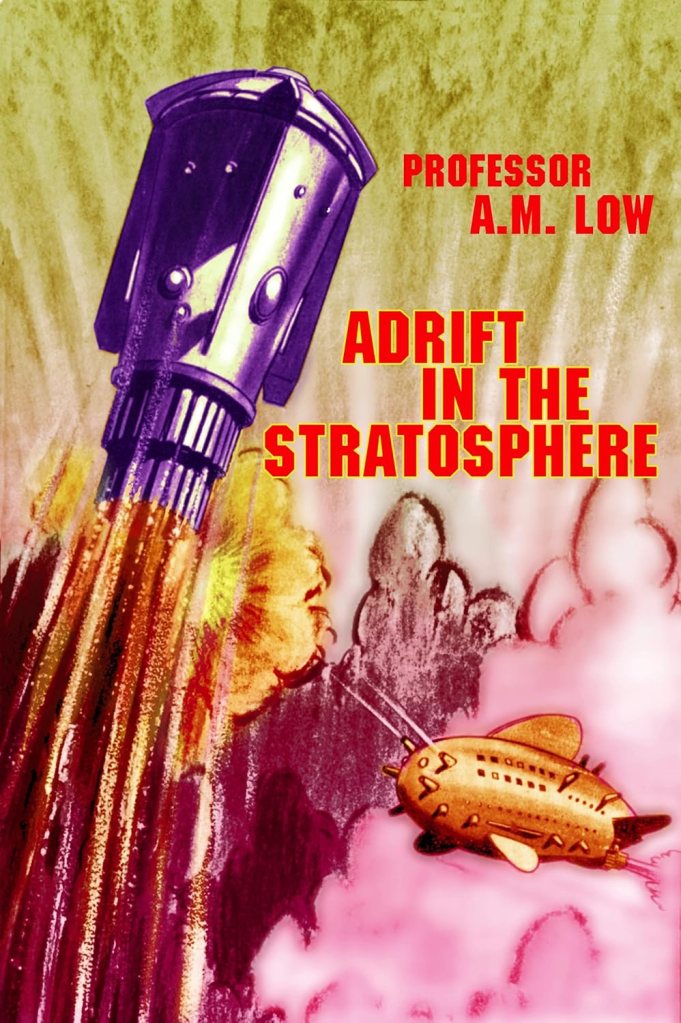
I actually have a follow up post to Charlie’s post yesterday, but it will wait till tomorrow, because by gum, Wednesdays are for fighting for a retrospective of my roots in science fiction.
Which since my essay for tomorrow is about why even suggest books for someone to read or do analysis and review at all, is one of the answers in advance: we can learn a lot of the history of a genre (or literature, or the time) from a few select books, in more or less chronological order.
I have to say this book was …. enlightening about the roots of the field. I’m sure I’ve read it before, but probably not among the first I read. The reason being that thought it was the first in collection argonauta I came on the scene considerably after it was first published and, to make things more complex, the Portuguese already had a version of printing to the net. Meaning they printed more or less what they expected to sell, had it out for a brief period, and that was it. I don’t know if they pulped the books that didn’t sell. I know by my time they continuously and egregiously underprinted, which is why when the “Greats” (look, Asimov, Heinlein and Simak, of course. What? I don’t know what to tell you. It was what it was) came out, there was a line outside the bookstore by the time it opened. Heck, there was a line outside the bookstore by 7 am. The bookstore opened at 9. By 10 the books would be gone. … by the time I was 16, I was the lone female and the only person under around 25 in that line. Also the only one who didn’t look like a caricature of an engineer. But I held my own, both in line and in the discussions. BTW, the guys were gallant. A couple of times when I’d arrived late and was far back in the line, people gave up the chance to buy the book so I could.
Anyway, this means that after that day, the book could only be found used; forgotten on a spinner rack in some smaller town (I scored glory road that way, with a faded front cover, in a beach resort); in the back of a closet in a box of others, (after you helped your friend’s family move and her father said, “Oh, yeah, I’d forgotten those books. I don’t think I’ll read them again. Do you want them?” And you call your dad to come pick you up because it’s too large a box to take in the train. Which is where I got Operation Chaos, and Simak’s City and Way Station.) Other ways. Trading with friends. And buying them from people willing to sell. And– I don’t think I ever did anyone’s homework for a copy of a science fiction book, but I did tutor people for books.
Anyway, as that implies, I read things in kind of a free form order. Books from the seventies, and books from the thirties, all mixed together.
Which is good, because I’m sure as heck not reading this in order, because of them aren’t “findable” and others some lunatic wants $500 for the paperback, so I’ll let it chill until someone issues it in ebook or in paper back again.
Anyway… ahem… this is not adrift in Sarah’s brain, it’s Adrift in the stratosphere, by A. M. Lowe, sometimes styled “Professor A. M. Low.” Was he a professor? Doesn’t seem so. He was also not a doctor, though some biographies indicate it. He was a notable engineer, but some people claim he never actually had any sort of degree.
If you’re terribly curious about the book, you can find it here: Adrift in the Stratosphere (Annotated).
And now you’re going to ask me if it’s worth it. Yes, in a way it is, though perhaps not for the same reason I’d buy a book written today.
There is a charming naivite to the book, a glimpse into a far less hidebound time. Which is not what you’d expect of a book first published in 1937. Look, we’re used to seeing them in their quaint clothes, and we know they had a lot more rigid society and– Yeah. Maybe. Maybe all of that. But I think while we loosened a lot of social interaction mores and manners, we added a whole lot of bureaucratic red tape and formalism and credentialism.
Anyway, the story wouldn’t be believable today and not just because we know there aren’t chunks of land, like islands in the stratosphere (though we do know that) but because none of us can conceive of three young men bicycling through the countryside and finding a spaceship in a barn, then accidentally launching themselves off. Whatever you think of the unlikelihood of what comes after (and it’s amazing how much we learned between 1937 and the moon flights) that beginning seems stupendously unlikely to me. Charming and alien, like something from a dream of childhood.
Perhaps that’s something we’ll recover, in the era of 3-d printing, and in an unimaginably more free and prosperous future, which is possible if not likely. Perhaps it will be possible, given future resources and the ability to look up all knowledge, who knows? That’s a lovely dream and one I’d like to see come to fruition. Not that I’ll live to see it, but the kids might.
Anyway, it starts with three friends cycling the country side. They stop and find a machine and accidentally end up on it.
I’ll point out here that one of the critiques of the book I read complained about the characters not being there at all. This is silly. I will confess it’s been a long time since I read British fiction of the time, so I was having trouble fully fleshing the characters. But I remember a time when the characters would have been fully fleshed to me, even though the author did not minutely (or otherwise) describe them.
Let me explain, there are… stereotypes in fiction of the time. Archetypes, even. Particularly in British fiction of the time, which often started with boarding school adventures. Describing someone as being blond and handsome was enough to unleash a whole stereotype in the reader’s mind, which has nothing to do with the unpleasant Arian stereotypes in ours. As I said, I’m no longer in touch with those, but back there in the detritus of my mind, pre-brain getting rattled couple three times, those stereotypes existed, because I read a lot of YA British literature of the turn of the twentieth century.
As an illustration, in Pyramids, when the boy in the Assassins league school tries to sacrifice a goat, Pratchett is playing with exactly those stereotypes: the religious boy and the young leader who defends his piety. It’s beautifully done, and probably completely misses the mark with modern American audiences.
Anyway, the lack of characterization didn’t bother me.
What bothered me are the things that happen in the space flight. They bothered me so much that I had to take breaks just to make sure I wasn’t hallucinating them. (Yes, I know how strange that sounds.)
The whole thing has an hallucinatory feelings and the “science” feels about right for an Uncle Scrooge comic. Take where they take a “super multivitamin” each of them containing 4000 calories. What even?
I remember my older family members saying when I grew up I probably would just take tablets instead of eating, but it never occurred to me they were serious, or that this was once upon a time acceptable wisdom. How did they think that many calories could be compressed… Never mind.
The ship itself is a balloon rocket. Okay. Whatever. I could deal with that. What I couldn’t deal with is that almost immediately in the stratosphere, they come across a dragon-creature who breathes poisonous gas.
There are other incidents, including one in which they breathe? Are hit with yellow? radium rays which almost kill them are are cured with anti-radium rays. (I’m sorry. I read it three months ago and stupidly didn’t make annotations on the book itself, and now can’t find my notebook.) Anyway, at one point one of them is breathing out luminous radiation, but comes back from it, no big. It buffs right out.
They are continuously threatened/interfered with by Martians but the most bizarre thing is that there are random “islands” in the stratosphere which are inhabited by humans that speak a dialect of English and live like English yeomen. Only very advanced, long-lived yeomen because they…
Hold it.
Hold it.
Hold it.
Because they have fountains of ultra violet rays, which cure EVERYTHING!
Anyway, in fact the whole thing has the hallucinatory quality of something that should involve the Duckburg Ducks…
Our heroes escape everything, including nefarious natives, and return to Earth victorious and to much acclaim.
It’s both enjoyable and forgettable, just “summer adventure” fodder which could take place at sea, or in Africa, or anywhere else at that time.
The interest in this one is mostly historical. How little someone who was interested and obviously — it feels painfully like that at times — trying to communicate and popularize what was scientific knowledge actually knew of things outside Earth.
However, there is one point that is almost painfully “nowadays” in terms of science fiction and it’s when the author, through the mouth of the wise old one in one of the stratosphere islands, who tells our heroes that if only everyone on Earth were irradiated with violet rays they’d also live long, healthy lives.
Let that be a lesson to you, children (and adults.) This is why we science fiction writing crackpots should lecture less, not more. These ideas that strike us as absolutely inevitable and brilliant would in fact destroy life on Earth.
Anyway, highly amusing book, as an…. historic document. It’s just, read in our time, it is more fantasy than science fiction.
Onward. Next week Festus Pragnell, The Green Man of Greypec. (Which I reviewed in 2016, but considering what that year was like, and that it’s been ten years, I’m going to read it again and let you know what I think. I’ll write about it Tuesday or Wednesday next week.)
And tomorrow we’ll talk about “why teach “literature” at all.
 According To Hoyt
Scoff not at balloon rockets: https://airandspace.si.edu/stories/editorial/rockoons-rocket-and-balloon-experiments
LikeLike
I’m not scoffing. I don’t think as designed it would work, but it was the thirties!
LikeLike
“He was a notable engineer, but some people claim he never actually had any sort of degree.”
Sounds like my father. His formal training was as a Navy radar technician; but he was a crackerjack electro-mechanical engineer for General Electric for over 20 years. Did half (or more) of the designing for the Elec-Trak tractors that GE sold back in the 70s before they sold it off. Also, gunsmith, machinist, hunter, fisherman, boater, carpenter, mason (both kinds), husband and father. I know, sounds like a eulogy. /laugh
LikeLiked by 1 person
Too many want a *credential* rather than a peer recommendation of “S/He really knows his/her sh[aving cream].”
Any damned fool can get a paper or “sheepskin.” But when one’s fellows say one is good? That ain’t pyrite. Ivy League? Feh. Ivy ain’t even as solid as pyrite!
LikeLike
Unfortunately, the HR departments frequently don’t care.
LikeLike
Worse: I’ve experienced liability-averse HR forbid making recommendations for a co-worker who was leaving, because not everyone would get one, it might not be fair, someone might get a negative reference and sue…
I did not tell them to do something anatomically dubious, but I did ignore them straightaway.
LikeLiked by 2 people
Nod, about all that HR “allows” companies to do is the confirm that the person Did Work From Them.
LikeLiked by 1 person
In my experience you can strike the word “frequently”.
Credentials uber alles, including actual prior jobs at that level. After one RIF, a classmate in my “how to look for a job” outplacement training afterward was a senior executive development trainer for C-suite training, who could not get an offer because she’d worked her way up without a college degree. Tons of actual experience, and piles of recommendation letters from prior people she trained, were to no avail.
The people she was interviewing with wanted to hire her but HR would not allow it.
LikeLike
Once you hire someone without a degree, you have to devise all sorts of tests and pass all sorts of disparate impact stuff to justify not hiring someone else without a degree.
LikeLiked by 1 person
Ultra-Violet health rays? Only the High Programmers must be allowed access to those, you Commie Mutant Traitors!
All hail our Friend The Computer!
(apologies, not sure what prompted that…)
LikeLike
Junior is now possessed by the great computer. Someone hack him.
LikeLike
And now to suit our great computer
You’re magnetic ink!
I’m more than that, I know I am, at least, I think I must be.
– Moody Blues, ‘In the beginning’
Other days, I must not be more than that.
– me
LikeLike
Not familiar with the RPG Paranoia?
It’s a satirical RPG set in an underground habitat called Alpha Complex, which is run by an AI referred to as The Computer. The Computer is your friend! The Computer has tasked you with eliminating dangerous traitors to Alpha Complex, which include Mutants, Commies, and members of other subversive organizations. You must do this while not allowing the computer to discover that you are a mutant, and also a member of a subversive organization (which might include a very cartoony version of Communists).
The game literally gives players six lives (clones) due to the high fatality count. Often those deaths come at the hands of other players…
LikeLike
A DM once ran a group I was in through a small sample adventure.
When you try to tell your players that they are supposed to try to survive, it’s too late. I continued to run through all mine.
A player did succeed in completing the mission but he never tried it on us again.
LikeLike
Paranoia is a game that requires the proper frame of mind from both the players and the GM. Completing the adventure is secondary to everyone having a side-splitting good time.
This is a game that had a published 1st Edition adventure that opened with the characters doing their morning exercise routine (calesthinics), and getting summarily executed if they refused. And the players were required to participate on behalf of their characters. And then they ran this adventure at Gen Con (I think), which apparently meant that all of the players were doing jumping jacks next to the game table at a very crowded convention.
:p
It’s a very unserious game.
LikeLike
Karn Evil 9, 3rd Impression.
LOAD YOUR PROGRAM
I AM YOURSELF
LikeLike
Central Scrutinizer (F. Zappa)
LikeLike
That’s what I always thought of when Pretendent Biden did that creepy whispering schtick: “Hey, it’s the Central Scrutinizer!”
We take you now to a garage in Canoga Park…
LikeLiked by 1 person
This is NOT a commentary on this (0r previous. or future) post(s).
Due to weather forecasts and co”workers” that make your typical field ox look like S. Hawking… I am FAR too tired/out of it to comment properly. Thus… not long after I press [ENTER] I shall go to bed, and hopefully gain something thereby.
Don’t start any revolutions that don’t absolutely need starting.
LikeLiked by 2 people
….if only everyone on Earth were irradiated with violet rays…
“….I’m N-ray the 8th, I am, I am…”
LikeLiked by 2 people
Go to bed, Orvan….. on a nice carp-foam mattress. 🎏🎏
LikeLike
Ditto. Squared.😜
LikeLike
“I have an authorization code Charlie Alfa four two Romeo Papa”
“I concur Charlie Alfa four two Romeo Papa we have a valid authorization”
“Get your key and Insert your key “
“Roger, Key inserted”
“On my mark turn your key to launch position. Three…two…one Mark!!”
“Keys show turned turned Board is now green all 12 of our ICBC have been launched at the target”
“Roger that our fish are away, Godspeed ballistic carp”
LikeLiked by 1 person
I love you SO MUCH right now.
LikeLike
Ah…. ballistic fish fry.
Now, about the cole slaw…
LikeLike
The aardvark will provide.
LikeLike
“Professor A. M. Low”
Maybe it says something about my lack of coffee but my first reaction to the name was “fake name” or “joke name”. [Crazy Grin]
Oh, I did look him up so I know he was a real person and that was his name.
LikeLike
If it was fake it would be ‘Professor I. M. Low’ :-D
‘Professor U. R. Low’?
LikeLiked by 1 person
Now I’m hearing, “Dr. Neil O’heret Brain.”
LikeLiked by 1 person
LOL. Well, his first name was ARCHIBALD.
LikeLiked by 1 person
Sounds like a command that the training Sgt. at the gunnery range might call out.
LikeLike
No. I also thought that, until I looked him up.
LikeLike
A.M. Low…. so… 550 kilocycles?
LikeLike
Grazing shots.
LikeLike
I recently finished reading/listening to The Complete Works Of Edgar Allen Poe. Your description reminds me of several of Poe’s SF/F works. His stories like Eureka: A Prose Poem, The Narrative of Arthur Gordon Pym of Nantuckett, and The Unparalleled Adventure of One Hans Pfaall all featured various “scientific discoveries” that were made of whole cloth. In the day they probably seemed plausible, but today we know are completely fanciful. They’re still entertaining though.
LikeLike
IIRC Poe had one story about a flight across the Atlantic was almost completely scientific accurate.
The main flaw was something that Poe could not have known about.
LikeLike
Yeah, I was referring to some of the other stories. I think you’re referring to The Balloon Hoax.
LikeLiked by 1 person
You’re likely correct.
LikeLike
Wait a minute, I thought we were all supposed to be eating all our meals in communal dining halls. Much more efficient.
MST3K made fun of the food pill concept.
https://www.youtube.com/watch?v=81eKLe_j7sc
LikeLiked by 1 person
Besides, a pill small enough to swallow containing 4000kcal of energy is perfectly feasible; you start with plutonium…😉
LikeLike
LOL
LikeLike
We do. We call them restaurants.
LikeLiked by 2 people
From the description it strikes me as typical pre-Campbellian science fiction, one of the more-typical lesser lights in the same vein as Edgar Rice Burroughs’ Barsoom (Mars) novels, or Doc Smith’s Skylark series.
LikeLiked by 1 person
Hope you aren’t lumping Burroughs and Smith in there.
A perfect lesser light is, E. Everett Evans, who tried to write in Smith’s style but made E.E. look like a master of characterization (note, E.E. was decent at characterization, but not terribly subtle).
But I just reread Masters of Space by Evans, even though it probably lies near thr same level as Missy the Werecat on the believeability scale.
LikeLike
Smith tried to keep things semi-reasonable scientifically, allowing for wilder stuff like psi-powers (which were once considered at least possible). Burroughs gave his work a thin veneer of plausibility by working in things like Martian gravity and the Venusian cloud cover into his worldbuilding, and carried the rest by sheer bravado (see his wild explanation for visitors to the Martian moon of Thuria shrinking in direct proportion to their new environment, or his description of subjective time in Pellucidar).
LikeLiked by 1 person
That man could bluff his way through almost anything.
LikeLiked by 1 person
He was good at that, and despite some of his wilder elements never jarred me out of the required “willing suspension of disbelief”.
LikeLiked by 2 people
Except for having older protagonists the story immediately reminded me of Eleanor Cameron’s Wonderful Flight to the Mushroom Planet, especially the let’s find/make a rocket ship in the barn aspects. Does anyone else fondly remember the Mushroom Planet stories?
LikeLike
Yep.
LikeLike
I remember those, though I sometimes get them mixed up with the Spaceship Under The Apple Tree.
LikeLike
I remember the Mushroom Planet series very fondly.
LikeLike
Yes, but I think I read them at a slightly older age than they were aimed at.
SPOILER
For instance, when the aliens find that egg yolks satisfy their sulfurous-nutrient need and the hen is left with them….I was old enough to say “Waittaminit, the hen won’t be able to thrive without sulfur in her diet, and they stop laying during the winter–“
LikeLiked by 1 person
Maybe the hen can eat something the Mushroom Planet people can’t or won’t eat like some sort of worm that gets sulfur from the dirt it burrows through. I won’t eat the bugs either!
LikeLike
I remember that series. Haven’t thought about in years. Also, chickens can lay eggs all year round. I had an AG teacher in Alaska who raised chickens at our high-school and had eggs in the dead of winter.
LikeLike
I remember enjoying it and then coming back as an adult.
Some of her other work aged more gracefully.
LikeLiked by 1 person
cured with anti-radium rays
Generated by anti-radium, I assume.
Can’t wait for more of these.
LikeLiked by 1 person
The funny thing is, I see where they are coming from. UV is part of how we synthesize Vitamin D, which we absolutely need for good health. It just has other side effects we didn’t know at the time.
And when we found out, we banned the sun, to other deletrius effects.
I’d forgotten about how everyone was going to live on food tablets. I remember that being a thing in Lost in Space. I wonder if it was another of those utopian dreams / nightmares?
LikeLiked by 1 person
The food tablets go at least as far back as L. Frank Baum (one of the middle-late Oz books, maybe Patchwork Girl?), who was smart enough to see the obvious problem: even if it’s nutritionally adequate, it’s not emotionally satisfying.
LikeLiked by 1 person
Lembas. Iron rations. Cram. You have to have some way of removing the need to spend time gathering and preparing food. And keeping the weight and bulk down to manageable levels.
LikeLiked by 2 people
Pemmican
LikeLiked by 1 person
Cram was presumably based on hard tack, which has existed since at least the Roman Republic. It’s not particularly nutritious, since it’s just flour, water, and salt. But it will fill you up, and can be eaten with foods that will give you nutrients you might need.
LikeLike
Some historical science fiction leans really hard on the fiction and barely brushes science. The Golden Apples of the Sun is one such story. As a kid, it was fascinating to think of a mechanical hand holding a cup, descending to scoop up some of the sun’s surface. As an adult…. Still, it inspired me to write The Golden Alicorn of the Sun which is a mix of real and cartoon physics, so win/win.
LikeLiked by 2 people
There seems to be a fair amount of early scifi we would today classify as clockpunk/steampunk fantasy. Just because we know more about how the world works.
LikeLiked by 1 person
Hey, the physics of these old stories may be bonkers, but you can’t deny the roll and thunder of the language.
He turned and put his hand to the working mechanism of the huge Cup; shoved his fingers into the robot Glove. A twitch of his hand here moved a gigantic hand, with gigantic metal fingers, from the bowels of the ship. Now, now, the great metal hand slid out holding the huge Copa de Oro, breathless, into the iron furnace, the bodiless body and the fleshless flesh of the sun.
LikeLiked by 2 people
Or the sheer scale of things like E.E. Smith’s Sunbeam from Second Stage Lensman. The scope of a system wide defense weapon that focuses some large part of the energy of a sun on a single point is just wild. The ancestor to giant tech like the Ringworld,
LikeLike
I remember it being in The Land of Oz, with the Wogglebug giving it to Tip.
Grok says I’m wrong, and they show up in The Patchwork Girl of Oz and Tik-Tok of Oz.
I’m probably confusing it with the wishing pills.
LikeLike
I’m now in the middle of fighting with Grok, because it is insisting that the scene I remember of Tip swallowing a wishing pill, it giving him a stomachache, and him wishing he never swallowed it, with the pill then being back in the box never happened. And that the chapter I then looked it up on line in three versions (including Gutenberg), “Dr Nikicik’s Famous Wishing Pills” does not exist.
Since I’m looking right at it, I don’t find this convincing.
LikeLiked by 1 person
Narrative vs. “lying eyes”? Maybe you’ve discovered the generator used by the MSM.
LikeLiked by 1 person
This is the first time I’ve gotten into an argument with Grok. Usually I can just point it to something showing my point, and it does a search and agrees with me.
Now, though I finally got it to admit I was right about a scene in The Land of Oz, it still insists that another scene that does not exist is there. I didn’t remember it at all, and reading the rest of the book on does not show it.
I think it is making it up.
LikeLike
An AI making things up? Who’d a think it?
LikeLiked by 2 people
I was finally able to beat it into submission, but it took far longer than it should have.
LikeLike
Must be a left-wing AI. Absolutely convinced it’s right, refuses to consider evidence, accuses you of unnatural perversions for daring to have a different opinion… :-P
LikeLiked by 1 person
close your session, open a new one and ask again and I bet it will go back to the old answer. It’s supposed to learn, but I don’t think it is.
LikeLike
What is the scene? It is entirely possible that someone “rewrote” the book at some point and added in additional scenes. It could also be getting inspiration from one of the movies. Maybe ask it to detail where it got the information?
LikeLiked by 2 people
In the Land of Oz, there is a scene where Tip swallows a magic wishing pill, which gives him a horrible pain, so he wishes he never took it. The pill then is back in the box. The Wogglebug has a tougher stomach, so he is able to take it and make the wish.
Grok kept trying to tell me that that scene didn’t exist.
It insisted that there was a scene where the Tin Woodman took the wishing pill later in the book to wish to find the witch Mombi.
That scene does not exist.
I finally copied several chapters from the Gutenburg version of The Land of Oz before it finally admitted both things. Just giving it the Gutenburg link did not do it.
Here is the link to the conversation, should you wish to follow it.
https://grok.com/share/bGVnYWN5_0fe1a2cc-804d-4f08-9103-225ec7031dc9
LikeLiked by 1 person
90% of AI stuff is from movies, if there’s a movie.
LikeLike
That’s what people talk about online.
LikeLike
Reason #1 to keep hard copies of books.
There it is in black and dingy white.
LikeLiked by 1 person
are you saying that grok says that something you can read in the book is not in the book?
I had that same problem. I asked about a minor character in a series and out the 15 books grok says she appears in two books and one short story. I pointed out that she us a named character in 3 books, and a different short story.
grok is amazing, but still a work in progress.
LikeLike
Yes, and also something that was not in the book was.
I had a similar problem a while back when we were talking about Angela Landsbury in the Harvey Girls, and I mentioned Judy Garland. It began its next response with “Although Judy Garland was not in the Harvey Girls” . Note: She was the star of that movie.
LikeLiked by 1 person
The Wogglebug had food pills and some of the group (the ones who ate) thought he was nuts for talking about how amazing they were.
LikeLike
Rule of thumb is that 4,000 calories (actually kilocalories) is one kilogram of pure glucose.
Nope, that’s a mighty big pill you’ve got there…
Took me a while to post this. While double-checking, I came across the third search result, and it took me a while to find the eyeballs. That result says that in that kilogram of glucose there is one gram of protein and one gram of fat.
(The interwebs are a dangerous place. Fortunately, Artemis just had a good brushing and isn’t in a playful mood at the moment…)
LikeLiked by 1 person
The Danny Dunn books. I read them in2nd grade. Again in 5th and again in high school. They held up fairly well.
Read the first of Missy the Werecat. It was sort of ok. Never bothered with the rest.
The Demon Accords for the firdt 10 or so were good. Starting about 3, woke stsrtex creeping in. Now its two male characters sureounded by girl bosses.
LikeLike
“but because none of us can conceive of three young men bicycling through the countryside and finding a spaceship in a barn, then accidentally launching themselves off.“
Eh. To a youngish lad that found an old (thirtysomething or early forties? Himself only knows the provenance) car in an old barn back in the day, it might be conceivable. Highly hypothetically speaking, if such young lad were to have done so, found a crumbling old handwritten(!) general maintenance and fixit log, along with some tools and random junk, somehow got it started and running (with no reverse gear, roll started, downhill, thank Himself it was pointed at the doors not the other way around. Then got it rambling about in the hills, the no-exhaust blasting the turkeys and early spring birds awake, having a grand old time despite barely being able to see over the giant wheel and working the gas with a brick laying on it…
Well, such a thing would have sounded grand to that extremely fictional lad that looked absolutely nothing like me at the time (they still don’t know where that old car ended up, and the questions haven’t stopped). But! Adventures, finding miraculous transportation devices in various old dilapidated structures, fleeing from unwarranted persecution, returning to great and friendly acclaim? Sounds likely enough, in broad strokes.
Todays youth? Probably would never get that (very very not actually true except in the moral- or rather immoral but fun- sense). What would be the analogue? Some ancient tape drive machine booted up to play Galaxians? An old boat with one of those venerable diesels that would run forever, and forever but only slows the oil on its inevitable return to the earth (also fictional- there is no evidence anywhere that I ever did that either. Made sure of that.)?
Sure, there are probably some out there. A farmer that plops the kid down on the tractor pointed at the barn and lets er rip. Or in some other far flung place, not here. Childhood adventures were safe-ish. We’d get bruises, scrapes, and so on but nobody died (unlike in the tales we was told at the time of other kids what did). That go ambling about the neighborhood, the woods, and only come back in time for supper before it gets dark.
A part of that is the urge for freedom to explore that is, I believe, innate in all human children. And it would be a sad thing were it to be lost, for all mankind. But that’s another ramble for another time.
LikeLiked by 1 person
I might own a copy of next week’s Green Man of Greypac. I have a couple boxes of Armchair Fiction reprints someplace. Unlikely to have enough time to dig out boxes to see if it’s in there; I haven’t even read most of them yet.
LikeLiked by 1 person
c2c
LikeLike
I think I would read Adrift in the Stratosphere in the same spirit as Gulliver’s Travels, although from Sarah’s description it seems to be without Swift’s social and political undertones.
“Gulliver tours Balnibarbi, the kingdom ruled from Laputa, as the guest of a low-ranking courtier and sees the ruin brought about by the blind pursuit of science without practical results, in a satire on bureaucracy and on the Royal Society and its experiments. At the Grand Academy of Lagado in Balnibarbi, great resources and manpower are employed on researching preposterous schemes such as extracting sunbeams from cucumbers, softening marble for use in pillows, learning how to mix paint by smell, and uncovering political conspiracies by examining the excrement of suspicious persons”
From one Wikipedia link to another — “Sky Island is a 1912 book by L. Frank Baum with the titular area split between the Kingdom of the Blues and the Pinks.”
Baum wrote several books trying to start up some non-Oz series, but none of them took off.
Which is why I’ve never heard of them before.
LikeLike