*Before we get on with the guest post let me explain how it came to be. I’ve known Richard for ten? twelve years? And though we’ve never met in person face to face and I’m an artistic philistine who thinks art can always be made better with more purple, more agonized expressions and a bit more gold, and going for barroque, we became friends. I started admiring Richard, his thoughts as expressed at The Remodern Review, and yes, his art, which has a direct truth to it combined with artistic fantasy that makes it irresistible.
I’m sure I read Remodern America when he published it in 2018. But I was very ill by then, and have absolutely no memory of the contents. So when I found it in a box in unpacking my library, I opened it and started reading.
Which is when I decided to ask Richard to let me run this as a guest post.
Not only is the post almost prescient, but it echoes what I feels like should be said now! And so, he gave me permission to post the prologue as a guest post and very kindly sent me a word document of it. So now I’ll get out of Richard’s way. He’s an artist and an amazingly articulate art philosopher, so listen to him. Also, you should definitely read Remodern America (It’s on my bedside and I’m re-reading it now I’m not in terrible shape.) and you should take a look at his art on his website. – SAH*
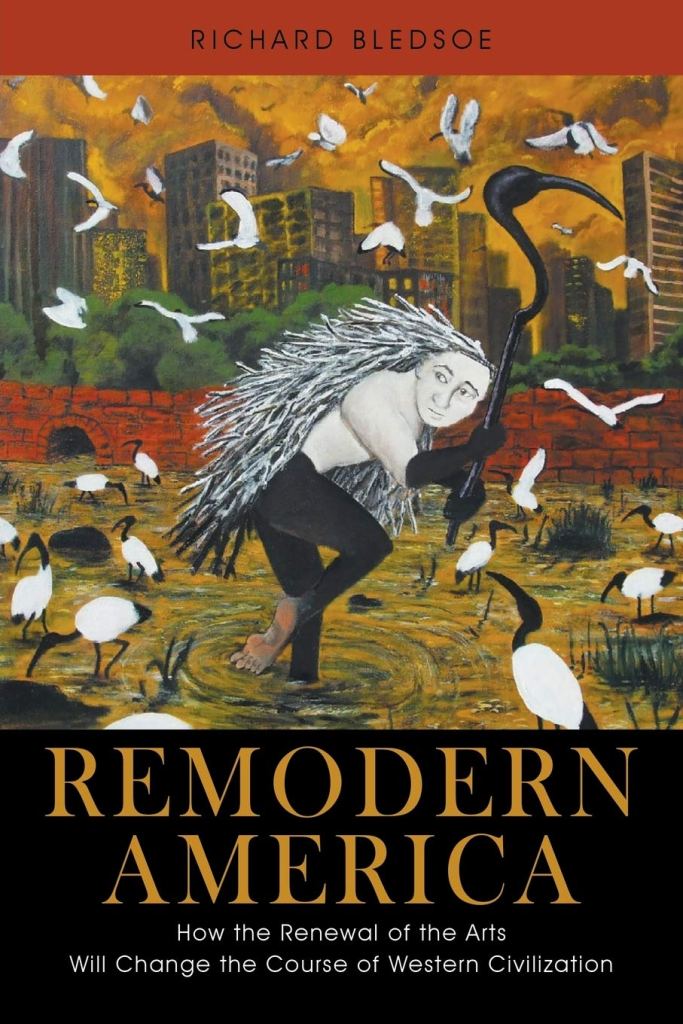
The Spirit of the Age,
by Richard Bledsoe
What is the spirit of this age?
History will recognize this as the era the general population of the United States realized the governing class and its connections, far from acting as responsible public servants, had mutated into an elitist ruling class.
These elitists decided amongst themselves, due to their superior intellects, credentials, and social status, they deserved to control how everybody else lived their lives. This mission of conquest was camouflaged with egalitarian rhetoric.
In exchange for the burden of managing their inferiors, this New Class exempted themselves from the expectations they imposed on others. Those underlings who supported the ascendancy of these would-be rulers received some special considerations as well, a semi-privileged status—but their greatest reward was to bask in the reflected glory of their masters.
The elitists had a plan, and it almost worked. Over decades, the institutions that sustained American culture have been infiltrated, their missions transformed.
Government, media, education, the arts—the occupying elitists within dedicated all resources towards undermining sustaining Western values, all to better serve the consolidation of unaccountable power. They used their influence over the various means of cultural communication and expression to exert pressure at all levels of society to embrace collectivist goals, distorting the concept of equality.
As part of these maneuvers, art was pushed into a crisis of relevance. Elitist malfeasance has marginalized the visual arts in popular culture. In doing so, the New Aristocracy of the Well-Connected block access to powerful resources. They deny our society the inspiration to live up to ideals, the encouragement to think and feel deeply, the yearning to harmonize with truth and beauty. As a result, the mass audience has turned away.
People instinctually reject the superficial and nihilistic contemporary art championed by an imperious would-be ruling class. We currently call this covert corrosion inflicted on the foundations of Western civilization the Postmodern era. A small sect usurped disproportionate power over the course of the entire nation. Now the terrible results of the corrupted establishment’s agenda are clear. Under their reign we are less prosperous, less safe, less free.
The elitists ran out of credibility and resources before their work was complete. Now, we, the people, must make sure they run out of time as well. The dominion of these deceitful despots must be demolished throughout the culture, on all fronts. Around the globe challenges are rising against the longstanding world order. The story of the 21st century will be the dismantling of centralized power.
As always, this course of history was prophesied by artists—those who are intuitively aware of the path unfolding ahead. Their works become maps so that others may find the way. The new directives emerging in our culture must be acknowledged. Enduring changes start in the arts.
The entrenched interests are desperate to deny this uprising, but denial won’t stop us. The parasitic Postmodern era is finished, but it won’t go quietly. The vast project of reconstruction will commence as we dislodge the failed status quo.
What is the spirit of this age?
This is an era of joyous insurgency and new beginnings.
Welcome to Remodern America.
 According To Hoyt
Pro-Life versus Anti-Life
If one prefers, Pro-Human versus Anti-Human.
But practically, if there were other sentient life forms that thought independently and were inspired by beauty, they would also be on the “destruct” list.
Human Wave Art
LikeLiked by 1 person
More and more folks see the disdain the “elites” hold for the “Common Folk”
As there are far more common folk than “elites” this always has a way of going wrong for their plans.
If they’re lucky, they just get tossed from power and some incarcerated. If they’re unlucky, Madame Guillotine arrives.
LikeLike
LOL! Reading your first sentence, my brain queued up “Bastille Day” by Rush.
“Hear the echoes of the centuries. Power isn’t all that money buys.”
LikeLiked by 2 people
Neil could write ’em
LikeLike
Thank you for sharing this, it is an honor!
LikeLiked by 3 people
C4C
LikeLike
I am absolutely convinced that the ugly, and pointless abominations of so-called “modern art” (which needs several paragraphs to explain a banana duct-taped to a wall and similar stupidities) is just a money-laundering scheme among the elite of the modern art collectors, art critics and auctioneers and their insanely rich patrons.
An elaborate money-laundering scheme. Change my mind.
LikeLiked by 2 people
Amen, Sister!
LikeLike
Which explains Hunter Biden’s “art,” of course.
Back on the high school humanities trip to NYC (1972), I was literally ill in thr Museum of Modern Art, and it wasn’t all the unfortunate food choices I made.
LikeLike
“There’s something about that woman’s smile. Hang her in my bathroom!”
LikeLiked by 1 person
“No, stop!! I meant the painting!” :-D
LikeLike
OK: Rather than money-laundering, it’s Soviet Union psy-ops, using agents of influence to promote ugly art as a means to sap the morale of the Main Enemy. After the fall of the USSR it shambled on, zombie-like. The leftist shamblers, infected by KGB zombie-memes, are enraged at what they see as the fall of Virtue and Enlightenment and Civilization to the right-wing barbarians of sin and evil, and so are doubling-down on the attack, feeling that if they can’t win, they can at least play Samson in the Temple. (That they are also protecting like WWII searchlights is another story.)
Any money-laundering is a sideline. If it were primarily about money-laundering, the product would have a higher kitsch factor and a lower level of nasty épater le bourgeois. We’d see more things like paintings of Che or Mao on black velvet and fewer vomit-in-your-face works.
LikeLiked by 1 person
THAT first paragraph is what Heinlein thought.
LikeLike
I’m not opposed to all modern art. The older modern art anyway — how new does it have to be to be modern? The original modernists were able to make traditional art if they wanted to, they simply chose not to and sometimes it worked very well. I remember stumbling across an article on how artists were taught to draw in the various academies and all of a sudden cubism made total sense to me. I think that’s it became utterly cyclical later — yes, I’m thinking of Pollack — and then the poor artists were taught that crap was the way. I know a few people who went to art school and Malkovich’s character in Art School Confidential was entirely on point.
FWIW, MOMA was a great place to meet a certain kind of girl when I was of an age to meet such girls. Girls at the Met tended to be much better looking, but not as …… accomodating.
LikeLiked by 1 person
Regarding your comment a few days ago about needing to see a major leftist change sides, does Aplle announcing they’re spending a bunch of money building a data center in the U.S count?
LikeLiked by 1 person
not really. They’re just being rational since their business model left them very exposed and they had started to move out of China well before Trump. On the other hand, I suppose it’s a good thing that their not cutting off their nose to spite their face like they did in Trump 45
LikeLike
Impressionism can be considered modern by some, and I like a lot of it, especially the landscapes. Some surrealist stuff is amazing as well, and I would not mind having it on my wall. Modern Western art can be striking.
I get the sense that the teaching is now a large part of the problem. Students don’t spend time learning the technical skills to reproduce, oh, a Van Eyche or a Rembrandt, and so they can’t take those skills and go their own way.
LikeLike
Academic painting was still going on during the same era and produced some real beauties.
LikeLike
But the relevant comment has always been, “You’re an artist? Fine; draw me a cow that looks like a cow. You can progress from there.”
That tends to separate the sheep from the goats. Or the artists from the banana-tapers.
LikeLike
me too.
LikeLike
… had mutated into an elitist ruling class …
had metastasized into an elitist ruling class.
There, I FIFY
LikeLike
Oooh, wonderful prologue. I especially like the alliteration in, “The dominion of…deceitful despots…” I’ll have to seek out the book.
As for art over the last century, there’s quite a bit of music, TV/Movies that I find enjoyable amongst the drek. Sadly, it’s become ever increasingly harder the last couple of decades to discover and I find myself drawn to the older examples when the Progressive cause was more muted. The visual arts of painting, drawing, photography seemed even harder to examples that the elites found acceptable/pushed that I actually enjoyed. Most of what I liked was dismissed as “pulp” or too commercial. Book covers and comic books come to mind. Boris Vallejo, Frank Frazetta, Ernie Chan and some others that drew Conan the Barbarian comics were among my favorites. “Modern Art” was either un-moving, or outright intentionally offensive (Piss Christ comes to mind) that pretty much pushed me away.
With the recent (has it only been a month?) political swing I can only hope that we’ll start seeing more art that actually appeals to the general public.
LikeLiked by 1 person
George MF Washington has a post about current movies that makes much the same point. Modern film over regulates and sanitizer everything, even casual background scenes, which turns the public off because it’s not “real”.
LikeLiked by 1 person
This brought to mind the “Frozen in Amber” post from a couple weeks ago. Postmodernism was the big new thing…how long ago? I don’t know what the official timing is, but it took hold before I was born, and I’m not young anymore. Yet here it still sits, bloated and immobile, smothering everything. Nobody has been allowed to move past it for half a century or more. In terms of artistic movements, it’s old enough to be radiocarbon-dated.
And postmodernism, in the end, has never been anything but destructive and empty. The name says it all. It has no creativity of its own; it merely exists *after* something else. To call a movement post-anything is to admit that your “art” is nothing more than a parasitic growth sucking the life out of whatever it is you’ve attached the “post” to.
LikeLiked by 1 person
Post modernism, at least in architecture, started in the late 70s to early 80s.
“Modern” architecture itself is well over 100 years old.
Unfortunately it’s not likely to go away any time soon, because they’ve finally made the advances in building materials science to allow it to work the way it was supposed to.
LikeLike
Sam Goldwyn had the right of it when he (allegedly?) declared, “Modern Dance is old fashioned.”
LikeLiked by 1 person
My experience is with literature more than anything else, but I think it can generally be said that the modernist era in fiction and visual arts began shortly before the turn of the 20th century and postmodernism hit in the 40s. My timescales could be off, though; I left that world a long time ago and haven’t paid much attention since.
LikeLiked by 1 person
CompostModernism
LikeLike
It’s not so much that ‘post-modern art’ is offensive, or even ugly, it’s the banality. Most of it is just not interesting. ‘Bleccch!’ is at least a reaction. Most of it just gets ‘Meh.’
LikeLike
The real crime is art is supposed to inspire you, make you think, make you feel. This new crap is just the opposite, it steals all emotion until even hope is gone. And that boys and girls is it’s true purpose, to steal hope, make you a slave just like them. Because we all know misery loves company and they are truly miserable, even before Trump they were miserable and they couldn’t stand the fact that we weren’t. They hate us with every last fiber of their being, BUT MOST OF ALL THEY HATE THAT WE HAVEN’T GIVEN UP.
Sorry assholes, we will never give up, we will never surrender, so tape your bananas to walls and hoot and howl and beat your chest about how great you are and how much we suck. In the end, We Win, You Lose.
Note; They are really Mad we didn’t Bugaloo, under President Pedophile. But I’ll bet you they will try and Bugaloo now that Word Salad has lost.
LikeLike
“boogaloo” Root word from a movie “Breakin 2: Electric Boogaloo”. Somehow the tough-talking folks chattering pointlessly online and those folks that stir the poop stole “boogaloo” for “revolution”. Sometimes shortened to “boog”.
“The Bugaloos” were saturday morning live-action cartoon characters.
https://en.wikipedia.org/wiki/The_Bugaloos
LikeLike
Started out as a riff on that movie’s title: “Civil War 2: Electric Boogaloo”, and in the way of things got shortened and became an in-group reference.
LikeLiked by 1 person
However the boogiemen stole it…..
(grin)
LikeLike
LikeLike
Years ago a traveling exhibition of some of Van Gogh’s work from the Louvre (IIRC) arrived at the Los Angeles County Museum of Art. I was not a big fan of Van Gogh myself but my wife and daughter were so I bought tickets and we all went there.
After browsing through the Van Gogh exhibit, my daughter wanted to visit the modern art wing. Being a good and dutiful father I took her and her mother there and was able to spend about an hour-and-a-half completely mystified as to why that stuff was called “art.”
On the way back to the car I detoured briefly through a display of Renaissance period art. It was almost all religious in nature and, being an atheist, the religious aspect did not impress me. However, it was obvious to me that the men who did those paintings were not just talented; they were inspired. The inspiration was obvious in the way they the images. The colors they chose. How they posed the figures. I did not have to believe in Ghod to appreciate the result of talent inspired by belief.
I came away with, I think, a better understanding of the contrast between inspiration by false beliefs from the lighter side of the Gray Spectrum versus what false beliefs from the darker side inspire.
LikeLike
There are a few music pieces inspired by the Greater Glory of G*d that I feel are nearly proof that it exists. At the very least, they prove the inspiration is real. (e.g. Hallelujah Chorus)
LikeLike
I certainly agree that religious belief has inspired some great works of art, music, literature, and architecture. Whether the source of that inspiration is real, myth, or memorex is probably not a subject for this forum.
LikeLike
Lauridsen’s “O Nata Lux” (the movement by that name) and “Magnum Mysterium.” The first is about the birth of Light, and builds from hushed darkness into glorious brilliance. Likewise the second, O, great mystery, starts dark and plain, building tension and joy both with a sense of hope, then of fulfillment. Even if you don’t believe in the text’s message, just the power of the notes can move you to tears.
LikeLike
I went to a MOMA with my parents, lo these many years ago. At one point, my dad was looking at a piece that looked like nothing so much as an enameled metal tabletop propped up against the wall. And he said, “I don’t get modern art.”
And what fell out of my mouth was, “Well, it does display minimalist leanings.”
I don’t think I’ve ever surpassed that level of improvisational pun-ishment.
LikeLike
I do remember something like that from the LA trip I mentioned. About 1x2x7 feet, leaning against the wall at about a 70° angle. Painted in orange or yellow maybe? At first I thought it had to be a support or something for a missing piece of “art” but it was the art.
LikeLike
This one was baby blue. Who knows, could have been part of a series.
LikeLike
I’ve had this idea for a cartoon for decades now. A couple folks (not necessarily a ‘couple’) looking at a work of ‘Modern Art’…
“What’s that?!”
“That’s art!”
“They get the guy who ran over ‘im?”
LikeLike
Early opinions, you don’t have any facts yet, Looks like Germany is heading towards the slow left of the Globalist GOP wing. In order to circumvent the will of the voters. Fine, your country, you be you, looks like they want to be Anti Trump as well, they have been Anti American for a while. Fine, move the U.S. bases from Germany to Poland/Czechoslovakia/Hungry? Eighty years is long enough, the French and British can stay they pretty much drank the socialist kool aid anyway. Just another opinion is all, no where near perfect.
LikeLike
Poland and Romania. Might as well have a shorter drive when things go back hot again, likely right when Chairman For Life Pooh goes spicy.
LikeLike
Heck, put one in Finland too.
LikeLike
Art has sucked for my entire life, which has become an unexpectedly long duration. I tuned it out, long ago.
Speaking of which, is Hello Dolly the apotheosis of The Musical or is it purposefully overdone? (like B horror flicks with blondes in high heels running through the woods shouting “Hello? Is anyone out there?”) Either way, it’s dreadfully overdone.
LikeLike
Running off to Alaska to visit my brother until 5 March. Have fun everyone!
LikeLike
Never been inspired by most current art. American continent, scenery, wildlife, photos, paintings regardless of mediums. Rarely pay for them. Few reasons:
Hubby is an amateur photographer. Even our old salvageable (be surprised even safely store, how degraded some are after 40+ years), selected (too dark, not chosen, for example) prints and slides are digitalized. He’s been printing some to create self picture books, inexpensive framing, and 4 gorgeous results print on metal (spring in the Tetons).
I have original oil art, grandpa’s paintings. Original charcoal and chalk, great-grandma’s work (have a number that need new frames, but after 100 years …). A couple of original oil art from sister. One original ink and watercolor my cousin did of hubby’s childhood Siberian Husky (which I actually paid for). Finally an original chalk piece from mom’s cousin (a prolific selling local artist when she was alive). Cousin went to art school, and has sold her art, but does not make a living out of it. Niece does beautiful work but will not put it out for public viewing. Otherwise, sister has sold one painting (makes her a “selling artist”). Rumor great-grandma sold art before her marriage (late 1800’s, east coast), but can’t find proof. Landscapes and wildlife.
We have bought some wildlife posters (wolves) and framed them (any of our wolf photos are circle black spot and write “Wolf! Honest.”) Hubby needs to choose some bear pictures for enlarging and printing (now that we have some that are not like the wolf pictures). We have some nice pictures of 399 with her 2020 quads as goofy yearlings.
LikeLike
There is a theory on the current era in the arts (broadly defined) that has a lot of appeal to me, that I think explains much of the elitist behavior toward them.
High art — in painting, sculpture, music, etc. — used to be something for the relatively few. You had to go to the gallery, or museum, or recital hall, or theater, to get the experience of it. You’d have to cross a continent, or an ocean, to view many great works of art. Deep, well-developed taste was only possible for someone with lots of resources to go lots of places. It was a status symbol, both economic and intellectual.
That has all changed. Sound recording, photography (especially when color came in), motion pictures, television, the Internet, these and many other developments have brought fine arts closer to literally billions of people. It no longer takes a small fortune to become well-versed in Leonardo or Bach or Mozart or Monet. The great arts are democratized. It is an almost incalculable increase in the cultural wealth of the world. Everyone can share, and it takes away from nobody else.
Except that it took from the elites, because now they weren’t special any longer.
(I’m probably part-elitist myself. I like the high-toned stuff — but I also like the idea that many, many other people have the chance to like it too, and did like it when they got the chance.)
So they created new definitions of high arts. They leaned hard into things regular people find bewildering or repulsive. Those, they claimed, were the new acme of the arts, and of course common people wouldn’t, couldn’t appreciate them. All that stuff the bourgeois masses liked, Michelangelo and Rembrandt and Beethoven, the beautiful stuff, that was old hat. There were more important things being done today.
The bewilderment and repulsiveness was itself part of the plan. It drove away the wrong sorts. It’s easy to love beautiful things, but to love what we love takes something special.
I don’t think that explains all of it, but I think it explains some.
Republica restituendae, et, Hamas delenda est.
LikeLiked by 1 person
I think that’s a large part of it. Postmodern “art” also works as a class symbol because ordinary people can’t afford to spend large amounts of time creating stuff that almost everybody hates. To do that, you have to either be in the moneyed elite or have its patronage.
LikeLiked by 1 person
I must not appreciate the finer points of modern art. Leaving a conference at a univ, I asked the help desk where the airport shuttle bus stopped. “By the Art Museum”. Self: “Is that the building with the pile of scrap metal on the front lawn”? Help desk lady (a fellow art cynic): “That’s the place”.
LikeLike
During the ACW it was standard practice for cavalry to tear up rail lines and burn the ties with the rails on top, after which they bent the rails into various contorted shapes so they couldn’t be re-used. Little did they know that if those piles of twisted, bent rails could have been sold to “art” collectors a century later it would have financed the war for years.😉😆😆
LikeLiked by 1 person
I will not write a time travel story. I will not write….
LikeLiked by 1 person
((leaves out carrots for Sarah’s plot bunnies…))
LikeLiked by 1 person
Aw, why not? That would be fun!
🤣🤣🤣
LikeLike
call it The Art of War?
LikeLike
😁😁😁
LikeLike
The hot rails were often twisted around trees, forming “Sherman’s Neckties”. Another nickname were the isolated chimneys still standing where plantation houses had been burned, known as “Sherman’s Scarecrows”.
LikeLike
Since the ACW was the first major conflict in which railroads played a significant part, It’s sort of amazing how many techniques were developed for dealing with them. Endless inventiveness…
LikeLike
Orson Scott Card said in an article in a magazine I used to have (and may still have) that the modern “fine arts” establishment was like the Brezhnev-era Soviet Politburo: an ossified elite mouthing the words of revolution who hadn’t had an original idea since the 1920s. Robert Heinlein (PBUH) said that while fine art these days looks like it was made by retarded monkeys, commercial art (like book cover paintings, forex) is steadily getting better. I know I’d rather have a Michael Whelan original than anything I’ve seen in a “modern art” museum.
A lot of “modern artists” think their job is to “epater les bourgoisie” My own take is that they are generally a bunch of talentless frauds who use their “art” to stick a middle finger up at Mommy, Daddy, their teachers, and everybody else who told them that they were no damn good.
LikeLike
I listen to a podcast, the Steve Deace Show, that says “it’s revival or bust”. Your article/excerpt made me think of this in relation to how the dichotomy of the spiritual battle we are in (Spirit of the Age v. the Risen Living God) has overtaken the arts much as everything else, to include politics, history, economics, the personal. I feel like that since Obama was elected, that I’ve been living in a kind of Lord of the Rings spinoff where Mordor was unleashed with tranny’s, communists, jihadists, pedophiles, actual demons, and a conspiracy so detailed and intertwined, only the Satan could make it up, and only a just and all-knowing God could foil it.
Was the deterioration of the arts, and the concomitant spiritual renewal that seeking to create things of beauty endows in society, a result of a plan by the “governing class”, or was that a result of our spiritual decay that caused us to harvest these wicked fruits?
LikeLike