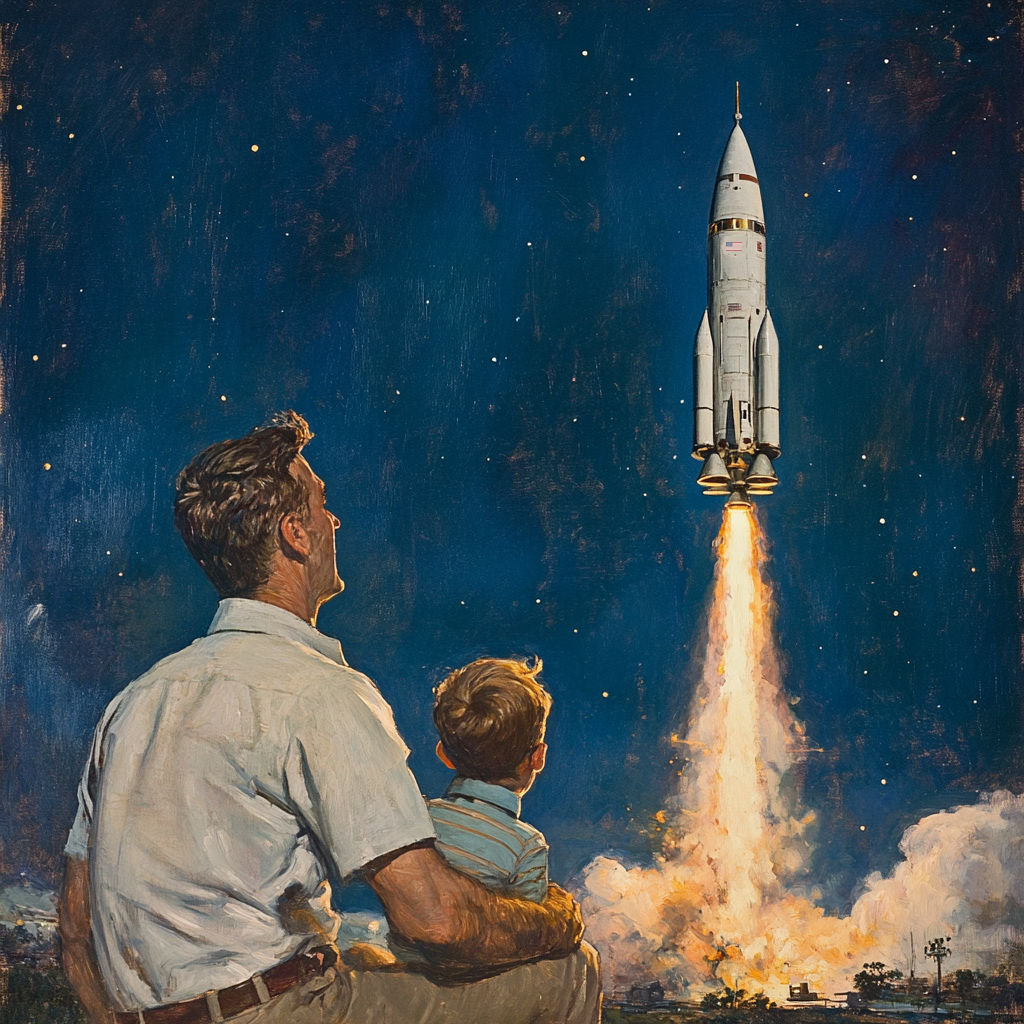
(Originally posted here: https://twitter.com/JeffGreason/status/1860439949100896479?mx=2)
2025: A Moment Of Opportunity In Space by Jeff Greason
Since 1969, a ritual of American politics is the re-examination of American space policy with each change in the presidency. A panel, commission, or task group gives recommendations. New initiatives are announced—to be mostly forgotten. The focus often shifts from the Moon to Mars or vice versa. Very little of this results in lasting change. While it is often said that “personnel is policy,” and certainly, leadership (or its lack) matters enormously, changes to the structure of policy matter more. The structure of the bureaucracies that carry out space policy in the U.S. and the incentives with which they operate matter immensely.
We are now at a moment of tremendous opportunity in space. Years of wise policy, combined with good fortune and the ability of U.S. business leaders to raise the capital needed for private ventures, have placed the U.S. back in a leadership position. SpaceX dominates world launch markets, and competitors are rising to chase after them. This superior position will not last if the US makes unwise policy choices—as Heinlein wrote: “The laws of physics work as well for others as they do for us.”
Goals should drive policy choices, so what are our goals in space? We want the U.S. commercial space industry to continue to lead the world. We want it to provide the industrial base for our defense needs in space. We want to lead the setting of norms of international behavior in space—rules-based international order with relationships between nations that create mutual benefits. We want the U.S. to lead discoveries of natural resources and phenomena in space, and put them to economic use. We want U.S. citizens and U.S. companies to pioneer the space frontier, free to innovate, risk, and thrive—and free to fail when risks exceed our grasp.
Achieving these goals requires us to foster the development of markets for new commercial space ventures, remove regulatory barriers that slow the pace of development of U.S. space-related businesses, provide a predictable and supportive legal and regulatory framework, and enable the U.S. Space Force to ensure the freedom of navigation in space and protect our space assets.
Lasting solutions require more than wise administrators; we need wise policy that survives even in their absence.
Five executive orders
First, I recommend moving the Office of Commercial Space Transportation (OCST) out of the FAA. Give OCST back to the Secretary of Transportation, where it belongs by statute. Placed within FAA by an executive order by Clinton, it can be removed from FAA by executive order. Unfortunately, the Part 450 regulation of space launch and reentry was a step backward—the U.S. should return to a more performance-based regulatory structure. After decades in which every launch and launch site license has received a Finding of No Significant Impact (FONSI), we should either seek a categorical exclusion, like we have for aircraft, or change to a “shall issue” structure where the government may deny a license application for cause, but, if it takes no action, the license is approved by default.
The experimental launch permit regime could have been used to cover Starship flights 1-5 with a single approval. If additional regulatory work is needed to revitalize the experimental permit regime, do it. Rather than adding staff to solve licensing backlog and delays, reduce the number of staff hours it takes per application by making greater use of existing authority to allow one application to cover multiple launches.
Second, a core tenet of U.S. space policy since Eisenhower is that space-based reconnaissance is a stabilizing capability, we thrive in open societies without secrecy , and taking pictures of the Earth is not a hostile act. As such, eliminate all licensing requirements for space-based imagery. No one should have to ask NOAA for permission to take pictures. If the commercial satellite imaging capabilities become as good or better than those of government satellites, we maintain access to the best imaging systems in the world. An executive order could direct NOAA to immediately approve all applications for Earth observation licensing, regardless of how good the imagery might be. Then, change the legislation so the requirement for licensing cannot be easily reinstated by a future administration.
Third, the U.S. space industry labors under tremendous disadvantages due to ITAR. The “technical assistance” category for ITAR control requires government review and approval for something as simple as describing a product on a website. Eliminate this category completely to restore freedom of speech to U.S. citizens—speaking about space capabilities is not a criminal act and attempts to make it so are unconstitutional. Note: This has nothing to do with keeping government secrets, which are governed by secrecy agreements, clearances, and the like. Instead, if companies want to talk about their products, or engineers in private industry want to talk about their work, let them. This is necessary to ensure the U.S. maintains a culture of technical leadership and finds markets for made-in-the-USA products. At a minimum, some kind of financial relationship needs to be in place before the U.S. government can claim speech constitutes “technical assistance.” An executive order could immediately redefine technical assistance to ensure the regulations do not infringe on free speech. Then, change the legislation.
Fourth, the FCC has expanded its own authority, making licenses for radio transmitters contingent on compliance with additional conditions imposed by the FCC that have nothing to do with managing the radio spectrum. The FCC’s domain should be to manage radio spectrum, not space debris or other aspects of what US commercial companies do in space. An executive order could eliminate this overreach immediately. And since the Supreme Court ended Chevron deference to such things, these rules are unlikely to return without congressional authorization.
Fifth, U.S. obligations under the Outer Space Treaty call for us to provide “authorization and continuing supervision” of our commercial space activities. Within the space industry, there is reasonable consensus that the Department of Commerce should take on this role, because a regulatory regime is not warranted yet. Instead, we need a mechanism for deconflicting potentially interfering uses. The Biden administration encouraged consultation among many agencies with none empowered to say “Yes.”
Pending legislation, an executive order could designate the Department of Commerce as the responsible agency for in-space commercial activities, just as Reagan made the Department of Transportation the responsible agency for commercial launch before the Commercial Space Launch Act codified it. Such an order must make clear that no permission is required from the government. Instead, the DoC would maintain a registry and check to confirm that a proposed activity doesn’t conflict with other registered activities or treaty compliance, such as no weapons of mass destruction. In the absence of a conflict, the activity is registered. When reviewing launch licenses, the Secretary of Transportation can check that the activity has been registered with DoC– that’s all that is needed. “Continuing supervision” can be maintained by requiring parties to update their registry when they change the nature of an activity. This process would create clarity for the space industry and provide the first steps towards a system of recognizing that entities operating on celestial bodies are entitled to do so, can expect to continue to do so, can transfer or sell their operations to others, and that others should not interfere with peaceful space activities.
All these measures have negligible impact on the federal budget.
NASA’s role
Other more challenging aspects in U.S. space policy have to do with NASA and are not free of cost. Since Kennedy’s redirection of NASA to go to the Moon in 1961 and the end of the Saturn V production in 1968-1970, we have struggled as a nation with the questions, “Why does the U.S. need a civilian space agency and what it is for?”
A detailed discussion of the purpose of civilian space agencies would be a much longer article, but in brief, the U.S. established NASA for three main reasons:
· To set the precedent for peaceful uses of space and be a leader so we can set norms of behavior. (In 1958, this was most urgently about creating the precedent that space reconnaissance and overflight of territory in space were peaceful uses.)
· Improve the technology for air and space vehicles to ensure that the U.S. industrial base was the most capable. (This was essentially a continuation, in space, of what the predecessor to NASA, the NACA, had done for aircraft.)
· Learn more about space, what is up there, and how we can benefit from it.
Kennedy repurposed NASA into a mission-conducting agency. NASA would conduct a high-profile, very expensive and complex mission—sending humans to the Moon and back—so as to forestall Soviet claims on the Moon and to ‘win’ the arena of perception of the U.S. as a leader in space.
Now, unfortunately, the mission-conducting elements of NASA for human spaceflight and space science missions consume the bulk of NASA’s budget. The original purpose—maturing technology to support the U.S industrial base—is underfunded. Human missions became ends in themselves, and a constituency in themselves, so that we pay for effort not results. Science missions also became their own constituency, conducted for the benefit of the science community alone—not to mature technology or to learn about the things in space from which we might derive economic benefits.
To forestall any claims by China, we have an urgent need to return humans to the Moon and on to Mars, and to support the peaceful use of space by like-minded nations, signatories to the Artemis Accords. A shift is needed from “pay for effort” to “pay for results.” To improve the performance of air and space vehicles, we need NASA to mature technologies, an activity that conflicts with its mission-conducting efforts. But, NASA’s technology development effort is focused on “technology needed for NASA missions,” and paradoxically, NASA missions are selected on the basis of “what can be done without any new technology.”
Either NASA mission selection and design needs to be subordinated to maturation of space technologies that benefit parties outside of NASA or the maturation of such technologies needs to be assigned to a new entity, funded and chartered for this purpose. If a new entity, note that the U.S. Space Force as well as U.S. industrial partners are likely customers for such technologies and should share in the development of roadmaps that describe the technologies that need maturation.
While it may be a step too far to reform NASA, the rest of these measures are policy changes, have negligible cost, and most can be commenced at once by executive order. The opportunities for accelerating U.S. efforts in space are greater than ever, and I hope the incoming Trump administration will take note of the opportunity.
 According To Hoyt
Great ideas here.
But, I think NASA should just be shut down at this point. Let private industry lead the way.
LikeLike
It’s an understandable sentiment. And NASA, and whichever agency we decide to do our technology pushing with (NASA or a new one), both can and should take more advantage of private sector capabilities. But in general, the private sector only does things for which there is a current or expected very near future market, and the purpose of government efforts in space is to fill those gaps and push a bit further ahead. The private space industry of today is resting on investments made by government decades ago — we need to resume making the investments that will make the industries of today obsolete in the future.
The fact (and it is a fact) that our government space efforts have invested in duplicating the efforts of the private sector rather than supporting them or fostering new markets (by kickstarting Lunar industries, for example) doesn’t mean we don’t need government space efforts. It means instead that they’ve been doing the wrong things.
LikeLike
Note further than the recent accomplishments from the private sector *have* benefited from some wise investments by NASA in the Commercial Cargo, Commercial Crew, and CLPS programs, so thing have been improving, even if there’s certainly further to go.
LikeLike
SpaceX is to space as Bell Labs used to be to electronics; research and development with an eye to new ways to make money via technology.
LikeLike
I wish that were so, but it isn’t. SpaceX is more like Intel; making dramatic progress by incremental improvement building on fundamental breakthroughs done by others (like Bell Labs for transistors or various government funded projects for rocket engines and thermal protection)
LikeLike
Once upon a time I ran across what seemed like a mere quip, but there was likely at least some substance to it. The best way to (at least start to) reform NASA would be to close its DC office.
LikeLiked by 1 person
…and NOT replace it.
LikeLiked by 1 person
Ever!
LikeLike
c4c
LikeLike
c4c
LikeLike
One of my papers for my master’s course back in the late 80s could be summed up with “Kill NASA Now!”
They need to be removed from the arena of space operations entirely and focus on R&D.
Especially since they being the cover story for USAF space operations has long since outlived it’s viability.
LikeLike
In short, we need space policies that will remain functional even when administered by scoundrels and idiots. Such as, oh, say, the Biden* Regime. Which has served a useful purpose — showing us just how dysfunctional the government can get.
I maintain that the Apollo Program was the world’s biggest and most expensive publicity stunt. The Space Shuttle was designed by a government committee, and Nixon nixed the first 3 designs, all of which were better than what we wound up with. Nixon hated Kennedy ever since the Democrats stole the 1960 election, and saw NASA as Kennedy’s legacy. Naturally he was hostile to NASA.
LikeLike
Who controls the orbitals rules the planet.
Get us up there, permanently and on our own systems. Orbit US DoD forces. Own it. Deny orbit to yahoos and tyrants.
Because they -will- stick it up our ass the moment they can. And fixing -that- debacle will take centuries, if ever.
LikeLike
So for NASA I think it ought to be trimmed way down. As much as the Moon landing gave us some REALLY interesting science and made the USSR waste effort in a micturition competition that goal (and the vacuum left after we “won”) probably slowed our progress in space by 20-30 years. The original staged model of Von Braun
Technologies move in stages. In the first stage they are pure speculation and then very iffy. Consider early aircraft. Without the forcing effect of WWI they would have developed far more slowly. Early passenger aircraft were subsidized to some degree by airmail that is the second stage. SpaceX is using a similar strategy using Starlink (and to some degree Tesla) to support Elon’s Mars ideas (this also looks rather like The Man Who Sold the Moon ). This is stage 2. If Starship really gets going (and this is looking better and better with the Biden folks about to be removed from the picture) access to LEO drops to $100-200, two orders of magnitude down. This is the third stage, the fourth stage is commonplace/ubiquitous use, and the fifth stage is retirement by some other technology (call that the buggy whip stage). Government involvement beyond early stage 2 (C.F. airmail) is undesirable as it tends to lead to the Fascist/Communist planned economy, which due to its inability to predict need or side effects stifles development and wastes resources. Market forces are far less prone to this issue (although they will go down blind alleys from time to time).
As we are in transition from 2-3 so it is long past time for NASA to get out of the process. Its value is totally in long term research and science although it does NOT do this even efficiently (See the WEBB telescope and similar that are way over budget). In general NASA should stick to planetary sciences (probes), general space science (space and later Lunar based telescopes for various frequencies) advanced propulsion (i.e. not chemical, Ion, Thermal Nuclear, pulse fission/fusion and true fusion if we ever get there) and advanced materials (heat shields, shapeable structures etc). The default contract should NOT be cost plus but fixed cost with cost plus ONLY used for extremely experimental item contracts. SLS should either be terminated (my preference) or rebid with fixed time/cost contracts with strong penalties for lateness. Any cost plus contract should be reviewed under Nunn/Mccurdy type rules with the CEO/CFO of the bidder sat down under oath in front of congress.
I agree the model for basic flight ought to be closer to that of an experimental aircraft. If you have paying customers you’re then back to an FAA like model but even SpaceX with things like Polaris Dawn is not there yet.
FCC should have NO jurisdiction other than the frequencies. If they’re authorized they’re authorized and get out of the way.
I also agree that Commerce should own Commercial space issues and ONLY Commerce.
Finally EPA/fish and game ??? should have strict directions on WHAT they may consider (best done through EO as legislature will be a fricking mess due to environmental wennie congress vritters). Once certified it STAYS certified unless for that piece of hardware/launch site UNLESS there is a major change (again specified by detailed E.O.) in the process (we need someone like Rand Simberg or Bob Zimmerman to help specify this stuff).
We should be looking to go back to the Moon for good. It is far more interesting (especially far side for science basing) in the short term than most orbital stuff. More Power to Elon and SpaceX on the Mars efforts. Although without at least .01 G or even .001 G constant thrust engines a 26 month set of windows really means a colony had better get self sufficient quick and had better be sure it can self sustain as if a window gets missed (due to assholes on earth taking over) you could end up with 52 or 78 month (or permanent) hiatus in deliveries. At least the folks that hit North America had the hope that someone could show up in 3-4 monts or that they could build ships and go back if things were truly FUBAR.
LikeLiked by 1 person
Oops I meant to say the ” The original staged model of Von Braun would have been far more sustainable then the mad rush to the moon bey any means necessary”. Lost that somewhere.
LikeLike
The originally preferred lunar landing method [as depicted in the Bonstell illustrations] was ‘Earth Orbit Rendezvous ‘ – implying multiple launches to build up some satellite infrastructure to assemble the vacuum to vacuum transports and a fuel depot.
The Apollo ‘Lunar Orbit Rendezvous’ let you get a small crew there and back again, but left no infrastructure in place – you only got the Command Module back – and it was in no shape to be reused.
LikeLike
Imagine where air travel would be if they ran it like NASA — every airplane only makes one flight, then they build a whole new airplane for the next flight. How much would tickets cost? Who would buy them, when every flight is a test flight?
LikeLike
Barring WWI and WWII and with the same restrictions for Wright and Curtiss that SpaceX puts up with I think we’d JUST be reaching monocoque metal monoplanes with super/turbocharged engines for flight above 10000 ft.
LikeLike
I’ve found it somewhere between amusing and depressing that for 15 years now, I’ve been trying to convince Big Government folks that it would be possible to return to the moon with Falcon, Falcon Heavy, and Vulcan derivatives; and when they keep saying it can’t be done, I point them to Von Braun’s 1958 ABMA study on how to do it with Saturn I’s — which had, at that time, the same payload capability and fairing volume as a Falcon 9 does now.
LikeLiked by 3 people
Wikipedia says Saturn I was capable of ~9100kg (9 metric tons each = approximately 1 long ton english) to LEO. Falcon 9 can do 17500kg(17.5 T) for $60million with booster recovery so ~2x. Falcon Heavy can do 57000kg(57T) for $90 million recovering all boosters 63,800kg (63.8T). Starship/heavy Block2 (flight 7+) is aiming for 100T+ to orbit with full recovery, price TBD. Can’t find a Saturn I cost but inflation since 1961 (first Saturn 1 test is 3200% (i.e, 1 1961 dollar buys 32 2024 dollars worth of stuff), so Saturn I had to be less than $2 million / launch to be cost competitive to Falcon 9 and actually it had to be less than 1 million or so as it is half the payload.
I think it is pretty clear that a variant of how Von Braun envisioned it and Bonestall illustrated it is well within possibility kind of like https://www.youtube.com/watch?v=8zcU85O82XE .
The SLS is expected to be 5 Billion/launch I think is funding at something like 2.5 billion per year just for SLS/Orion. Dump that and it buys 27 Falcon Heavy launches a YEAR thats 1539 tons to LEO. I suspect we can do something with that.
LikeLike
In practice, for LEO payloads, Falcon Heavy isn’t very useful because you max out the fairing before you max out the throw weight.
The best thing I’ve found is a mix of Falcon 9’s and Vulcan’s (to get that 5m centaur up their as your earth departure stage)
LikeLiked by 1 person
Darn that’s a nuisance. Vulcans and New Glenn’s are essentially a cross between hopium and unobtainium due to the BE-3 engine line being, as we New Englanders say, wicked slow. There has been one Vulcan launch back in January. Vulcan tops out at 27T to LEO so, mass wise, Falcon Heavy is a big win. I’m seeing 5.4m for Vulcan fairing diameter vs 5.2m for Heavy so not that big a win (10 cm in all dimensions if I read that right). New Glenn is 7m so a big help, but we return to the unobtainium issue.
Why use centaur upper stages? Why not a space tug with 3 to 6 of the new raptor engines (vacuum variant)? SpaceX has to figure out refueling in space (also hopium at this point, but if they don’t get it to work no moon lander for Orion/SLS or mars trips so Elon has a big motivation) so the local fuel station is going to have liquid methane and LOX not H2 and LOX like a Centaur needs.
I wonder if we can get something bigger than the letter slot on the Starship? maybe like the old Shuttle doors? Or maybe someone could work on a bigger fairing for Falcon? I know SpaceX likes things to be the same (the ford model T style is how they crank the hardware out) but perhaps work with some other small startup vendor?
LikeLike
Of course there is no “one best way” to put a mission together based on existing assets, but that 5m Centaur with the LOX/LH2 and the hardware all in place for a long cost between restarts is essentially a modern S-IVb just waiting to be used. And I’m fairly confident Vulcan launch cadence will pick up in 2025. And you only need one of those per Lunar mission, so it isn’t so bad.
LikeLiked by 1 person
As a short term solution to replace the SLS that sounds good. But I’d ultimately like moon bases far more like 2001. Hey how much H2/Lox is left in the centaur, I’d expect a lot of that to be expended in the second stage to get it to orbit? I suppose if the cargo is short the max weight some of that fuel will not be used and can be kept as fuel. Dang this is a complicated mess.
A nice radio telescope on the far side so there is 2000+ miles of rock between it and our noisy Earth. Similarly, a truly large (say 100M+) scope for IR, visual and UV would be nice. At least no native Selenians will be protesting the development.
To do that we will need to move LOTS of stuff either from LEO or the South Pole to the far side. It may be that we can build a space scope in L2 where Webb is using Starship’s improved lift capability (much of Webb’s craziness was origamiing it into the shroud for liftoff). but it is usually easier/cheaper to work in a gravitational field to build stuff. I suppose the telescopes (radio and light) could be remote once in operation, but you’ll need some folks there to build them. And that’s going to need more than a couple Centaurs worth of stuff thus a space tug of some sort. Even the current planned Lunar Starship is a compromise as it has 1/2 regular atmosphere Raptors to get it to orbit the first time. Even with the power improvements tailoring a vehicle to its purpose often makes it cheaper and more efficient to the task at hand.
And yes actually LOX/LH2 is a better cycle for Lunar work as it is easier to make that from water though to be available at the South Pole. The CH4/LOx cycle is tailored specifically for Mars where it is believed solid CO2 and H20 are available and thus CH4 and O2 can be sourced. It’s kind of like Gas Vs Diesel. So for the present where they intend to get CH4/O2 to orbit it seems we stick to the fuel we can get at the fill up station :-) (hey will they be Sinclair stations or maybe ESSO).
LikeLike
In the fullness of time, Starship and New Glenn will likely both be on line and options will abound. The challenge is getting started Right Now.
LikeLiked by 1 person
Our Biggest issue seems to be that we tend to look for short term gain, mostly because our political system can’t look further than 24 months out to the next election. Heck they’ve been failing to make real budgets for like the last 20 years or so. Not sure how to get an ongoing consensus and the Democrats are mostly opposed on the basis of colonization as if there were Selenites to exploit and vast vistas to ruin.
There is probably SOME scientific value in getting there sooner especially if you can fit a lot of lab hardware in the Lunar Starship. There is also the political issue that China (and perhaps India?) are trying to head to the moon. That said I’d really like us to go back and stay to some degree like we do in Antarctica. And for that we really want the more complete infrastructure.
LikeLike
Right now, NASA should be reformed so that it deals in “pure science” missions, R&D that is difficult or impossible for private companies to perform (nuclear thermal rockets, nuclear reactors, etc, etc, etc), and pushing the boundaries of flight and space physics.
After the disaster that is the Orion/SLS and how it has become an economic tar pit, NASA should be putting everything behind SpaceX and Starship, which has been meeting its mission goals and plans.
LikeLiked by 1 person
Oh, that Orion. For a second there I thought you meant the other Orion. :-)
LikeLiked by 1 person
I would assume many of us are waiting for that Orion
LikeLike
That would be correct. But no launches from my neighborhood, please! (One of the only scenarios where NIMBY is actually justified…😉)
Maybe I’ll re-read “Footfall” and “Orion Shall Rise” again; it’s been quite a few years.
LikeLike
…Launch in my neighborhood? Only if I am aboard it…
LikeLike
One can dream…
LikeLike
The window of opportunity for external fission-pulse propulsion has probably passed. We don’t need it for Earth to Orbit any more and we can do better for most space-to-space missions. Now the ‘do better’ systems need to be demonstrated and brought to flight readiness — but then, so would external fission-pulse need to be.
LikeLike
Jeff Orion was probably Never a reasonable choice to get to orbit except in extremis (CF Niven and Pournelle’s Footfall ) unless you launch from the middle of the pacific with VERY clean bombs. But small pulsed fission (or better yet inertially contained pulsed fusion) seem like one of the few ways that get us orbits faster than Hohmann minimum energy transfer orbits that are at least in reach with current physics (Thermal nuclear like NERVA being the other). We need interplanetary trips on the order of less than a year to match historical time lines for colonizing the Americas (about 2-3 months one way) and India (8 months port to port plus land travel one way). The moon is ~3 days one way so workable even with crude chemical launch methods. Mars is 26 Months one way so 3 times India 8 times the Americas. Ceres and other asteroids would be similar in time to Mars and surface wise are more like the Moon in challenge. Titan (another suggested place by some for colonization) is 7 years , 84 months one way, and right now we don’t use Hohmann orbits as we can’t get the delta-v we need to get one (and the widows are really rare). We tend to do gravity assists in the inner system to get the energy needed like for Europa Clipper. which hits Jupiter in the early 2030’s.
I love Elon’s vision and devotion to colonizing other planets but using the 26month windows combined with limited long term understanding of farming in Martian soil or raising/reproducing food animals (even say chickens and cavies) the 26 month windows make for very grim prospects if things even go a little wrong. Plymouth lost half its folks first year, Roanoke just disappeared (though likely due to natives, less of an issue on MARS unless Bradbury’s or worse Well’s Martians are lurking :-) ) Many of the Spanish, Portuguese and French colonies had similar issues and that was on a planet where most of the required items for life were easily (compared to Mars, Titan, Ceres or the Moon) available. Being able to evacuate if something goes wrong at month 3 into the time window means you don’t have to wait 2 years for help or to bug out.
LikeLike
I think Aldrin Earth-Mars cyclers are on the order of 150 days and Earth-Venus cyclers on the order of 100 days. A hardware intensive approach but brings the human travel times into your desired range. With the cost of throwing up mass getting less every year, at some point it might prove viable. Then we can get to Earth-Ceres and Mars-Ceres cyclers along with others. Once these cycler backbones start plying between planets, I bet some uses will be found for the longer periods of their cycles when they are not shuttling humans and materials. At the very least there lots of observation opportunities of the Sun and the solar wind from many different angles.
LikeLiked by 1 person
To quote Marvin Martian
I have a lovely YouTube clip of this but WordPress refuses to embed it just giving me a spinning wheel of death at least from Firefox. WordPress Delenda Erat!
LikeLike
So some NASA programs facing college students were making a point of asking those students for diversity information that the NASA bureaucracy could repackage and provide to political customers.
Those political customers are some of the same reason that so many behavioralist fields have in effect been taken over by race war nutter flavor academics. Any political faction can potentially capture a field if it is relatively easy for government to provide far greater funding than that field can obtain from private sources. IE, the private economic value of that theory.
There is a very basic question of whether the government can fund science in a given field, or if it can only fund government propaganda.
This is some function of the people in that field, and involves unknowns. One estimator is how much opportunity peopel the field considers trained have for work that is not government funded.
For DEI, on paper there is a private demand for DEI bureaucrats, but that is partly government regulation, and partly people in private industry colluding to take academic DEI theory seriously.
For fields like engineering, and chemistry, the private job opportunities that might be there anyway argue that there is some potential for doing actual science in engineering, and in chemistry. The academic and government complexes may effectively suppress some speech relevant to the doing and teaching of these skills, but they probably cannot effectively force everything to be fabricated.
For some of the pure ‘hard’ science fields, it may be possible that government cannot fund any science.
It might be desireable to have an agency that could fund those, but the reality might be that the best thing that could be done is leave some or more of academia fallow for a couple of generations, while we maybe recover a population and work force that could plausibly do trustworthy work.
I’m almost certainly dooming, blackpilling, or catastrophizing.
LikeLike
Almost all of ‘climate science’ is government funded… :-(
“Politics perverts science. Scientists are rewarded not for finding and reporting the truth, but for telling those in charge of doling out the money whatever they want to hear. Play the approved tune and you get government grants, you get consulting fees, you get published. Make the wrong waves, and you don’t. Such measures do not produce good science, or good scientists.”
LikeLiked by 1 person
As I said on Twitter, this needs to go to every member of Congress, President Trump, and all of his cabinet members.
LikeLike
I like this. I bet DOGE would like this also. And riffing on “can space be profitable” I provide this link that I think is awesome. https://devoneriksen.substack.com/p/the-trillionaires-of-mars?r=9sy97&triedRedirect=true
LikeLiked by 2 people
Tried to read it, and I was doing just fine until I came to “Dejah Thoris in a chainmail bikini”. Screeching halt. When I stop salivating I’ll try to continue…😉😁😁
LikeLiked by 1 person
Some guys are soooo heterosexual. :)
LikeLike
Mia maxima culpa.😁
LikeLiked by 1 person
The radiomen are the worst. They all want to eat with the opposite sex. Hetero-dining.
LikeLike
Nah, electrician types. It’s all about male – female connections.
LikeLike
The radiomen have those, too.
LikeLike
After our honeymoon I turned in a (yes, obviously fake) trip report about, “Verification of male-female connectors,” and reported the verification was successful.
LikeLike
LOL
LikeLike
Perfect!🤣🤣🤣
LikeLike
GROAN!🤢
Bravo, sir!😆
LikeLike
I’m trying to decide if I should praise the sheer genius of the word play or get the intermediate range ballistic carp loaded up. For the present I lean toward the former. Well Played sir.
LikeLiked by 1 person
Just meditate on the vision of a slightly (already) overweight woman about 8 months pregnant walking the concourse at the Baltimore Worldcon in a chainmail bikini and you will lose most of your desire to ever see a chainmail bikini again.
LikeLike
Baltimore? I used to live near Annapolis; from what I recall of Baltimore (or “Bal-tee-more”, or “Balmer”, depending on location) that would have been a “[yawn] So what’s new?”
LikeLike
Well now that caught my attention. Of course, Dejah Thoris never wore bikini’s, chainmail or otherwise. Just jewelry and perhaps makeup needed to maintain that nice ruddy complexion. She wouldn’t want to look green and be mistaken for a Thark (Unlikely too few arms wrong dentition), or white and be mistaken for an Orovar (white Martian, nearly as fricking evil as the current Democrat toadies in DC) or a white ape (insufficient arms and fur).
LikeLike
While the original Dejah Thoris almost certainly didn’t wear a bikini, the “other” Dejah, Dr. D.T. Carter (nee Burroughs) probably did. And from RAH’s description would have looked quite good in one.😉😁😁
LikeLiked by 1 person
Bob I do think Dr D.T. Carter would probably have been my first preference given she is a redhead (and her other stated attributes), except for the fact that I’d rather not compete with (or piss off) Dr. John Z. Carter or her Dad.
That said I suspect the real (original) Dejah Thoris was certainly not to be scoffed at:
And the sight which met my eyes was that of a slender, girlish figure, similar in every detail to the earthly women of my past life… Her face was oval and beautiful in the extreme, her every feature was finely chiseled and exquisite, her eyes large and lustrous and her head surmounted by a mass of coal black, waving hair, caught loosely into a strange yet becoming coiffure. Her skin was of a light reddish copper color, against which the crimson glow of her cheeks and the ruby of her beautifully molded lips shone with a strangely enhancing effect. She was as destitute of clothes as the green Martians who accompanied her; indeed, save for her highly wrought ornaments she was entirely naked, nor could any apparel have enhanced the beauty of her perfect and symmetrical figure.
Doesn’t sound half bad to me and unsurprisingly I always pictured her much like Mr. Frazetta’s 1970 ish art (cover and interior art, given that was the copy I had gotten from the used book store).
Ms Collins who played her in John Carter of Mars did quite well but I’d always leaned closer to Lynda Carter in her youth or Ms. Gal Gadot. Ms Gadot’s more Mediterranean natural skin tones might be more amenable to make up to achieve the proper skin tone for the Princess of Helium.
LikeLike
Very much appreciated. I hope mightily that our president-elect’s team looks at this and acts upon it!!
LikeLike
I realize the article is about space, but if we are chopping up NASA…
NASA’s red headed stepchild is the first A, Aeronautics. If tech development for space is de emphasized, imagine how little NASA cares about tech developed for those lesser uses down here in Earth’s atmosphere. Aero R&D has been underfunded for decades, with major research centers closed and only model aircraft projects funded. Their Cyber stuff gets more attention than Aero.
So if you’re going to split things up, I see two options:
Option 1) Carve out the spaceflight stuff, unmanned and manned both, and put that into a new agency. That would leave Aeronautic technology development and Space technology development behind. But this means Space and Aero technology development would still be directly competing for internal resources, and that means sexy Space stuff would beat boring but likely more useful Aero stuff. That points to…
Option 2) Split todays NASA into three agencies: One for Space Ops, One for Space Technology R&D, and one for Aeronautics Technology R&D, so basically a civilian equivalent of the U.S. Space Force, the space side of pre-Apollo NASA, and the old NACA. Then the fights for budget and such would be clear and more open, and there would be no “steal money from everywhere to fund SLS” shenanigans.
Thank you for attending my TED talk.
LikeLiked by 1 person
I would expect Space Ops to get rolled under Space Force.
LikeLike
That’s fine for military purposes. Various data satellites should fall under their parent uses e.g NOAA for weather, Commerce for imaging for crop production, {lanetary exploration NASA etc. and be contracted for fixed price contracts just like other transport would be.
Funneling it all through NASA made little sense before and none now. This is a leftover of the bad old Shuttle days where everything was originally going to go Shuttle to justify its cost. That then fed back as certain groups who shall not be named (but have the initials NRO and can now be named) needed larger physical capacity than the early shuttle had which caused all sorts of rework as did Centaur upper stage and NASA trying to loft planetary explorers via the Shuttle
One does not make NOAA go through the Air Force to get planes for hurricane watching or have congress ask for transport. Although VIP transport is used, that should be stopped except for President, VP and cabinet folks like Sec State WHEN on explicit business otherwise they should contract with commercial services and pay out of their budgets (Hey DOGE something to stamp out the use of military VIP flights for congress critters other than for specialized foreign affairs stuff)).
LikeLike
Maybe I’m looking at Space Force differently. I’m thinking more Coast Guard than Navy.
LikeLiked by 1 person
Space Force is a grab bag of space related military activities including
At present they are DEFENSIVE only but I expect there are contingencies where that could change in a heartbeat. Hopefully, there are plans for that unless Space Force has been wasting all its money and effort on woke crap like the other services (honestly I’d be shocked if they didn’t they’re derived from the Air Force).
LikeLike
Shuttle was the size it ended up, and thus the complexity and thus cost, because of the mil requirements to fit a KH-class satellite in the cargo bay, plus the odd thought that it had to be able to steal Soviet sats from weird Soviet polar orbits and bring them back, which drove the cross range requirement. Amortizing the cost drove the requirement that all US sat launches use Shuttle. And the first to bail on Shuttle after Challenger were the mil launches.
LikeLiked by 1 person
Indeed they had shuttle facilities at Vandenberg that were never used. Space Force seems to be sticking to using commercial launches on a fixed cost basis so I’m good with that.
LikeLiked by 1 person
And unrelated to my humble proposal, if you want an example of space technology everyone has known forever is critical to expanded space development but that NASA has not developed, I’d cite space refueling and space propellant depots.
SpaceX is developing it now because they have to in order to get significant mass to Mars and the Moon with full reusability, but the efficacy of this technology was obvious even back in the late 1950s when the various Apollo mission configurations were being trade-studied. The main reason the one-big-rocket was selected was that the prop-transfer tech was not in existence, and developing it and ironing out the inevitable problems would add too long to the schedule to meet the one decade deadline, even if it would put a lot more mass on the lunar surface.
NASA neglected any development on this known need for 70 years.
LikeLiked by 1 person
Propellant transfer — known critical since 1958, never demonstrated with cryogenic fuels in space, now critical path for Starship-based return to the moon.
Supersonic retropropulsion — known to be the “it just fixes everything” solution for Mars entry, descent, and landing since at least the 1980’s, dismissed as “too risky” in spite of many (myself included) pointing out that the rocket doesn’t even KNOW it’s in an external supersonic flow. Now Falcon 9 demonstrates this every week and yet it’s *still* considered “too risky” for Mars use because it hasn’t been demonstrated *on Mars*
Spin gravity — known since Skylab that long-term microgravity exposure is not good for humans, countermeasures on ISS and Shuttle have proven of limited effectiveness. Tether-to-counterweight spin gravity tried at the 0.0001 g level on Gemini, worked the first time it was tried, never tried since with humans.
Advanced space propulsion — there must be half a dozen ways of doing fast transits to Mars and from Mars to Earth thus avoiding the need to put passengers in the high radiation environment for 9 months each way; none flown in space in spite of considerable ground work being done.
LikeLiked by 1 person
I was waiting in the hope WP did not eat my reply comment yesterday but it apparently did – WPDE – so here’s another try:
Re Spin Gravity, how about more foundational Tether Physics? The time they tried it in shuttle it had unexpected results, and as per usual modern NASA, all results must be as expected or else. Meanwhile, in Real Science, unexpected results are where actual scientific discovery happens, so how about a structured examination of tether physics in orbital environs? Since tethers appear to promise both station keeping and a free electrical power source for sats, it would be nice to know what’s what with tethers.
LikeLike
Tethers can’t supply a free lunch. That ‘free’ electricity comes from the satellite’s kinetic energy. Using it degrades the orbit.
Many years ago I read a story, in Analog I think, about some folks building a space station out of discarded Space Shuttle main tanks. (The tanks actually go into orbit right along with the Shuttle; NASA just had to be ‘persuaded’ to stop immediately dumping them back into the atmosphere)
NASA was…not entirely pleased with this ‘unauthorized’ jackleg operation, but public opinion forestalled them taking direct action. They could deny them any support, though, and did.
The station’s orbit was low enough to cause slight atmospheric drag, which they needed to counteract. With NASA denying them any source of fuel, they were in a bind. They did have plenty of solar panels.
So, somebody had the bright idea to deploy a tether anchored to a dead satellite and then push current down the wire to generate thrust. There were clusters of pointy wires to collect free electrons at one end and disperse them at the other end, passing the return current through the ionosphere.
LikeLike
Right, but they knew all that theory before the STS-75 experiment and it didn’t work, apparently because they got more electrical potential than expected and it zapped the tether.
So how about some incremental experimentation to characterize reality?
LikeLike
Apparently I have underestimated the quantity of free retardation in the environment.
LikeLiked by 2 people
“It is difficult to get a man to understand something, when his salary depends on not understanding it” — Sinclair Lewis, I think
LikeLike
NASA’s fate was made much worse by the New Left that did not believe in Progress.
Once upon a time there were progressives who actually believed in progress. They died out in the late 1960s and early 1970s with the Apollo program being their last hurrah. Afterwards they were supplanted by a new left with a new party line of “Learn to live with less, you hate-filled greedy bastards!”
Now those actually-for-progress progressives had some huge flaws. One was a willingness to bulldoze people’s personal plans in favor of their own Big Plans For Society. Another was to seriously underestimate just how poisonous socialism and government regulation are to an economy. But they still favored a better, brighter, more prosperous future in a way the “Learn to live with less!” leftists did not.
My speculation is that the new left saw that the USSR had lost the space race and that more generally they realized, deep down inside, that their dream of Super Soviet Economics leaving the “horse-and-buggy” free market in the dust was not going to happen. So the prosperity and well-being that even a semi-free West was better at creating had to be trashed as evil and wrong, and the poverty and oppression that Super Soviet Economics was superior at producing had to be praised as good and virtuous.
LikeLike
”…the USSR had lost the space race…”
Ah, but the official party line, adopted and echoed by paid assets, true believers and useful idiots in the West, was that the USSR was never actually competing in any so-called “space race”, so there’s no way they could have lost.
LikeLiked by 1 person
The more-intelligent party line is that the Soviets won the race to Venus and remain the winners there.
LikeLike
What disappoints me is that nobody seems to have explored any alternatives to shooting ballistic missiles off vertically, meaning that almost 10 MPS² of the engines’ thrust is consumed just opposing gravity. To achieve any sort of efficiency requires multiple G’s of thrust, as a rocket with 1G thrust would just sit on the ground and burn up all of its fuel without ever going anywhere. This means the engines have to be big, and heavy. The rocket’s structure has to be strong, and heavy. The payload, inanimate or otherwise, has to withstand multiple G’s. You guessed it; additional weight. Non-payload weight is the enemy of getting into orbit.
The rocket has to carry all of its propellant. Most rockets use hydrogen and oxygen for fuel in a molecular ratio slightly greater than 2:1. You actually get better performance by running the engines a bit hydrogen-rich. This also makes the flame less corrosive. Still, oxygen makes up about 88% of the propellant mass. Most of that oxygen is consumed in the first few minutes of flight — while the rocket is surrounded by oxygen-rich air.
I propose a rocket-plane. Use jet engines to reach the edge of the atmosphere and accelerate to about Mach 3. The air taken in by jet engines is not only oxidizer for the fuel, it’s also reaction mass the plane doesn’t have to haul up from the ground. We know it’s possible; the SR-71 did just that more than 60 years ago. Then switch to rockets to achieve orbit. I know it wouldn’t be as simple as adding a couple of rocket engines and an oxygen tank to an SR-71, but such an approach has the potential of greatly improved performance and efficiency, and reduced cost.
Such a spaceplane would fly up to around 30,000 meters while accelerating to Mach 3 or more, then fire the rockets to make orbit. The spaceplane, and its contents, would never have to experience more than about 1.5 G.
Re-entry could also be a lot lower-stress since the spaceplane can resume powered flight once it’s back in the atmosphere. It can afford to shed velocity a lot more gradually.
LikeLike
Your suggestion is known and has a name: “Smithsonian To Orbit”. Several stages to cheat Tsiolkovsky and get into the high atmosphere, and rocket out from that last platform.
It has all proved more complex than what the Starship promises, which is just a heavy booster what comes back; thus expending only time and propellant.
LikeLike
You propose nothing new, and it turns out to be much easier to make a rocket that isn’t built around the philosophy of shave every gram than it is to build a spaceplane that managed to fit a plane’s worth of wasted grams on a rocket.
LikeLike
90% of a rocket’s liftoff weight is propellant; 88% of propellant is oxygen. If an alternative configuration can take off with just 40% less oxygen, that’s 32% of takeoff weight that can now be something other than propellant. That’s a lot. And I think 40% less oxygen is a conservative estimate.
Using ambient air for reaction mass disrupts the Tsiolkovsky paradigm in a big way.
LikeLike
Yes. Again; everyone knows this.
Everyone has known this for decades.
Turned out it was easier to just accept the fact that you need fuel and build steel rockets. And you get the bonus of having a structure which can take some heat. The attitude of save every gram has stunted the thinking of so many engineers.
LikeLike
This is not about shaving grams, or even kilograms. I’m talking about 30, 40, even 50 tons less oxygen needed to reach orbit. Surely that’s worth pursuing.
LikeLike
50 tons on what size payload?
LikeLike
Something about the size of the Space Shuttle orbiter alone, with a gross takeoff weight around 300 tons. The Shuttle’s launch configuration weighed in at over 2,000 tons, of which 95% was propellant, including 104 tons of liquid hydrogen and more than 630 tons of liquid oxygen. All to get 25 tons of payload into low orbit.
LikeLike
Hmmm, I put a reply here but it didn’t post. Was WP just being DE again, or did my computer flake out? Trying again:
The Space Shuttle had a gross launch weight of over 2,000 tons, of which almost 95% is propellant including 106 tons of hydrogen, 630 tons of oxygen and 1,000 tons of solid rocket fuel. It took thousands of people 6 months to get a Space Shuttle ready to launch a 25 ton payload into low orbit. That is unspeakably crappy performance.
I’m talking about a hybrid jet/rocket space plane about the physical size of the Space Shuttle orbiter alone, 300 – 400 tons gross takeoff weight carrying a 10 – 15 ton payload with 250 – 280 tons of methane and liquid oxygen propellant. Methane is not as effective a fuel as hydrogen, but it is MUCH easier to handle.
Neither the jet nor the rocket engines would have to be nearly as big as those on a guided missile; they don’t have to hoist the plane’s entire takeoff weight straight up. Indeed, the rocket engines would only have to provide a total of 200,000 – 300,000 pounds of thrust as the plane would be substantially lighter at the point it transitions to rocket power.
Flight profile would be subsonic up to about 15,000 meters to minimize drag, then accelerating to Mach 3 or faster while climbing to 30,000 meters. Fire up the rockets, shut down the jets and accelerate to orbital velocity. At no time would acceleration exceed 2G.
The space plane does not require facilities to support a crew of 8 for up to 2 weeks in orbit. A typical mission would last 10 – 15 hours with a crew of 2 and the plane would be ready to fly again within days. A personnel shuttle variant would add more seats in place of cargo space.
LikeLike
So to save a few tons of fuel and its associated tankage you are *checks notes*
1 making your entire vehicle design more complicated
2 pushing into the absolute limits of material science
3 trying to save gravity drag losses by carrying a huge amount of dead weight
4 crippling your payload
5 I sincerely hope you are building this thing’s structure out of titanium and not replicating the cost saving mistake of the Shuttle being built out of aluminum.
6 you don’t appear to have done even back of the envelope calculations for what the delta-v of those numbers works out to, or how you plan to make that work structurally
Alternatively Musk can make the steel rocket a fraction larger to carry your tiny payloads along with whatever it was carrying anyway and not have to deal with any of that. And all it costs is slightly more fuel.
LikeLike
There are problems you may not be considering.
Use of air breathing means you need separate engines because dealing with air that’s not pure oxygen but 80% nitrogen is a different issue from dealing with liquid oxygen.
Air breathing engines tend to be a lot heavier for a given thrust than rocket engines.
Building up anywhere close to orbital velocity in “breathable” (by the engines) air results in much drag and much aerodynamic heating.
Wings, needed for lift if you’re not doing the “straight up” thing are more weight and more drag.
People really have looked at this stuff and decided that, on balance, “free oxidizer” isn’t worth what you pay for it.
LikeLike
And the absolute *best* case scenario, you get to use airbreathing for a few percent of the total energy needed to reach orbit.
You can sort of almost kind of justify this if you have a purely atmospheric first stage, launching a small spaceplane with a tiny payload. He isn’t even suggesting that relatively sane option, but a SSTO spaceplane.
But “tiny payload” points to the more serious problem: it’s poverty mindset all the way down. We aren’t getting anywhere with 15 tons to orbit. And I have to wonder if he has been under a rock for the past decade, let alone the last 50 years of people looking at non-rocket alternative. Because I don’t know how else one could have missed the lessons of SpaceX.
LikeLike
The way I look at NASA is that it mainly does the space station. The mission of the space station was to justify the space shuttle. The mission of the space shuttle was to serve the space station. WIth or without the shuttle, there is no actual reason to have a space station.
It may be that NASA still has useful things it can do. Deep space exploration, perhaps. Maybe.
LikeLike
We need space stations; we just don’t need that space station. What we need are industrial space stations, not an orbital academic outpost. What does space offer? Near zero gravity and easy access to high-quality vacuum. Unlimited energy from sunlight concentrated by paper-thin mirrors. What can we manufacture under those conditions? Exotic materials and electronic components, just to begin with.
LikeLiked by 1 person