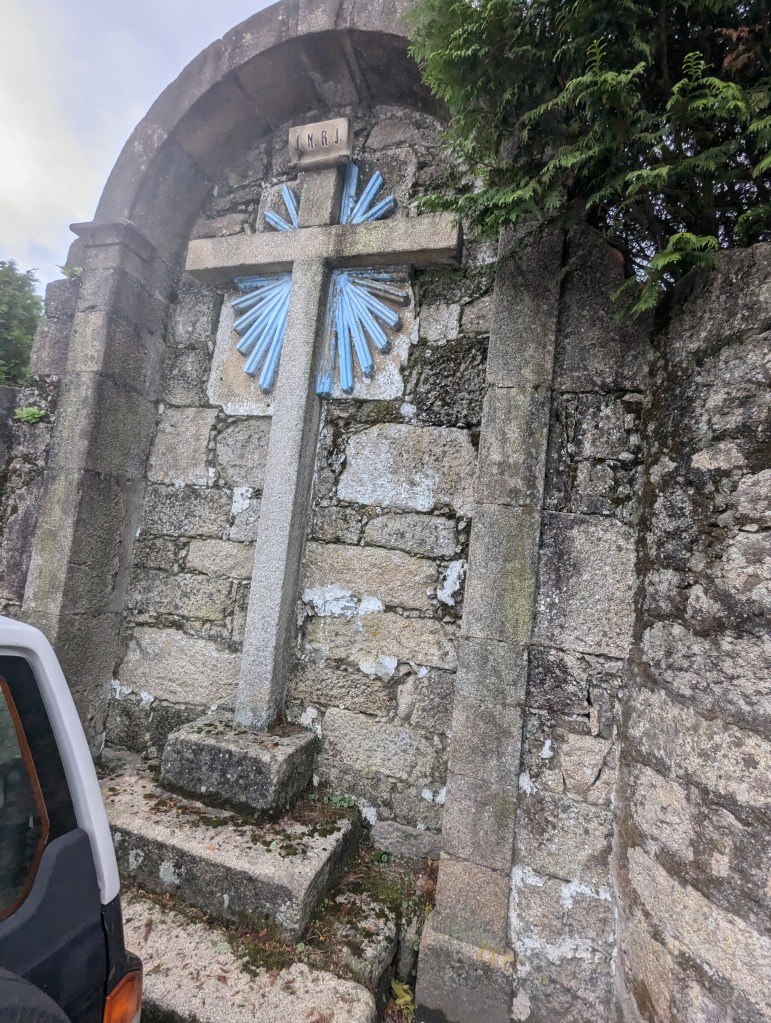
Some utter savage painted the rays on the cross blue, on a cross that is very very old. How old I don’t know, these things aren’t precisely documented.
This cross stood once, before highways crisscrossed the entire village and refashioned it into something utterly alien, at the crossroads that led to the village.
As it’s normal, all sorts of superstitions accrued to it. My dad had this thing going that truly annoyed him. If it was even slightly overcast, when he passed the cross, it would start to rain.
And people left flowers for blessings on their relationships and such.
BUT–
But…. the most common one was the part of “bad things come in three” superstition. It was believed that when death managed to cross below the cross, it took three people.
In my headcanon, and note that I have absolutely no support for this at all, that cross was erected when — something I only found out on the net — the plague killed 90% of the residents. (It was unusually hard hit, probably because of being a large market town, back then. And it was reduced to a village size with one main road.)
In my head, it was put in place, precisely to make it difficult for death to come past it and claim most of the village.
Of course, whoever erected it never counted on highways bypassing the crossroads and providing other avenues into the village.
…. not to mention some BARBARIAN painting the old stone blue.
 According To Hoyt
Sorry Sarah, but I can imagine worse things that Barbarians could do to that cross.
LikeLiked by 2 people
It certainly isn’t Ecce Homo.
LikeLike
Desecrate is what it is called. Other actions may be more obvious, but to do it subtly is the worst.
LikeLike
Alas, you could be happy the cross was not removed by some socialist sot.
But wtf … blue? Gold, or yellow (if not having the money for metalic “gold” paint) I could sorta see.
Blue?
LikeLiked by 1 person
Blue is associated with the Virgin Mary, so perhaps it was tying the cross to the Queen of Heaven.
LikeLike
Usually, Marys’ associative blue is a Lapis Lazuli dark blue, and would not be used as a radiance, at least not through most of the Mediaeval and Renaissance periods.
That said, many of the white or grey stone sculptures of those periods were originally polychromed and / or gilded.
LikeLike
I’d bet you this one wasn’t. For one the stone is VERY ROUGH.
LikeLike
Call me a heretic, but I think it looks kinda pretty, blue and all. Looks like a scrub brush and some soap could take it off though.
LikeLiked by 1 person
Okay, you’re a heretic, and they did’t even do a very good paint job. Maybe the sheltered bits had more gunk so the paint flaked off there, but if you are going to desecrate a cross At least you could commit to some upkeep on your desecration.
As it stands it looks some sort of bureaucratic desecration carried out by civil service employees.
”But this paint isn’t sticking under here.”
“Eh, it’ll be fine. The idiot said paint the rays blue and they’re blue. It’s time for second breakfast anyway, let’s go.”
LikeLike
On that type of stone, getting ALL of it off is a right pain. Ask me how I know…
LikeLike
It is pretty, it’s just not respectful.
LikeLiked by 1 person
That woukd depend on who did it, and their intent. Whoever it was could have had adornment in mind. But neither you nor I know.
LikeLike
Nope, there’s no world where “I am going to go and paint something that doesn’t belong to me, in a manner that is completely out of touch with the one claim I could make on it, of tradition,” is respectful.
LikeLiked by 1 person
Since apparently no one knows who painted it, nor whether such painting was respectful in that person’s world (maybe a traveling preacher?) IMHO none of that applies.
Disrespect lies solely in intent. But I’m not interested in an argument, so I’ll just note that we see this differently.
LikeLike
As it happens, no, disrespect does not rely on “intent.”
In most cases, it comes from ignoring the respect someone is owed.
Such as, don’t paint other people’s stuff.
LikeLike
My main point was that we have no idea who painted it; it may even have been the local priest, or a group of the “other people” whose “stuff” it is (it’s apparently local “community property” from the description). We simply don’t know “who dunnit”. And since we don’t know, accusations that this was inarguably disrespect are at best premature.
LikeLike
We do know that it was built at a crossroads, so it may have been part of the “commons”…. which is a cliche of a problem.
That usually means that no one person or organization (the town, province, kingdom, their equivalents in the Church?) owned it.
The only other fact we have is that someone painted it. Divining “intent” would require magic, and not the Light kind.
LikeLiked by 2 people
Pretty much my point. If it was “common property” and 51% of the local population decided to paint it in order to emphasize its attraction, would that still be “disrespectful”, especially if the other 49% was OK with it but didn’t participate? Who would be being “disrespected”? If, as a religious symbol, the local Church authorities were responsible for it and decided to embellish it, would that be “disrespectful”? To whom? As I noted, we don’t know any of the facts except that someone(s) painted it and apparently did a not-very-good job.
FWIW, I don’t think it improves it; some symbols should be left alone. But that’s simply my opinion, and as a non-owner and non-resident my opinion is irrelevant.
LikeLike
I disagree but before you turn loose the Inquisition on this Heretic, I suggest that this is an agree to disagree situation. 😊
LikeLike
No one expects the Portuguese Inquisition!
LikeLike
You can “agree to disagree” that graffiti suddenly becomes something other than disrespect of the rights of others because it’s done to a religious image all you like. I feel no need to join you.
LikeLike
I’m trying to avoid a nasty fight as it’s not as bad as “crucifix in urine” or “Virgin Mary done in elephant dung”.
But if you want a “nasty fight”, you can have it without me.
LikeLike
Generally, if trying to “avoid a nasty fight,” one should avoid taking one’s shot before announcing the cease-fire demands.
LikeLiked by 1 person
IMO I haven’t been nasty… yet.
Do you want me to get nasty?
LikeLike
Drak, I do not care if you think you’ve been “nasty” or not.
It has zero to do with painting over other folks’ property, which is a public religious symbol, in a manner that is completely divorced from that tradition, and doing a cruddy job of it, being disrespectful.
LikeLike
This is my last comment on this Subject.
Goodbye.
LikeLike
Okay, answering here because it’s being weird. NO it wasn’t the local priest (the poor man doesn’t really have time to go around painting things.) SECOND it’s something so old no one knows when it was erected. painting it is an encroachment and as Foxfier puts it disrespect.” It’s taking liberties. It’s …. How would anyone like it if someone went out and painted The Thinker?
LikeLiked by 1 person
Made the Statue of Liberty “pretty.”
Wrote slogans on the Vietnam memorial.
Painted the faces of the folks on the Korean War memorial, so those quite real men were “prettier” in bronze.
LikeLiked by 1 person
My thought was, a believer wanted to emphasize the power of Jesus Christ, as represented by that cross.
Some mushhead kid perhaps, or smug old gheezer. But a believer, not some rando thug.
LikeLiked by 1 person
Right. I saw Sarah’s line about “Some utter savage painted the rays on the cross …” before I noticed the picture, so I was mentally prepared to see vandalism. Instead, what I saw was an attempt to beautify the carving. An attempt that made some odd color choices (yellow or gold would be far more traditional), but still a respectful attempt at beautifying it.
LikeLike
I’m inclined to think that thugs intent on mischief wouldn’t have carefully painted what they had done to that cross. The paint may have been misguided, but the intent seems to be to prettify the cross rather than to destroy it.
Someone suggested that the vandals should have had the decency to maintain the paint, but I can easily think of reasons why that didn’t happen — up to and including moving away or dying.
LikeLike
Might it have been painted originally, hundreds of years ago? I know traces of bright colored paint have been found on all sorts of things we once thought were always just dull gray or brown.
LikeLiked by 1 person
This is what I was going to say. It’s likely that the cross or even the whole monument was painted back when it was first made. Probably no way we could actually know at this late date, but it’s very possible.
There are sheltered corners of the Parthenon where small traces of paint have survived for 2300+ years, and enough of it has been discovered to verify that the whole thing used to be painted in bold colors. The seemingly pristine marble we’re used to is the result of a thousand-year period in which people went from not maintaining the paint job to eventually forgetting that it had ever been painted at all. (I did a big research paper on the Parthenon a long time ago; if you ever want me to talk your ear off, just point the conversation in the direction of the Athenian Acropolis.)
LikeLike
I’ve been meaning to make myself a button that says “I’m a man of few words … unless a pet topic comes up, then I can’t shut up!” and then put a list of particular topics on the edge around the button.
LikeLike
Make it a t-shirt
LikeLike
True. A lot of statuary has been found to have traces of pigment on them indicating that those beautiful with statues may have actually been painted after carving (hard and rather futile to paint them before carving.)
LikeLike
Yeah, I’ve heard the same.
Which is just pure crazy talk these days, since people have been leaving the statuary unpainted since forever. And it’s not as if there was a period of a thousand years when they stopped producing statuary. So one day someone must have said, “Let’s stop painting statues,” and it caught on everywhere in Europe.
LikeLike
And yet people are always touching up their garden gnomes, their washtub Mary statutes, at those little girl concrete statues that resemble Shirley Temple.
LikeLike
Just be careful which garden gnomes you paint. Some of ’em will shank ya… :-P
LikeLike
The Tannerite clan has that temper issue….
LikeLike
Cousin of mine always makes an appropriate sacrifice at the Shirley Temple.
LikeLike
Shirley you jest!
LikeLiked by 1 person
He’s dead serious. And don’t call him Shirley.
LikeLike
Alright, there’s got to be a can of sardine-sized carp down one of these supermarket aisles.
LikeLiked by 1 person
I don’t know if the group still does it, but someone at Pennsic used to put up a shrine to Mrs. Butterworth.
I can’t say too much, since when we camped with the barony (my beloved being the Baron and all) one of our guys put on work jeans and shirt, boots and a hard hat, added a clipboard and went to our neighbors saying, “OSHA inspection.” He had some of them really worried.
LikeLiked by 1 person
Nice! All-Hallows costume idea!
LikeLike
When they dug up classical-era sculptures any paint had worn off, so clearly the Greeks and Romans made’em that way, and thus the Renaissance folks did it that way too.
The traces of pigment research is pretty modern.
LikeLiked by 1 person
They painted some statues. Not all. We know because poets use the whiteness of marble statues as a metaphor frequently.
LikeLiked by 1 person
Not a clear recollection, but I seem to recall reading somewhere the painting was more of a Greek thing, which carried over to painting the temples and such, though they find paint residue on Roman statues too. Almost certainly everything the Egyptians made was painted.
I think it probably went in waves of fashion, where the next generation could not abide that the last had painted/not painted their statuary, and made the house staff fix it.
”Look, I’ve served this house since I was bought in as a little lad, and this is just what happens when there’s a new mistress. That statue of the goddess in the entry has had more paint applied and stripped off than the doxies down at the high end brothel on Via Polonius.”
LikeLiked by 1 person
…I just flashed on Up Pompeii.
LikeLiked by 1 person
It’s my understanding that this is a side effect of the Renaissance — when they started finding Greek statues, deciding that these were the pinnacle of beauty (with a touch of “pinnacle of civilization” thrown in), noticing they weren’t painted, and thus emulating what they thought was the tradition.
Something similar happened to Greek plays: they decided that the plays weren’t spoken, but sung instead, and thus they wrote operas to emulate them!
LikeLiked by 1 person
Without knowing what was intended, I won’t think it was an act of desecration. If it was, that falls into God’s territory.
LikeLiked by 1 person
Karma is indeed a bitch.
LikeLike
People just loves them some colors in symbolism, and Divine Rays coming from the Heart is no exception. I think blue or pale blue tint is supposed to represent water/righteousness[?] and red blood. But I’ve seen blue rays with a yellow background, golden rays, silver rays. And so on.
LikeLike
[note, somewhere in my not so distant past of 5 generations ago some forebears were a significant part of the RPCNA – Reformed Presbyterian Church of North America – who refused to vote in Federal Elections as the country refused to accept Christ as their King, or something like that. I claim no specific Christian sect/religion, but since the other half of my kin were Baptists, I tread lightly on any specific theological considerations.]
LikeLike
And some of my best friends are lapsed Catholics.
LikeLiked by 1 person
I’m a limping Catholic, not lapsed. ;-)
LikeLiked by 1 person
How about recovering Catholics defected to (Global) Methodism?
LikeLike
That shade of blue (or what looks like that shade of blue) is used to ward off ill-fortune and unclean spirits in New Mexico and a few other places. But I agree that it doesn’t work, either theologically or artistically, on that particular cross.
LikeLiked by 2 people
C4C (apparently WordPress has decided the Reader should no longer get comments automatically)
LikeLike
c4c
LikeLike
What do the letters at the top stand for?
LikeLike
Swapping I ofvthe Latin for J of English/others
Iesus Nazarenus Rex Iedeorum
INRI
The words Pontius Pilate ordered placed on the cross: Jesus of Nazareth, King of the Jews
LikeLiked by 1 person
Somewhere I read the Protestant folk interpretation as “Iron Nails Ran In.”
I’ll quote it before someone else does: “Iron, cold iron, shall be master of them all.”
LikeLike
Mr Stoddard as a lifetime Christian wandering among several Protestant faiths (Congregationalist, Episcopalian, Baptist, Presbyterian, and non-denominational evangelical) I have never heard that. The explanation was always that these letters represented the Latin for “Jesus of Nazareth king of the Jews” as was requested tobe posted by .
Whether INRI was there or possibly ΙΝΒΕ ( The Koine Greek which replaces Rex with Βασιλιάς and Judaeorum with Εβραίων) or even something in Aramaic (the point being for the viewers to understand it and Latin being less commonly spoken/read in the region) can be argued but I think not proven in any meaningful fashion.
That said there is a tendency in the Protestant faiths (ESPECIALLY older line of the Congregationalists and purists of the Presbyterian and Baptist denominations) to eschew ANY adornment of the cross, it tends to be the basic cross with perhaps some simple gold leaf or gold paint. The crucifix is rarely seen (except in the more Anglo Catholic side of the Episcopalian/Church of England) mostly in a misguided effort to avoid even the appearance of worshiping a graven idol. Similarly, churches reworked in the 20’s and 30’s will often have plain glass to avoid what was seen as excessive adornment. These styles do come and go, for example, there was a large Congregational church in New London CT built in the late 19th century that had gorgeous stone work and stunning stained glass. Alas that church collapsed recently (January this year?) after many years of needing major restoration.
LikeLiked by 1 person
”Sarge, all of that won’t fit, not big enough to see when it’s up there! And we have that schedule to keep, we gotta do these three guys, then six more tomorrow. Just this sign will take a week!”
”No, just put the first letters of each word. It’s something I invented – I call it an Acronym. It’ll be a big deal someday, you just watch. Now get it done, legionary!”
Actually it was pretty common practice for inscriptions to get shortened, especially in stone, to reduce the carving. This was likely just painted, but the same principle applies.
LikeLiked by 1 person
It was also common in writing in 1st century Koine (and later and likely in Latin too). Parchment and papyrus are expensive so certain recurring phrases got shortened especially in Koine texts from the early period and these were copied by the scribes. These were called nomina sacra (singular nominum sacrum, details here https://en.wikipedia.org/wiki/Nomina_sacra).
LikeLiked by 1 person
Satisfied, Optio Brutus wandered off to find other Legionaries to guide.
”Plutus, he didn’t invent anything – look, right here: ‘SPQR’. Right on our uniforms.”
”Shut up, Gaius! He might hear you! And then instead of painting four letters on a sign here in the shade we’ll be out on the parade ground in this heat with weighted armor and Scutum to correct our disrespectful attitudes.”
LikeLike
Generally, the correct response is, “If it’s not yours, don’t touch it without asking.” Since the person who did it has not come forward, and nobody else has said they asked somebody to paint it, is all you really need to know as to whether the painting was done respectfully or not.
Even if the person who did it *meant* it to be respectful by accenting a part of the object, if it’s not yours, messing with it shows an inherent lack of respect for the property of others. And yes, even if it is community property, that does not make it yours to do with as you wish.
LikeLiked by 1 person