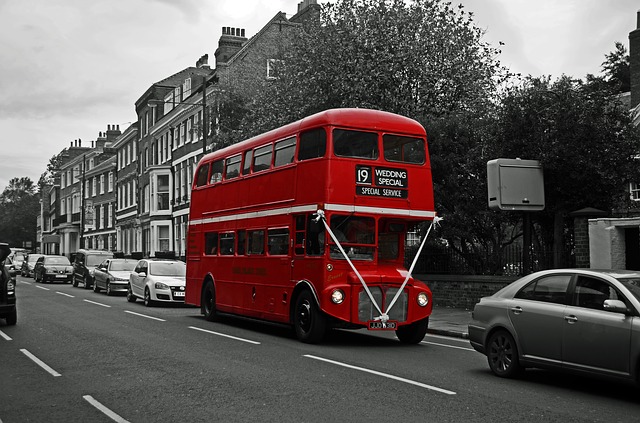
I doubt it will surprise any of my readers that I was a fairly…. unusual — let’s go with unusual — child. Not only was one of my favorite pastimes during recess from middle-school on balancing on the edge of a flower bed, but when I started going to middle school, which was out of the village, I had to take a combination of buses that looked like the one above and legacy “trolley cars” that looked like this (without the advertisement. They were a chaste yellow):
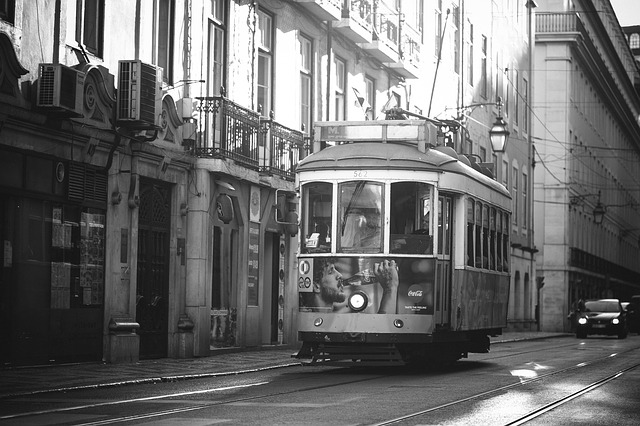
Now often both of them were filled to the gills (usually if it was raining) and it will tell you something that mom saw it fit to tell me that I should not under any circumstances grab on and hold to the back, like the street boys did, because it was dangerous.
When the bus was full, the biggest danger was pervs performing frottage, which is why grandma gave me the world’s largest hat pin and told me where to stick it if some guy was rubbing against me. It wasn’t an if, but a when and (once I went to high school downtown where the buses, and sometimes the trains were packed at the hours I used them) about once a month I made some perv scream like a little girl. (And in the bus the conductor would stop the bus, come out back and punch him out of the bus. Note far from being traumatized by this, I’m still very cheered at the conductors’ decisive actions.)
But not that particular route and on the morning schedule (Portuguese schools have morning and afternoon schedules, no lunch period and no homeroom/study hall.) Mostly they were completely empty.
And yet, most of the time, instead of sitting, I stood in the isle and balanced. I tried to do it without holding on to the seats on either side. And it was harder than it sounds, since Portuguese traffic is slightly less (yes, I know what I typed!) sane than Italian traffic, so sudden stops and take offs at speed were completely normal.
Why did I pride myself on being able to keep my feet? I don’t know. Maybe because I was just starting to grow out of a prolonged period of clumsiness.
Or maybe because I couldn’t read — or I’d go past my stop. No, trust me on this — and I got very bored.
Anyway, I got pretty good at it. One of the drivers was our neighbor and a family friend, and sometimes I’d catch him looking at me in the rear view mirror and grinning. (Since I babysat/half raised his kid, who was the same type of kid I was (so much so it’s hard to believe he’s not a blood relation) I assume there was a pretty good chance the neighbor had been that kind of kid as well, and knew what I was doing.)
This image came to mind when I was thinking of what to write.
It’s something like this: we were, before this branch covidian nonsense came about already in a period of crazy rate of change. I know that publishing was not only upside down, sideways and tilt-a-whirl, but changed every two or three years, so that some of the things that made you insanely high earning, suddenly, over night became a liability.
I want to write, not to follow statistics and charts, so you know, mostly I try to keep an eye out on what other people say is working, and if my indie income falls through the floor, I go investigate by asking my more connected friends.
BUT the point is that things were already changing at a crazy clip.
The problem with that is that when things change very fast humans get froggy. Don’t believe me? Go look at time lines of technological change actually affecting the daily life of most people and track it with periods of great disruption: wars, revolutions, etc. (The etc normally being “stupid sh*t governments do.”)
Look, I’m a fan of innovation and change. It’s highly doubtful I’d have survived my first year if we were still hunter-gatherers. But our back brain is at odds with our curious-ape ability to transform the environment around us.
Our back brain mostly wants tomorrow to be exactly like today, only slightly better, but not enough better that we can’t keep our footing and don’t know where tomorrow’s meals are going to come from: even if they’re better and delivered right to the door.
Humans, being great apes are incredibly status conscious too. So, you know, we really need to know that this thing we trained really hard for is still going to give us status. We need to know what we learned in our 20 years in x field will have some value.
Unfortunately in the early twenty first century we were already all at risk of the fate of the lamp lighters, the buggy whip makers, etc.
Because, see? when I went through school, learning to touch type was guaranteed money forever. I don’t think this is true any longer.
I know, in the fields I work in or have friends in that things were completely different. And also that people take really long to catch on — hence people still longing for traditional publication. Trust me, not worth it — so that they don’t fully realize what’s going on, certainly not what’s going on in other fields.
I know translation has gone a long way towards being automated. I know that my friend who manages retail says that she expects what she does will go away, anyway, in 10 years.
And I have in the past predicted that …. well, most of the fields taken over by the left were on the way out. This was only partly because of innovation, mind.
I mean, look, humans also resist change, with both feet and possibly by tying themselves to the masts of their ships and stuffing their ears with wax.
So, would books have gone to ebook format if it weren’t for the fact that paper books had fallen victim to a double blow of the publishing houses being taken over by glitterati preaching Marx and bookstores falling victim to “efficiency schemes” (“the computer says we should order to the net”)?
I don’t know.
Sure ebooks are a much more efficient and cost effective way to distribute story. But I expect it would have taken decades to get even halfway accepted, because people are creatures of habit. Only because the offerings were so thoroughly unpalatable in paper, it pushed the move to ebooks.
So, I was predicting a lot of problems with the industries that, like mine, had forgotten they were supposed to cater to their customers.
However, then the covidiocy hit. And it nudged a lot of other changes for which the tech existed, but which, in fact, had still been making their buggy whips and might be making them in perpetuity… if not for the left’s attempt to drag us back to the 1930s.
For instance, the tech has been there for my husband to work from home since the mid 90s. In fact, he’s done so since the mid-nineties on occasion, like when he was sick, or there was too much snow on the ground.
But the expectation, up to last year was that he would still need to go in to the office at least three days a week. And sometimes every day. Because that’s what people did.
Until — they didn’t. Until most people with desk jobs realized they could in fact work from home. Oh, and they could teach their kids at home and do a better job than the schools (which arguably is damning with faint praise.)
As the post from Chef K showed yesterday, this has set a second order wave of disruption.
You see, the left doesn’t get second (or third) order effects at all. They’re playing a game they played at other times, with other measures. The homeless invasion of our great cities, the crazed lockdowns, all of this is to make what they believe is great real-estate available for their buddies.
I shouldn’t laugh. Because in publishing the disruption is well in motion, covidiocy is the coup the grace and yet publishers and distributors are dancing the pavane on the beach as the impending tsunami has drawn the waters way back.
So how could they possibly foresee what they’ve done to the cities by applying the butt-kick of covidiocy to society and causing us to actually use remote-work technology.
The funny thing is some of them must get it. Because I’ve started seeing articles here and there stompy foot stompy foot insisting that by gum the cities are too coming back and that only about 2% of workers can work remotely. If they said 20% it would have a little more credibility, certainly, but it’s the 2% and the hysterical tone of the articles that make me giggle, because they are so much like the stuff I was reading even 10 years ago, the whistling past the graveyard articles of traditional publishing screaming “just wait, they’ll come back crawling.”
As I said, 20% is probably closer to the mark for “can work anywhere” — though it might be higher as I’m hearing of people working remotely in professions I wouldn’t think would be ready for it — but there are the “support professions” that will follow those, all the faster since the left has taken 2020 and 2021 to destroy everything that made it worthwhile to live in a big city.
Sure, okay, retail workers can’t work in small cities the same as in large, but only yesterday I found a new company doing grocery delivery — just delivery — even to very small towns (where the nearest grocery store might be half an hour away.) And I’m sure there are other such things starting up.
Point is, except for manufacturing (and particularly with the crazy stuff this administration is imposing on all employers, from minimum wage to unionization to who knows what? that is increasingly more automated factories with very few workers. And can be located — as we discussed here the other day — anywhere train lines reach…. which is far outside big cities. (Where it’s often impossible to build these days)) the hands on professions were in the cities because that’s where people had to be to do all the jobs.
I think that’s coming to an end. And no, I don’t have any idea what things like restaurants will look like. I’m going to guess if they have to serve five or six small towns, instead of a concentrated population, we’re going to see a lot more of “prepared food delivery” probably refrigerated to re-heat at home. (And yes, I do know that all the chefs just screamed. And yet, these things tend to follow necessity.)
Universities I expect to be distributed, with perhaps concentrated teaching “workshops” for things that must be hands on.
The museums, the symphonies, all of those might very well remain in cities, or at least in cities that successfully transition to “touristic destinations” which won’t be all of them. The mayors killing their cities and betting they will return are engaged in a fool’s game.
When they say “normal” isn’t coming back, they are right. But the future that’s taking shape is not what they think it is. They think the future will be with them in control of our every breath, of everyone’s movements and what everyone is allowed to do.
The state they aspire to is that of Louis XIV, standing for his portrait and declaring “L’etat c’est moi.”
But that was the nascent state of the industrial age (not yet in full bloom, and its full hit would consume Louis’ descendant.) the machine, and the gear, and everything in its place.
This is not where we live now. We are entering a distributed age, where civilization is where we are and where you can work in a city thousands of miles away from your home.
Oh, and those who think that will be a global state are ignorant innocents who don’t understand the importance of culture and shared law. If the covidiocy didn’t teach them these lessons, nothing will.
But even in China, the clockwork state is in trouble. In fact, their latest exploits are a sign that they are in trouble and fighting to keep the mandate of heaven.
As for our own idiots… I’m interested in how their every spasm, their every attempt to stay mounted makes is more and more certain they will fall. And the longer they hold on, the harder the fall will be.
They don’t even understand the forces they’ve unleashed.
To be fair, I’m pretty good at divining the near future, and even I don’t see clearly what this future will look like, except for distributed, more individual, and in some ways smaller (but probably not poorer, once we’re past the socialist death spasms.)
But ah, the socialist death spasms lie ahead. We didn’t pay for the socialist folly in the nineties, and we should have. There should have been trials and executions, and there weren’t. And now–
I’m still praying the butcher’s bill passes us by. But I’m not expecting it.
Mind you, like everything else, the unrest and the violence will be localized, both in time and space, while around it life will go on.
But even past that turbulence, things will change very fast. Once that little trolley car is careening down a street with a 45 degree incline, it just gathers speed.
So, what can you do? How can you ensure you continue to survive, maybe even thrive in this insanity?
Ah, well, I can give you some lessons from my riding the buses, standing and without holding on to anything:
Stay alert. Look ahead. You don’t have to look very far ahead, just enough to see if the car ahead is braking. Or in this case, take a deep breath, and look month by month, sometimes week by week, to see what’s changing, and what might cause a drastic change in your life, your profession, your family. Month by month, week by week, even day by day.
Stay flexible: keep your knees loose, and be ready to keep your knees flexible for that sudden stop or start. Or, in this case: stay flexible in skills and how you use those skills. Think of other ways you could do your job, other ways you could sell your products, other things you can do to get by. Day by day.
And, because the government is a great big perv, in this case one that got onboard without paying his ticket, and at any minute is going to come up behind you and take liberties, keep that big hat pin handy. And make sure you know where to stick it. Hopefully you won’t need it, but better be prepared.
And just in case, make sure you have a few friendly drivers handy to remove the nuisance from your immediate vicinity, or at least stop it pleasuring itself at your expense. That is, make sure you have networks, and people who will come to your aid in a sticky situation. Or before the situation becomes sticky.
It’s only going to get crazier. But you can stand.
Be not afraid.
Keep your balance.






















 According To Hoyt