Life In Insane Color

You know the old saw about the man with one eye in the land of the blind and being king.

They were wrong.  The man with one eye in the land of the blind is shouted down and accused of making up this “vision” thing.

Which is why many of us feel a little — ah — Odd about the world we live in.  Look, Zero edge thinks we live in a stupid country.  It’s a fair cop, but misguided.  After perusing things like this:

1. If you can get arrested for hunting or fishing without a license, but not for being in the country illegally, you live in a country run by idiots.

2. If you have to get your parents’ permission to go on a field trip or take an aspirin in school, but not to get an abortion, you live in a country run by idiots.

3. If you have to show identification to board an airplane, cash a check, buy liquor or check out a library book, but not to vote on who runs the government, you live in a country run by idiots.

You could be excused for thinking so, but in fact it’s far, far worse than that.  The truth is that we live in a world run by CRAZY people.

And yes, Zero edge has a little of bit of the infection itself. I used to think they were completely inane.  Now I think they’re insane about half the time.  The other half they’re… telling the truth about the bind we’re in, which is binding indeed. (Their comments are the nuttiest collection of conspiracy theorists, so read them only if you’re short on nuts in your diet.)

The half that they’re insane about is the bit where they kind of sorta of believe in the whole Marxist class warfare.  Not that the crony-capitalist top of the pile isn’t revolting, but just because a pile of slugs is revolting, it doesn’t mean it’s causing the problems in the world. Not even close to all the problems in the world.

Fortunately we live int he US where speech is free — at least if you can buy political speech insurance.

If you’re about on the verge of tears, calm down.  There is a reason — if not a method — for all this madness.

I was talking to my friend Bill Reader yesterday and I posited that in fact what we’re seeing is the convulsions on the way to ah — and here I’ll drive the commenters at zero edge insane — a new world order.

And before all you sane (?) people edge towards the exits, I’m not going to start raving about the trilateral commission and chemtrails.  I’m simply going to note that the industrial revolution lead to a world of larger and larger political units.  (And in the states, to the consolidation of Federal power.)

I’m not going to start an argument with anyone — again — over what is needed for large scale manufacturing and the changes likely to come or not. Though I’m going to guess the changes in a hundred years are likely to surprise all of us.  Mostly because we won’t be different human species, but never mind that.

But I’m going to point out that even as the industrial revolution happened farming stayed the principal occupation of everyone for a long, long time.  We’re now at the beginning of another revolution, kind of where we were 300 years ago.  Large scale manufacturing is ceding primacy to for lack of a better word “individual industry.”

This is going to create a lot of bump and grind, and not in a good way. For one countries are different places along that road.  For another, those wedded to a Marxist narrative hate the new direction like poison, which is how we get the actual idiot in the guardian who said that self-publishing was retrogade. But in the end, we should end up somewhere with smaller units of government and perhaps at least in some of them a bit more freedom. BTW my friend Bill brought up the “copycat effect of history.” And I told him I expect Catalonia and the Basques and perhaps at the end of it even the North of Portugal joining in.  We’ve tried the massive units that give no representation to the individual and attract all the power hungry sharks.  Let’s go the other way now. So while they’re not on the same page, I found this article from zero edge interesting.

They don’t know if they’re coming or going.  No wonder they obsess about stuff like this. Because, yeah, this whole “we need more upper class females everywhere, from gaming to writing” is the most important thing ever.  Gynocracy forever.

Because reality be d*mned, people are widgets and should be treated as such. Looking at tech, they’re in for a lot more trouble than we are.

Be of good cheer.  We’re not likely to see the end of this transition period, which means we’re stuck living in interesting times.  BUT at least we see with eyes unclouded by Marx. And we know at the end of this we win they lose.

And there are surprising signs of sanity.  Though of course, for my money, you’d dump the politicians straight into the shark infested waters and skip the “survival” part.

And that’s Friday.  On personal news, I realized — and this sounds entirely stupid a thing not to have realized before — that the problem this, oh, year and a half, is that my imagination had shut down.  I was running on craft, fumes and cannibalizing some of my own old ideas. This worked for shorts but not for novels.

I realized it because the imagination is back and things are flowing.  Why?

I don’t know.  Could be a number of factors ranging from the likely (fixed vacuum which has been off for 3 years, and breathing is WAY better.  Also, hormonal stuff seems to be settling down.) To the nuts and unlikely but maybe possible (I’ve been taking vitamin b-12.  I have no idea why that would help, but hey, it’s not cocaine, so, on the off chance, I’ll keep taking it.) I will not do chapters this weekend, as I THINK I really can finish Through Fire.  (Please, no crazy stuff, for one weekend?)

But there will be other posts here, so stay tuned.

And now I’m going to clean cat boxes because culture, history and politics is all a distraction.  The highest purpose of human is to cater to cat.



Tonight I’m Mewed Up To my Heaviness

It was a clear and bright morning

It was a crystal clear morning in the Rocky Mountains.  The air was still warm enough, but had that crisp feel that foretells coming snow storms.  I was thirty seven years old.  The boys were ten and six.  I walked them to school through the bright, cool morning.  Dan had left for the week the day before (he had a traveling job.  I called them the Marines of Programming.  When someone had an insoluble problem, they were called in to solve it.  That week he was in DC.) I was late according to my own schedule (not the publisher’s) on Any Man So Daring.  I walked the kids to school, waited till the little one went in.  I was re-reading Pol Anderson’s Operation Chaos in a beat up paperback I carried in the pocket of my jeans.  So I waited till the younger one went in, reading my book. Then I walked back home enjoying the morning — that beautiful September morning, with only a touch of future frost.

I’d got on the net — our TV reception was awful — and read yahoo news (I think.  I hadn’t found instapundit, yet) and read that  a plane had struck the tower.  I thought it was a small plane and a stupid accident.  I felt vaguely sorry, but…

I stopped in the kitchen to make coffee.  And the phone rang.  This wasn’t alarming.  My friend Rebecca Lickiss was also a stay at home mom/writer, and in those days when the internet was still dial up, we often called each other in the morning to discuss a plot point, or tell the other about this cool idea we’d had.

But when I answered the phone, Becky was crying.  She said “Turn on the TV!”  I said “I can’t get anything on the TV.  What is it?”  And she said “A plane has struck the towers.”  I said “Oh, that?” She said “TURN ON THE TV.”

So I did and watched through the fuzzy reception.

And we entered the wrong leg of the trousers of time.

First let me say, it could have been worse.  How?  Oh, it could have been worse in many ways, but the most notably worse for the country would have been if this had been domestic terrorism.  If you don’t know what I’m talking about, you don’t remember those days.  In the aftermath of the 2000 election, the “progressives” who had been counting on Gore as a sure thing were so… unhinged (I thought) that I thought at first it had been a left-plot, some sort of attack.  I was almost relieved when I heard it was an Arab hit.

I’ve told the story before.  I didn’t know if Dan was dead or alive for hours, because this was a new job and I didn’t know where he was (nowhere near the pentagon, but in DC, it turned out.) My friend Charles came over because he worked in what passes for a tall building around here, and they sent him home.

Was I scared?  I was scared.  Not of the terrorists, though.  This week’s trifecta discusses that.  My reaction to the terrorists was defiance.  I tried to paint a banner.  It didn’t work.  It was supposed to say:

No refuge could save the hireling and slave From the terror of flight, or the gloom of the grave. 

But I had to paint it on plastic (it was all I had on hand) and it wasn’t really legible.  I got my twin towers t-shirt acquired in our second honeymoon the year before, and wore it.

But I was scared.  Not of the terrorists.

Listening to Osama talk about how we were filled with fear just made me want to punch him in his dumb face.

But those among us who were scared and would rather do anything rather than admit they were scared.  Those, always too inclined to hate their own countrymen and to think themselves superior to all of humanity by the force of their disdain — them I was afraid of.

And I was right.  Just like when they were afraid of communism and therefore would justify anything communists did to the point of acting as a fifth column in our midst, they became apologists for the enemy, blamers of their brethren.  They’ve spent the last thirteen years bleating that it’s all our fault, because that’s an easier pill to swallow than the idea they were wrong.

I was wrong back then too, btw.  On that beautiful September day, I was an internationalist Libertarian, well-nigh an anarchist.  When the towers fell my wishful thinking fell with them, my blind certainty that other people were just as much in love with peace as we were, and that they wouldn’t attack us for no reason (or simply because our very existence puts the lie to their cherished beliefs.)

Am I better for it?  Ah!

I’m more grown up for it.  I think my understanding of the world is better.  It’s also darker.

My youth fell to the ground on that September day.  My utopian folly jumped with those poor people with no other way out of the towers. My ridiculous — but pleasant — assurance that I knew what was best for everyone else is gone.

And I’ve watched my country turn on itself.  I watched the dreadful fruit of the Soviet union propaganda and of the counterculture of the sixties blossom into where we are now: our allies betrayed, the blood of our compatriots wasted, threatened on all sides.

I’ve watched 9/11/12 be swept under the rug like someone who is slapped while he’s tied down and can’t respond.

Am I afraid?

Ah!

No, I am not afraid.  I am sad.

I feel like we fell down the wrong leg of the pants of time and I’d give everything I have and something besides to go back to that crisp September morning, to come home, to make coffee, go up to my office and pound out five thousand words on Any Man So Daring, to wait for Dan’s call that night, and talk about the cats and the kids’ homework.  To never get that phone call that says “turn on the TV” because there would have been nothing special happening.  I’d give everything I have to unring that bell.

In that other world — in the other leg of the pants of time — none of those  people died.  The towers stand as they did when I first flew into New York as a newly arrived immigrant.  And I’m probably still a political idiot, but a political idiot who laughs more often and who has some really delightful illusions.

We can’t get there.  Even if parallel worlds exist, that is not our world.  Here in the present, I’m older and sadder and I feel betrayed by the administration and those who enable it.

Here in the real world there’s a lot of work to do.  Those of our own who turned on us after 9/11 might or might not wake up.  And those who took the opportunity of the crisis to plunge a dagger in our back in the name of their own utopian dreams won’t stop.

The best we can do is work against the forces of destruction.  Build up.  Build around.  Build through.  Be ready when they collapse.


Here, in this pantleg of time, we have a heck of a job ahead of us.

But not tonight.  Tonight I say a prayer for all those Americans who are gone — in the towers and in the battlefields.

On the twelfth we resume the fight.  On the day after tomorrow we resume working, with clear eyes towards the best world that can be obtained from where we are.  Not the shiny world of my fantasies, but perhaps a better one that works for real humans.

But tonight?  Tonight and tomorrow I cry for the lost.

And for just a moment — the briefest of moments — I imagine I can reach back and be in that world, in that unclouded September morning, with the towers gleaming bright in the sunlight and all our troubles so far away and yet with the frost already in the air.

On 9/12 I will resume work towards the world I want to leave my children.

And the star-spangled banner in triumph shall wave
O’er the land of the free and the home of the brave!

Modeling Clay

When I was in college, one of my best friends made a middle-class salary from part time modeling. I tried out for it, but I was turned down, because I was a little short. Mind you, this was Portugal in the eighties, and I was five seven and a size seven, which means in every group of women I was usually the tallest by a head. Except when I was with this particular friend, who was half Italian (from the German border) and who was six feet tall and blond.

The person that they wanted on the runway, selling clothes to Portuguese women had in fact nothing to do with Portuguese women.

In fact, considering that some of the models modeling men’s clothes are women, (and very oddly vice-versa) I’d guess that most of the models on runways today have nothing to do with men.

Of course being rejected for the job, immediately made me feel worthless and ugly and totally destroyed my life.  Also, another thing that destroyed my life, and the reason I’m living in a cardboard box under a bridge is the fact that I looked at that runway and saw no one that looked like me.

So I knew I’d never amount to anything, right?

Which brings us to models of another kind. Role models.

I’m not going to look for it, but last week an article from the Telegraph caught my eye. It was about how Britain now has some sort of minister/secretary/whatever for science. And she’s a woman. This will immediately (implied, to great rejoicing) increase the numbers of women/girls/female creatures in all branches of science.

I don’t know what to say. Except maybe W(inning) T(he) F(uture) people?

What is this obsession with role models and with someone you can identify with in all walks of life and in literature too?

And no, btw, I don’t think that having a woman in charge of science something or other will result in hordes of people of vaginitude storming the halls of science. Seriously – how would that work?

Kid, playing with dolls on carpet. Looks up. Sees adult woman giving boring speech. Sees that she’s minister/secretary for science something or other. Puts doll down. “Mom, you must give me a test tube set, for I now know that because bureaucrats do science stuff, and one of them is a woman, I too can do bureaucratic science stuff! Forget the test tube, buy me a rubber stamp.”

We’re assaulted with this type of strange magical thinking at all levels.

Girls need role models.  Minorities need role models.  People don’t read because there’s no one like them in the books. If I look around an organization and everyone there is blond and tall, they’re putting me down, because I’m not, and now I know I’ll never be successful.

Because totally what counts is if people match me on the outside.  Well, it is what is important if I want to borrow their clothes a lot.  For other things… not so much?

In school they used to tell us we needed more women teachers so girls would have role models. Now, of course, no one says anything about the dearth of male teachers.

In the same way, we’ve been told ad nauseum that we needed more women heroes in books, so that girls could aspire to being heroic. No one is saying anything about the complete dearth of male anything in books these days. Instead they say “boys don’t read.”

So, let’s talk about reading and role models in books.

When I was little I was very aware of male and female stories. Male stories (often swiped from my brother) were about adventures and exploration, about killing the bad guys or at least hurting them very badly. They were fun. Female stories were about friends and feelings and oh, my heavens, clothes. I could enjoy those too, in a certain frame of mind. Not all of them. I never got the thing with the bullfighters and mourning them forever.

However, I really liked, oh, Tom Sawyer (a boy book); The Prince and the Pauper (an in between book); Tarzan (boy books); The Countess of Segur (Girl books, and btw, dealing with surprisingly modern themes for fairytales, including spouse abuse); The Adventures of Captain Morgan (boy books); The Little Princess (Girl book.)

That last one, btw, could have been a boy book too, but my brother hated it with a burning passion. I think it was because it’s your classical Cinderella story and there’s a lot about how she was mistreated and then rescued from it all because she was deserving. I loved it for the adventure and the stealth involved in bringing the happy ending about.

What I’m trying to say is this – in my head at a very young age, I classified books as “boy” or “girl,” but it rarely had anything to do with the sex of the protagonist. What it had to do with was with the feel of the book and the virtues it relied on.

I don’t remember once – not once – thinking I needed a role model in a book, or thinking (even) that there must be someone like me in the book for me to enjoy it. Heck, Captain Morgan hated a lot of things, but he hated Portuguese most of all. He set fire to their ships and put them to the sword. Reading the books (mind you, by then I was 12) I thought “okay, it makes a certain sense since he’s a dedicated anti-slaver and at that time Portuguese ran slave ships. Also, you know, nations have disagreements. He was English and hated the Portuguese. These were imaginary Portuguese. No real Portuguese were harmed in the making of this book, and I certainly hadn’t been harmed.

The Three Musketeers (a boy book) held forth that Frenchmen were the pinnacle of civilization. Well, they would. They were French. It didn’t make me like them any the less.

But, you’ll say, what about the virtues girls are supposed to learn from books? Should these be masculine virtues?

I think that learning to be good to those who are weaker; kind to those in need; self-restrained; logical; protective which are the virtues those books embodied don’t hurt women. What about the more female-like books? Well, they taught the same virtues, except that you did all of that while in snazzy clothes, something I don’t exactly object to either.

The only difference I see is that women in real life tend to be “no holds barred” fighters, while books for men tend to teach restraint, more than books for women do

Restraint is usually the better road.

I don’t understand the idea that in books; in positions of power; in professions you need to see someone like you to make sure you can go there. Perhaps this is odd in me? Even if there were no woman writers, I’d still want to be a writer. The relative dearth (not complete, but relative) of women writers in her class didn’t hurt Jane Austen after all.

And I’ve loved books where the voice character was a very heterosexual male. The Moon Is A Harsh Mistress comes to mind.

You see, as far as I’m concerned, books exist for one reason: to make it possible for me to experience a narration/life/point of view from behind someone else’s eyes instead of my own.

Story? Nah. I can watch story on a screen. But watching story is not the same as living it, as feeling sweat drip, as having that itch behind your knee just as you’re going into battle. Only books can let you live it.

Which is why the obsession with “having one of me” in a book (and its mirror image of having to be a certain race/sex/orientation to write about that) is maddening. If I wanted to stay locked behind my eyes, dude, I wouldn’t read books.

Are there really people so narcissistic that they just want to read about themselves, forever?

Or are they looking for reinforcement and idealization. “Look, that’s me on the stage, and I’m six feet tall and blond.”

Perhaps that’s why the modeling industry in Portugal, in the eighties, loved my friend. Or perhaps it was because she made the clothes look good.

And perhaps there are really people who love seeing themselves reflected mirror-like on the books they read. Or perhaps – perhaps – this is all nonsense and people just like characters that engage them and carry them along, no matter what they look like/are like.

And perhaps the obsession with making sure there’s someone for the reader (particularly women, for which I think we should feel insulted. Do they think we lack imagination?) to identify with by mirroring what we think these readers are is a peculiar insanity of the elites.

Like the idea that having a woman science “minister” will immediately make little girls forget everything and want to be scientists.

Because if all the push in schools, in the media, in stories, can’t make them do it – yeah, sure – the bureaucrat with a science title will surely bring about utopia.


Of Grants and Literature and the Brainwashing of our Kids -Amanda Green

*I displaced Amanda’s monthly guest post yesterday for the character blog tour, so I’m putting it up today.  I’ll add one thing to what she says below — well, a few — when my kids were in elementary, there was a city program where they were given incentives to read.  Read x pages get a burger.  Read x pages get a movie ticket.  I never let them participate in the program.  Why not (besides meanness?)  Because I didn’t want them to think of reading as a chore you had to be compensated for. This is the mentality I keep running into, even from thirty somethings “reading is a chore and you need to give me stuff so I’ll read.” For some this becomes “reading is a chore, so I’ll read only ‘improving’ materials. And thus we come to writers who think that writing is kind of school work and that it can be graded by how many “ideas that improve the world” it has (in their opinion) instead of a purely ludic activity. Me?  I believe whatever else writing might be, it must be fun first, or it already failed.  No one was paid or compensated for reading Dumas or Austen.  They were read because they were fun. Shakespeare was read because he was fun. Did they accomplish other things? Maybe. But fun comes first.*

Of Grants and Literature and the Brainwashing of our Kids -Amanda Green


Earlier this month, New Zealand author Eleanor Catton announced that she was establishing a grant that would allow authors to take three months leave to “read the work of their fellow authors.” My first thought was “Cool!” Then it read a bit further and realized that she was seeding the grant with only $3,000 and that there weren’t a lot of other details in the story. So I went in search of more information and the more I read, the more I shook my head.

For those not familiar with Catton, she has written two books. According to her Twitter feed, she made more than $140,000 last year and is happy to pay 40% to “give young kiwis in poverty a chance” and goes on to say what a great policy this is from the Green Party. She also notes that artists don’t create to help people or make money. According to her tweet, artists create to “discover the truth underneath the assumed and bring it to the surface.”

Hmm, starting to sound familiar yet?

But back to the grant. According to another piece, it would allow writers the “ability to read” and the only requirement would be that the recipients post a short non-fiction piece online describing what they are reading.

Now, I’ll admit the idea of being paid to read appeals to me but it isn’t necessary. Far from it, in fact. More than that, I don’t think I could take three months off from writing and not go stark raving mad. But it goes beyond that. No matter what my deadlines or how immersed I am in my writing, I am still reading. I may not read as much when I’m mid-book as I do when editing or planning a new project, but I’m still reading.

My concern with the possible rules for the grant – I say possible because I haven’t been able to find anything more than Catton wants to fund it and let authors take 3 months leave to read – is that they will limit what authors can read. That concern naturally, at least in my mind, reminded me of the frustration I had with the school system when my son was still in school, a system that came very close to destroying his joy of reading and has done just that in so many other children.

My son is now an adult, one who loves to read. But it very well could have gone the other way. The war to save him as a reader started in the third grade. That is when he had a teacher who decided to use reading as a punishment. She chose the most boring, most inappropriate books she could for a boy of my son’s age. There wasn’t a single book during that time that had any action. Not one that had someone my son could identify with. No fun stories and no happy endings (male version). Instead, we were being exposed to the first attempt to de-manify (it is, too, a word) our boys using books. In each of the books he was given to read, the boys were bullies, the men evil.

The only good thing that came from that year was that my son got to see up close and personal that his parents would go toe-to-toe with teachers and administrators we felt were not doing their jobs.

But the damage was started and the education system as a whole continued the attack. The responsibility for coming up with summer reading lists was turned over to people who weren’t in the trenches with the students on a daily basis. Instead of books our kids, and especially our boys, would want to read, these were books that were “socially relevant”. In other words, they continued the attack on boys and men and more, much more.

The list for the summer going into fifth grade included books about drug abuse, living in poverty, teen pregnancy – not through rape but through consensual sex but without dealing with the consequences after the birth, at least not the consequences for the girl because her family, poor as they were, rallied around her and they lived happily ever after. But the one with the penis was evil because he didn’t control himself even as the girl was a willing partner – mental illness and confused sexual identity.

Doesn’t that sound like a list of topics you wanted to read over your summer vacation when you were still in elementary school?

But I think it was worse the next year because the socially relevant and politically correct topics were better hidden, at least at first glance. I’ll never forget being on vacation with my son and mother that year. We were visiting my aunt and her family just outside of Cleveland and one afternoon my son and I were reading. I soon learned I’d made a big mistake by not reading all of the book he was currently reading. Yep, another summer reading list book. I’d skimmed the first few chapters and it had seemed harmless enough. A gothic novel with the mandatory ghost story.

And then he got to the end.

And then my temper went through the roof.

And it was a very good thing we were more than 1,000 miles from his school because I would have been in raising hell.

The last half of the book turned into the typical man-hating book. Men ruled by desire for sex at all costs and the woman’s consent – or lack thereof – doesn’t count. A woman who, in the beginning of the book was capable and had a brain, suddenly was helpless and a victim. Add to that a very brutal attempted rape scene, thwarted by – wait for it – the ghost and the book went flying against the wall.

Fortunately, before he finished reading the rape scene, my son asked me what something meant. I’m not ashamed to admit I did one of those cartoonish head whips with the eyeballs bounding out of my head before rushing back in. I grabbed the book from him and read the paragraph in question. Then I backed up and read the entire page, and the entire chapter. And then I told my son he didn’t have to finish the book and here was what happened.

Was it a sanitized version? Sort of. I told him about the attempted rape and I told him how the ghost intervened. But then we talked about how the bad guy wasn’t representative of all men and certainly not of him. We had our first in-depth discussion that afternoon about how authors and publishers sometimes have an agenda they try to push with their books.

That was when he finally voiced the question I knew he’d been thinking. Why was the school forcing kids to read stuff that was boring and insulting? I told him I didn’t know but that we would go ask just as soon as we returned home.

And we did. The first day we were back, we piled into the car and went to the school. Our first stop was the administration office to see if the big wigs could answer the question. I wasn’t surprised when they passed the buck and said to go talk to the teacher. When we tried to do that, I had a very strong sense of déjà vu. Once more we were back to the third grade with teachers trying to convince my son and other boys that they were second class citizens because they were – gasp – male.

When I made it clear that wasn’t going to fly, the young female teacher informed me that if I had had any objections to the reading list, I could have lodged them before school was out and we would have been given an alternate list. Since I hadn’t, it was all my fault.

Looking back on that day, I can smile now. Then, I saw red. Even my son saw the warning signs and he knew the teacher had gone too far. She had no idea what sort of monster she’d just unloosed by trying to put the blame on me. But she would soon learn.

Very coolly and calmly – that stage when anyone with an ounce of sense knows the berserker is lurking just beneath the surface – I asked her to show me where in the curriculum or school/district information there was anything to say we had a chance to review the summer reading list before it was handed out. She couldn’t. I was told it was something I should have known. Yes, I asked if I was supposed to just intuit it. She stared at me as if she had no idea what I was saying.

Then I asked her to present me with a copy of the alternative list. Of course, she couldn’t. She said I had to get it from the librarian. Hmm, the alternate list came from someone who wasn’t responsible for the original list. Why was that and how was I to know? Another blank stare and another attempt to pass the blame back to me.

When she tried to tell me I should have read all the books before my son did, I swear my son took a step back. He knew the explosion was about to come. He was wrong. By then, I was like a cat playing with a mouse. I had read almost all the books. But I also knew I was the exception to the rule because I’d done my homework and called some of the parents of the kids in my son’s class to see if they had read any of the books. No, they hadn’t but they had noticed how their kids weren’t doing the reading. Now they understood why.

When I asked the teacher if she really thought parents would read all the books before letting their kids do so, she said that wasn’t her concern. If we didn’t like the list, we could have asked for the alternate list. But she really didn’t see anything wrong with the books on the list. After all, the sooner our kids learned that the world consisted mainly of poor people living in squalid conditions and that it was our duty to make the world better for them, the better. She went on to say that the books, like the one I was objecting to, were there to show the boys that they needed to curb their animal side and take their cues from the women in their lives because, you know, women are so much calmer and exercise better judgment than men.

I think I laughed then. I know I asked if she’d paid one bit of attention to her female students and if she remembered junior high.

Looking back now, I realize I had just met a GHHer in training.

How does all this relate back to the grant to let writers read? One way is that I have a feeling that they are going to be encouraged to read “literature” and then pass on how wonderful it is. For another, those of us who don’t write “literature” are too busy writing what we enjoy and what sells to worry about taking three months off. We don’t take years to write a single book. More than that, we read even if we are writing. We don’t need someone to subsidize us so we have what is basically a three month vacation. We’re working stiffs who understand that three months off will impact our bottom line down the road.

In other words, going on the dole – even if it is a grant from another writer – isn’t the way to prove our worth as a writer or the way to recharge our batteries. It is a way to decrease our earnings over time. It smacks of the guaranteed month off workers get in some European countries, countries with the ensuing problems because of that.

Thanks very much, but I won’t be applying. As it stands now, even when writing, I read anywhere between 1,000 – 5,000 pages a month, sometimes more. Now, if someone wants to pay me to do that AND let me write at the same time, cool. Until then, I’ll keep being the hack I am and writing books folks want to read. Books where there are good and bad men AND women, books with more than a socially relevant message to them.

And, until the education system is overhauled, if you have kids in school, please check what they are reading and be prepared to offer counter-arguments to the SJW pabulum that is being spoon fed to our kids in an attempt to “socialize” them.

Meet the Character

*The lovely and talented Jagi Lamplighter tagged me for a “meet the character” blog tour.  Her own can be found here.

So you can either blame her or thank her for what follows:*

Meet His Grace, Seraphim Ainsling, the Duke of Darkwater, main character of Witchfinder.

The duke comes into his study wearily. He’s not at all sure about this strange person who wants to interview him, after all. It’s all very well to say she is the author, but the Duke of Darkwater is a proper Christian, raised as such, and really, he doesn’t believe in this whole thing about the Author being a woman sitting in another parallel world.

It’s not that Seraphim Ainsling, Duke of Darkwater disbelieves in other worlds. He’s a magic user, after all. What’s more, since his father’s shameful and still unexplained suicide, he’s been reading his father’s diaries.

He has discovered that his father was the King’s Witchfinder, which means the man in charge of a service that traveled to other worlds where magic was forbidden to rescue magic practitioners or, often, shape shifters, most of them children, most of them condemned to death.

And Seraphim, with the help of his half-brother, Gabriel Penn, has been doing the same work.

So he knows without being told that the woman slouching on one of his straight-backed chairs, wearing really quite indecent breeches and a far too molding shirt is from the world he and Gabriel nicknamed The Madhouse. It’s a barbarous place without magic, which, in its place has developed a lot of machinery, most of it bewildering.

The Duke comes in and bows, very correctly, and the wretched woman has the decency to stand, if not to curtsey. On the other hand, he wouldn’t like to see her attempt a curtsey. She looks rather… unbalanced, as is.

“Ah,” he says. “Lady Sarah Hoyt?”

She pushes her spectacles up her nose and tries to frown at him, but really looks like a cat about to cough up a hairball. “Not lady. Mrs. I’m an American. We don’t have titles of nobility, and I rather like it that way.”

He has time to do no more than say “Ah!” in a tone he hopes is interpreted as “Who let you in my study without knowing the most rudimentary mode of interaction between human beings,” before she explains, “Of course, I understand it’s different in your world, Avalon, where the land is bound to people by magic, and magic makes everything different. It’s strange, you know, because on Earth we tend to think of magic as an easy way to get things. But magic is really duty in your case, isn’t it.”

He inclines his head. Duty about covers everything he does, from trying to restore his house’s financial fortunes which his father quite squandered in wine and women and more wine and more women and occasionally even women and wine. There are the younger children – Caroline and Michael – to provide for. And something must be done about Gabriel, who had to leave the university over that unfortunate scandal involving the necromancer.

“So,” Mrs.-not-lady Hoyt says, smiling dementedly at him and waving around a notebook and something that looks like a stylus. “So, what would you say is your personal goal?”

“To try to bring my family through financial ruin and the implications of my father’s dangerous doings unscathed,” he says.

“But what about your illegal rescue missions? Didn’t the king forbid travel to other worlds? And don’t you and your half-brother do just that? What if they discover you?”

“Oh, you know about that?” He sighed. “If they discover us, attainder and perhaps death follow. At least imprisonment.”

“Then why do it?”

“Because we aren’t put in the world – any world – Mrs. Hoyt, to please ourselves and ignore our duty to other human beings.”

“Isn’t that a problem, though, approaching life as nothing but duty?”

The Duke’s green eyes look world-weary, suddenly, “The only thing—”

“Yes?”

“The only thing I resent is having to marry Honoria Blythe. But if I understand my father’s notes correctly that was his plan to restore our fortunes. And Blythe’s Blessings is a huge magic house. If only I were sure it wasn’t tied in to the Others.”

“The Others?”

“People who seem to be … ah… involved in shady financial and magical dealings in low magic worlds. We… they’ve attempted against Gabriel and I more than once, including setting traps.”

“I see.”

“Well, Mrs. Hoyt, I’m glad you do because I don’t.” He rustles some papers on his desk, “If you excuse me, Madam, I am extremely busy.” If only he were sure that Gabriel’s half-elf origins weren’t part of the problem.

He looks up to see if the intruder has left, but his office is quite empty and suddenly he isn’t sure why he thought he was talking to the Author. At any rate, surely if his lifestory were a book, surely it would be written by someone with more aplomb than a middle aged woman with neither style nor manners.

He stands up to ring his bell and summon Gabriel to his study for a discussion.

But pinned to the bellpull is a card. It says Witchfinder – in which Seraphim Ainsling, Duke of Darkwater discovers there is more to life than duty, and that his family can often rescue itself.

He frowns at the card, then drops it, fluttering, to the floor, and rings the bell.

WHOM TO TAG:

Being myself, which is a bit of a liability, I got busy writing and herding cats or in this case family members, and forgot to give people I wanted to tag a heads up.

Given all that, I got lucky three had responded by tonight.  If others respond tomorrow, I’ll add them here as the day goes on.

The three that answered are:

Amanda Green –

I’m older than 20 and younger than death and that’s all you’ll get from me about my age. After all, it’s not polite to ask a woman how old she is. I’m a mother, a daughter and was a wife. I’ve spent most of my life in the South and love to travel. The only problem with that is my dog always thinks I’ve abandoned him when I do and it takes weeks to reassure the poor thing and my cat resents the fact I came back before he could figure out a way to kill the dog and hide the body. My house is haunted – it is, really. I swear it. What else explains the table that plays music and the light that comes on by itself? – but it’s mine and I love it. Okay, I’m a little strange. But that makes life interesting.

When it comes to writing, I’ve been doing it for as long as I can remember. It’s something I can’t not do. Nor, it seems, can I stick with one genre. I have books out that are urban fantasy, romantic suspense, paranormal romance and military science fiction. I will soon be releasing in episodic form an historical fantasy set at the turn of the 20th Century. There never seems to be a dearth of ideas, only a severe lack of time to write them all.

Amanda blogs at Nocturnal Lives.

Dave Freer:

Dave Freer lives on Flinders Island in the Bass Strait, off Australia, being about as far into the remote backwoods as he could put himself or be put (let’s not ask which). There he lives a sort of chaotic experiment in self-sufficiency, involving a lot time at sea in small boats, doing remarkably silly things with spears and nets in water cold enough to freeze an impure though solid. His real talent is the fine art of making one vegetable grow, sort-of, where fifty plants flourished before. He’s the author of a slew of books (19?), a few of which blundered onto bestseller lists, until thrown out by respectable literature. He’s a disgrace, really. You can read of his misadventures at Flinders Freers.

Doug Dandrige:

Doug Dandridge was born in Venice Florida in 1957, the son of a Florida native and a Mother of French Canadian descent. An avid reader from an early age, Doug has read most of the classic novels and shorts of Science Fiction and Fantasy, as well as multiple hundreds of historical works. Doug has military experience including Marine Corps JROTC, Active Duty Army, and the Florida National Guard. He attended Florida State University, studying Biology, Geology, Physics, and Chemistry, and receiving a BS in Psychology. Doug then studied Clinical Psychology at the University of Alabama, with specific interests in Neuropsychology and Child Psychology, completing a Masters and all course work required for a PhD. He has worked in Psychiatric Hospitals, Mental Health Centers, a Prison, a Juvenile Residential Facility, and for the past five years for the Florida Department of Children and Families. Doug has been writing on and off for fifteen years. He concentrates on intelligent science fiction and fantasy in which there is always hope, no matter how hard the situation. No area of the fantastic is outside his scope, as he has completed works in near and far future Science Fiction, Urban and High Fantasy, Horror, and Alternate History.

You can find him here.

UPDATE: Jody Lynn Nye has also answered in the affirmative:

Jody Lynn Nye lists her main career activity as ‘spoiling cats.’ When not engaged upon this worthy occupation, she writes fantasy and science fiction books and short stories.  You can find her here.

Grocers of Despair – a blast from the past post from December 2012

*This is oddly topical for science fiction — and not just for science fiction, interestingly.  Oh, and those who are subscribers, I put out subscriber chow in the protected space.  Second chapter of To The Dragons.*

This is a post about the qualities and the effects of despair.  There are several reasons for it, the proximate one being that we are fed a lot of it – purposely? – by our art and entertainment complex.

I’m well acquainted with despair.  You could say it is an old friend of mine, except that despair is no one’s friend.

Despair accounted for how long it took me to break into publishing, to an extent, by creating long gaps of silence in my production, and several attempts at doing something else – anything else – with my life.  My basement is littered with the beginnings of would-be-money-making projects I tried to engage in to avoid what seemed to be a hopeless attempt at getting published.  Despair has accounted for how few of my books have been out the last two years.  Those of you who have followed my blog through that time know I hit the nadir of despair about a year ago, when it looked like despite all my best efforts to keep running on ice, my career in writing was over.

I was wrong.  I was wrong for several reasons, one of them being that Darkship Thieves – my heart’s darling at that point – did well for itself, and continues to do surprisingly well.  I was wrong, because indie possibilities opened.  I was wrong because I lost it – truly lost it – and started telling it like it is, and weirdly, surprisingly the “me” I’d suppressed so long, in order to have a career that would allow me to feed the kids, allowed me to find readers who helped my career.  Go figure.

But the point is not that I was wrong.  The point is that I know from despair and what’s more, I understand why despair is considered a sin.  This is not always the case, and I’ve always had an issue with, say, sloth, since – being active by nature – I can’t imagine a worst punishment than being forced to do nothing.

Despair is a sin because it eats you, from the inside out.  Despair comes with “I will never” and “what is the use” and “the game is rigged, so why bother?”  Despair comes with beating your head against a glass window that shouldn’t be there, and yet is.  Despair, in its ultimate form has blighted more artistic careers, destroyed more souls (and by soul here, I don’t require you believe in an immortal entity.  I refer only to that which makes your mind and spirit yours) caused more suicides than anything else.

Despair is that feeling you get when you’ve run the maze, you’ve done your best, and you come to the end and there’s nothing but a blank wall.

It is a powerful emotion, at least for those of us who have faced it.  It is dramatic, if you end a story with it, after a good run and a lot of hope.  It stays in the mind.

It is in fact a primary color, and it’s small wonder beginning writers use it, just like beginning artists – say kindergarten – use primary colors.

And it is a sin.  It is a sin against your future self.  It is a sin against humanity.  It is a sin against possibility.  Remember that.  We’ll come back to it.

However, the fact that it is an easily identifiable tint and primary doesn’t explain why there is so much of it larded around science fiction and fantasy, which SHOULD be the literature of possibility.  Sure a lot of this can be explained by the youth of writers (in truth or in practice,) the youth of editors (most of the ones working with newby writers are just out of college) and a certain fashionable air of the times, when it is considered smart and hip to dress all in black and moan about the evils of the future.  (Kind of like it was fashionable for Goethe’s Werner.  Never mind.  Hip, I tell you.  futuristic even.)

But wait, there’s more.  There’s what despair serves to do.  People who despair don’t try to change things and/or undermine the establishment.  People who despair, at the very least go away and shut up, even if they don’t deliberately kill themselves.

There is a striking scene in one of Leo Frankowki’s books, in which a Mongol Lord gets peasants to line up so he can behead them.  And when the hero comes along and kills him, the peasants turn on the hero because “now you’ve gone and angered them.”  And when the hero asks what can be worse than being killed, they have nothing, except “they will make it worse.”  THAT’s despair.  Despair makes you embrace death willingly rather than rebel, no matter how bad things get.

While I don’t believe in a grand conspiracy among publishing outlets and entertainment venues, I do believe in a tribal culture in what is – after all – when it comes to influential people maybe a few thousand people: a small village.  Tribal cultures are easy to influence.  I’m not saying anyone is, I’m saying it’s possible – and we’ve found that type of influence behind a lot of the recent “trends.”

So, before you give in to despair, ask yourself qui bono?  (And if you’re not into asking yourself Latin questions and are now wondering if you should have been paying more attention to Dancing With The Stars and supermarket tabloids, let me dispel your confusion.  That means “Whom does this profit?”)

Dave Freer talks about sheep and goats.  Most of humanity are sheep.  Some of us are goats.  The problem of any establishment, any power, anyone who abrogates influence over human hearts and minds is to control the goats and to make the sheep do more than stand in place and bah.  The more brutally repressive regimes eliminate the goats, often physically, and leave only the sheep.  The result is all the innovation and elan of… North Korea.

The best regimes manage to allow the goats their head, keeping them only off the things that will hurt other people.  They usually result in the highest production – both artistic and material.

In between there are several types of goat-herding schemes, including tolerating them within certain bounds and shipping them abroad to claim new pastures for the sheep.  The British Empire used both strategies with great success since the Elizabethan age.  They eventually stopped using it and resorted to despair.  The British Empire didn’t survive much longer.

So ask yourself what about the current establishment makes it resort to despair?  It’s surely the mark of a philosophical system that has nothing else to offer its goats.  It’s the mark of a philosophical system that is doomed, and wants to keep things quiet “just a little longer.”

And it has been THE culture in publishing since the seventies.  The embrace of declining numbers, declining revenues, declining living standards for writers – the willing embrace of decline – the meek submission to the people who are killing us, because you wouldn’t want to get them angry.  They could really make it unpleasant then.

We’ve talked about how going Indie is a mark of impatience… or something – at least according to the establishment.  We’re supposed to stay still, and let despair permeate us, and slowly tighten around us like a band, allowing us to make only the approved noises, which increase the cultural despair and get everyone accustomed to decline and darkness, and no way out.  When publishers say the mid-list should die, they expect us to curl up and do so.  How quaint.

Despair is a sin.  And, to quote Jerry Pournelle, it might not even reflect the truth.  Look at Heinlein, a smart man and most of us would say an optimist, who chose not to have children, avowedly (yes, I’m aware there might have been other reasons) because “the world was such a mess.”  And yet, if he’d had a child in his first marriage, that child would now be older than my dad, who has had a full life, and not an unpleasant one.

Do not take Mr. Heinlein’s example in that particular aspect of his life.  Take his example in his writing.  Despair is a sin.  And there is usually another way: a way through, a way around.  Find the way.  Pull the Mongol horseman down.  If you kill enough of them, they’ll go away.  Refuse to write despair.  Refuse to believe despair.  Look doom and gloom in the eye and ask them “you and what army?”  Yes, it might all come to the same in the end, but at least you’ll have fought and died like a human being and not a bah lamb.

Tell the Grocers of Despair you have better things to do.  There is a fight going on, and you’d rather fight.  And then go on and discover new pastures.  The poor sheep need somewhere to graze on.  And you’ll have more freedom to breathe.  And everyone wins in the end.

Remember qui bono?  If they sell you despair it’s because they’re afraid of what you can do if you don’t give up.  Don’t give up.  Nothing will piss the establishment more than your continued – and cheerful – battling on.  Do it.  Let THEM despair.

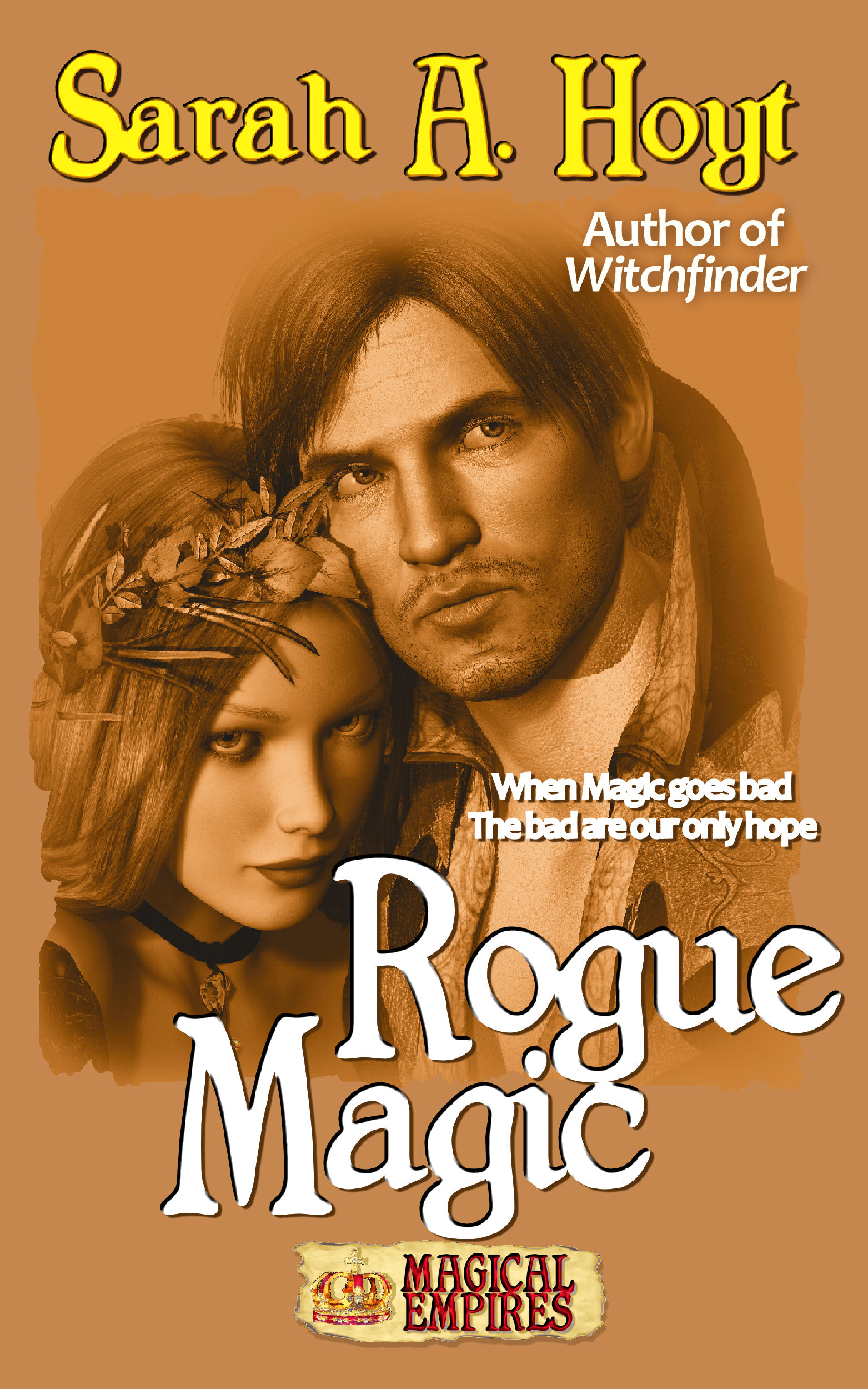
Rogue Magic, Free Novel, Chapter 58

Rogue Magic, the second Magical Empires book.

The prequel to this — Witchfinder — is now up on Amazon.

This novel will get posted here a chapter every Friday or Saturday, or occasionally Sunday.  If you contribute $6 you shall be subscribed for the earc and first clean version in electronic format.  I think it will probably take another three months to finish.  Less, if I can have a weekend to run through and get ahead of the game.  It hasn’t happened yet.

NOTICE: For those unsure about copyright law and because there was a particularly weird case, just because I’m making the pre-first draft of my novel available to blog readers, it doesn’t mean that this isn’t copyrighted to me.  Rogue Magic as all the contents of this blog is © Sarah A. Hoyt 2013.  Do not copy, alter, distribute or resell without permission.  Exceptions made for ATTRIBUTED quotes as critique or linking to this blog. Credit for the cover image is © Ateliersommerland | Dreamstime.com

The Rogue, Himself

The Honorable Jonathan Blythe, Earl of Savage


There was a feeling like being dragged backwards through a piece of silk, which ripped as I went through. It reminded me of this time when Ferddy, the honorable Ferdinand Holloway that is, had taken us to this brothel in Cheapside, where we were supposed to lie naked atop silken sheets under which were the, so to put it, hospitality workers of the place. By their moving around and wiggling they were supposed to bring one to ecstasy, only I’d gotten annoyed halfway through, because I wanted to touch the gels, not the damned silk, and had left to have a drink at one of my favorite taverns.

Funny thing isn’t it wasn’t until I went to the second tavern that anyone – myself included – noticed I was naked. I’m not sure what this means about my normal state of dress or what people expected of me.

This time I didn’t arrive naked, which is a demmed good thing, because after the feeling of silk ripping against me, and a blink’s worth of darkness, I found myself in as elaborate a study as you’re likely to find, full of globes and mechanical contraptions, and with a gently curved glass-front window overlooking Fairyland.

And what’s more the room was full of chaps, in front of which it would be quite beyond the point to be naked: Seraphim Ainsling, his younger brother Michael, his half brother, the king of fairyland and my brother in law – and the king of Fairyland’s cher ami – Marlon, lord Sydell.

They all looked expectantly at me, as though they thought I were about to conjure a rabbit from the hat I was not wearing.

And then, without so much as a good-day, Seraphim turned to Marlon and said, “I can imagine, if the intention is to create a poisoned package of some kind that might corrupt the enemy, then conjuring Jon here into the middle of it is the way to go.”

I opened my mouth to protest, but Seraphim turned to look at me and smile a little, “Sorry, Jonathan, but you must admit when it comes to powers of corruption… Most of us still remember the games mistress and the frogs.”

I opened my mouth again, to explain that prank hadn’t even been my idea, and that turning the frogs into muscular naked young men was supposed to make her run screaming into the night, not… well, not run screaming into the night. But instead, I simply cleared my throat and said, “Where are we? And to what do I owe the pleasure?”

It was explained to me that this aerie – that’s what he called it – was by way of being the safe spot of the king of fairyland, and also, that the king of fairyland had not so much involuntarily split as split himself to hide from his enemies.

His kingdom was under attack by the mythworld, an older and darker world that claimed all our worlds came from it. If they took Gabriel Penn, such the connection between his world and himself, they would assuredly take all the world.

I contributed what I had gleaned, from Ginevra, “they mean to sacrifice those of us who are… uncomfortable in our position in life. I’m not sure why, but there is something about having great dammed up possibilities that will propel the greatest magic.”

Gabriel waved a hand, “I know that. That will give them power to take over my kingdom, myself and my world, and through it all the worlds.”

I frowned at him. There was something to what he said that made no sense, and which bothered the back of my brain, like a sweet you’re halfway through swallowing that sticks in your throat just out of reach and won’t be dislodged. But when I tried to think what it might be, it was just out of reach and refused to be expressed in words.

I’d have taken the next suggestion more easily if it hadn’t been made by Seraphim’s younger brother Michael, who wasn’t exactly what I’d call an engaging scamp, or not as we’d been at his age, but who’d nevertheless always struck me as a serious, well-intentioned and well brought up young man. So imagine my surprise as he said, “So we thought we’d have them sacrifice you, Lord Savage.”

I rounded on him, “Oh, you did, did you? How kind. I’ll have you know, young jackanapes, that they mean to sacrifice all of us. Myself, your two brothers, your sister, my sister, and a lot of other people connected to us, like the manager of manufactories for my house.”

His mouth dropped open in surprise, as though he’d never intended to give offense, which only goes to show you he had windmills in his head. And then he said, “Oh, but I don’t mean like that. You see, you have to agree to it. And you have to go into it with your mind fully alert, and be ready to counterattack. They will jump at the chance to take you, you see, because you have possibly the greatest power of the lot, and the more… ah… complicated power, being, as you are, descended from Hermes in the fifth generation.”

“I beg your pardon?” It was official. The young man was completely and utterly insane. I tried to catch Seraphim’s eye to give him my condolences that they’d have to lock young Michael up, but Seraphim was looking attentively at his brother, like an adult watching a precocious child say his lessons. Maybe the entire family was touched in the upperworks. I mean, I suppose Gabriel was no crazier than most kings of fairyland, but still that was an awful lot of crazy.

“Oh, you didn’t know?” My brother in law asked, conversationally. “Yes, the blood in your family line was not elf, as has long been rumored, though we can see how someone could have got confused, since it’s the blood of one of the trickster gods, but all the same, Lord Sydell, it is true that you have a very great power, and that if they sacrifice you, or start to, and you’re ready to counterattack, we have a chance of escaping.” I wasn’t sure what it meant that my brother in law called me Lord Sydell while Seraphim called me Jon, but neither was I going to investigate.

“Be clear at once, what is this thing about my counterattacking,” I asked, lost to patience.

“Oh, he means,” Michael explained. “The poisoned pill. You start to let them engulf your power, so you can get access to their… their magic and their… true selves, and then you act. Of course you’ll need to know exactly what to do and some of it… some of it is going to need to be instinctive, since people without the blood of the old myths can’t fully understand their power.”

“Oh,” I said. And then, as a memory emerged, “But isn’t that the spell that Merlin did that caused the world to shatter into several worlds, and which encased him in an impenetrable shell in the betweener forever?”

They didn’t need to answer. The answer was on all their faces.

“I think,” I said. “I’m going to need a seat. And a glass of brandy, if it’s all the same to everyone here.”

No man should be required to face death without brandy.


I won’t inflict Caturday on you

UPDATE: I have updated the subscriber page with chapter 2 of To The Dragons.

Though the temptation is massive.

Our Free Range Oyster is still dealing with family issues.  I’ll have a chapter of To The Dragons in the subscriber area later, as well as another chapter of Rogue Magic.  (The To The Dragons one is written.)

It’s cold, it’s dark, it’s dreary and I have a cat (ah! snuck Caturday on you) and a husband wishing to snuggle, and what’s more, my internet connection is SLOOOOOOOOOOOOW, which is why I didn’t put up chapter last night.  I don’t know why, but I’m going to reset to before the last critical update and see.  To be fair, I’m not sure it’s the internet.  Everything seems to have slowed to a crawl.

Though to be fair, at least my computer isn’t smoking, so it can’t be that bad.

Until they achieve this on a mass scale, we’ll have to use the internet (my love.)

But you think at least they do this brain-to-typing, so I could get these novels out of my head?

Anyway, it’s taking forever to type each sentence, so I’ll be back in a couple of hours after I do a restore on this thing.

And meanwhile, I was going to inflict cat pictures on you, but the doggyness of the internet won’t let me upload them.  Even in small version.

I’m going back to bed and restarting the day in a couple of hours, okay?


In Praise of Naked Apes

I grew up in the seventies, or at least that’s when I discovered history and philosophical currents. I read both the treatises from my grandparents’ time and before, the attitude of which can be summed in Shakespeare’s lines: “What a piece of work is man… etc.”

But I also read a lot of seventies claptrap moral philosophy and theorizing about man. I don’t have a very high regard for the seventies, an era that seems to me to have been heavily influenced by drug use and eye-searing polyester to the point people could believe two thousand impossible things before breakfast, which ran into lunch because they were passed out on the floor, tripping on horse tranquilizers.

Okay, maybe this was just the view of a young woman just coming of age in a country undergoing great upheaval.

However, if the sixties started it, the seventies is when the ah… new age of entertainment and thought hit the mainstream. Perhaps it was when the slow marchers got enough power to influence things. Suddenly every book and every movie seemed bent on rubbing our noses in the fact that humans were animals and not nice animals.

In anthropology – I was a weird kid. As the youngest of a huge extended-but-living-in-each-other’s-pockets family, I was very lonely (my ten years older brother was the nearest to my age) but also well provided with books, college texts, and stuff on subjects my much older cousins favored – it was the age of the Naked Ape, red in tooth and claw.

Universally the view as that we were bad, bad, bad all through and that the only hope for society was for our betters to take us in hand and change us.

I didn’t realize at the time this was a vile-prog point of view. I do realize now it hasn’t changed much.

Watching people at the DNC say “We all have to belong to something, so we belong to the government” made my hair stand on end, but if you believed that man, the human by itself, left alone, is an evil being, a uniquely evil being in the scale of the world, wouldn’t you think you needed something – some entity, some enlightened someone – to fix him? And if you don’t believe in G-d, who are you going to call? Other humans. And because you have to believe in something you believe that government somehow transforms humans into angels.

Don’t ask me. I don’t get it either. I believe both in G-d and that he created flawed humanity and believes in us and in our ability to struggle to salvation.

But whether you believe in Him or not, if you believe we humans are unredeemable, it explains both the ridiculous need for “overseers”, the hatred of humans (zero population growth and extinction-lust programs and books), “bad humans, good aliens” movies (gag) and the endless pathology of the left which seems to hate humans just a little more than they hate… everything else.

And this is nonsense.

Those books of seventies sold us a bill of goods, including that humans are the only beings who murder their own kind; the only humans who commit murder; the only animals capable of making war, and who knows what else.

None of those are true. What is true is this: we are sentient creatures built on an animal base. The structures of our rationality are built onto the body of a pre-rational animal. We are built on an ape base, and that comes with certain qualities, as much a part of us as anything we want to be or think ourselves to be: we are sexual beings; we are creatures of instinct; we are social creatures; we are both lazy and clever, an ape who makes complex things.

The important thing to remember, though, is that we have the qualities of our vices.

I’ve moaned here, and you’ve heard me moan that we’re tribal creatures. This has some awful side effects because we tend to tribal-up. Some of the effect is minor. Get a bunch of my friends and Dan’s in a room. Or just an undifferentiated bunch of IT people and writers. As the night advances, we’ll divide into two groups and roll our eyes at the other guys.

This drives the social justice warriors nuts. They want to understand/integrate/whatever the other. They want to lift up the other and debase the group to which they belong. But they too are build on the same social animal base we are. So what they end up is forming a tribe of “The people who care deeply for the other” and… well, the other. Those of us who couldn’t care less and some people who think there’s nothing wrong with them that a few swirlies couldn’t fix. (And sometimes my loyalty veers to the second tribe.) This is the basis of all oikophobia. Wanting to belong to the tribe that is achingly, achingly I tell you (stop laughing) sympathetic to the “other.” Unless the other is their own tribesmen who think they are a few buckets short of a gallon of water, to be caring deeply about people who would stone them to death for their behavior.

What they – as well as the moralists who would have us all, even the least suited to it become utter saints – fail to get is that you can’t – not as a fellow human, not even, often, as yourself – excise the bad parts of someone and leave the good standing. That’s not how it works.

As individuals or as a species we are the same: we have the virtues of our vices. So humans who are tribal might get in league against “the other” but they also, by being tribal, stand in close association and protection, and will take care of the weak and the old they consider to be their own. (The SJWs want the government to do it, but that’s something else. It’s a delusion of sorts.)

Men are aggressive, but that aggression turned to protectiveness, has caused them to die in droves to protect the homeland and women they never even met.

Yes, humans strive against each other in war, but that’s a side effect of striving FOR something.

Civilization consists of individual humans choosing to channel their natural instincts productively. A functional society consists of giving them incentives to do so, instead of killing and pillaging.

Yes, there are bad men. Yes, there are bad women too. Yes, periodically all civilizations go dysfunctional or at least dysfunctional for a while, and yes, Mr. du Toit might be absolutely right that our collective psyche is being fractured by the speed of change which creates a sort of regression in some people who would rather go howling into the dark ages than towards a future they don’t understand.

But by and large, humans have done well. It’s not just a matter of our covering the face of the Earth, not altogether bad for a “naked ape.” It’s also the fact that we can look back just 400 years to Elizabethan England and see how far we’ve come.

It’s entirely possible, mind, that Western civilization is a terrible thing. (Terrible according to WHOM?) but if you are disabled, weak, a woman, a child or just plain weird, where would you prefer to be? In a Western nation or elsewhere? And more importantly, in the world now, or elsewhen?

It’s all in how you channel your aggression. You’re not born human. You’re born something like human. A civilized society can make you human, though, and we’re getting pretty good at this.

If we understand this, we can stop the self-reflexive hatred.

Virtue and vice are one, and the denied one fuels the other. No human is so good he’s without bad impulses, no. BUT he can choose. And those impulses are often never expressed.

We might, yes, be a killer ape. But we’re a killer ape whose expansionist desires can make him dream of the stars, and realize we might even be friends with those we meet there – if they extend a hand of friendship to us.

A naked ape can’t ask for much more.