 Recently, through a series of unconnected incidents, including discussing the cover for my upcoming Sword And Blood (as Sarah Marques, from Prime Books) I became aware that not only are covers still important, but what’s a “good cover” has changed dramatically over the last few years.
Or perhaps it isn’t a good cover that has changed but my perception of a good cover.
When I first sold my Shakespeare Fantasies, my idea for the cover was that it would show a young Shakespeare meeting a lady in the forest. It might have done well. Instead I got what many small presses are resorting to these days: out of copyright art from Sandis, utterly nondescript, even if gorgeous.
This probably would have been salvageable, if the cover said ANYTHING about “fantasy” or even “Fiction.” But it didn’t. Rumor has it that it was supposed to have the big marketing plan that is limited if one restricts the audience to “those who read fantasy.” Anyway, speaking of slips betwix the cup and the lip, that got lost… somehow. So what bookstores were faced with was this book called Ill Met By Moonlight (Until M. Lackey reused the title, the only book by that name was a WWII non fiction, btw) with a classical painting on the cover.
Children, that book got shelved EVERYWHERE except… where it was meant to be. From Art to Shakespeare Biography to Theater, the book went everywhere… and no one could find it.
This was when I learned that a cover was not just a piece of art to put on the outside of the book and make it pretty – it wasn’t even, at any level – an attempt to represent what was in the book. Rather, it worked like those drawings on the outside of packages to grab the attention of the distracted shopper. (Those can misfire too. Once in Germany I spent my precious last money on a container of lard, thinking it was ice-cream. Yeah, I knew German – two years – but not enough. I saw the word “creamy” and the drawing looked like ice-cream.)
If you’re selling, say, crackers… do you have a drawing of a beautiful, laughing baby? Why? You might have that in teething biscuits, mind, but it best have a large biscuit superimposed. Trust me, as an often distracted shopper, I often grab the wrong thing because I forget to read. However, even if the best thing about your teething biscuits are oat flakes, do you have a drawing of a bowl of oatmeal too? Well… no, that would confuse people. Particularly if it’s the only thing you have.
For books this is even more tricky. You have to look at it, pretend it’s not yours and analyze what it says. The cover from Prime, on first iteration, had a sword with a big polished shield behind, ghostly wings coming out of the shield, and a chain around the top. There was also some dark stuff that might be lace, but what I got was the type of cover that should grace a title called “the Sword of the Conqueror.” With Sword in the title, nine out of ten people would look at it and go “military fantasy” or “historical military” and never even notice the black lace. After I talked to the editor, it came back with a heart where the shield had been, which signals “romantic fantasy” and perhaps even “vampire”. I hope. The black lace seems more obvious and serves notice the book has… not exactly uncomplicated sex within its pages.
I will tell you in all earnestness, though, even two years ago, I’d have been appalled at the cover. It’s too simple, too Symbol filled, with too few human figures. But now we’re in an age of ebooks, and in a thumbnail, the sword, the heart and the chains will be very visible, and perhaps lead people to click on it, which will then reveal the wings and the lace. I think it will work.
Frankly, even the debacle that was my Shakespeare series didn’t fully open my eyes — the second book shows a woman in historical costume wandering the streets of London carrying a lantern. Very pretty. However, there’s not even a flying fairy to give the idea that this is not an historical romance. And btw, in the book, they used mage lights, which might have served as more of a warning. The third does have centaurs – in the distance. So tiny you could barely see them. Behind the large woman, holding a lantern.
Note that NONE of these said “this is fantasy with fairies and Shakespeare. You’d think it would be easy, right? Have the iconic Shakespeare image somewhere, even if you prettify him and youngify him. Have an elf or a fairy, or something. Nope.
Strangely, the people who bought the book, unless they’d read a review, weren’t looking for fantasy or Shakespeare. It took years for word of mouth to get started, and by then the book was out of print, and I was getting no royalties, though for a while (until two years ago) boxes of the book were apparently discovered in the publisher’s warehouses and thrown into circulation. (Yeah.)
Fast forward to my first book with Baen. I don’t know what Jim was thinking, except that he was very ill at the time, which is the only possible excuse fo the cover of Draw One In The Dark – the hard cover cover – which managed to go one better on the first Shakespeare cover. Not only didn’t it have almost anything to do with the book, but it signaled all wrong as to genre and style and, oh, yeah, it was repulsive to look at.
Children, while a pretty cover won’t sell a book, a horrible-looking cover, no matter if it is accurate, won’t sell your books. (The exception will be some zombie anthologies.) I mean, if you wouldn’t want to be in the same room with that picture on the wall… it’s not a good cover. It has to draw the reader forth.
The cover has been described as “A zombie with an udder fetish.” For reasons semi explicable, he stands in front of a castle. For reasons even less explicable, the castle is called The Athens. The only element that rings true are the dragons behind the castle… but they are… uh… strange looking.
In the context of the castle, the dragons and the zombie, what you think is “uh… historical fantasy with dragons. VERY dark fantasy. Possibly set in Athens.” Actually, the story is light urban fantasy with shape shifters set in a diner.
Because the book cover is executed at middle-school skill, you will also – probably – assume it’s a YA. A… uh… horror YA.
I was VERY happy when the cover was changed for the paperback, and I’m still grateful to Toni for changing it. She got me Tom Kidd, an artist I love, too. The cover shows a city street and a Chinese dragon. It’s not quite… I mean, it still looks dark and all. But it is a nice cover as opposed to a “Good gracious, what’s that?”
For the sequel, Gentleman Takes A chance, the cover shows the diner on which the plot centers, and on the roof of it a dragon, a panther and a lion. It looks nice and inviting.
Being a writer, I just thought “well, they’re both scenes from the book.” And “Nice.” And it didn’t hit me that the covers weren’t doing their job until I was at a convention with Ilona Gordon, (half of Ilona Andrews) and we were signing at the same table. She picked up my books and said “What are they?” I said “Urban fantasy” and she said “I’d never have guessed.” And proceeded to instruct me on urban fantasy covers. They always have a hot girl or sometimes a hot guy, with a tattoo or a weapon or a hint of danger. Yes, it gets monotonous, but in the quick-signage game it works like a dream. People who like urban fantasy will pick it up immediately, and give it a chance.
(BTW, my instincts were right even if I knew nothing, because what I wanted for the first cover was something that resembled Tattoo by Boris Valejo  and for the second, I had the vague idea of a woman in a short skirt, leaning against a lamppost in noir style, while a saber tooth jumps at her. Ah, well, maybe for the third book. And no, I don’t blame Toni for the mis-signaling on the covers. I didn’t know any better, and I DO read UF, which Baen isn’t known for – well, okay, not traditional UF.)
My Magical British Empire series, again lovely covers. But except for the details (a ship flying in, a flying building and a dragon) they could be travelogues, rather than historic fantasy with a hint of steampunk (i.e. magical machinery is big in the stories.) What could they have done to show that? I don’t know. I’m not a cover artist. Perhaps put goggles on the dragon? (G)
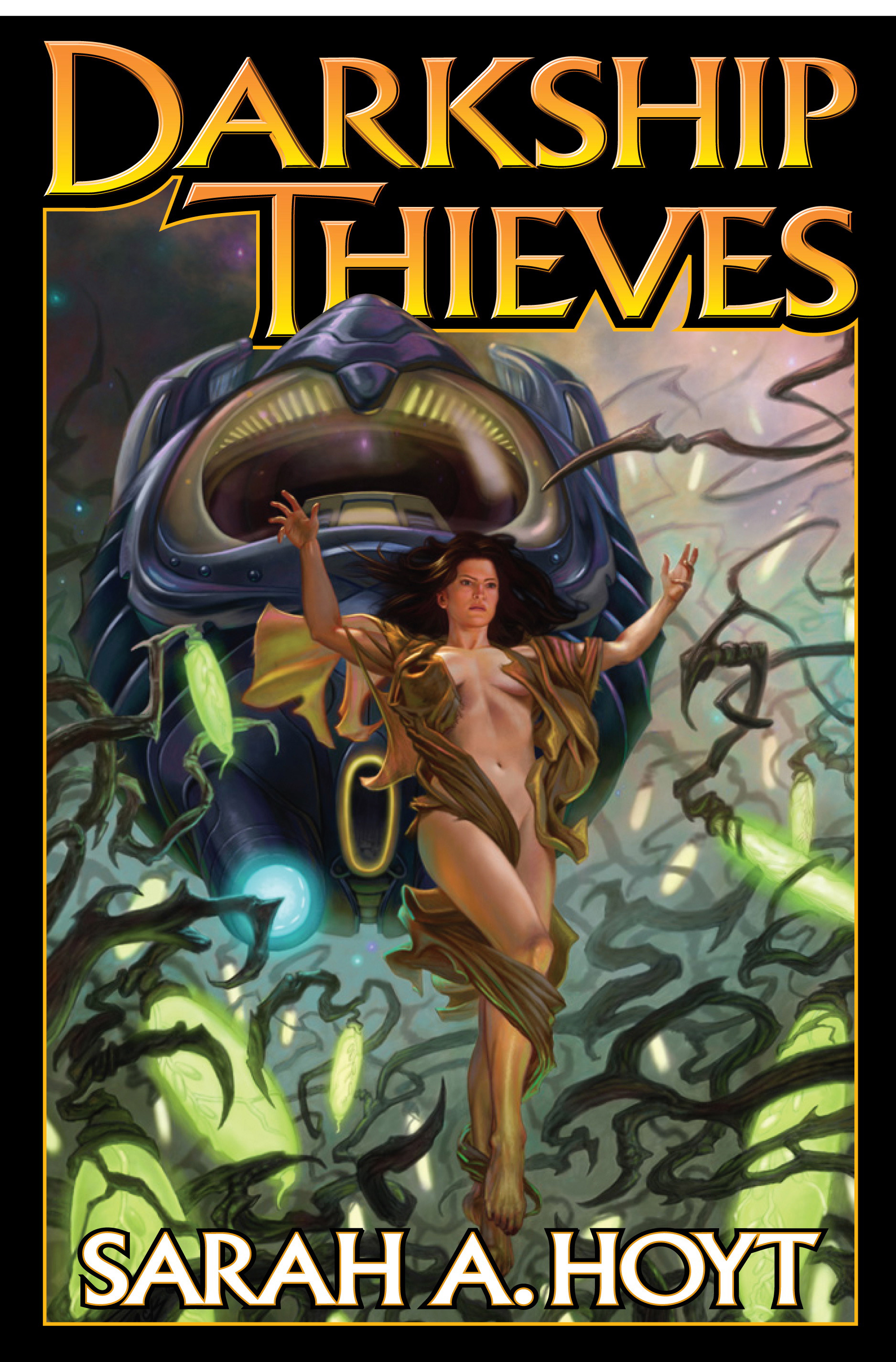
Frankly, the cover I like best, so far, is the Darkship Thieves cover. It doesn’t show a scene from the novel, but it evokes the novel beautifully. First there’s Athena, unclothed and looking like she’s quite sufficient onto herself. behind her is a spaceship and the powerpods twine around her. It has a “Heinlein” feel, says science fiction, and says it’s about a woman. The “sexy” bit suggests romance, which the book does have. Forget that the scene isn’t anywhere near the book (you can’t walk naked in space, okay. No, not even Thena) it’s perfect signage.
And now you know, I think, why romance always has some beautiful half clothed woman in period clothing/not and often being held by a brawny man (but not always.) Because the signage says “Romance” and that’s all. After that people go with title and blurb. SOMETIMES they will also go with “how nice is the cover” which hints at how good the company thought the book was. But that’s all. I can pick out regency romances based on clothing alone. (And do.)
So, how has that changed for the net? I’m seeing a lot more – even in Romance – of just partial shots of a woman in luscious clothing, or a brawny man supporting her. In the seventies and even recently, it would show man, woman, their faces, the ducal mansion, a horse, a butterfly and three kittens. (I’m exaggerating, but look up the covers at smart bitches.) Now it’s tightly focused and uncluttered. Why? Ebooks. Thumbnails.
One of the small publishers, who is trying to go with the “scene from the book” approach has a woman sitting on a buckboard wagon. From the position, in the thumbnail, it looks like she’s doing what bears do in the woods. Okay, it got me to click on it. For all the wrong reasons.
Take the cover for Death Of A Musketeer with Naked Reader. If it were still the market we had two years ago, I’d hate that cover. It’s just a hand, with a frilly glove, holding a sword.
I’ll grant you that mystery covers are in general more sparse (unless it’s funny mystery. No, don’t ask.) but that, on a shelf says “historical book on swords. Non fiction.” On an ebook it says “Hand, sword. What? Oh, Death – ah, mystery – of a musketeer, ah historical mystery. Okay. maybe I’ll download sample!” In other words, for a book I expect to sell MOSTLY in electronic format, it’s perfect.
Do I have a handle on this? Well, no. Cover artists and designers make a living from this. I wouldn’t take over their craft anymore than I would expect them to take over mine. Do they backfire? Sure. They’re human. The problem is, until recently everything depended on the cover. Now, it sort of does. The cover needs to signal the right genre, the right feel, and be intriguing enough for people to pick up the book. It also has to be clear in black and white, which is all the kindle (still by far the largest ebook platform) displays.
This seems to be leading to clear/concise signage and just enough visual interest to encourage download.
What are you feelings, both on cover and on how it’s changing?
*Yes, I HAVE been reading Agatha Christie’s Sleeping murder, again.
Crossposted at Mad Genius Club
 According To Hoyt
First, Sarah, you have pinned it exactly and precisely. One of the conversations I’ve had with Garrett Vance, illustrator for the Gazette is that he MUST preview the covers in 80 pixel thumbnails. If you can’t make it out in an 80px thumbnail it doesn’t exist.
The one thing you missed mentioning is Title and Author in Bigger Print With Better Contrast — you must be able to READ the title and/or the author (depending on name recognition) in 80 px thumbnails. No more subtlety.
That’s why the kindle covers for the Gazettes have got a black box around them with a giant ERIC FLINT’S above “Grantville Gazette.”
It is my profound wish that Amazon and BN and the mobi and epub formats had the ability to do separate thumbnails and larger covers. You could have the “zoom into one part” thumbnail and the “rich for viewing larger” covers. But for now, you said it exactly. If it’s a bad cover in an 80 px thumbnail, it’s a bad cover.
LikeLike
Cover art has always been an “Art” in the choosing. I remember when I was thinking about doing covers instead of writing the pages inside, I was learning all about it, and all the authors said, why don’t the cover artists ever read the book? Why can’t they pick a scene out and do that? Why is my Heroine’s hair Red instead of Black? And the artists said, why can’t they send me the actual book and art editor’s instructions more that 1 week before its due? Why can’t the author pick out a couple of scenes that they think really sell the story? And meanwhile, we don’t even want to get into what everyone says about the back cover blurb writers!
But it sounds like you are getting a good handle on what it needs to look like, but then the question is….is there anything you can do about it?
I think that in so far as downloads, I know that when I click on the little icon I want to know what the big picture is. I love the art, too. So, I would mourn the loss good cover art.
LikeLike
Well, obviously one CAN judge a book by its cover – the cover is a critical marketing element of the book, signalling the reader its content much as a movie poster communicates something about the movie postered. It was SOMEBODY’s critical judgment about how to present the book. Doesn’t mean the book is good or bad, but it does say much about the editor/publisher’s idea of who the likely purchaser might be.
BTW, I’ve noticed that many adages are only partially accurate. Along with the book cover is the “customer is always right” adage; not true, but easier to say than “nobody ever won an argument with a customer.” Or “you get what you pay for” would more properly be expressed: you rarely get what you didn’t pay for.
LikeLike
RES
Back in my salad days, when I was working retail, I once took a return from a customer of a defective magnet — because it didn’t stick to wood. And I didn’t laugh like an hyenna till customer left the store.
As for “you get what you pay for” I prefer TANSTAAFL.
LikeLike