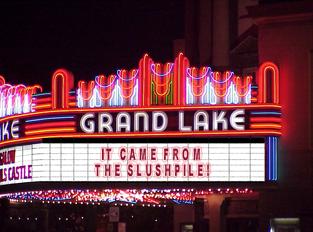
It Came From The Slush Pile

I’ve beat up on editors for unprofessional behavior towards writers, and I’ve beat up on writers for being wussies about rejections. Today, girls and boys, dragons and butterflies, we’re going to look into everyone’s favorite punching bag… The slush pile.

Or rather, we’re not just going to look into the slush pile. We’re going to look into beginning writers and why they really, really – really, really, really – need a second opinion. And not just from their dog or girlfriend. Particularly in these days when anyone can just throw their work on Amazon or self-publish for nothing. Because you run a risk of making a really big – not to say huge – mistake if you do it without vetting.

There is a peculiar arrogance to a beginner writer, a particular certainty that their work is the best thing since sliced bread, peanut butter and the invention of the rotto tiller – the sort of brass faced “read me, I’m wonderful” that nine times out of ten means this person can barely string a sentence together, has half a dozen words in the first paragraph that don’t mean what he thinks they mean, and is either playing with a world/idea that has been done to the point of nausea or most of the world is still in their heads and what’s on the page is a disjointed mess.

Conversely, the beginner writer who slips their work at me reluctantly and only after I asked to see it is, nine times out of ten either already publishable or very close to it.

I thought this was a peculiar curse of publishing, which makes the current system – dependent on self-confidence and self promoting – a peculiarly counterproductive one. But it turns out it’s actually the curse of any task whose completion doesn’t show immediate and concrete results, at least according to this article: http://www.damninteresting.com/unskilled-and-unaware-of-it

For those of you unwilling to click through, the idea behind that article – which is research supported – is that the less skilled you are at a task susceptible of personal evaluation (i.e., not whether you mowed the lawn or not) the more likely you are to think you are extremely competent at it.

The thesis is that until you gain basic competence you don’t see your own errors. I have to say I have found this to be true for myself at any variety of crafts (from crochet to embroidery) as well as at art and writing. It is not till I learn SOMETHING about the tasks that I start seeing all the errors I made in the early projects that, when I did them, seemed perfect.

Apparently this correlates to the four stages of competence theory, which can be summarized as follows, in progression:

1- Unconscious Incompetence

The individual does not understand or know how to do something and does not necessarily recognize the deficit.

2 – Conscious Incompetence

Though the individual does not understand or know how to do something, he or she does recognize the deficit.

3 – Conscious Competence

The individual understands or knows how to do something. However, demonstrating the skill or knowledge requires concentration.

4 – Unconscious Competence

The individual has had so much practice with a skill that it has become “second nature” and can be performed easily. He or she may be able to teach it to others, depending upon how and when it was learned.

These four stages correlate completely not only with my writing, or my progression in art – where I am, at best, in stage 2 – but with such tasks as fine-chopping an onion without either cutting myself or being excruciatingly slow.

Unfortunately confidence seems to move in inverse progression through the set. People in the stage of unconscious competence, often assume that they’re not very good at all because they still see how much further they have to go. This unfortunately means that if you get to stage four without showing your work to anyone, you’re not going to have the courage after that.

It also means that slush piles might drive most if not all editors insane. I’ve read some of these and the sheer volume of unadulterated, imaginably bad… Raw sewage that hits those is almost unbelievable. A lot of it is literally incomprehensible. And then there’s any number that’s just understandable enough to be repulsive.

Oh, come on, Sarah, you’re saying. Surely writing doesn’t fall to incompetent-but-unaware. I mean, people have been reading their whole lives, so they know what makes a book/story.

Uh… yeah, theoretically. But the problem is when it’s your book/story you have to be playing chess on both sides – to learn to be both the writer and the reader, and not to read into your stuff more (or sometimes – ick, trust me – less) than you put in. Until you get there you’re often unconscious incompetent. Very, very incompetent.

Unfortunately this is also, often, the bane of writers groups, because there is an effect associated with that. As you’re going through the stages (as the first article mentions) you’re not capable of evaluating anyone who is above you. This means unconscious incompetent will rate down conscious competent who will accept it because he/she underrates him/herself. This is one of the reasons I’m STRONGLY against anonymous or semi-anonymous, large online critique groups: after a while a certain tyranny of hte unconscious incompetent rules and destroys anyone who might have had a shot. Writers groups should be small and personal and you should be able to evaluate the person’s opinions in relation to where the person is on the writing journey.

And then you won’t risk letting your little monster into the wild, trailing excess adjectives, incoherent sentences and unresolved plots and making half of the readers scream “Oh, no, it came from the slush pile!”

Do you see yourself in those stages at all, or is it just me? Do you see the stages in others? How do you think this affects self-promotion ability? And do you have any slush horror stories to share? (I brought some slush-tentacles, if pressed to share mine.)

*Crossposted at Mad Genius Club*

Learning To Dance

Years ago when I met Jerry Pournelle, I got him talking – I know this will shock all of my faithful readers – about Heinlein. He mentioned I live in the town where Heinlein lived for a long time. I knew that. I’d even ferreted out the true address, because the one in Grumbles From The Grave is wrong.

In fact, the house has been up for sale twice, but the price grazing the half million is much too rich for our blood. The house is near the Broadmoor, in one of the most exclusive neighborhoods in town. I don’t think I’m giving too much away and at least the last owners had grown resigned to leading people through the house on impromptu tours. (I think they took down the distinctive number pictured in Grumbles, though, which is how I found it, one happy Spring morning, while driving the preschooler and the toddler to the zoo. (And I regret to report it my dears, but I made a total and absolute fool of myself, getting out of the car and standing on the road, touching the mailbox and crying. Yeah, okay, I’m a deranged fan as well as a writer. Though I’m happy to say I’m way too shy to EVER be a stalker. Also to stalk most of the people I’m that nutty on I’d need a time-travel machine or a ouija board.)

I confess I’d never thought very deeply about the location of the house, or its cost. I knew, having read Grumbles, that it had been built from scratch to their specifications, and since it was nigh to the only five star resort hotel in town, I assumed it was expensive even when built. I mean, the EARLIEST I remember being aware of such a thing as advances or how writers got paid (I think before that I had a nebulous idea writers were employees, hired by a company and put on salary to turn out x number of books a year – which, btw, might NOT be a bad model, if they’re going to be as bad as they are at tracking sales. Some of us would probably take write for hire for a book a year for a minimum of x and x years, provided we could write our own stuff on the side. Some of us have kids and obligations. More on this later.) was a notice in a Portuguese paper that Heinlein had got eight million dollars advance for Friday. So… expensive resort hotel… about right.

But Jerry said part of the reason they bought where they did was that the housing/land/living was cheap in Colorado Springs at the time. You see, the money didn’t come until much later than that. Until then they lived from book to book. They made do…

This is a continuous discussion at every con. The older writers complain about how bourgeois we’ve all become, and in fact there is something to be said about that, except I’m writing that article – hopefully – for publication. Meanwhile the truth is more than bourgeois, we’ve gotten older. People rarely break into the field in their twenties, anymore, or if they do they’re treated as darlings and have no worries. I’m one o the younger sf/f writers at any gathering, and I can see fifty nearing at speed. At our age we have families and obligations and we’re starting to think in terms of “how am I going to live in old age.”

I don’t know anyone under fifty who expects social security to pay them much, if anything at all. I view that money as being poured down a hole. If you think you’ll see a dime from it, you’re a far more hopeful person than I. It’s demographics. There is no lock box. There is no fund. There is a new generation paying for the older. Which works great if the new generation is bigger than the retiring one. AND all of them are employed and… Uh… you see the issue right? (Don’t blame me, I tried to have eleven children.) The way the market as been, both for me as a writer – yeah, I broke in in the quarter of 9/11 – and for my husband in tech, we have some money set by, in retirement funds we can’t touch, which would see us… through a year, I think. IF we’re extremely lucky.

Suffice it to say neither of us expects to retire. I intend to work as long as I can work, at writing, if writing will continue paying (something that as of now is up in the air, but being very stubborn and a battler I have hopes of figuring out a way) after the upheavals publishing is going through. At something else, if I have to. I can refinish furniture. I’m a decent seamstress. If all else fails I can teach and tutor in languages.

Dan, likewise, intends to die with his hands on the keyboard. How is somewhat of a puzzle too, since most companies these days actively discriminate against you once you hit fifty. (Yeah, I think it’s against the law too, but there’s always ways.) However we’ll figure it out.

But this type of life requires minimizing your living expenses, paying off the house, keeping things as cheap as possible.

And sometimes I feel guilty for having taken this path at all. You see, when we were twenty (it was just yesterday, I swear) it seemed so simple. I was going to write until I had a bestseller, which would happen with my first book (more on the lack of understanding of your own incompetence when you start out later) of course, and then I’d support Dan while he got his music going. Sometimes I think I should have gone back to school and gotten my AMERICAN teaching certificate, so that we’d have been a two income family all along. (I have a Portuguese teaching certificate but I wasn’t even allowed to take certification exams in the states. My diploma, from one of the oldest universities in Europe wasn’t accepted because the bureaucracy had never heard of it.)

But then I look at our friends who did what my husband arguably did, to keep a roof over our heads. They traded in their artistic dreams, their dreams of success at the thing they loved best for a steady income… Which for my generation hasn’t been all that steady.

Dan’s career in tech through the tech bubble and the turmoil of contracting has hardly been a sinecure.

With all that – lest I seem to be whining – we’re probably in better shape than 80% of our generation. Even if we’re eating into our savings at a prodigious rate.

What is this all about, you ask? Well… Yesterday I was talking to my older son who is in pre-med and we were discussing the uncertainties attending their future, and it occurred to me, truly, that there is no safe option. In the years of accelerating technological change we’re facing, there is no career you can enter and be safe forever and ever.

Everywhere I turn, even my dentist, talks about tech that will end his job as he knows it.

So what is my advice to you bright hopefuls setting out on the glory road of writing?

1- If that’s what you really want to do and are willing to starve for it, do it. Trading in on a “real” career won’t keep you any safer. (A caveat is since I don’t approve of living off other people, be they your parents or the taxpayers, get a part time job to support your writing habit. But treat it as a way to support your writing habit, not as a career. There is a difference.)

2 – Don’t expect a bestseller right away. I know, the world cowers before your brilliance. Or at least your cat and your boyfriend cower before your brilliance, which is why, my dear, we’ve told you to stop using soap with glitter in it. BUT weirdly and more than ever now, brilliance alone isn’t enough. Luck and above all persistence come in. Be prepared to be persistent. What this means in practical terms is that you MIGHT need that part time job and a place to live other than mom and dad’s basement. Beware you might be in your late thirties by the time you even break in. This seems to be the median age for breaking in now. (Though that might change with digital self-publishing.)

3 – Once you made the decision, keep on keeping on. I wasted ten years, writing a novel then going back to work full time, then writing another novel, ensuring both my skills and knowledge of the field grew VERY slowly.

4- Through realities out of our control – demographics; the pace of technological change; other factors that would be posts in themselves – most of us now under fifty will spend the rest of our lives in times of high uncertainty, aka “interesting times.” So there is no safe place to hide. In publishing or anywhere else, you’re going to fall on your face very often. The question is “how fast can you get up?”

Over my computer I have to signs pinned. One says “Success is how high you bounce when you hit the bottom.” (General George S. Patton.) It went up in 2003, when the failure of my first series seemed to ensure I’d never again be published. The second went up a few years later, when I lived in fear of trying new genres and new styles because… what would people think of me? And what if I failed. But then I realized I’d already failed once by playing it as safe as I could. And I saw other people failing around me all the time, for the same reason. That sign says “If you must walk on thin ice, you might as well learn to dance.”

All publishing is FOREVER thin ice. It was when Heinlein was publishing. It is now. Like all the arts it will probably always be. The other professions are just moving towards us.

So, as you stand there, on your thin ice and take a little experimental step, think on this:

5 – One day you will die, as every human will. Maybe you’re lucky. Maybe death will come suddenly, with no time for regrets or second thoughts. Most people are not that lucky these days, though. There are sometimes years of laying in bed, unable to do much but think over the past.

In that final and terrible time, what will weigh most on you? That you never had a corporate career? Never took expensive vacations? Never got to be a great: doctor, engineer, salesman, cook? If any of these is true, go and pursue those. If you love anything more than writing, go in peace – and whistle as you go, you’re a free person.

But if you’re going to lay there, on your death bed, regretting the worlds and characters that will die with you, unknown to the rest of humanity, come back here and sit down, you’re my brother or my sister even if I never met you. Arrange your life so you can live while creating. And set your nose to the grindstone.

War and Publishing

Are both at times hell.  As some of you know I’ve made snarky comments (which I probably shouldn’t have, but meh…) about the one sales statement I’ve got so far this reporting period.  Since I usually do that, and since I’ve long assumed my statements are the greatest form of fiction in the world, and other people’s MUST make more sense, imagine my surprise to find I wasn’t the only one with concerns.

Amanda Green writes about the kerfuffle rattling the windows of the publishing world.  http://amandasgreen.wordpress.com/  Well worth reading the whole thing as well as the blogposts she links to.  (In fact, if you intend to work in this field, you should be following both Krish Rusch and Dean Wesley Smith.)  [I highly recommend their workshops, too, which give solid value for the money.  I’ve taken any number of them.]

Mind you this might all die down and quickly too.  We writers are simple folk.  The next idea for a story comes along and we forget reality and as long as we have a roof over our head and a place to plug our computer, we’re easily pacified.  OTOH my feeling is that this is the beginning of something — something I’m not sure I want to deal with.  Let’s just say my blogpost on anger last wednesday might have been all too apropos. 

And look, I JUST want to write.  That’s ALL I’m really interested in.  If I can make enough from writing to help Dan keep this house going and to have some very mild fun with Dan and the kids, (our version of fun runs to museums and walks in the park, okay?) I’m perfecly contented.  A cutting-edge lifestyle I do NOT have. 

However as Ulysses (and George Washington!) found, sometimes even the most devoted of private citizens have to leave their plows behind.

Did I mention I NEVER asked to live in interesting times?

p://dieselsweeties.com/readby/theme/twitter/story.php?pag

Footprints in Your Heart

This will be a scattered post, however I trust it will also be self explanatory. It ties in marginally with my post about fans and the relationship about authors and fans.

When I started out with Baen and was given my own conference, I had very few fans at first (my last book had come out years before, and the book with Baen was still due.) Among the first was John, who more or less single handedly harassed me about rewriting and starting to post Darkship Thieves which led to its being bought.

As I came to know John, I valued him for his insouciant sense of humor – he needled me on my occasional bottomless lack of self-confidence by calling me “dumbass” when I doubted myself, and referred to my Magical British Empire series (which has ONE gay shifter. Okay, two, but…) As the “Gay animal porn” series – sometimes sending me highly inappropriate but very funny videos when I was going through a rough patch. (This was not homophobia, their closest family friends and some of the very few trusted sitters for their daughter are a gay couple.  It was just his way of picking on me.) I also found there was a more serious man beneath the silliness: he was principal caretaker for his daughter who is an atypical angelman’s syndrome child, with other – as yet undiagnosed – complications. His choice to not intitutionalize the profoundly handicapped child cost him his opportunities of employment and caused serious financial hardship. And while I understood his reasons (he shuddered to think of what might happen to a non-verbal girl child in an institutional setting) I very much fear that in the same situation I couldn’t do what he did. In other words he is a far, far better person than I am.

John neglected his own health while caring for his daughter and when you’re in your fifties and have not coddled yourself, this is not a safe path to take. A few ignored issues have caught up with him and he’s right now in the hospital, struggling between life and death.

I’d like to beg everyone’s prayers – if you’re a believer – or good thoughts on behalf of John, known in my conference in the bar as Saint Basset. He’s battled long and well, but he can’t leave the field yet. Too many of us need him on this side.

Note – Dave Freer and I have talked to Baen about doing an anthology to benefit/set up a fund for John’s daughter. Unfortunately this kind of thing is very slow, and our intention to start a storyteller’s bowl on her behalf got sidetracked as the horrible economy and whatever is happening to our field (more on that later) put a terrible strain on our finances causing us to scramble for survival. So…. Everything is delayed and given how things are right now, I’m not sure that storyteller’s bowl is a good idea. I do know that both John and his wife would be loathe to accept handouts, but they would be all right with a project that provides their daughter with some income/security.  I just have to figure out what that might pay off short term.

Drunken Debauchery

Mine.  I’m back home after night of drunken debauchery with evil companions.  Best kind of drunken debauchery since I didn’t drink a drop of alcohol.  (Couldn’t, had allergy meds before going.)

I think this is the latest I’ve woken in… ever.  Decided not to grace you with my profound thoughts this morning.  Had profound thoughts but can’t remember it.  Maybe actual sleep is bad for profound thoughts.

Will now go feed the cats which are — they ASSURE me — starving.  Then I’ll go have something resembling caffeine.  If I have profound thoughts by then, I’ll post again. ;)

Pieces

This blog was going to be entitled “yes, writers ARE your b*tches” mostly because – though I don’t believe that I also believe stating “So and so is not your b*tch” is incomplete. Relationships between writers and fans are not that simple. But because relationships between writers and fans are not that simple and because I have in the past ran across a couple of unhinged ones, I thought I’d better not get too playful.

To go right to the heart of the matter, no, writers are not, technically, their fans’ slaves. You can’t tell us “write this one. Now write that one. Now do it faster and with pudding on your head.” On the other hand readers are also not the writers’ slaves. No matter how dedicated a fan is or how much he loves a series, he’s going to get tired of waiting for the next book (a verity I’m quite aware of as I juggle four series); he’s going to get upset when your character gets a personality transplant in book ten; he’s going to get mad at you when you announce you’re not going to write his favorite series anymore and instead are going to start a new one (in this last case, though, please check with the author, before badmouthing him/her far and wide. Chances are he/she was a victim of real or imaginary computer numbers [imaginary, you say? Look, it’s computers. If there isn’t a kink in the program somewhere, I’ll eat their circuits. It’s hard to believe a series with enough distribution to elicit death threats when stopped doesn’t have enough fans to keep going. And yet, I’ve seen it.])

What’s more, fans have a right to be upset – even if they don’t have the right to send death threats. As both a reader and a writer, what a writer contracts for is selling more than a few hundred pages of words. A write sells worlds. A writer sells lives. A writer sells imagination that is not contained in the reader’s head, but which the reader does end up owning, and making his own by the process of reading and re-imagining.

It is that process of owning that creates fans – as opposed to just readers – and makes them go out and hand sell the book everywhere. And it gives them fractional ownership in the writer’s imagination. And the writer, who makes a living from having enough fans to do this, cannot complain. He or she might not like it, but it’s what he/she signed up for.

So am I saying that from now on when one of you wails that you want another book in… oh, let me pick a good and dead series, the Shakespeare series, I’ll rush to provide? Well no. Because see, while you’re not my b*tches and I can’t take you for granted, I’m not your b*tch either, and you can’t take me for granted. We have, in a way, a relationship, but it’s more like courting, where we each have to be sensitive of the feelings of others.

For one, for people who want say another Shifter’s book now, I can only way “right now I’m working on Darkship Renegades. Barring cloning, I can only write a book at a time.”

Lately I’ve found myself in the odd position of not being able to post on FB when I am cleaning (which is actually relevant, as I’m away from computer and can’t answer messages or pokes) or if I’m engaged in some non-writing project, because people will yell at me and tell me my job is writing. Yes, I know what happened to George R R Martin and his post about doing something fun, which occasioned Neil Gaiman’s “George RR Martin is not your b*tch” post to which this one is a “no, but…” response.

No, but, as a reader, I imagine the resentment they must feel. The new electronic communications has linked readers and writers in a way that gives both very odd ideas about the other. I can imagine people who subscribe to my facebook page to hear about the next book being frustrated when I talk about kids and cats. “Why is she doing this? Why is she not writing?” I can understand it. They shouldn’t take me for granted, but neither should I take them.

So, instead I’m going to explain – lately I’ve come to think of my books as pieces of myself. It’s not far off. In fact, reading other authors’ books I can sometimes get the almost physical sense of a piece of their mind/their emotions/their personality torn from them and put on the pages.

For the purpose of the analogy, these pieces regrow. Also for the purpose of this analogy when one has been on a killing schedule for a while – and the pace of killing schedules varies per author. For some one or two books a year is a killing schedule – there is no time for the pieces to regrow, and you start filling the books with parts that are vital. This is often the author’s best work. It is also unsustainable. Keep it up long enough and you’ll be empty, and a great silence will come that can’t be broken.

Fortunately this is not very common. More common are writers who go silent for a month or a year and then start writing again. And each of us has a different way of refilling the bucket (my friend Chris McMahon has a great running analogy for this over at Mad Genius Club yesterday.) My favorite way, when money and time permit is to go to Denver with Dan and the kids and spend three days bumming around mini-golf courses, museums and diners or occasionally hiking, and reading – voraciously. I usually buy 50 or so books at the beginning of those vacations, and have finished by the end. (Have I mentioned I love my kindle?)

 That hasn’t happened in a while which, yes, is an issue right now. Other things I’ve done include taking art classes, because sometimes my brain spins over the same spot of the plot and I can neither resolve it nor get past it, and art chases the words away.

And sometimes I just put the book down for a week and paint walls or crochet a curtain.

The important thing is to allow those pieces to grow back, so I can fulfill my unspoken contract with you guys. Because otherwise the contract breaks both ways, and no one gets what they want and need.

Trust me, I want to write those books as much as you want to read them.  If I weren’t enamoured of the worlds and characters I wouldn’t have created them to begin with.  But writing is not totally an act of will, and sometimes you have to let the subconscious catch up.

Stuck In The Group With You

Here we talk about writers groups, when they’re useful, when they’re not, and when you should run screaming into the night.

This is something I get asked about at every possible (and some impossible) writers venues. “Do I need a writers’ group?” “How do I find a writers’ group?” “How do I know if my writers’ group is bad for me?”

If I were to say “Probably”, “Varies” and “Is it making want to give up writing?” you’d be upset, so let’s get a little deeper.

Yes you probably need a writers’ group, particularly if you’re not selling yet, but are serious about selling eventually. And don’t be playing all professional and cool and saying “I want a group that just does critiques; I don’t need buddies. I already have buddies.”

Actually you need a writers’ group for TWO reasons: one is to critique you and give you a sense of what’s out there, outside your head; the other is for camaraderie and comfort. The first one is always imperfect – remember that – depending on where people are in your group, it might be very good or very, very bad. A lot of what raw beginners do is “share ignorance.” The second one is always imperfect, too – there is a lot of competition as well as support in any group worth its salt – but on the other hand there is empathy you won’t get anywhere else. Those other friends you have, who aren’t writers? Yeah… I’m going to quote from Kevin J. Anderson who should know “All writers need writer friends, because they’re the only ones who understand your crazy life and your crazy job.”

In a way, I would say particularly in the beginning, before you sell a word, the social function is more important than the critique function. It gives you a sense you’re neither alone nor completely around the twist. It gives you strength to keep going.

The critique is useful too, but sometimes writers groups are worse critique partners than your buddy from the army. Why? Because people tend to obsess on the things they’re fighting themselves. So, someone who is struggling with plotting will say “Hey, you know, you can’t plot.” Or focus on all the minor errors in your plotting that other readers might not even notice.

Here you need to get all psychological and take in account what your group is like and what each individual is fighting, before you decide to take the critique seriously.

Some rules help: No discussing of members’ submission before meeting – for ex – and copyedit marks in text but not spoken; also, member going late that found same issue as member before, just say “what she said” and don’t embroider, to avoid feeding frenzy; also, time critiques. Oh, yeah, and always allow rebuttal.

As for how to find a writers’ group… Well… danged if I know. My first one was formed by us falling in with each other more or less by accident, and added to by us putting an ad in local paper and library. The later might work for any of you.

As for whether your group is bad for you… Well, sometimes through no fault of its own, a group is bad for someone. We’ll leave aside the obvious, such as they’re all pros and you’re a newby (actually that one can be very, very good, depending on the pros) or they’re all newbys and you’re a pro; they all write romance and you write science fiction; they are a religious group and you write erotica. Beyond that, there is personal, undefinable, chemistry. Some people just rub you wrong/are rubbed wrong by you.

If you find your story gets pounded on all out of proportion to other people’s and there is no obvious reason for it, or that the critiques you get are blocking you, it’s time to move on. If you write a story a week and are in a group that doesn’t write, it’s time to move on. If going to group has become a chore, it’s time to move on. If the group just tells you everything is wonderful and bows to you, it’s time to move on.

Accept that in every writer’s life, unless very lucky, a time comes when they can’t have a group. There aren’t writers at their level (high or low) in the area. Other work won’t allow it. The people available are not the people you want. Etc.

At that point it’s time to remember you write for you and your readers, not group approval. It’s time to remember your own wellsprings, and maybe train a half a dozen first readers to give you perspective.

It’s Fatal, But Not Serious

So, I keep telling you guys you need to get someone other than your mom, your boyfriend (particularly you straight guys, who would have to get a boyfriend, and think how inconvenient that would be) or your cat to give you an opinion on your writing.

The reason for this is obvious – chances are not only that the people close to you won’t want to hurt you (unless they’re mean mommies like me, who fling their eleven year-old’s attempt at a story in the kid’s face and say “That’s not a story. Stop fooling around unless you mean to write a story. Here are some books you should read.”) but also that even if they wanted to give you honest critique they wouldn’t be able to. Part of it is that you’ve probably talked the ear of the people close to you off about the novel. (Yeah, I always tell the kid not to talk it, too. But everyone does.) This means they’re reading into it things that are only in your head, and now in theirs. And part of it is that they’re not writers themselves and have no idea of the type of critique you need.

Heck, a lot of you out there, I would bet, have no clue what kind of critique you need. This is part of the reason a writers group is better than just an assemblage of first line readers because you can’t help but stumble towards the right type of critique. On the other hand, I’m the first to know for a fact a writers group (which if you want me to I’ll talk about more/again in next post) is not always possible and if possible it’s not always the writers group you need. It’s hard to find that many loon– er… writers in your area who are as dedicated as you are and with whom you can work in some sort of harmony. This before you bring in the mismatched levels the writers might be at. And long distance groups don’t seem to have the same chemistry. They just don’t.

So, sooner or later – even if later, in my case – you need to round up and train first readers. (Note “train” not “shoot” though you might be tempted to to begin with.)

This is a trick in itself, though once you’re published people will volunteer to first read at astonishing rates, and then you can afford to toss out those who don’t work out right. Or to save them for the type of stories they do well with.

Most first readers start by giving you the type of critiques that are fatal but not serious. Fatal because if you’re beat enough with them you might doubt your basic competence and toss something that could be very easily “fixed” into a brilliant masterpiece.

What do I mean by this. Well… take the friend who once told me that a book was horrible, terrible, sucked and then when I asked him in what way started giving me a list of missed commas and typos. (And we’re talking maybe one per chapter, okay, not one per line.) Fortunately I was far enough along as a writer to laugh at this. But then this made him upset… He meant well, he really thought that was what he was supposed to be doing.

In fact this is what 99% of people think when they first read something for you. They think they’re supposed to typo-hunt. Slightly more sophisticated ones will try to grammar-hunt, or might tell you where you changed the character’s eye color on page 35.

Is this useless? Well, no. It can be fatal – there’s another friend who once told me that all my verbs were weak and cost me six months of writing. Why? Because there were no examples, and he didn’t have anything concrete to point to. So every time I was about to write a verb, I flinched – and it’s not serious, but it’s not useless, either. (It turned out he was generalizing impressions, which is something else that beginning beta-readers do. I did have a few weak verbs in the story, but not nearly al of them. But I had to get to the point of seeing which verbs were weak and analyzing the text myself before I could write again.) Yeah, if you’re published and under contract, you’re going to get a proof reader/copy editor, but trust me, they don’t catch everything.

HOWEVER, this is not why you need first readers. If this were the main point then English teachers would have lucrative side businesses reading hopeful writers’ books.

What you want from your first readers – what will make a difference in your getting accepted and where – is something totally different.

Here are some questions you can use when you send a book out to them, so they get their heads in the right place:

1 – Is there any place where you lost interest and almost put the book down? Are there other places where you’d have put it down if you weren’t doing this for me?

2 – If this were a book by someone you never heard of, where would you have stopped reading?

3- Was there any scene/action/plot point that threw you out?

4 – What is your general impression of the book?

5- If you have any typos/grammar/inconsistencies, would you mark them. I’ll just find them in the text. (This avoids people concentrating on them so they start reading you a list and think “it’s full of typos.)

After the critique comes in, there are some other questions you should ask:

6 – How do you feel about character A? X? Y? (This is to test they come across as you want them to, of course.)

7 – Did scene X? Y? Z? Scare you/make you laugh/make you wonder…

8- Did you see the plot twist coming. If so, how far back? (And don’t get necessarily discouraged by this? I always see these coming way back. Some readers do.)

Oh, and when you have the answers, run them through what I call a reality check. Some people ALWAYS think a book is funny. Some of them are going to tell you it’s scary because you mentioned the word zombie, once, even if it was just “when he woke up in the morning he acted like a zombie till he had coffee.” Some people are going to think any book without explicit sex is boring, and some people will like any book that has gore in it. So, be aware your readers are people, not interchangeable robots, and take who they are in account in what they say.

And now, go forth and hunt opinions.

Anger

Dave Freer wrote about anger almost a year ago. Mostly he wrote about the incredibly self-destructive anger that comes with being a writer.

I can’t improve on what he said particularly the part about how every crash is assume to be driver’s error even if the wheels came off the publishing effort before the driver took the wheel.

A few years before Dave wrote that, I stumbled on a book on burnout, because I hit a wall of sorts, where I couldn’t motivate myself to write, even when I wanted to write. (This wall is endemic. It comes, I fight against it. It comes again.)

The book on burnout was, of course, not directed at writers. It was actually a book on escaping the situation that caused the burnout. And the first thing it identified was the situation that almost inevitably causes the worst burnout – what they called the perfect storm.

Apparently people are able or at least willing to withstand working their hearts out at things where the outcome can’t be under their control (i.e. no matter how excellent they are or how hard they work, they can’t guarantee the outcome will be good.) They can survive this situation given, ideally, two things – recognition (pats on the back, prestige, the sense that what they’re doing is special and needed) and very good pay. The lack of control over their position will still tire them, and they’ll need vacations and cosseting. Now, if you remove just one of those compensations – the high pay or the recognition – you’re going to make it more likely that burnout will happen. If you remove both the compensations, so you have someone with no control over the outcome of their work, no high compensation and no recognition you’ve just created a mid list author… er… I mean the perfect storm for burnout.

Or perhaps “the reason my dentist thinks I should wear a mouth guard at night because of tooth-grinding.”

(Their advice, btw, was to run away from such a situation at all costs because it will kill you in a short time. Of course, for writers, at least up till now, the escape hatches are few.)

I happened to re-read Dave’s post last week, while looking for something on MGC and this brought to mind the book on burnout (remind me I need to find my mouth guard) which in turn came to mind again when I read a post by a friendly colleague about her extreme depression, brought about by… lack of control of the outcome, lack of recognition and lack of money. This post touched me greatly because there but for the grace of Baen go I. I was saved from being exactly where she is, by Jim and Toni giving me my own conference in the Baen bar oh… six? Years ago. Which in turn resulted in my hearing directly from Baen fans, so that even if the establishment doesn’t know my name, I do get people asking what happens next, and talking about my characters like real people, and that recognition keeps me going, even through all the worry about money and book distribution and my wretched attempts at publicity.

And then yesterday, while writing on rejections, it occurred to me that there is something there that links in with both Dave’s post and this colleague’s plea for help and that is – they treat us like children or fools.

Now, I mentioned this to a friend who said she knew many stores that treated their employees like that. Yeah, I’m sure she does. I know some computer shops that do the same. But it’s not an industry wide syndrome. Exploited employees can usually walk down the street and get something new. (Well, maybe not in the present economy.) In writing – though there are quite a few exceptions – the norm seems to be for anyone in an editorial position to treat the writer like dirt beneath their chariot wheels.

Crude, rude and overbearing rejections are not rare. Making generalizations about writers being like children are not rare. In fact, anywhere that industry professionals gather, writers will often be treated like idiot children.

My friend suggested perhaps this is because – though the number of writers who fit the stereotype is very small – there is a stereotype that writers are unstable.

I don’t think so. Look, the stereotype for postal workers IS that they’re unstable. Hence the “going postal” and I don’t see a supervisor treating a carrier this way – say, taking a professional of twenty years and telling him “you don’t know how to distribute mail. You can’t drive that car properly” or anything like that. Why not? Because they are afraid the postal worker will go berserk.

On the contrary, I think the general rudeness and unprofessional belittling of writers comes from the fact that until recently, to quote my grandmother’s expression for these situations, the publishing side of the equation had both the knife and the cheese. If you were so much as rude to them, or they just didn’t like you, you could be shut out of publishing. It didn’t even take any formal blacklisting. I personally observed one of these cases up close and personal (no, not me) and despite excellent sales all it took was putting word about that the writer is “hard to work with.” (Which isn’t even true.)

Even beyond that, if they didn’t actively like you/your book and get very involved in it, your distribution would suck, and failing all that if, by a miracle, you still sold, they were in control of your statements and you couldn’t see your numbers, so they could p*ss on your neck and tell you it was raining.

So you had to approach them cap in hand, and bow and tug on your forelock. You had to stay in their good graces to keep working, and your entire livelihood was dependent on this handful of interconnected (with some exceptions, like Baen) people.

Did this breed contempt? Good Lord, yes. I mean, seriously, it doesn’t surprise me that people with the ink barely dry on their fine arts diploma would presume to tell professionals how to do their job. What surprises me, under the circumstances, is that they didn’t feed us to literal lions for their amusement. (We won’t mention the metaphorical lions.)

What is the point of this? Other than venting my anger?

Well, writers are starting to acquire other channels. Not as viable as mainstream publishing yet, I’ll give you that. For all but a lucky few, it won’t support us… yet.

But things are changing very fast. And long before it is viable for a writer to make a living from self publishing, it will be possible for enough exasperated writers to walk away or die trying. (And no, I’m not ready to yet. Read about where I got a conference from Jim and Toni. And also, things seem to be finally starting to sell.  Besides, at this point I’m more or less down to editors I enjoy working with.  But there are a lot of people where I was a few years ago.) And for enough competing offerings to be available to take money from the publisher’s bottom line.

In other words – long before we can live without them, publishers will find they can’t live without us.

And then they’ll run up against that anger Dave mentioned.

I’ve long ago preached about writers growing up. Don’t bitch at an editor. Don’t tell them they’re stupid because they rejected you. (I’ve been on the other side of that desk. Most people who do that are not people I want to work with.) If an editor offers politely expressed non-ludicrous comments, consider them before you dismiss them. (But don’t rewrite unless they’re paying you or at least agreeing to read it again. As for ludicrous, if I get one more rejection critiquing a three page synopsis as though it were the whole book… I’m going to find my mouth guard.) Accept in your heart that no matter how good you are, some books are simply not what the editor (or sometimes anyone) is looking for. Be willing to move on to the next book.

Now, hark, for I’m the voice that cries in the desert, and who doesn’t expect to be heard until … a year or two from now, when the desertion of the midlisters (and lower) starts hurting. And even then, it might take a while.

But perhaps it’s time for editors (and some agents) to consider (this just from things that happened to me I’ve heard much worse, and I’m sure our readers have too):

– Not telling the writer that you have read better things from your three year old son;

– not telling the writer that you disapprove of his/her moral stance and he/she must be “depraved”;

-not spending hours thinking of belittling ways to describe the writers’ work (the one that stuck in my mind was ‘flipping voices like a cook flipping pancakes in a cheap greasy spoon’ (12 years ago, from an agent for… Darkship Thieves.);

-not sending a rejection saying “your novel was terrible” when the only thing the author ever sent you was a request for guidelines (and the author hadn’t published yet, so chances of your having seen one of her novels are small to none.)

Editors should instead – particularly when they’re dealing with authors who have published more than one or two books – treat them as professionals treat other professionals. Oh, sure if there’s a chance you’ll buy the book if they fix a detail or two, point out what they got wrong. If they’ve got some egregious error of science of history (or grammar, like the lady who had a character with a “copulant face” in a story I read for a slush pile long ago. I was forced to point out “I think you mean corpulent, and that’s still wrong.) you can mention it politely.

Of course, if the author doesn’t behave like a professional, THEN you may take your gloves off, but don’t preemptively assume you’re dealing with the mentally unstable. It takes a degree of fortitude and work to produce readable work. I know you’ll find this hard to believe, but truly, anyone off the street CAN’T do it.

See, now you might still have the knife, but the writers have the cheese. You’re going to have to behave as if they matter, because they do. And you won’t survive without them.

 *crossposted at Mad Genius Club*