Love In The Potato Cellar

Most people remember when they got their first crush – that feeling that there was something special about the opposite (of for some people same) gender and that this person embodied it.

I’ve talked to people who remember their first crush coming in all sorts of ways. It doesn’t always have to be on someone who is flesh and blood. Sometimes it is, of course. I think the best literary description of this is Tom Sawyer seeing Becky Thatcher. It’s about the right tone and the right reaction. I have friends who fell “in love” with someone on the screen. The other day, apropos nothing I remembered the girl in my notoriously difficult eighth grade physics class, who went up to get a test she was afraid of seeing clutching a collector’s card of a character of Space 1999 (Alan Wassname.) Her name has long since disappeared in the mists of my memory, as has her face, but I remember her hand clutching the card behind her back as a talisman, because “he” had protective powers. And I remember we all teased her about her crush.

It is perhaps fitting that I would take this one step further. I first fell in love with a person composed entirely of words – a creature who had no form or shape except what the author could evoke in the reader’s imagination.

Yes, it was Athos, from the Three Musketeers. For years I’ve assumed I was eleven, perhaps because it’s the ideal age for this. Looking back, though, I don’t think so. I was somewhere between eight and ten. (We played at the Three Musketeers in elementary school. By eleven I was at the two year “preparatory school” where I never got anyone to play my games and instead used to walk around the playground daydreaming.)

I remember hiding in grandma’s potato-storage area. (Her house was up the road, so I spent my afternoons there.) I don’t know why, but I suspect I was hiding from my long division homework. If I’d been found out, I’d have been made to do it, as opposed to inventing a very important reason it hadn’t been done, which had served me fine so far, and was much more fun. I had the Three Musketeers with me. I started reading it not expecting much, because lately I’d been going through the “real literature classics” section of the family library and had learned not to expect much. Still, it was printed and it presumably was a story. I got past the whole thing with the horrible-looking horse fairly unmoved, but of course, I wanted to see if D’Artagnan caught the man who stole his letter.

And then… And then the musketeers come in, and are being chewed out, and … And Athos appears. Wounded, in pain, but coming here to save his friends from disgrace.

I think I read that passage five times in a row. I might have worn the ink off the page. The next few weeks were devoted to fervid day dreams where Athos got catapulted into my immediate vicinity through some sort of space time/reality disturbance (thereby probably making me fit only for science fiction.) The dreams never got very far, since my knowledge of love was reduced to what I could see of the people who courted my cousin Natalia – i.e. when you were in love you got to sit on the uncomfortable front room sofas, under the eagle eye of a chaperone, and make stilted small talk. But I knew I liked men – not boys, note. Most boys my age annoyed me – and I knew what did it for me was nobility and intelligence. (And perhaps a tinge of sadness, though I eventually grew out of that. Still, a tragic past is so romantic, provided you don’t have to live with the guy.)

Most first crushes fade, I guess, but this one remained. At first I re-read the book obsessively, eventually adding Twenty Years after, and later the wretched Viscount the Bragelonne (I still think Dumas Jr. wrote it. Either that, or his father had gone soppy in his old age.) I finally weaned myself to one re-read a year. But Athos remained my fictional crush.

Finally, in my thirties, I realized I was now a writer and I had the power to invoke him at will and spend however much time I wanted with him. About that time, my editor at Prime Crime asked if I wanted to do an historical mystery.

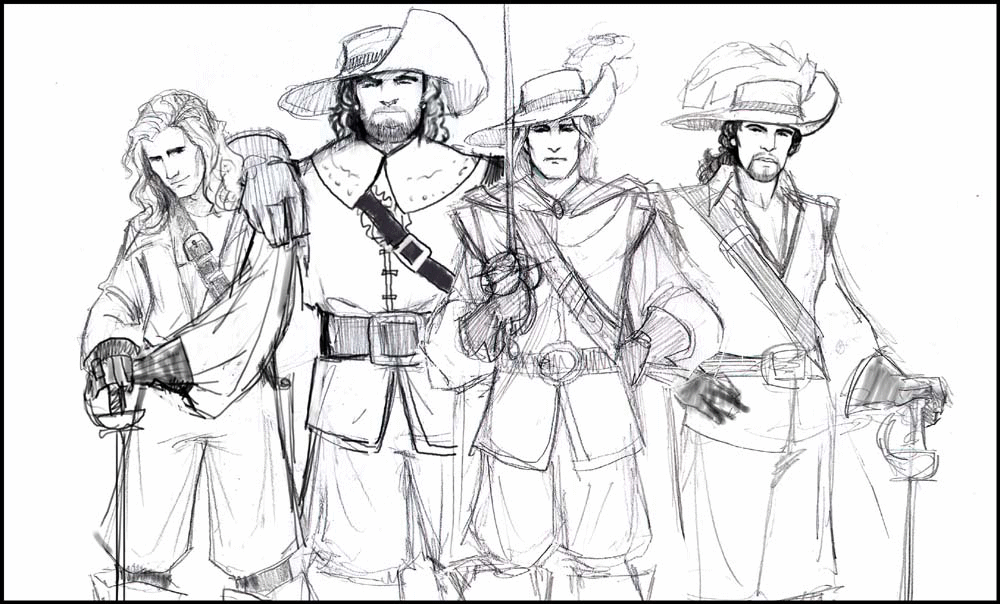
The result was the musketeers mysteries, written as Sarah D’Almeida. The first one, Death Of A Musketeer, has now reverted to me. I’ve made a deal for its publication with Naked Reader Press. I’m not sure of the exact publication date yet, but I think it’s February.

Give it a try, if you haven’t yet, or even if you have but would like an e-copy. It’s non-DRMed, so it will last you through changes of devices. And if this sells well enough for me to think it’s worth my trouble, I’ll be happy to write book six, and seven, and…

You may ceasse with the demanding emails.  (Not that the ego boost isn’t appreciated!)  The continuation of the series is in your hands. Not to mention the enabling of my crush.

Crossposted at Naked Reader Press Blog

A Time Of Innocence; A Time Of Confidences

I was thinking today about my first “best friend.” I’m not sure I have a “best friend” now – it always seems a little strange for adults, unless they’ve been best friends from childhood – though I do have a small circle of close friends, then a circle of slightly less close friends (this is usually dictated more by time and circumstances than by liking) – and then a vast, protean group of friends – i.e. people I would turn to in a pinch and trust with secrets if needed, but who, at this time, are not very close – and then an even larger group of friendly acquaintances who are people I don’t know well enough to be friends, but with whom I might hang out and have a beer at a con.

However, in childhood there always seemed to be a “best friend” who was as close as any sibling, only usually one’s age. My best friend was Isabel, the girl who lived across the street from me, and our friendship was very much the stuff of Ray Bradbury stories. (The ones that were a celebration of magical childhoods, not the ones where something creepy comes out of the undergrowth and steals your bones.)

First, we were as close to pure opposites as two kids can be. Oh, by American standards we were both dark haired. Okay, so she was “Portuguese blond” but that’s a whole other concept. The resemblance stopped there. She came from a family of thirteen kids. (She was number 11.) I came from a family of two “only children,” my brother being almost ten years older than I and mature for his age, meant I was closer to having three parents than a sibling. I was – again, by Portuguese standards. I was a size 7 when I got married – tall and massive. She was small and so slim my graceless cousins nicknamed her x-ray when we were ten. I could trip on both my feet while standing still, but I wrote stories more or less compulsively from the age of six. She was dyslexic and weird things happened to her words on the way between brain and hand. (She could tell me “metal is composed of ions” but she wrote “metal is an ion.”) On the other hand, she was a very promising ballet dancer until upheaval and a change of governments closed the program in which she was learning.

We did have some things in common, though. We both read – possibly too much – and traded books back and forth across the street. And we were both gifted with a tendency to overthink things, which meant we spent a lot of time talking over everything under the sun and – mostly – sharing ignorance.

We were almost – by the standards of today – charmingly innocent. And by that I don’t mean that we didn’t know the facts of life. We sort of figured those out by piecing bits of information. It’s not that arcane. It’s more that we grew up almost in isolation, in a place and at a time when no one thought it very important to disabuse us of our illusions about how the world worked. We used to build entire structures of “this could happen,” before we learned better (usually years later.)

We attended the same one room school. Our class had twelve girls in it, but was usually paired with another class of twelve. Though there was a fireplace in the room, it was never lit in the time I attended and in winter sometimes the ink would freeze in the inkwells, and we’d have to hold them in our hands to defrost. On the other hand, we got recess for however long the teacher felt like. If she was under the weather it might be two hours or so. Time enough to dream.

I think I was the one who invented the games, but I could never have imposed the insanity on the others without Isabel’s cooperation. You see, most of what the girls did – jump rope, hopscotch, elastic – jumping, catch – I was terrible at. Actually to this day I have to manage jumping rope ONCE. As for elastic? Hopeless. No, I also never managed to ride a bike. My brother has the exact same issues, so it might be genetic. But I read a lot, and I had a fertile imagination.

In retrospect, what I came up with was sort of a proto-acted-out-version of role playing games. I had these general scripts and then we acted them out and the battles counted. There were many, including WWII (don’t ask) and Explorers in Africa and (later) Colonizers in a New Planet. I’m fairly sure we played Three Musketeers too, when I read it, but I can’t remember details.  Except I think I was Athos and my friend was Aramis.  However, the favorite, by far, was Robin Hood. I got to be Robin Hood and my best friend – of course – got to be the Sheriff. (Equal parts, see.) Various favored friends filled in the secondary roles. I always felt a little sorry for the girls who played girls. Their general role seemed to be “look pretty” and “use trickery” and I had no patience for that sort of thing. But some girls, inexplicably, seemed to prefer it. (In retrospect, I think it was the “look pretty” part and “pretend boys will fight over you, even if it’s just a game.”)

Various parts of the playground were the forest or the castle. We got quite good at the fights. The field next door to the school was not cultivated and had an extensive patch of bamboo, which we raided for swords. We got quite good at taking care of minor scrapes and cuts, too, without the teacher finding out, but when the game was good there would be blood and torn clothes we couldn’t hide. I remember the teacher saying she’d never had a class of girls as troublesome as us and that we played more like boys than boys. It’s probably wrong to still feel proud of this.

At the end of fourth grade only five of us went on to preparatory school (preparatory for highschool, lasting two years.) The rest went to work in the textile mills and after that we more or less lost touch with those.

Isabel and I went to the preparatory school together, though for some reason (alphabetic, probably) we were never in the same form. But we walked home together, and we studied for tests together and we still traded books.

In seventh grade we entered different high schools, as I went to a magnet school downtown… And we drifted apart for a time there. We drifted back together after I was an exchange student to the US for a year. She had spent a Summer in France and both experiences changed us.

We tried out the “early adulthood” stuff together – going shopping on our own, and first money earned and that sort of thing.

She got married – to a Frenchman! – the year before I did. For a long time, we corresponded and kept in touch by phone. But as my Portuguese became more… er… problematic… it became more daunting to call her. Particularly since the idea of having to explain to her children who I am, in French, is enough to reduce me to silence. (And you guys know how hard that is.)

Still, she was the first person to see my writing. For a long time, she collected my juvenalia. I don’t think she has any now (I hope.) One would like to avoid what can only be called a “For Us The Living.”

And all this came to mind because I friended her daughter on Facebook (that I know of, her mom is not on facebook. At least not that I can find) and I was looking at a post of hers today, with pictures of herself and her relatives and friends. Her daughter is one year older than my older son. (Her son is somewhat older.)

It occurred to me how unnatural this is. Looking at her daughter, who does look somewhat like my friend, it seems odd that I didn’t see this kid grow up, that she knows next to nothing about me. You see, in normal circumstances, if we’d stayed in the village, we’d probably be ersatz aunts to the other’s kids. As is… well, my kids have heard about her, but I doubt they remember her name, as such. I’m sure the same is true the other way around.

I’m sure her kids, like mine, have their own friends and their place in the world.

But in a very Bradbury way, I’m fairly sure somewhere in the multiverse, there are still two little tomboys engaged in a rousing mock sword fight through one of the endless recesses of childhood.

I wonder if she knows how much I miss her?  And I wonder who she grew up to be.  And I wonder if we’d still be friends now, were it not for time and distance.

This Article Does Not Exist

* A guest post by Robert Anson Hoyt aka #1 son — who has suspected he’s an elephant since he was about two, in the same way I’ve often suspected I’m a cat. So excuse the pachiderm-o-centric imagery. He is what he is. :) And, oh, yeah, he does overthink it. (Wipes furtive tear.) My boy.*

Postmodern Blues
Or: This Article Does Not Exist
Also: How Not to Practice Zoology

I’ll be blunt. Postmodernism makes me itch. There are very few viewpoints on this planet that annoy me to the extent that postmodernism does. Postmodernism actually manages to be worse than Nihilism.

Oh, you think they’re the same? They aren’t, and I’ll tell you why. Sure, a Nihilist will raise their nose and tell you that all values are subjective. But it takes a Postmodernist to look at the Nihilist and tell them that – not because of the ideas they asserted, but merely because they asserted ideas – they are wrong.

But I’m getting ahead of myself. To understand my position, let me lead you back through the mists of time to Hell, also known as my high school classroom. I am, for my sins, an IB graduate, and like all IB graduates, that meant I had to participate in a class called Theory of Knowledge. I won’t lead you through the details as to what the class was supposed to teach, because no matter what it was, it didn’t succeed.

Not to say the class taught me nothing, it just didn’t teach me anything the prim and proper IB heads in France would dream of putting on their brochure. It took me along the bowels of the nightmare carnival from Hell known as postmodernism, showing me in loving detail its every blemish, often saying those were features rather than bugs. Then it spit me out into the world with a philosophical certainty etched in my heart that – many demons though I might have – I will never resort to postmodernism.

Let us take the first parable chosen by TOK class. It concerns several wise men, all of them totally blind, observing an elephant by hand. One feels the trunk, and proclaims that an elephant is like a snake. One feels the leg and says it is like a tree. One feels the side, and suggests it is like a wall. One feels the tusk, and proclaims it is pointy like a spear. Then, because all of them has a different answer, they get in a flaming row. The very postmodern moral: the elephant can be likened to the truth, and the men to people searching for truth, such that each understands a part of it, but none of them all of it.

This sounds very sage, of course, until you start poking at it. I’ll admit up front that the very metaphor itself annoyed me. What, for example, qualifies these men as “wise” if their general approach to learning about an object is to poke it and then immediately assert opinions? Is this how postmodernists think people do science? If that object was a bear trap, would their scientific opinion be that you shouldn’t poke it? Or are they normally wise, but today they were very drunk? Does that explain why they thought it would be a good idea to rub an elephant? Then again, perhaps their aforementioned method of gaining information pissed off the villagers so much that they’re trying to get the men trampled, because the village maidens are really tired of them “looking for information” in their bosoms? For that matter, just why hasn’t the elephant trampled them? Is it just so confused that old men are coming from the woodwork to rub it that it hasn’t thought up an appropriate reaction?

I realize that’s nitpicking, so let’s consider what the story is actually supposed to mean, instead. There is some central truth, and a variety of people examining it. The people come away with observations that are all partially true, but none are entirely true. And here’s the problem, right away. This may be postmodernism’s explanation of science, but in a strange way, it isn’t what postmodernism actually believes. Postmodernism asserts that all points of view are just reflections of the people making them. The men in the parable were making concrete, verifiable, but incomplete observations. But if the parable really wanted to express postmodernism properly, the village idiot would have come by and observed that the elephant was covered in feathers, and therefore like a chicken. (And then, if it were real, all the old men would have beat him with sticks. And rightly so.)

But wait, I need to explain why postmodernism believes that all points of view are reflections of the people making them. It has to do with a given society defining things in certain ways that make people observe things using specific patterns. And the postmodernists engage in a variety of little games to attempt to explain away reality by using this statement. Of course, for all that they argue that reality is just patterns of social constructs and individual observations, I notice that the current number of postmodernists to have successfully jumped off a building and flown via arguing that gravity doesn’t exist, or doesn’t work the same if you come from a different culture, or if you call it by a different name, remains at zero. But the problem with postmodernists is that, even if one of them tried it, even if you and every other person on Earth watched them splatter on the ground, their very devoted postmodernist friends would just say that it was possible that within that person’s perception, they flew.

What made this even worse was that the postmodernists at some point got science. This is laughable to begin with, since postmodernism was supposed to be a counter-response to the rigidity of scientific thought. And what branch did they select as their own? Quantum physics, of course. The thing that attracted postmodernists to quantum physics, like flies to a jar of honey, was that very little beyond the basics is properly understandable without post-doctoral education. But the general ideas presented by many famous experiments, if not the actual mechanisms behind them, were very useful. The idea that the observer affects the observed alone was intriguing to postmodernists. Finally, they could get credibility.

After all, this was essentially their central thesis. With a little due diligence and a thick dose of illogical thought, that was what postmodernism could use to infect the sciences. And while from the perspective of the sciences it never succeeded (thank heavens, or we might get wooden rockets powered entirely by the belief of the builders that they could fly), from the perspective of the humanities, they have had the forces of science on the run since that time. Being a self-admitted reaction to the philosophies behind science, they could have asked for nothing more. And when you get right down to it, it demonstrated to what lengths postmodernism was willing to go to become an all-embracing philosophy.

By now, I hope you’re starting to realize the problem with postmodernism. For a social movement working to span ever vaster swathes of academia, it’s frighteningly empty. By intent, it has no substance. Everyone has had the experience of arguing with a postmodernist on the playground in elementary school. Remember the imaginary battle you had with someone at some point, where you said your robot had one hundred missiles, and they said they had a thousand, and so on until infinity-plus-one? No matter what the argument, the postmodernist writes everything off as no more than a perspective: there is no goalpost they can’t move, no fact they cannot disprove through a simple twist of mental gymnastics. For the postmodernist, being right requires very little thought and certainly no actual understanding. Infinity plus one can be bigger than infinity if you believe it is, in other words.

But you see, the ultimate strength of postmodernism is also its ultimate weakness. Definitionally, postmodernism should not be capable of existing. Because the postmodernists, as proud as they are of believing no one perspective is correct, are taking a perspective. Postmodernists do not truly believe all perspectives are equally valid. They believe that their perspective — that all perspectives are equally valid – is correct.

Now, of course, the true postmodernist can easily overcome that little hurdle by becoming what you might call a post-postmodernist, believing that the belief that all perspectives are equally valid is simultaneously correct, and incorrect. Of course, many would argue these are mutually exclusive but (trust me, if you ever meet one, you’ll find this out the hard way), this does not deter them. The problem becomes that one can also believe that post-postmodernism is incorrect. And so, to embrace the ever-expanding range of opinions, our nascent post-post-postmodernist arrives at his new philosophy, only to realize that even as he took the new position a new opposition instantly appeared.

In other words, postmodernism manages to be so faulty as a philosophy that it has something previously available only to computer programs: a memory leak. In an attempt to perform its function, post-modernism must necessarily continue expanding ad infinitum, never capable of holding itself under any umbrella or even fully defining itself.

Our crafty post-modernist might try to escape by challenging this directly, simply saying that postmodernism does not have to do this. Of course, our opinion that it does is equally valid, they say condescendingly. But wait: we don’t believe both opinions are equally valid. Sweat appears. That opinion too is equally valid. And now the pattern has emerged, and we’re back in the swing of it. We don’t believe that all three options are equally valid.

We could chase every possible such thread to infinity around postmodernism, but we really don’t need to, for I can already see the proponents rallying. Proving that postmodernism is inherently prone to running to infinity in this way doesn’t prove it’s wrong, per se. We could chase that, too, to infinity, but we don’t really need to. Remember, the whole point of postmodernism is that it can’t be proved wrong. It can’t be proved right, either, but that’s a very minor setback for any philosophy. The infinity game, however, lays bare the mechanism that is the death of postmodernism.

Postmodernism must, always and ever, avoid taking a position. Functionally, therefore, it is exactly as useful as taking no position at all. For a philosophy with such a loud mouth, it’s amazing that it has nothing whatsoever to say. Some postmodernists will defend it as making people more aware of the positions that others hold, but the instant they assert that opinion, they fail as postmodernists. And if they want to regain the title, then they cannot defend postmodernism, but must flee into infinity again, frantically accepting the indictments of it.

In the end, the problem that people who assert that no objective truth exists run into is that, to take their own favorite parable, that would mean there is no elephant. But even in the absence of an elephant, mankind is a species made for producing elephants. It doesn’t really matter, in some ways, whether anyone could objectively define good, evil, justice or truth. Saying that they can’t find an objective truth misses the point entirely, because humanity in general can feel those elephants; even if no one person can define them because of their personal bias, true, but more importantly, even if those elephants do not exist.

If that sounds suspiciously postmodern, it’s really not. Postmodernism purports to desire more diversity of opinions, but as a philosophy it forces you to abandon all opinions and accept theirs. It purports to desire more purity in defining knowledge, but it puts empirical evidence on par with the babble of the junkie on a streetcorner. It is inherently deceitful, always doing the exact opposite of its stated goals. I’m not sure I could ever get far enough away from that.

Rather than pummel the issue with my own words, let me sum up the issue by quoting Terry Pratchett’s character Death in the Hogfather: “Take the universe and grind it down to the finest powder and sieve it through the finest sieve and then show me one atom of justice, one molecule of mercy. And yet you act, like there was some sort of rightness in the universe by which it may be judged.”. What Pratchett touched was not merely the essence of humanity, but the antithesis of postmodernism… which should be a serious warning to us.

We create the elephants that people feel because as humans, we desire them. They help give us something to live up to: standards that raise us above what we might otherwise be. Rules that we live by. You can’t find objective truth for these things, but not for the reasons the postmodernists think. Each person’s definition of these words is personal, it’s true, but each person also has a stake in the larger elephant. That larger elephant is simply how people everywhere act according to these words. That system is inherently correctable. Because we create the elephant, it changes as we do. Because we live according it, we change as it does. It is not objective because nowhere did it ever claim to be objective. Just the opposite. These are the ideas that humans establish so that they will know they are more than simply human in species.

These are not religious ideas, per se. These are the ideas you need to even understand something like religion, or complex secular ideas like “decency”. Rather than concentrating on the question of whether any person’s bit is valid, it’s more important to question whether the elephant they create, in terms of the actions it inspires, is doing good or ill. That’s critical, because someone could evolve the purest, most moral philosophy on Earth, but if no one buys it, it means nothing. The FIRST priority of a philosophy, even and especially postmodernism, is and must be gaining a stake in the larger elephant, and our first priority must be to fight, therefore, those contributors to it that are most harmful. And depending on the answer, the next question is how to change it. And that’s another argument, to be judged by the lights of other elephants, but in this case, it doesn’t really matter.

Because postmodernism, which likes to claim that all these ideas are equally valid, forgets the ultimate purpose of the ideas humanity forms. Some ideas are inherently contrary to the survival of the human race, and by calling them all equal you are destroying the purpose of humanity’s guiding lights. If you let it, it will make you swallow honey and poison in equal measure and declare the two exactly the same. It shows no understanding of why questions of truth and justice exist in the first place. But unlike nihilism, it forges that belief into a single overarching idea. In doing so, it tries to “win” the argument. And to a postmodernist, winning is more important that the survival of the species.

In short, postmodernism fails for multiple reasons. Part of why it fails is that it is internally inconsistent and impossible to define. But it also fails because it does everything in its power to avoid taking a definite position, and so completely loses all usefulness. And finally, it is contrary to the very purpose of philosophy and ultimately creates great potential to harm humanity.

Despite all this, however, postmodernism can be insidious. Many people are tempted by the ability to win every battle, even if they realize on some level that it means losing the war. It appeals, certainly, to those who have always wanted to feel as though they are a little smarter than everybody else, most especially if this is far from the truth. It appeals to the jaded and the cynical, who feel that they can finally rise above every conflict of ideals, where both sides always look alike to them. It appeals to those who want the safety in numbers it offers, to those who can impress a professor with it, to those who think their high-minded rhetoric will help them get girls. Some put it on and wear it like fashionable clothing but never really buy it, others take the dangerous step of accepting it.

But from the minds of those who see through the postmodern facade, a little baby elephant has also been born. That elephant stands in the path of the diseased old bull of postmodernism and trumpets defiance, not because it is objectively right, but because it is right by human standards. For the good of our species, we must contribute all we can to keep that baby elephant alive. In part, it stands for the very ideals that are best in humanity. But more than that, it stands for the idea that humanity could have ideals at all.

Remember this, if you take nothing else away from this article. If that elephant should ever die, if postmodernism should ever ultimately win, then we will be walking down a difficult, deceptive, and dangerous path. And when we walk down that path, there is no guarantee we will ever be able to turn back.
Names, I’ve Had A Few

*But then again, too few NOT to mention*

I’ve been aware for some time that I don’t have a fandom as such – I have multiple fandoms. Some number of fans read everything I write that they can locate, no matter under which name, no matter what the subject matter. They will as cheerfully tuck into Darkship Thieves as into Plain Jane. This is the type of fan I am for say… Heinlein or Pratchett. A variant on these fans are the ones who buy everything I write, because they’re fans of the sf, their kids read the fantasy, their sister reads the mystery and their spouse likes the historicals.

These fans are not a problem, of course, except perhaps for their scarcity. (Well, that and I live in fear of writing certain things, like erotica because some of you – you know who you are – would read it, enjoy it, and send me witty comments. And helpful pictures drawn on the back of napkins.)

But then I have fans – rabid, vocal fans – who read only my mystery, or my science fiction. I don’t know any who read only my fantasy, though there might be some. For all I know I might have fans who read ONLY my vampires, which would be sad, because I have only published short stories with vampires.

The publishing industry’s view of this is that this means I should write/market/brand only one thing – I should make sure I’m known only for science fiction. Or mystery. Or…

I’ve never subscribed to this. (Oh, I could be dramatically wrong, I guess.) First, because as a reader I read everything, down to and including, in a pinch, the classifieds or the instructions to assemble a machine I don’t even own. I enjoy almost all fiction and a vast array of non fiction. If you ask me which of those is my passion, I’d have to say “all of them!”

I mean, I’ll confess and openly too that I’m a LITTLE more prone to enjoying science fiction than the other genres, but you wouldn’t know it from my buying decisions. A riveting mystery beats a hum-drum science fiction every time.

So I fail to see why, as a writer, I shouldn’t write everything I have riveting ideas for.

Second because as a writer I find that writing something different is often as good as a holiday. In fact, if you try to make me write only one thing, I probably would stop writing after two books. (I had a heck of a time finishing my third Shakespearean fantasy because at the time it looked like I was locked into “literary fantasy” the rest of my life. And my mind doesn’t like a mono-diet.)

Third because I don’t understand how my writing several different things – at least in the business model quase ante, where most of what you bought came from bookstore shelves – can “dilute” my market. Sure, some people will know me for science fiction, some for fantasy and some for mystery, but absent some sort of prejudice among readers (which I, at least, don’t have) I fail to see what difference this makes. For one, books will be shelved in different areas. So, for instance, my mystery readers will never even see the science fiction.

That was the idea at least. now with the turmoil brought on by ebook publishing I’ve made slight revisions.

I still want to write everything, except maybe men’s adventure, erotica and children’s books. (No, not together. EW. You’re sick.)

However if the market is going to be even fifty percent electronic and split among several distribution centers, one has to take in account that some of the sellers are spectacularly bad at giving descriptions and/or samples of the book.

I would hate for someone who loved Darkship Thieves to download No Will But His expecting science fiction. (Okay, this is a very naive reader. And for the gentleman in the back leering at me, NWBH is the fictionalized biography of Kathryn Howard, fifth wife of Henry VIII. That was her chosen motto.)

So, this late in the game, I’m thinking I REALLY need to brand, so people addicted to one form of my fiction don’t accidentally stumble into another. At the same time, I’ll have to remain absolutely open about my misdeeds under various pen names – I already have them on my first page, but maybe I’ll add them here – so those rare, eclectic readers will find all of them. (Sarah’s names! Collect all four![Sarah A. Hoyt; Sarah D’Almeida; Elise Hyatt AND a one-off under the house name Laurien Gardner, though I’m right now negotiating to sell books under Sarah Marques – you decide which one is the fourth.)

(Of course, I’ll always keep in mind you people need your fix of already-started series, natch. In fact, I don’t think I’d have more than four series going at once because of how long I’d have to make the fans wait. And I swear I’ll try to continue the musketeers mysteries despite publishers – I’m negotiating to sell Death Of A Musketeer to Naked Reader Press and if it sells well there will be more. PLEASE stop threatening to come over and make me write it.)

What do you think? Should I brand more specifically? Limit my wild flights of fancy that make me want to write stuff I never wrote before? Or – now that we’re less likely to be limited by what the gatekeepers will buy – just continue writing as much as I can and in what is pressing at the time? What is your opinion on this whole branding issue? Can a writer write too much for you? (I’d buy a Pratchett daily, if he could write them, but I might be weird.)

*Crossposted at Mad Genius Club*


Hoyt On Heinlein – A Forest Of Jungian* Knives

As some of you know I got to read Learning Curve by William Patterson in Advanced Reading Copy format, and I was dissatisfied – through my own fault – with my blogging about it at Tor.com. (I was NOT dissatisfied with the book, which I think every Heinlein fan should read.) Not blaming anyone save myself, because I tend to get emotional when it comes to Heinlein. Frankly more so than I would expect. And one of the ways I fit the stereotype of the Latin female is that I am… excitable. At least that’s what my husband says.

I will start the serious Heinlein blogging next week, and hopefully do one post a week.

This one is sort of a general Heinlein blogging thing.

If you’re in Colorado Springs, and even if you’re not, you probably know that Cosine, the local con, has a panel on Heinlein every year. This is actually not unusual. I always get put on these panels – no, I’m not complaining – because sometimes I think I should be shown at fairs, sideshows and museums as “the woman who loves Heinlein.” (More ranting on this coming later, you don’t want to get me started this early on. no, truly, you don’t. Winding up the Sarah might be funny, but it’s also dangerous.)

This year’s panel started badly for me. Despite appearances (Grin) I hate and despise being late for panels, but first my computer acted up while I was trying to do a post (which is why Sunday ended up without a post.) Second, as I was running late, my cats knocked over the clean-clothes baskets I hadn’t had time to sort, and I ended up trying to find my pants in a big mess.

The end result was our getting to the panel 15 minutes late which in retrospect was probably a good thing.

You see, I missed the annual declaration of virtue for “people who dare admit they are Heinlein fans in the current climate.” These people must exonerate themselves by making sure we – and everyone – know that they are only funs of the juveniles, but not of the later ones, with all their politics and sex.

This is where I’m a double freak. At least if they’re telling the truth and not stealthing it. (Who knows? We’ve become a masked ball, where everyone hides behind the face they find safe. You need to be a little mad and a lot reckless to tell the truth most of the time. Yeah, I’m both.)

You see, the only juveniles I read – in Portugal, as a kid – were Have Spacesuit and The Door Into Summer. (And the second is not a juvenile, IMHO.) I didn’t encounter his earlier work until I was married and living in the US. Actually I didn’t encounter his earlier work until we were living in Manitou, fourteen years ago, so I was thirty four. And may I say, though the most mediocre of Heinlein’s work can beat the best work of all of today’s writers (save perhaps Terry Pratchett) all hollow, that the juveniles failed to impress this raving fan of his later works?

They’re not bad books, mind. And of course, by the time I read them I was so far off their target audience as to be almost from another planet. But the important thing is that they are relatively simple and relatively… defanged when compared to his later work. And two of them I could never get into on language “cadence” alone (yeah, that’s a weirdness of mine. Some ways of assembling words make it impossible for me to read the book. It’s like nails on the chalkboard): The Star Beast and The Rolling Stones. (Curiously, the later I listened to in audio and that was easier than reading it. Still not one of my favorites.)

But I loved his later works. Granted my favorite is The Moon Is A Harsh Mistress, but I LOVED The Number Of The Beast and while just now Time Enough For Love gets on my nerves, I remember liking it when it first came out, and I probably will like it again. (Right now it feels too “unstructured” for my mind.)

Yes, his later books have sex and politics. Well, my dears, as you get older you tend to have sharper political opinions. Part of it is that you see what doesn’t work. This sometimes causes you to change your political opinions drastically – something we’ll go into later. Also, as you get older, you become more and more yourself – we’ll also go into this later. As for the sex… Well, look… I’m not saying he handled all of it perfectly. Even Heinlein – I have it on good authority – was human. At least his wife said he was, and I’ll take her opinion on this.

And the way he was handling sex and what he was doing with it was monumentally difficult. Oh, part of it might have been the old feeling that people his generation (and younger!) had that every taboo had to be broken down before the future could be built. Except sometimes the taboos are there to protect people who can’t think their way out of drowning in the rain… but that is a common failing. However, more importantly, what he was trying to do with sex was what he tried to do with everything else – i.e., extrapolate how technology will change people.

Though I’m not saying we’re not completely capable of mucking it up – oh, we are, trust me – we are on the threshold of two huge steps he foresaw: life extension and divorcing sex from reproduction. Part of this work is already underway – we’re living longer lives, and yeah, the pill started the process of separating those two processes. But right now the life extension is mostly extension of our aged years; and the pill is a negative separation of reproduction and sex. i.e. we can now have sex without risking babies. However, if this goes on (grin) we could be looking at 200 years healthy “middle age” and sexless reproduction (the later arguably sort of happens now fairly easily, but not in the array that will doubtless soon be possible.) These changes, more than even space travel and/or computers have the potential for striking at the heart of what it means to be human.

In this as in everything else, Heinlein had made it his mission to “prepare the future” – i.e. to make it easier for us to deal rationally with the changes. Hence all the sex and weird relationships in his later books. He was trying to extrapolate a “new morality” for new ways of being human. (Which is part of the reason my futures tend to involve biology and engineered humans.)

Do I agree with everything he extrapolated? Oh, heavens, no. He raised me better than that. He raised me to think for myself and to use my own life-experience and knowledge. BUT I do think he’s one of few, very few authors who even tried to deal with the subject. On the courage alone one has to admire him. And if he failed to be perfectly predictive, he still created books that can be enjoyed if you realize you’re reading spec-fic and not hymnals and stop getting offended every two pages.

(BTW, may I say I find it rich that most of the people who complain about sex in later Heinlein are boomers – aka the generation that ushered in New Wave, which brought in, among other things, a lot of sex (and a more inward looking plot) to SF? Yeah, I have a lot of boomer friends, but at least they’re not HYPOCRITES. You know the “it’s not the crime, it’s the coverup?” In this case, what gets on my nerves “is not the criticism, it’s the hypocrisy.”)

I gave a condensed version of my musings above at the Heinlein panel, (but stopped short of remarking that I grew up in the seventies and read most people who came into the field in the sixties and seventies – and whom people ten to twenty years older than I still adore – and I read more bad sex in Science Fiction than you could get in a year of attending clinics for sexual dysfunctions. The generation that wrote all that – and note I’m not complaining. I read it. No one forced me to – has no room to complain about excessive sex in Heinlein.) And I was going to add what comes next. I didn’t because as I was speaking I heard this weird “vibrato” in my voice. It came out of nowhere, without my realizing I was particularly upset. Unfortunately, I’ve learned to recognize that vibrato…

It is a sign I’m becoming too emotional. Mind you, I didn’t feel emotional, but often I hear it before I know I’m becoming such.

However, if I COULD have trusted myself, this is what I’d like all the Heinlein critics – particularly those who haven’t actually read him but ‘know’ he was guilty of all sorts of thought crimes – to think about:

Robert A. Heinlein has been dead for about 22 years. We’re still arguing about him and discussing him everywhere.  (Someone noted this, but not the following:)

WHO of the current writers has that sort of influence? Take the most popular of current writers, particularly in science fiction – do you see any of them influencing an entire generation, let alone the two or three Heinlein managed? Do you see anyone in the future – children from OTHER countries and cultures, mind – calling themselves “so and so”’s children?

Look, I adore Pratchett. I think he’s the greatest living writer in any genre. But as much as I love him, and as much as some of his insight has helped shape me (and the kids) I don’t think his influence will be half that of Heinlein’s.

As a writer, as a futurist, as a thinker, Heinlein still looms on the horizon of our thoughts, dwarfing all the younger generations.

And thereby, I think, hangs the problem. I’ve never felt a great urge to topple giants. I prefer to stand on their shoulders. But it is a known impulse of mankind to sacrifice the king and to murder the hero.

I think most of my colleagues who seethe in revolt against Heinlein are prey to that most ancient of urges. Heinlein raised them. And Heinlein is a mythical father, so large, so powerful, that they can only become themselves and feel good about themselves by virtually murdering him/his memory.

Of course it doesn’t work. Even if they succeeded (and so far they are less than successful) they would regret it immediately after. And then they’d find some way of deifying him – which would probably upset him even more, if he knew.

So, ladies and gentlemen, let’s admit that on a good day, to a benevolent reader, we might be able to reach sort of to Heinlein’s ankles. Let’s discuss him without rancor. And let’s consider him as the human he was, not the god we both rage against him for being and still wish he were.

Let’s put away the Jungian* knives, shall we?

*Technically this should be called A Forest of Freudian knives, since Totem and Taboo was Freud’s book, not Jung’s. However calling this “A Forest of Freudian Knives” would give entirely the wrong idea. And besides, I (and a lot of other people) associate mythical situations with Jung, not Freud, and when it comes to Heinlein, you have to agree it has all gone “myffic.”

(And, oh, yeah, let the Heinlein flame wars begin! For those of you who don’t know what I’m talking about, coff, the best scientists, coff, having analyzed the internet have determined that the non-porn part is fifty percent cute cat pictures and fifty percent Heinlein flame wars.)

Con-sarn it

As some of you know — but probably not all — I am doing Cosine this weekend.  It is five/ten minutes from our house, via the highway so it’s a very odd con as we come home at night and sometimes between panels. 

I think this is the first time in several years I’m not deathly ill at the START of Cosine, but I have a sore throat after the first day of Cosine so you figure it out.  No, I don’t think it was excessive talking.

I meant to take a camera and take pictures to post, but we forgot it.  I might record my reading today, if I can find the dang tape recorder.  And I’ll be the woman trying to write in the hallways between panels.

Right now, I’m going to shower and get ready and hope my throat feels better later.

Maybe I’ll remember the camera today…

An Allotment of Words

When I was at Fencon in Texas I met a young (well, compared to me) writer who said that she was given an allotment of words everyday. If she used too many of them, then she wouldn’t be able to write. So she wouldn’t even answer the phone, if she hadn’t written her quota of words.

While I don’t think I suffer from this problem – I think she was excessively visual and/or mathematical, and verbal must be an effort, hence the “allotment of words.” I tend to think in words, and often I end up having to talk through something to reason – as must be obvious from some of my posts.

That said, I’ve been noticing a weird effect, since I’ve tried everyday blogging, and it’s weird because it’s the same I had during the famous, never ending blog tour. If I write a blog post, it seems to sap my ability to write fiction for a day or two.

Now, in terms of allotment of words, this makes no sense.

Even my most wordy blog posts take… 2k words, tops. My top production in fiction, revised, was 40k words over a weekend. So…

I think it uses different parts of my brain and that, having engaged one, I have trouble switching over.

No, this is not an announcement I’m abandoning the blog. For one, I really think it’s important, at the present time, for people to try to think of what’s ahead in publishing. For another, (see under bad influences <G>) my agent and several editors have told me I need to have a web presence. Mind you, my agent (who is a smart woman) also told me “Not at the expense of your writing.” Which makes me wonder if she’s found this before.

However, another thing that bugs me about writing these posts is that I usually come at them an hour before bed, when I’m exhausted. (Believe it or not, sitting in front of the computer unable to write is more exhausting than writing.) This is obvious in the rambling nature of my posts. I’m one of those people who writes long when she doesn’t have the time to make it short.

So, here’s what I’m going to try to do – I’m going to try to do my blog posts on one day a week and schedule them. At the same time, I might try to con my kids/husband into doing a post a week, to relieve some of the stress.

What else can I do? As readers of this blog, what would you like to see? Reviews? (Keep in mind because there are tangled relationships between myself and other writers in this field, most of the time my reviews will probably be outside the field. Most likely non fiction and books-for-writers, but possibly, occasionally, romance.) Interviews? Slice-of-life as in “What I did today”? Pictures of stuff from my walks? Little things about my favorite places? (Mind you, those might silence the fiction, too, but they seem to pull less than the thought-out opinion pieces.) Recipes? More cats? (I got cats. I got cats like you won’t believe!) Stuff on Portuguese (and other) history? Funny quizzes? Guest posts (other than my family)? Occasionally snippets of the day’s output (with a note of what it is or what I think it is)?

Do any of these sound even remotely interesting?

A melodrama in three cats — plus one.

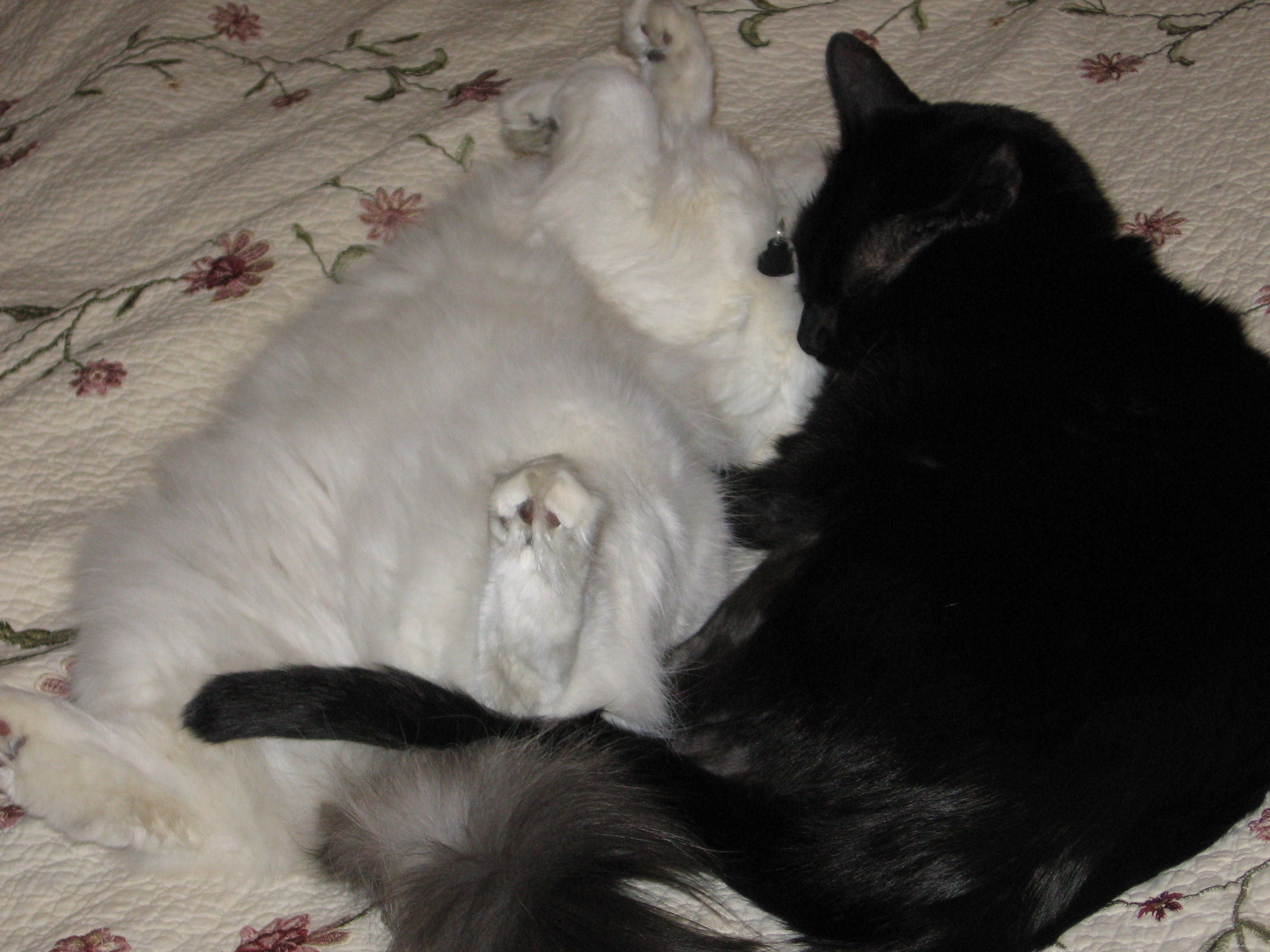
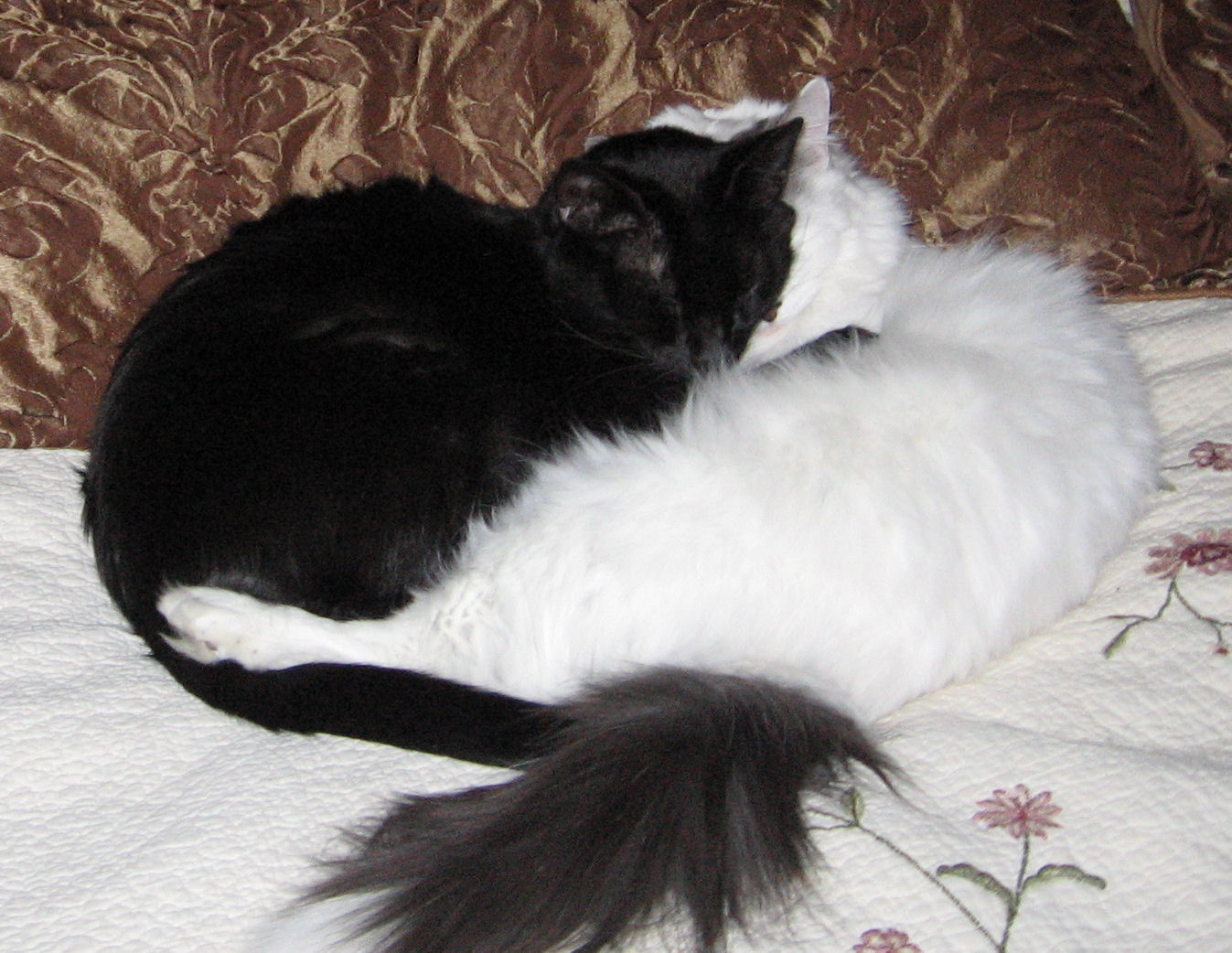
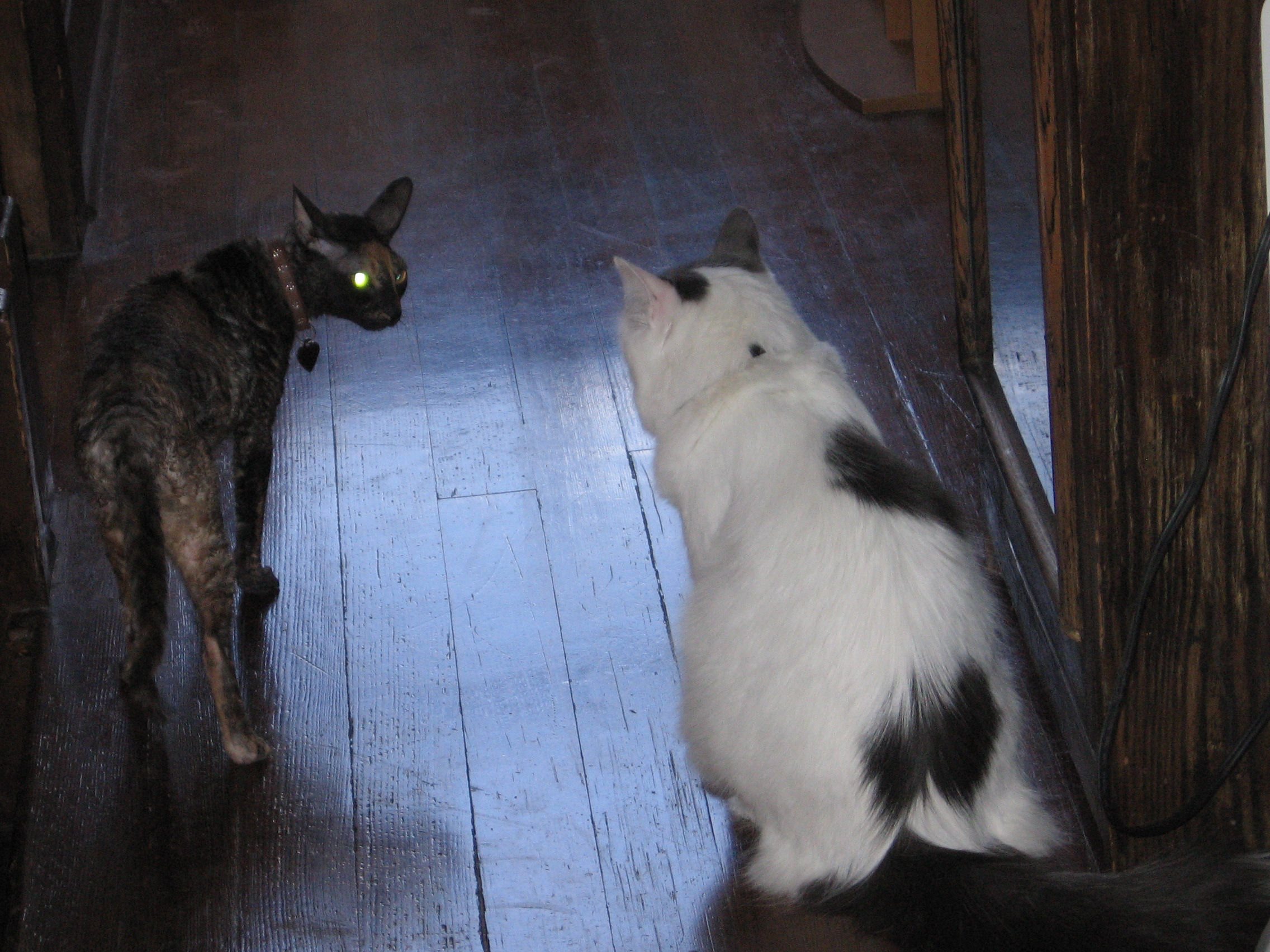
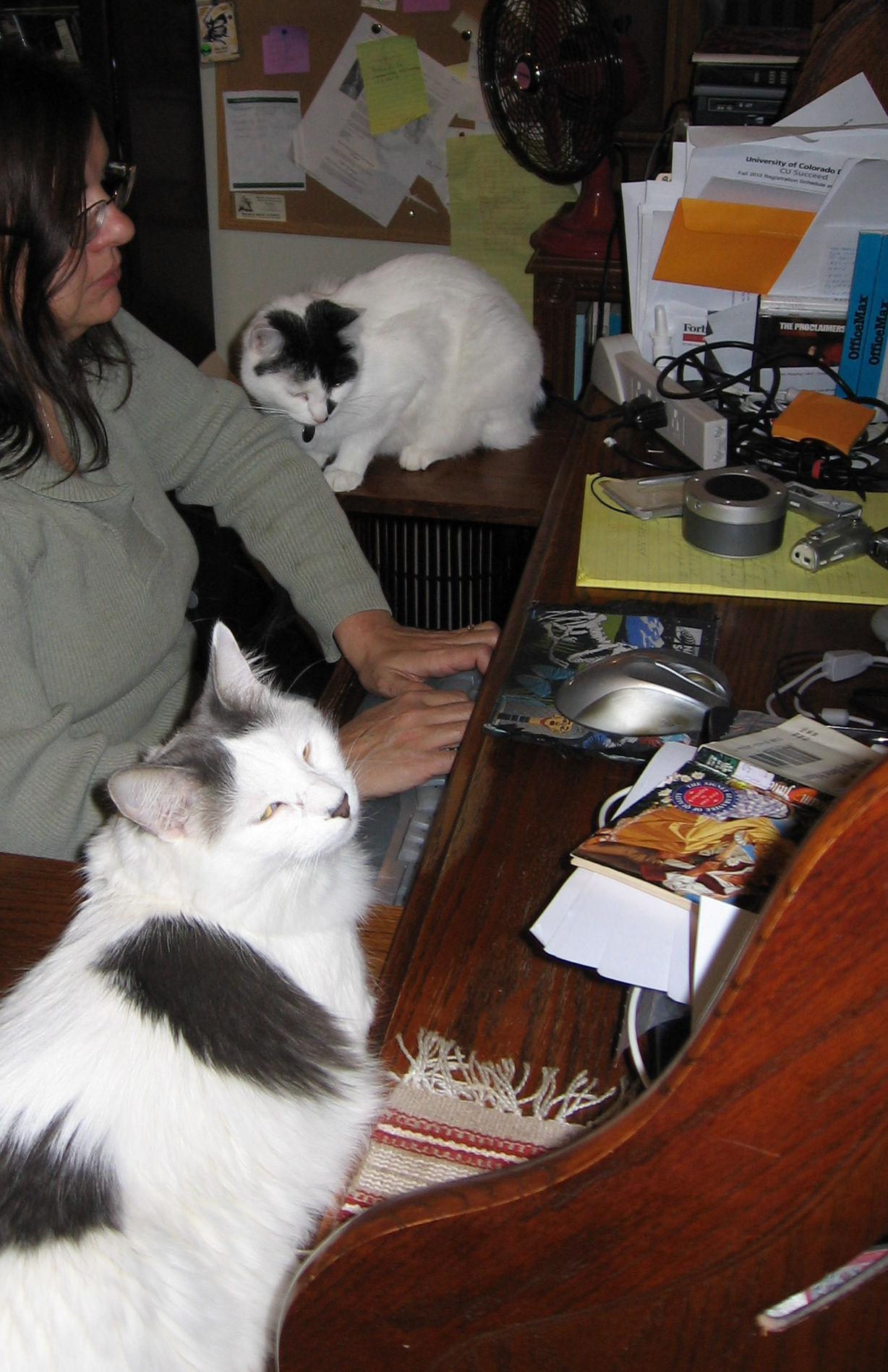
First there were Euclid and D’Artagnan. And Euclid and D’Artagnan were inseparable. I mean, really inseparable. Couldn’t separate them with a water hose inseparable:

Miranda cat, the girl in the house, was not impressed. Good thing she didn’t want to be friends with those PLEBIANS anyway!

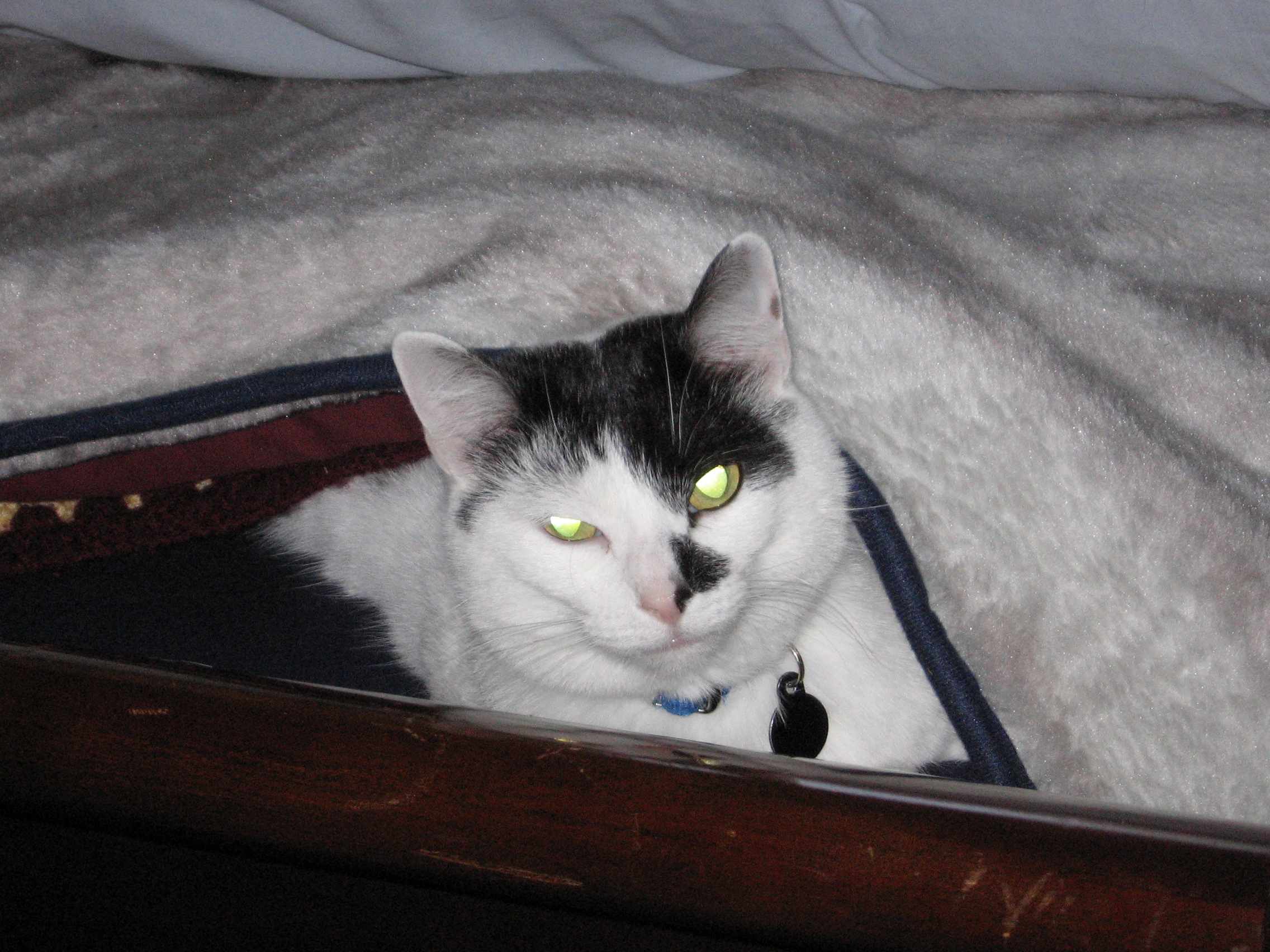
Then, one day we went minigolfing. While there we found this tiny, incredibly dirty kitten, with a broken tail. We thought, surely he’s lost — we’ll take him home, wash him and care for him till we find his family.

Of course, we couldn’t find a family.  So we had the vet bathe him.  Then we bathed him again.  Then we washed him with Dawn (it’s safe, and he was covered in grease, like a victim of an oil-spill).  Twice.  Then we rubbed cornstartch into his (dried) fur and brushed it out.  Then we did it again.  When he was clean we fed him.  and we fed him.  And we… fed him.

For a brief while, all three boys cuddled together.

But soon it became clear Euclid liked Havelock better.

This made D’Artagnan very, very sad (and also a little homicidal)

Miranda’s opinion of the plebians remains unchanged, only now she has one more to terrorize.

A wilderness Of Mirrors

First and before I go into this post, I want to make it clear that I don’t believe in writing-with-a-message. I am in full agreement with whoever said “if you want to send a message, use western union.” Since everything became infused with “message” which somehow always comes down to politics and since everything local became political, (it never was the other way around. Or at least they never believed it.) they’ve done their best to politicize that most localized of personal events – the thoughts in your head. Which are supposed to be worthwhile and useful and… socially relevant.

The obvious problem with “message literature” is that it requires the message to be open and obvious. It also requires it to be in full accord with the visions of the gatekeepers. In fact, message-literature only invaded the field when the publishers and editors themselves started believing literature should send messages. Since, of course, most of the artists doing message-art nowadays view themselves as counter cultural, there’s a delicious irony there. It’s just that it hurts when I laugh.

However, I also want to point out that of course every piece of REAL art HAS a message (or several). The message might be as simple as “I’ve got a serious Jones for Greco-Roman tradition” (which in itself was fraught with all sorts of subtexts for the culture of the Renaissance, including the implicit assumption that the human body was beautiful) or as complex as “this is how humans grow up, with a foot in reality and one in myth.” (I’m thinking of The Amazing Maurice And His Educated Rodents – though many other books fit this “message.”)

Art creation, at least in my experience, happens somewhere halfway between the conscious and the subconscious, in a war between who we think we are and who we really are, what we think reality is and what reality really is. It is from that tension that real art is born. (I did not consciously put any “message” in Darkship Thieves, but all sorts of people are finding message in it, anyway. And even I can see all sorts of messages in it, in retrospect. Things that shape the artist try to leak through.)

While this does not invalidate self-consciously-aimed messages against whatever the current regime/society is, or stories that echo recent events and TWIST to make you see the artist’s point of view, to my mind art only happens when the subconscious adds yet something else, so the whole book has a deep resonance and doesn’t have that quality of learned-and-regurgitated accepted truth. (For instance, Ursula LeGuinn’s The Left Hand Of Darkness was aimed – I’m fairly sure – as a blunt argument on the nature of sex and gender, but what actually emerged echoes with deeper resonances of the subconscious which I’m sure she (or anyone) could neither have planned nor put in.)

But even when “messages” become art despite themselves few consciously aimed messages remain art after being vetted for ideological purity by gatekeepers. At least, I don’t think so.

Which is why an establishment that requires “message” or an establishment that requires any type of conformity – an establishment that has become concentrated and holds all the power of the purse, in fact – tends to produce very bad art… or good art ONLY despite itself. It also tends to produce a “reaction” art that is vibrant and full of energy… and held at bay as long as possible.

This is perhaps easiest to see in the French nineteenth century where art was encouraged and promoted by the State.

I recently took a course that echoed the methods they used to learn at the time – notably drawing from the cast (a plaster cast of a classical statue). I found it useful, but of course I wasn’t forced to spend year after year doing just this. I wasn’t forced to believe that only classical or biblical themes were acceptable and that color was a dangerous tempting demon. And I didn’t draw the cast over and over again for years, till I learned to see people like that, in the “correct” proportions and NOT as they really were.

Most of all, though, it became a competition of virtuosity. Using the permitted methods, themes and forms, artists vied with each other to make each painting more complex and “difficult.” One expression of this was the paintings with multitudes of people and animals, which given the fact they had to draw from life (or stuffed. Er… animals. Not people. I think.) because they couldn’t otherwise record images, became very difficult indeed. (It was usually done in stages, of course.)

It occurred to me, recently, that a lot of science fiction and fantasy and even mystery have become like that. “And now, for my next feat, I will attempt a completely alien world where the aliens communicate only through their salivary glands!” Okay, that’s exaggerating, but I’ve seen stuff that “reaches” almost as much. There certainly is fantasy set in almost every time period, striving to remain both believable/true to history AND magical. And there are mysteries using every profession under the sun as detectives.

While this might seem like a logical post-modernistic affliction, the result of everything having been said, I don’t believe that’s the case. After all, every creature, by nature, has something new to say – as new and individual as his journey. The thing is that OVERTLY all these books HAVE to say exactly the same thing. That’s why, to keep the artist motivated, they are set in such varying places and have such varying stratagems. They have to distinguish themselves, somehow, but the industry that banned a still-vigorously-selling John Norman AND still brags about it, will not let heretical messages flourish (not that I personally could ever understand WHY Gor should flourish, but then I don’t understand the popularity of its polar opposite type of series, one of which, at least, started a whole subgenre of fantastic literature.)

So in this multiplying wilderness of form and virtuosity, symbolism flourishes too – to get less approved-of messages through the gatekeepers – and as in the nineteenth century painting field, in France, it is sometimes so obscure that only the author “gets” it fully.

The problem with this, as the problem with most French art of the time when the monetary rewards went to those who followed the “correct” form and fashion, is that it’s become a dialogue amid the artists. We might find it fascinating, but the public has largely tuned out. Because art that echoes the establishment is never very exciting. (Gag – Soviet art. Gag.)

So, where do we go from here?

Well, fortunately technology is likely to lend a hand by removing control from a handful of gatekeepers residing in a square mile of terrain or so. But even without technology it would probably have happened – albeit not so fast – since it is part of the cycles of how art “dies” and is reborn.

Note, in favor of my thesis that Baen – which is not in that square mile – publishes a lot of old science fiction and fantasy memes (that’s a topic for another post. In SF/F there is a certain need to ‘reincarnate’ certain types of stories, for new generations) there isn’t a proliferation of the “and now, still more difficult” type of books. Writers write largely for their public, not other writers or the gatekeepers – a lesson I think more and more midlisters are learning in the stuff they put out on their own.

This is very exciting, of course – a fun and terrible time to be alive and writing, the very definition of “interesting times.” And they’ll only get more interesting.

I look forward to writing without trying to aim messages or disguise messages or in general self-consciously head off my subconscious from forbidden subjects and opinions.

I look forward to freedom and an engaged reading public again.

Am I wrong? Is there no great hunger for stuff where the message doesn’t clobber you over the head? Should I just start thinking of a science fiction about aliens who communicate with their salivary glands?

*Crossposted at Mad Genius Club and Classical Values*